The re-imagined story …
I have such wonderful memories of childhood Christmas’s. I suppose most children would say the same.
With five of us in the family, we didn’t have much, not like children today. We would hang our stockings on the bedposts on Christmas Eve and try to keep awake all night to wait for Father Christmas to come, but of course we never saw him. Does any child?
And on Christmas morning we took our bulging stockings beneath the bedcovers to keep warm as we opened them. There was always a tangerine and some walnuts and some humbugs and a little toy. I remember the year my brother Bert received a real guard’s whistle and blew it until I thought my ear drums would burst. Mother told him he wasn’t to blow it again until Boxing Day.
As soon as we could read, we received a book. Sometimes a character improving story like The White Feather but one year Fred received a copy of Treasure Island and I got a copy of Little Women!
And as members of the Congregational Chapel Sunday School we always received a little gift from Mrs Stanier. The Stanier family was very involved with the Chapel. We were all a bit frightened of Mr Stanier. He was a bigwig in the factory and you had to mind your ps and qs around him. But we were all very fond of Mrs Stanier. We used to think she was very old but of course she wasn’t. As a child you can never imagine older people as they might have been when young; vibrant and vital with loves and lives of their own. You never take account of the sorrow and the losses they may have suffered. I suppose we didn’t consider her much at all.
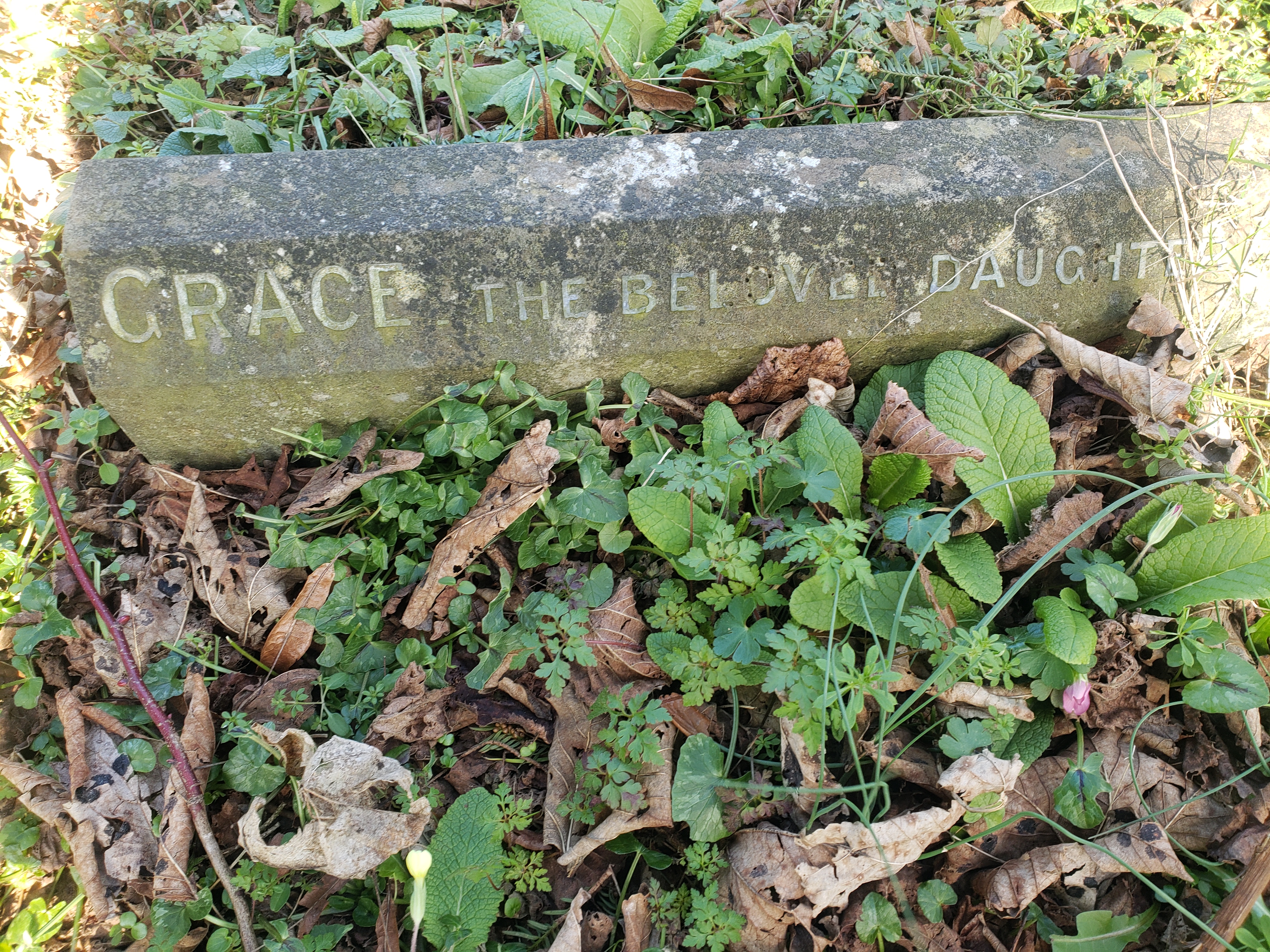
It was only after her funeral that mother told me she had been buried with her little daughter Grace who died when she was seven years old. Mrs Stanier had also lost two little boys, Francis John who was three years old when he died and Alfred, who was just a baby. She probably thought of those children when she wrapped up our gifts every Christmas.
The facts …
Grace Ball was born in Southport, Lancashire in 1847, the daughter of Robert Ball, a shopkeeper and farmer and his wife Ann. Grace grew up at North Moels and worked as a teacher in a small private school there.
Grace married William Henry Stanier in the Ormskirk registration district during the September quarter of 1875. By 1881 they were living at Church Place, Swindon with their three children William, Annie and Charles. The couple went on to have five more children but sadly three of these died in childhood. The couple’s last home together was at Oakfield, Bath Road.
The funeral of the late Mrs Stanier, wife of Ald. W.H. Stanier, of “Oakfield,” Bath Road, Swindon, took place on Tuesday afternoon, and evidence of keen regret and deep sympathy was everywhere apparent.
At 2.30 pm an impressive service was commenced at the Sanford Street Congregational Church, of which the deceased lady had been a prominent member. As the procession entered the building, “O Rest in the Lord” was played on the organ. The service was conducted by the Rev J. Stroud Williams (Pastor), and the Rev T. Garbutt Vinson (Pastor of the Victoria Street Congregational Church). The hymns, “Light after darkness,” and “When the day of toil is past” were sung during the service, and the Dead March in “Saul” was played as the procession slowly filed out of the building.
During the service the Rev Stroud Williams said: We little thought a few days ago when we met in this Church on a similar occasion that we should meet here to-day. Our sister, greatly beloved, has been called to her rest, after a long and painful illness. Her departure leaves a keen sense of loss and bereavement behind. We cannot estimate the loss. Hers was a bright, sunny soul. In early years she came to know Christ as her Saviour, and consecrated herself and her life to His service. In very many ways she sought to help forward His work. She was full of cheerfulness and strong hope, and that cheerfulness and hope bore her through all the years of weakness and of pain, and when the call came it did not find her unprepared. She knew in whom she believed. She knew she was going to Christ. “Blessed are they that die in the Lord.” Why should we be sorry? Our sorrow is not sin. It is manly, it is Divine. For Jesus Himself wept at the graveside. We sorrow, but not as those who have no hope of a reunion. We see only the going down into the valley, and not the climbing up the hill of God and the entrance into life. Our sister has seen the face of Christ. She knows what she longed to know. We are thankful for the memory that she has left behind, and we pray for the grace that we may follow as she followed Christ.
At the graveside the committal sentences were said by the Rev. J.S. Williams.
The inscription on the coffin was as follows: “Grace Stanier, died 10th November, 1905, aged 58 years.”
The chief mourners were Mr W.H. Stanier (husband), Messrs. W., C., and G. Stanier (sons) Misses Stanier (daughters), Mrs C. Stanier, Mr and Mrs H.A. Stanier, Miss B. Stanier, Mr T.W. Stanier (Newcastle), Mr and Mrs H. Hill, Miss Hill, Miss Morse, and Mr E. C. Riley.
Others following were: …
The following were present representing the GWR Loco and Carriage Department Staffs: Messrs. J. Lockyer, J.W. Rose, W.H. Adams, C. Godsell, W.J. Burleigh, and John Clark. The Stores Department was represented by Messrs W. Jones, J. Wood, E.H. Page. A.H. Dunn, J. Dowling, V.R. Daines, J.H. Barker, A.H. Jervis, W. Davies, W.S. Clark, C.T. Smith, W.J. Smith, A. Tyler, H. Brown, F.J. Etherington, C.A. Plaister, H.J. Edmonds, R. Brock, J. Hart, D. Sheward, A.J. Rolls, F.S. Westlake, E.A. Blackman, J.W. Smith, S.F. Adams, C.E. Barker, J.E. Lockyer, and H.L. Smith.
Councillor George Brooks was unable to be present in consequence of his having to attend to some business in London that day, in the place of Mr Stanier.
Many members of the Sanford Street Congregational Church were also present.
The funeral arrangements were carried out by Messrs Chandler Bros of Wood Street, under the personal direction of Mr J.H. Chandler.
Extracts published from The Swindon Advertiser, Friday, November 17, 1905
Mrs Stanier was buried in plot A2508/9 in a double plot where she lies with her young daughter Grace who died in October 1890 aged 7 years. On the other side of the footpath lie her two young sons, Francis John and Alfred, buried in plot A188.

You may also like to read:


 Radnor Street Cemetery