When Alderman Edwin Jones formally opened the new cemetery at Whitworth Road in 1914 he made a gesture of remembrance, uniting the two cemeteries and Swindon’s history. He planted an oak sapling grown from an acorn dropped by ‘the magnificent oak tree which is such a prominent feature of the Radnor Street cemetery’ reported the Faringdon Advertiser.
Today the mature shrubs and trees in Radnor Street Cemetery create a green oasis in the town centre, but where is that magnificent oak tree?
We believe this is the oak tree, pictured at the beginning of the 20th century.
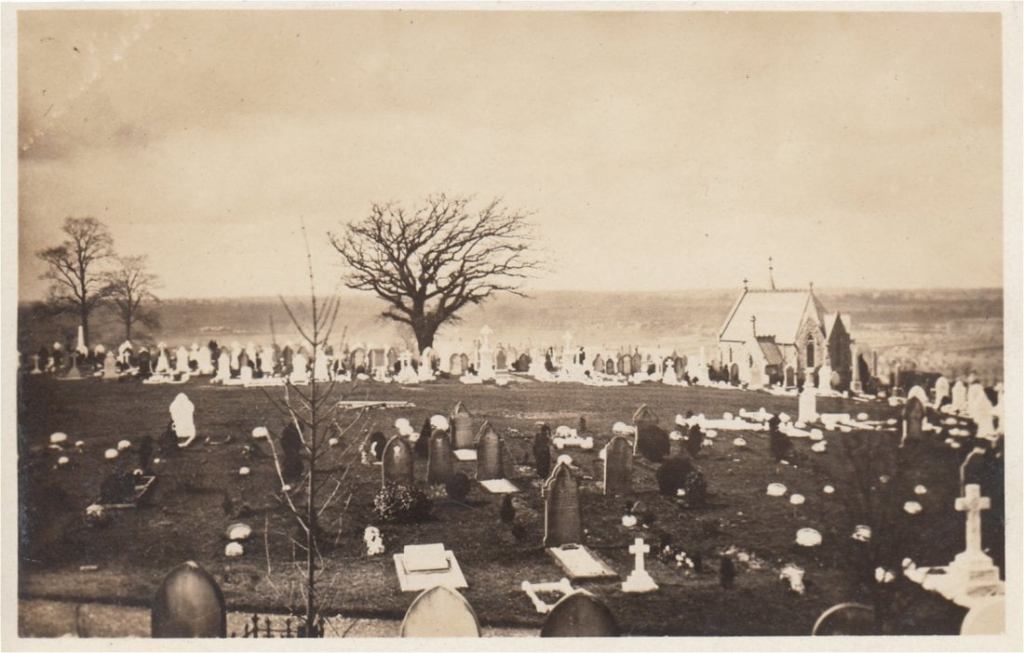
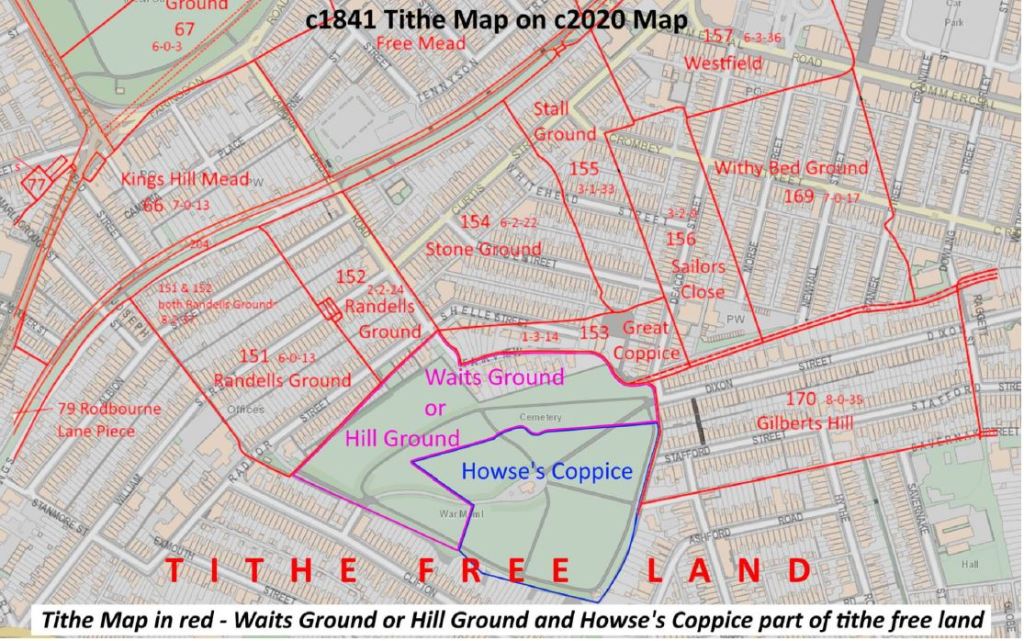
In 1881 the cemetery was laid out on a piece of managed woodland called Howse’s (previously Wibley’s) Coppice. Local historian Kevin Leakey has kindly shared his work on plotting the fields as they appeared on the Tithe Map in 1841.
Kevin explains that the land on which the cemetery was later laid out was part of tithe free land. You can read more about Howse’s Coppice here.
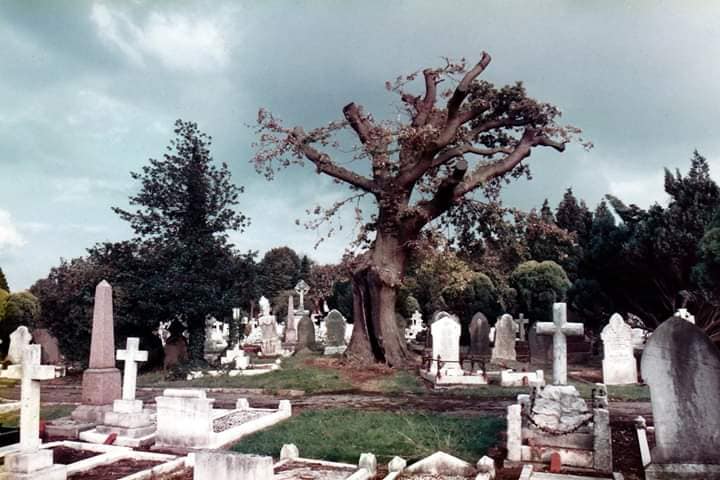
How old was the oak tree in 1914. A hundred years old, two hundred, who knows? Sadly, it does not survive in 2022, but looking through the images in our archive Andy recently came across this one, sent to us by Robin Earle. Taken sometime in the 1980s this photograph captures an oak tree, heavily pruned but still there. We can only assume it was later deemed unsafe and eventually felled.
Swindon’s new cemetery on the Whitworth Road, which has cost the Town Council £7,283, was formally opened by Alderman E. Jones (chairman of the Health Committee) on Saturday.
The Council have acquired 35 acres of land, and laid out ten acres for immediate provision, and upon this they have erected a chapel at a cost of £760, and a superintendent’s lodge will be built at a cost of £400.
After an inspection of the grounds already laid out with drives, fencing, rockeries and shrubs, the chapel was visited, and appreciation of the compactness and pleasant appearance of the building was expressed by the members of the Health Committee present. To commemorate the occasion a tree was planted by Alderman Jones – a 12 years old oak sapling which grew from an acorn dropped by the magnificent oak tree which is such a prominent feature of the Radnor Street cemetery. Alderman Jones, in an interesting speech, remarked that that week commenced his twenty-third year in connection with the work of the town, and in looking back upon that long period he was sorry to recollect how many had passed away with whom he had been associated in public office.
In 1881 Swindon commenced to utilise the Radnor Street interment ground, and since that time there had been 13,500 persons buried in that cemetery; 1,800 grave plots had been purchased; 1,200 monuments had been erected, and the area contained 7,000 glass wreaths. This cemetery had cost the town £10,000, but it was recognised by the Town Council some years ago that other provision would have to be made for the growing needs of the community.
Negotiations for this further accommodation were commenced in 1907, and out of several sites this one, which combined an advantage of situation and Local Government Board requirements, was selected. It was hoped that this portion would last at least 40 to 50 years.
The Faringdon Advertiser, Saturday, May 2, 1914.

 Radnor Street Cemetery