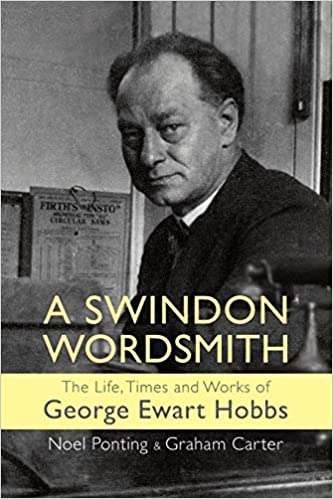
We’re often asked if there is anyone famous buried in Radnor Street Cemetery. Well George Ewart Hobbs is definitely up there when it comes to homegrown brilliance. George was an example of a self taught man with an exceptional intellect. He left school at the age of 13 to begin a lifetime of working ‘inside’ (as the locomotive factory was called) as did every other schoolboy who lived in Rodbourne.
The UK Railway Employment Records 1833-1956 state his first job description was that of ‘boy.’ He would later become an apprentice fitter and turner, then a chargeman and eventually a foreman.
He married Agnes Ann Thomas in 1901 and the couple had two children Dorothy, and Ivor, who sadly died aged 2 years old.
And I’m not going to tell you anymore about George as my friends Noel Ponting and Graham Carter have already done that in two meticulously researched and readable books – A Swindon Wordsmith and A Swindon Radical. Both books can be purchased in the Library Shop, Swindon Central Library or from the publishers Hobnob Press.
George Ewart Hobbs died on December 22, 1946 aged 63 years. He lies in an unmarked grave in Radnor Street Cemetery, which he shares with his young son Ivor and his mother-in-law Eliza Anne Thomas. His wife Agnes died in 1964 and was the last person buried in this family grave, plot number C3617.
Occasionally I return to a Radnor Street Cemetery resident for a second blogpost and I felt that W.H. Read was a worthy candidate. You can read about him here where I mention a couple of the building commissions he is best remembered for, but looking at his long list of projects I felt he deserved a revisit.
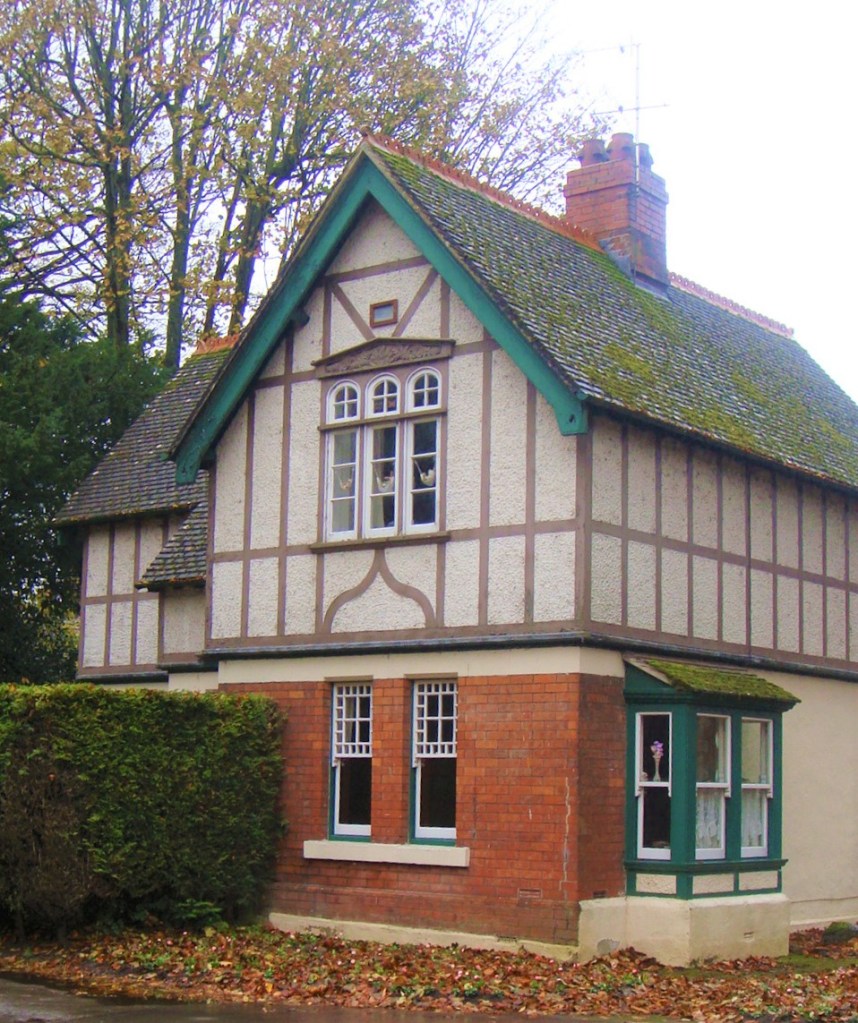
In 1894 the town celebrated the opening of the Town Gardens with a parade and a celebratory dinner for local dignitaries held in the evening at the Goddard Arms Hotel. The pleasure park was created on a 7-8 acre site of the worked out Swindon quarries and purchased from Ambrose Goddard. W.H. Read had designed the layout of the new recreation ground, the park keeper’s lodge and the band stand. The band stand was erected by Messrs Allan of Glasgow with the assistance of local builder Joseph Williams who also built the lodge at the Westlecott Road entrance. On the arrival of the procession at the Westlecott Road entrance W.H. Read presented W. Reynolds (chairman of the Local Board) with a silver plated key and the gardens were officially opened.
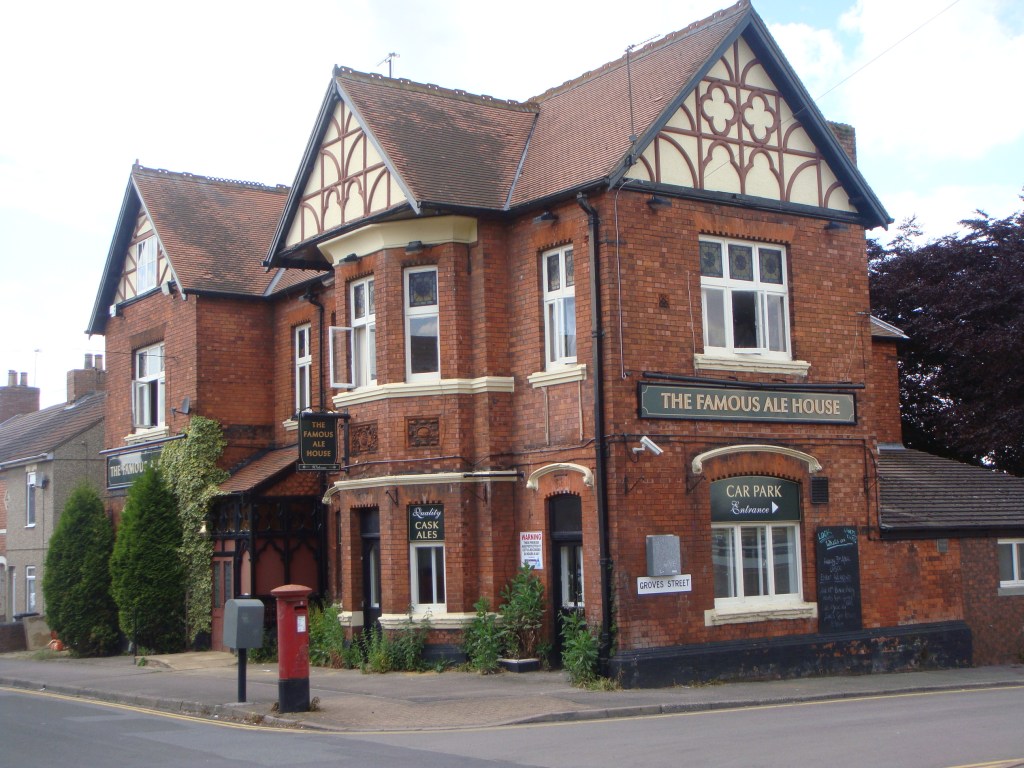
In 1898 Read designed the Even Swindon Hotel for John Groves and Sons Ltd of the Hope Brewery, Weymouth. The hotel was built on a plot of land owned by James Morrison on the corner of an intended new street, which would later become Groves Road, Rodbourne.
And among the prestigious, prize winning projects were the bread and butter commissions – four houses in Cow Lane in 1876, repairs to seven cottages in Mill Street for Swindon Permanent Building Society in 1881 and in 1892 houses in Turner Street.
William Henry Read died in November 1901. A brief report of his funeral, which had taken place earlier that day, was published in the Swindon Advertiser dated Wednesday November 6.
The Late Mr W.H. Read
Funeral To-day
The funeral of the late Mr William Henry Read, architect of Swindon, took place this afternoon. The cortege left deceased’s late residence in Bath Road at two p.m., and the first portion of the service was conducted in the Parish Church. The coffin was conveyed on a hand-bier, and the mourners were all on foot. They included deceased’s sons, and also the following relatives and tradesmen:- Messrs J.H. Chandler, T. Chandler, W. Reynolds, H.W. Reynolds, R. Reynolds, R.S. Edmonds, A. Plummer, S. Snell, R.J. Beswick, Cullingford, Cox, etc
There were signs of mourning on every hand, shutters being up and blinds drawn at all the residences and shops en route to the church. The officiating clergy were the Rev Canon E.W. Estcourt (vicar), and Rev W. Scott (curate). After the first portion of the service at the Parish Church the cortege proceeded to the Cemetery, where the interment took place. The coffin was covered with beautiful wreaths from sorrowing relatives and friends.
William Street published courtesy of P.A. Williams and Local Studies, Swindon Central Library.
In 1950 Sir John Betjeman, Poet Laureate 1972-84, described Swindon as a town with very little architecture and a great deal of building – and you’ve got to take his point. There has never been a time when Swindon was not desperate for housing and the basic red brick, utilitarian terrace house is a feature of our town.
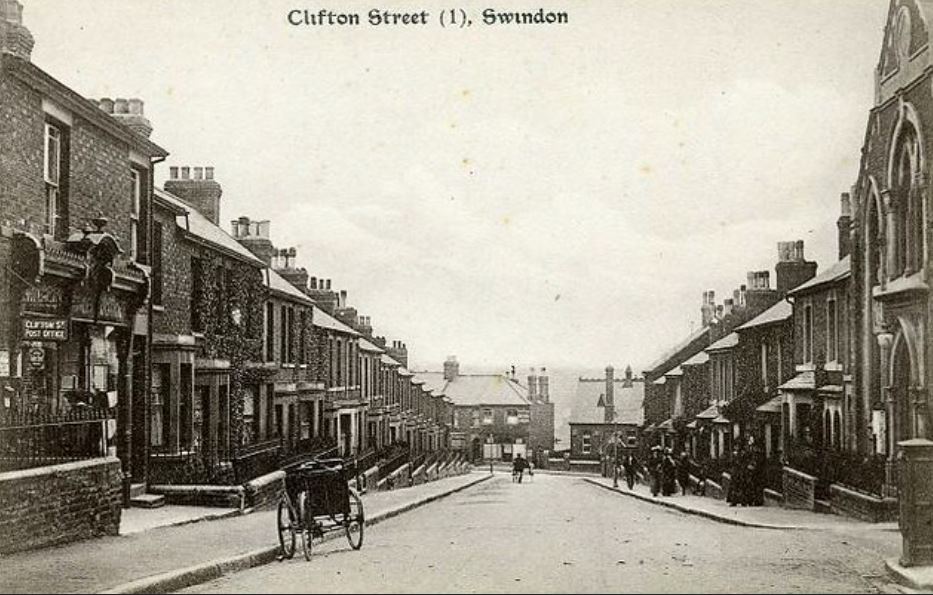
There were a lot of builders in 19th century Swindon, all buying up pieces of land for development. Some bought great swathes of land such as James Hinton who laid out Dixon, Stafford, and Clifton Streets in 1879 and the Gorse Hill housing estate in 1889. Others worked on a smaller, though no less productive scale, sometimes entering into short term partnerships, later creating what would become a family firm employing more than one generation.
George Kilminster was one such builder, working with a Mr Ball on several properties in Swindon Road before establishing his own family business. And between 1893 and 1921 George Kilminster worked close to home – very close.
George Kilminster was born into the building trade in 1857, the son of Cricklade slater and plasterer Robert Kilminster and his wife Maria. By 1871 fourteen year old George was working with his brothers Joseph 18 and Alfred 12 as slaters alongside their father.
George married Mary Ann Hart in Cricklade St Sampson in 1880 and by the time of the census the following year they were living in Upper Stratton. In 1891 the census records the family living in William Street, which became their permanent home and George’s workplace. Between 1893 and 1921 George built in William Street a toolhouse and store; 2 cottages; a schoolroom at the Wesleyan Chapel; seven houses and a villa.
In Roadways – The History of Swindon’s Street Names, authors Peter Sheldon and Richard Tomkins list William Street as being named after builder William Crombey with work beginning in 1878. Street numbering begins and ends at Cambria Bridge Road with more than 160 properties extending to the Kingshill Road. Today there is some new building half way along and alterations to properties at either end of the street, most especially the demolition of the Wesleyan Methodist Chapel. But to stand in the street on a quiet day when there aren’t so many cars parked there, well it could look quite similar to the street George would have known.
George died in 1941, leaving his business in the hands of his sons Arthur and Harry. He was buried on February 15 in Radnor Street Cemetery in plot D1037 which he shares with his wife Mary Ann who died in 1946 and their daughter Iris who died in 1978.
Wesleyan Mission Hall
William Street, New Swindon
Such has been the growth of the cause of Wesleyan Methodism in West Swindon that it was found necessary to contemplate the erection of a hall in which to hold the services. A suitable piece of land having been procured at the west end of William Street situated immediately on the south side of the Wilts and Berks Canal and close to the Wootton Bassett road, the erection of a mission hall was very soon commenced. The erection of the building is being accomplished by Messrs J and C Williams, builders, of Swindon, to the specified plans of Mr Davis, architect. The dimensions of the hall will be 35 feet in length by 24 feet breadth, and 13 feet in height. In addition, there will be the necessary out-offices. The building will be of brick, with freestone dressings to windows and piers. Inside, the roof will be match boarded, with worked principals. So far has the erection of the building proceeded that the ceremony of laying the foundation stones was gone through on Wednesday last.
Extract from the Swindon Advertiser, Saturday, October 8, 1887.
William Street published courtesy of P.A. Williams and Local Studies, Swindon Central Library.
Mr Limmex’s shop stood on the corner of High Street and Wood Street. Every morning one of the shop assistants was tasked with assembling the shop front display out on the street and then at the end of the day taking it all back in again.
It must have taken ages. There were brooms and spades and tools of every description that the gardener, handyman and farmer would ever require.
You could buy anything and everything at Limmex’s, but one day my granddad sent me shopping for a seemingly impossible item.
“Fred – have you heard what this young man wants?”
“We did have a packet of those once – now where did I see them?”
“I think we ought to ask Mr. Limmex – he’ll know where they would be.”
“Now what’s all this chatter going on?”
“It’s this young man, sir, he’s desirous of a very specialised item of carpentry.”
“It’s for my granddad,” I said helpfully. “He said you’d be sure to have a packet of rubber nails.”
The shop assistants laughed, the customers laughed and even Mr Limmex laughed.
Well if Mr. Limmex didn’t stock them I don’t know where my granddad would find his rubber nails.
The facts …
Limmex ironmongers shop dominated the corner of High Street and Wood Street for more than a hundred years.
Samuel Joseph Limmex opened his shop in about 1873. Before this he had a similar business in Brighton where he had married Rebecca Bartrop, a young widow with three children.
Samuel was born in the West Indies in 1842, the son of Methodist Missionary William and his wife Eleanor who are both buried here as well.
The couple led a nomadic life as William continued to follow his calling. After their return from the West Indies they lived in various places across the UK. In the 1870s William was preaching on the Allendale Circuit in Northumberland, travelling across the Scottish Borders. But by 1881 William had retired and he and Eleanor were living next door to Samuel and his family at 15 Prospect.
The shop on the corner of Wood Street continued under the management of Samuel’s son Frederick William following Samuel’s death in 1935. It eventually closed in 2000.
William Morris, founder of the Advertiser, is captured on film in this Victorian photograph of the High Street frontage of the Limmex shop.
The photograph of this stained glass window, a memorial to the Limmex family in the Bath Road Methodist Church, was sent to us following one of our walks.
Liddington’s Loss
Death of Mr S.J. Limmex
Mr Samuel Joseph Limmex of Liddington, who was one of the oldest men in the district, died at his home, Fair View, yesterday. He was 94 years of age, and had been confined to his bed for only a week.
The son of a missionary, he was born in the West Indies, but was brought to England as a child, in a four-masted sailing ship. He was sent to Woodhouse Grove School Yorkshire, and when his father left the West Indies and was appointed superintendent minister in Swindon of the Wesleyan Church, Mr. S.J. Limmex accompanied his parents to Wiltshire.
Mr. Limmex served his apprenticeship with the late Mr. W.V. Edwards ironmonger, of Swindon. Later he set up business in Brighton, but not long afterwards came back to Swindon, and founded the business which is now carried on by his son, Mr. F.W. Limmex, at Old Town, Swindon.
Mr. S.J. Limmex retired about 25 years ago, and went to Wanborough to live, but after the war he removed to Liddington. Since the death of his wife, about 30 years ago, his daughter, Miss Limmex, has kept house for him.
Mr. Limmex was a member of the Swindon Chamber of Commerce since its inception. He took a keen interest in Swindon Bath-road Methodist Church, having held every office to a layman.
Have you ever thought how fortunate you are to be born in this place at this time? I could have been born 100 years ago or a 150 years from now. What would Swindon be like in the year 2001. Will the mighty GWR, God’s Wonderful Railway still be here in Swindon? Perhaps they will be producing other forms of transport, a time travelling machine perhaps.
Mother says I have some funny notions and how could I possibly have been born in the future. But surely it’s just a random act that a soul enters a body at a given time and place in history – but I suppose if you don’t believe in the existence of the soul, then it does all sound a bit phantasmagorical. I’m not sure what I believe in when it comes to religion. I think there are some things that are still inexplicable and science doesn’t have the answer to everything – yet!
I think my parents wish I was more practical. It’s all very good having these theories but they won’t put food on the table or pay the rent, mother says.
But surely the great inventors of our time are not just good with their hands. Take Mr Bickle, for example. Without a questioning mind how could he invent his double vibrating cylinder steam engine presently on exhibition at the Great Exhibition. Mother and father are going to take me to London in the school holidays. There are so many things I want to see in the Great Exhibition. I especially want to see the Lord of the Isles loco, which will be on display, but I also want to see Mr Bickle’s invention – apparently it is so small it will be displayed on a two inch counter space. Isn’t that incredible. I think that if anyone could invent a time travelling machine it would be Mr. Bickle – or possibly me!
The facts …
‘Daddy’ Bickle’s engineering treasure chest
15 May 1981 Swindon Evening Advertiser
Swindon’s reputation for high quality engineering goes back a long way.
Ever since the railway works were established alongside Brunel’s iron road to the West, generations of craftsmen have been producing the best.
So it’s not altogether surprising that a Swindon man had an exhibit accepted for the world famous Great Exhibition of 1851 at Crystal Palace.
The official catalogue says William Bickle, described as a designer and manufacturer of 18 Reading Street, exhibited ‘a working model of a pair of non-condensing steam engines, which stand within the compass of a shilling and weighs three drachms; made, with the exception of the piston rods, of fine white metal.’
Imagine in thos days when a man had little more than his own skills to depend on producing a working model which would stand on a five pence piece and weighed less than a quarter of an ounce.
A recent visitor to Swindon from Yeovil remembered meeting this remarkable man whose work was ranked so highly 130 years ago.
‘I knew him as ‘Daddy Bickle’ and used to go to his home – he had moved to Oriel Street – to look at all the wonderful things he had made said Stanley Richards, now in his upper eighties.
Stanley’s family lived in Medgbury Road and London Street, and Stanley was apprenticed in the railway works and later held important posts with the aircraft manufacturers Handley Page and Westland.
He remembers William Bickle as an outstanding engineer who made at least two microscopes, a gyroscope and his own geometric lathe which enabled him to produce many other pieces.
A beam engine expert employed by Harvey’s of Hale in Cornwall, Mr Bickle is believed to have moved to Swindon to instal the beam engine which kept the Severn railway tunnel free of water.
At one time he worked in the Spanish copper industry.
He became a railway man by adoption and left one example of his craft in the Mechanics Institute a working electric clock, unfortunately no longer in evidence.
Swindon – In addition to the locomotive engine now in course of erection in the Swindon works, and intended for the Great Exhibition, two other articles will be sent from this place, one of which is a double vibrating cylinder steam engine, the handiwork of Mr Wm. Bickle, one of the artizans employed at the Swindon works. So small is this article, that after being wrapped up in paper it can be placed very comfortably in an ordinary size walnut shell. The plate on which this Lilliputian piece of workmanship stands being about the size of a sixpence, yet we have been informed by competent judges that it is quite complete, and that the workmanship and finish are of a first rate character. We understand that two inches of counter space was applied for and granted for this model.
The other article is of a more practical character, being a model to exemplify an improvement in the valve gearing of steam engines. This article is now in course of manufacture by the inventor, Mr. W.D. Sharp, of Swindon.
Salisbury and Winchester Journal Saturday January 25, 1851.
Model of a High Pressure Oscillating Steam Engine, improved and constructed by William Bickle of Hayle Foundry. This model was intended to illustrate an engine of greater simplicity than any hitherto constructed. The steam enters the piston through one side of the tumbler in the cylinder, and leaves through the opposite side. This tumbler is so contrived that the oscillating motion of the cylinder opens and closes those passages at the proper time. All valves, eccentrics, and gear of every sort are therefore dispensed with, and consequently, the liability to derangement is considerably diminished. The speed of the engine is regulated by turning the cock fixed underneath the cylinder; the same cock also reverses the engine by admitting steam through the opposite side of the tumbler; consequently by turning this cock, a reversal of the motion is certain. This engine is therefore peculiarly applicable for whims, marine purposes etc, or where a reverse motion is often required.
As with so many of the 33,000 burials in Radnor Street Cemetery, William Bickle’s grave has no surviving memorial.
With thanks to the family historian bicklehe who has submitted information on a public family tree on Ancestry.
Clifton Street with Beswick’s Primitive Methodist chapel on the edge of the photo to the right. Published courtesy of Swindon Museum and Art Gallery
Robert J.R. Beswick was born in Manchester on November 30, 1856 the son of Robert, a Spirits Merchant, and his wife Anne. Robert was christened on January 4, 1857 in Manchester Cathedral.
Robert had moved to Swindon by the mid 1870s when he was articled to another popular local architect W.H. Read and was in practice from about 1874. In 1884 he married Emilie Matilda Elliott, the daughter of John Elliott, a painter in the works.
During a prolific career he designed many landmark buildings in Swindon including the Mechanics Institute Reading Room at 158-9 Rodbourne Road. He also designed the Primitive Methodist Chapel which stood at the Clifton Street entrance to the cemetery, long since demolished and replaced by a modern property. He designed the Co-op premises in East Street and John Street and the Palace Cinema in Gorse Hill.
In 1911 Beswick, by then widowed, was living at a property in Westlecott Road called Kingswood, a house he designed himself. He lived there with his architect son Robert Frederick Beswick (the son who later died in India) and the two men were looked after by housekeeper Gertrude Woodward and a general domestic servant Alice Brinkworth.
Beswick died at the Cheriton Nursing Home on March 28, 1931. He left administration of his will to his only surviving son Alfred Edward Beswick, another architect. His effects were valued at £6,129 4s 3d.
Manchester Road c1912. For more images of the Broadgreen and Queenstown area of Swindon visit the Local Studies flickr page.
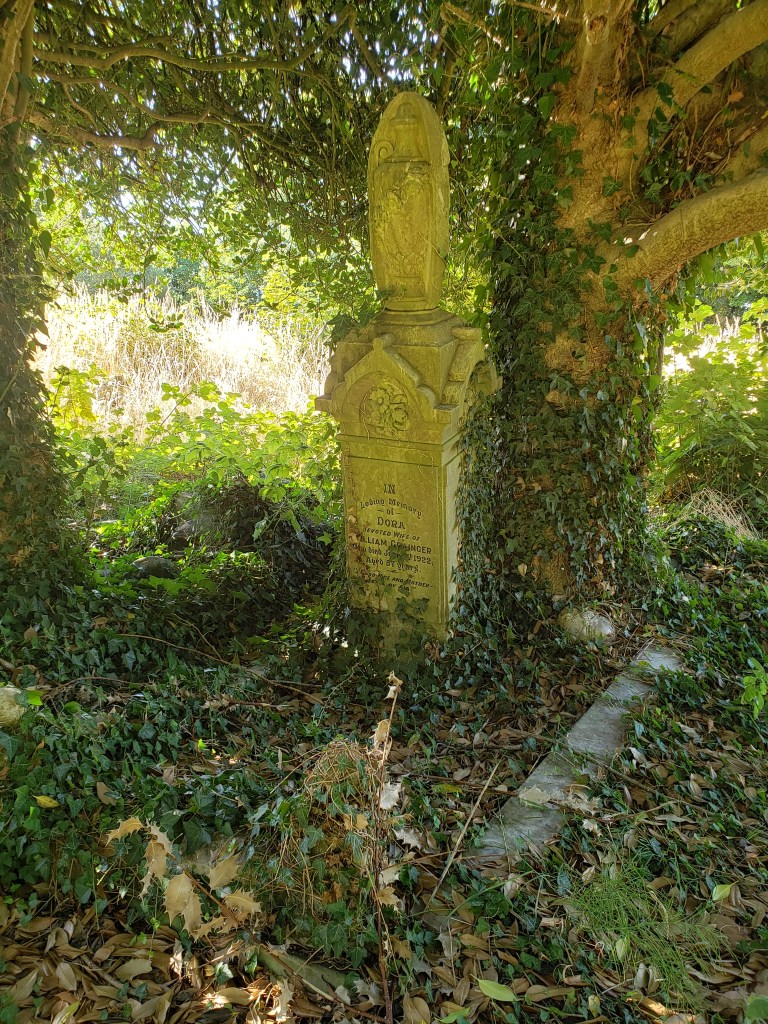
Nestling beneath the shade of a tree is this attractive memorial to Dora and William Grainger, a restful place to lie during the current heatwave.
The report of William Grainger’s death (see below) includes an account of his business career, but a rather vague version.
William Grainger was born in about 1865, the second son of Edward Grainger and his wife Sarah. He grew up in Quenington, Gloucestershire and followed his father into the building trade working as a plasterer. By 1887 William was living at 35a Cheltenham Street when he married Dora Ockwell at St. Mark’s Church. The couple had four children but sadly only two daughters survived to adulthood – Emily born in 1891 and Helen in 1893.
George’s business premises were first located at 60 Dryden Street before moving to 141 Manchester Road and spanned the years 1891-1907. During this time he did indeed build a great many properties. In 1897 alone he built a stable and traphouse in Dryden Street; 12 houses numbered 15-26 on the east side of Gladstone Street; 12 houses numbered 107-118 on the west side of Salisbury Street and 12 houses numbered 1-12 on the south side of Elmina Road.
In 1898 he was even busier. The Eastcott Hotel in Manchester Road was built in this year by Strong & Co Brewery of Romsey, most probably with the work sub contracted out to William. In 1898 William built 147 properties in Salisbury Street; Manchester Road (which included his own home); Edinburgh Street, Elmina Road, Graham Street and Rosebery Street.
He appears to have finished work in around 1907 when he was about 41 years old. At the time of the 1911 census he states his occupation as ‘builder with nothing to do.’
Dora died at the family home at 141 Manchester Road and was buried on this spot on June 7, 1922. Perhaps William planted this tree to shade her grave during the hot summers to come. William died five years later and was buried with his wife on May 18, 1927.
Death of Mr W. Grainger – The death took place on Saturday at 141, Manchester Road, at the age of 62 years, of Mr William Grainger. The deceased formerly carried on an extensive business as a builder, and was responsible for the erection of between 400 and 500 houses in Swindon. Among his large contracts was the building of the Eastcott Hotel in Manchester Road. He retired from business at an early age. He was a keen sportsman and was a popular member of the Swindon Town Bowling Club and was also a member of the North Wilts Constitutional Club. He leaves two daughters, who are living in Swindon, and two brothers and two sisters, who reside out of the town. His wife predeceased him some years ago.
Elsie Wootten White was born on August 26, 1885 the daughter of Frank James White, a machineman in the GWR Works, and his wife Susan. She was baptised at St. Mark’s Church on October 19 when the family were living at 5 Bangor Terrace, Rodbourne Road.
Elsie began her long teaching career as a 15 year old pupil teacher and at the outbreak of the First World War she was working as an Assistant Mistress at one of the town’s board schools. By 1916 she was a member of Miss Slade and Miss Handley’s growing band of volunteers.
The Swindon Committee for the Provision of Comforts for the Wiltshire Regiment was formed in 1914. Miss Mary E. Slade, Infant Head Teacher at King William Street School, led a team of volunteers, most of whom were women. These volunteers were based at the Victoria Hall where they collected and packed boxes to send to soldiers serving in the Wiltshire Regiment. However, this work soon became a matter of life and death as the plight of the prisoners of war was revealed.
“When letters began to arrive from the men themselves begging for bread, it was soon realised that they were in dire need, and in imminent risk of dying from starvation, exposure and disease,” W. D. Bavin wrote in his seminal book Swindon’s War Record published in 1922.
All the prisoners received daily was a slice of dry bread for breakfast and tea and a bowl of cabbage soup for dinner.
“Had it not been for the parcels received out there from Great Britain we should have starved,” said returning serviceman T. Saddler.
In the beginning the committee spent £2 a week on groceries to be sent to Gottingen and other camps where a large number of Wiltshire men had been interned following their capture in 1914. By October 1915 the committee was sending parcels to 660 men, including 332 at Gottingen and 152 at Munster. And at the end of July 1916 they had despatched 1,365 parcels of groceries, 1,419 of bread comprising 4,741 loaves, 38 parcels of clothing and 15 of books.
As the men were moved from prison camps on labour details, the committee adopted a system of sending parcels individually addressed. Each prisoner received a parcel once every seven weeks containing seven shillings worth of food. More than 3,750 individual parcels were despatched in the five months to the end of November 1916.
Elsie and her mother Susan lived for many years at 25 Euclid Street where Susan died in 1941. Elsie died at the Victoria Hospital in July 1954 and was buried with her mother in grave plot D44A.







 Radnor Street Cemetery