So, what did James Hinton ever do for us? Not me personally, but Swindon in general. Here is a quick resume of the roles he played in both his personal life and his public one.

Published courtesy of Local Studies, Swindon Central Library.
He was born in 1842 in Newport Street, Swindon but grew up on the family farm at Wanborough. In 1860 he married Sarah Ann May and the following year the couple were living in Lambourn where he worked as a Corn, Seed and Flour Factor. He next worked as a butcher, first in Longcot and then in Wroughton. Sarah died in 1870 and after his second marriage to Sarah Honor Whiteman he moved back to Swindon and emerged on the Swindon scene as a businessman of considerable influence. A builder and brick maker he soon became an auctioneer with premises in Regents Circus. He was a railway entrepreneur, a Freemason and a Forester, New Swindon Local Board member, Alderman and Mayor of Swindon in 1903.
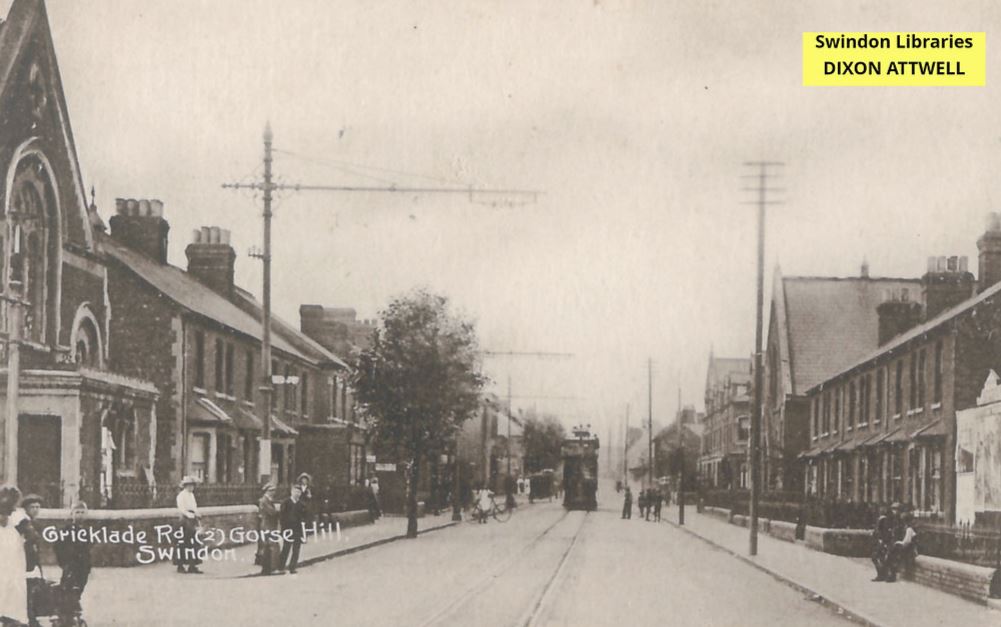
But his biggest legacy has to be the numerous properties he built across the town, which still survive to this day. Perhaps his two largest building projects were the development in Kingshill where he laid out the Mount Pleasant housing estate in 1877, building 35 houses in 1878. In 1879 he laid out land between Dixon, Stafford and Clifton Streets where he continued to build in 1883 and 1884. In 1881 he built a brick kiln in Kingshill, obviously to keep up with the demand for bricks while work continued. In 1889 he began work on the Gorse Hill Farm housing estate, meanwhile continuing with further projects across both New and Old Swindon.
There can be no denying that James Hinton made a tidy penny for himself. After his death in 1907 his effects were valued at £18,910 4s 1d (worth today approximately £2.1m) but without his investment in the fabric of the town it is questionable that it would have developed so extensively or so rapidly as it did in the 1870/80s.
James Hinton died in 1907 and is buried in Radnor Street Cemetery with his wife Sarah who died in 1928.


 Radnor Street Cemetery
2 thoughts on “James Hinton – a return visit”