Job Day was born in 1840, the eldest child of stone mason Moses Day and his wife Esther. By 1874 Job had established two businesses, which he advertised regularly in the North Wilts Herald. Based at his home in North Street, Job set up as a coal and coke merchant alongside his work as a builder and stone mason ‘estimates supplied, building and drainage in all its branches, stove, grates etc fixed.’
The start of a new decade proved a busy one as he married Emma Matilda Pepler in 1870. On the work front during the early 1870s Job’s building projects included a house at the station and two properties in Cheltenham Street and in 1871 he built four houses numbered 42 to 45 North Street, properties in which the family would live at various times. On the 1881 census returns he was described as a Master Builder employing 1 man and 2 boys.
But perhaps his most prestigious contract proved to be his most problematic. A large school building programme began following the creation of the Swindon School Board at the beginning of the 1880s when Job applied for the position of Clerk of the Works. He was up against some keen competition but Job had an influential supporter in his corner. Newspaper proprietor Mr William Morris proposed the appointment of Job, which was seconded by bank manager Wm Brewer Wearing and Job was duly elected at a salary of £2 a week.

His new job kicked off with the construction of Sanford Street School for Boys followed by the approval of the site and plans for a school in Westcott Street. But within two years things had gone badly wrong, as the following letter published in the North Wilts Herald explains:-
‘The Swindon School Board and the Clerk of the Works – Mr Job Day, the late clerk of the works to the Swindon School Board, requests us to publish the subjoined letter which he has addressed to the Swindon School Board in reference to a resolution passed at their last meeting;-
Gentlemen, I am in receipt of a copy of the resolution passed at your meeting on Thursday last, and as it reflects upon the acknowledgement of my services passed by you 24th March, 1881, I beg to return you the letter, as I should be sorry to retain it without, in your opinion, I had deserved it. Allow me to say, in reference to this matter, as a temporary accommodation I hauled 20 and 30 loads of sand at the starting of Westcott Schools. My relations with the contractors towards the end were of a very disagreeable nature, through the work I made them do again. Mr Binyon consented to some points in the building of the walls that I objected to. I said when the wall fell down it was through the mortar having perished, and I still have the same opinion.
It was my opinion that the walls should not have been built in the weather they were, but you must remember the work was greatly pressed by the Board.
I am, gentlemen, your obedient servant
Job Day
North Street, Swindon, 17th April, 1882.’

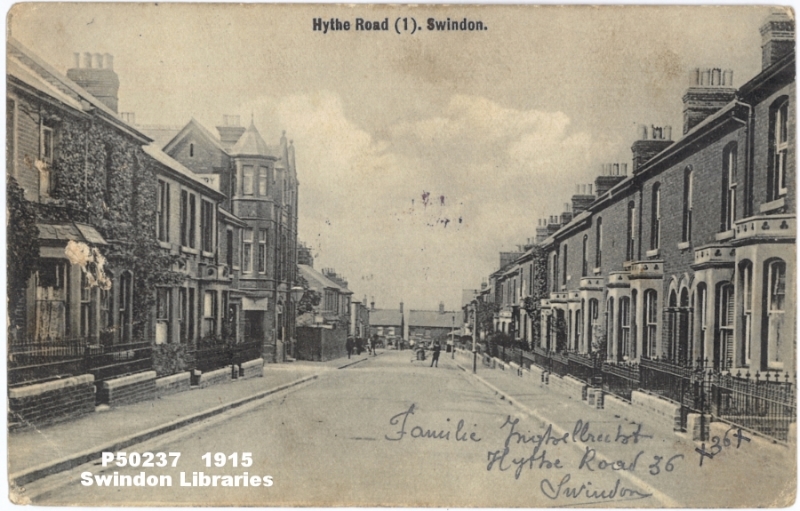
The altercation concerning architect Brightwen Binyon and the Swindon School Board did not hold him back though and during the 1880s he went on to build cottages in Clifton Street and houses in Hythe, Ashford and Kent Road.
At the time of the 1911 census Job Day was 70 years old and a widower. He lived at 45 North Street where his 17 year old niece Annie Pepler acted as his housekeeper. He describes his occupation as Builder & Decorator & Coal Dealer. He states he had 5 children, none of them living.
Job died on March 22, 1921 aged 80 years of age. He was buried on March 26, in plot E8013. Buried with him are his daughter Annie Sarah who died in 1899, his son William John who died in 1904 and his wife Emma Matilda who died in 1909.

 Radnor Street Cemetery
Another of France’s excellent articles which give a real insight into the character of the person in question.
LikeLike
Thank you Gordon. Much appreciated.
LikeLike