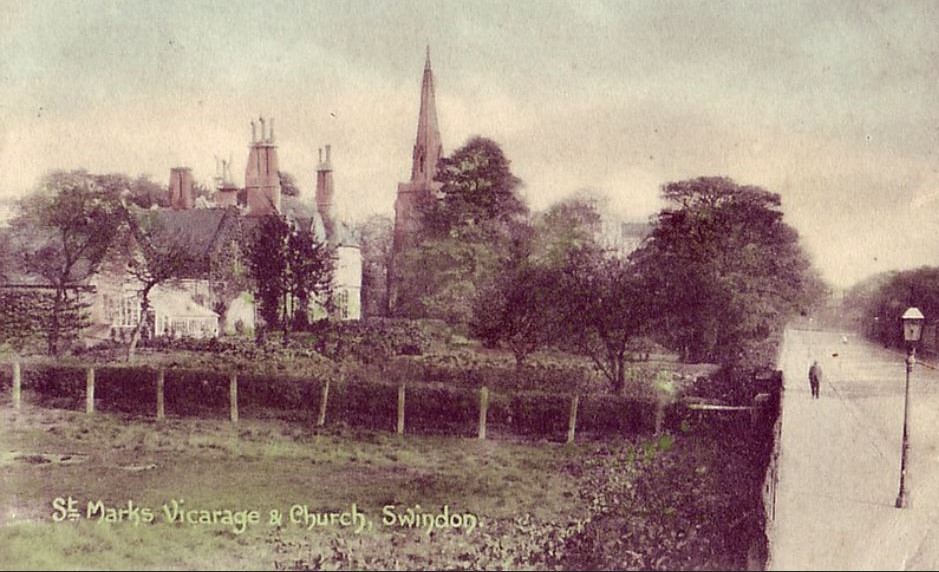
Image published courtesy of P.A. Williams and Local Studies, Swindon Central Library
The re-imagined story …
There was no easy route to the cemetery on the hill, as he soon discovered. The steepest was the walk from town up Deacon Street, and this was the one he seldom used, not wishing to arrive out of breath, the sweat on his brow.
Usually he walked from the vicarage around the cricket ground and up Cambria Bridge Road. The only disadvantage with this route was that he met many parishioners who wished to stop him and chat. On these occasions he allowed longer to get to there.
He had little realised how much time he would spend at the cemetery. The parish of New Swindon was large and growing when he joined the team of clergy but, perhaps naively, he had not expected so much death.
Sometimes he accompanied the funeral party, but he soon realised there would be many occasions when he made that long walk alone to stand at a grave beside a grieving father. He never grew accustomed to the burial of infants. How could he give thanks for a life that numbered in weeks? How could he offer consolation to parents that their child was with God when it had been with them such a short time?
That first time he left the cemetery by the Dixon Street gate and walked down Deacon Street to the town centre. He was grateful there were few people about on that wet day at the end of October 1891.
The facts …
Alexander George Gordon Ross was born in 1866 and baptised on April 14, 1866 at Trinity Church, Westminster. He was the younger of two sons born to Alexander Henry Ross and his wife Juliana Moseley.
The Rev Ross’s name appears frequently in the Radnor Street Cemetery burial registers, the first time on October 29, 1891 when he attended the funeral of William Crocker aged 48, a solicitor’s clerk who lived at 28 Read Street.
The following day he was at the cemetery again to conduct the service at the burial of twin babies. Ada Kathleen and Agnes Hilda Thompson were two months old.
Death of Canon A.G.G. Ross
Swindon Vicar for Many Years
A Keen Chessman
Canon A.G.G. Ross, Vicar of St Mark’s, Swindon, until September of last year, died suddenly at Oxford on Tuesday. For 47 years he worked at St. Mark’s, which was the only parish to which he was ever attached. He was the son of a former Member of Parliament for Maidstone, and was educated at Eton and New College, Oxford. He was trained at Wells Theological College, and ordained deacon by Bishop C.J. Ellicott, at Bristol in 1891. He came to Swindon the same year.
For 12 years he was assistant priest at St. Mark’s under Canon the Hon. M.J.G. Ponsonby, now Lord de Mauley. He had much to do with the rapid expansion and increasing activities of the growing parish, and he was one of the first to introduced amateur theatricals in Swindon on a large scale.
For some years he was in charge of St. John’s district church, and when Lord de Mauley left Swindon, on his appointment as Vicar of Wantage, Canon Ross was appointed Vicar of St. Mark’s in his place. The office of honorary Canon of Bristol Cathedral was conferred on him in 1909.
St. Luke’s Built
The principal extension of the parish with which Canon Ross was connected was the building of the district church of St. Luke’s. Services were previously held in the buildings which are now used as schoolrooms.
The spiritual work of the district increased greatly during Canon Ross’s incumbency, although during the war the parish had to suffer the reduction of the clergy from eight to five. When he retired Canon Ross had many tributes paid him. The Bishop of Malmesbury wrote: “We all thank God for his ministry.” And the Rev. Lord de Mauley referred to his “long and good time” in the parish.

A Chess Enthusiast
One of Canon Ross’s main interests outside his work, was chess. He was president of the British Chess Federation and his knowledge of the game was of great value to the Swindon Mechanics’ Institution Club, to the Wilts County team and to the St. Mark’s Chess Club.
When he had been 25 years as vicar of the parish, the parishioners presented him with an illuminated album as a memento of the dedication of a beautiful oak rood screen which was set up as a thanksgiving for the 25 years of his vicariate.
Since his retirement, Canon Ross had spent a good deal of his time at Maidstone, where he went to live. At the time of his death he was staying with the Rev. Trevor Jalland, Vicar of St. Thomas’s, Oxford, and formerly of St. Luke’s, Swindon.
There will be a Requiem Mass at St. Mark’s, Swindon, on Saturday morning.
North Wilts Herald, Friday, 13 May, 1938.

The late Canon Ross
The funeral of Canon A.G.G. Ross, former Vicar of St Mark’s, Swindon, who died suddenly at Oxford on Tuesday, will take place at Swindon on Saturday. The body will be brought to Swindon to-day (Friday) and will rest in St. Mark’s Church, where watch will be kept. On Saturday morning there will be Requiem Masses at 7, 7.30 and 8 o’clock, and a solemn requiem will be sung at 9.30. The funeral service will take place at St. Mark’s at 2.30 the same day, and the interment will be in Radnor-street cemetery.
North Wilts Herald, Friday, 13 May, 1938.

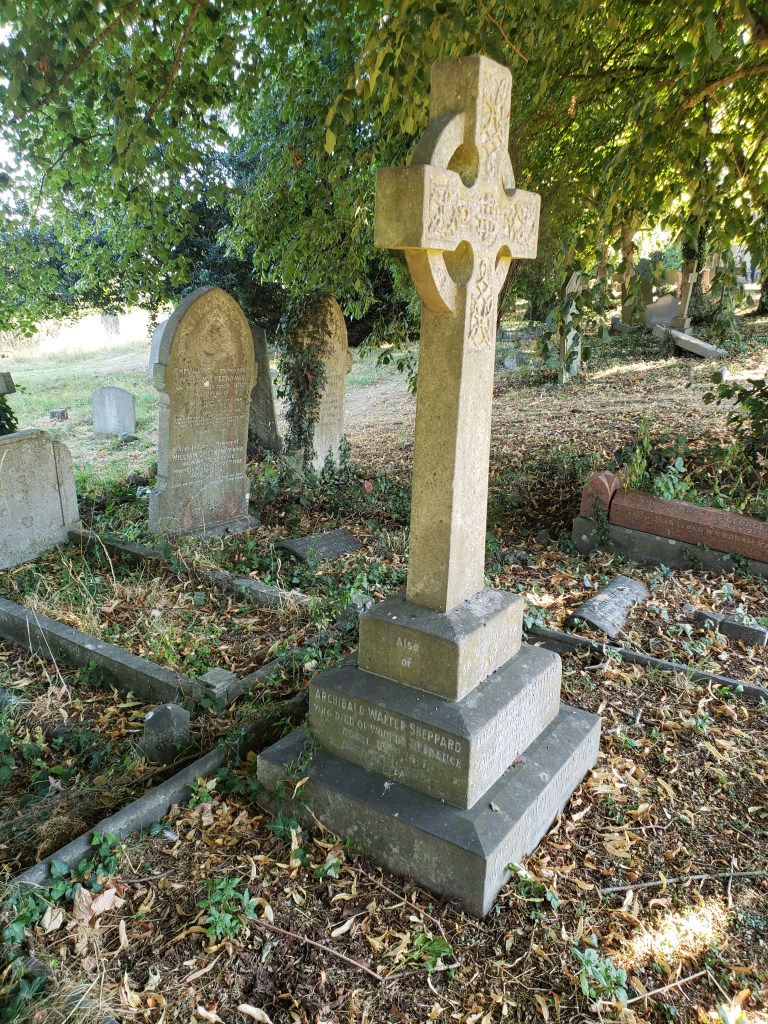
 Radnor Street Cemetery