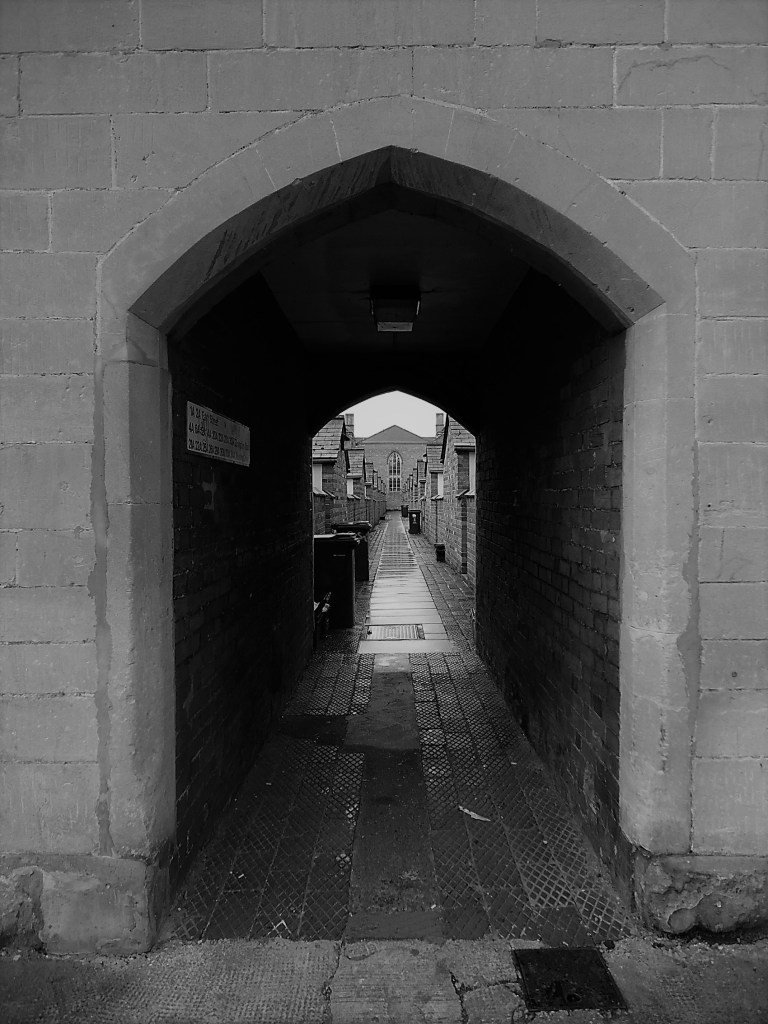
The re-imagined story …
We were promised a company house when we moved to New Swindon but when we arrived we discovered they were still being built!
So we ended up in one of twelve wooden cottages built in the back of beyond.
New Swindon was referred to as a pioneer town and out at Hay Lane we certainly felt we were living on the frontier. It would never have surprised me to see a herd of buffalo come bounding across the fields with Red Indians whooping and yelling behind them.
When the young Fairbairn couple moved into the empty cottage next to ours Margaret was heavily pregnant. It was her first child, but she was remarkably calm about giving birth in such primitive conditions.
Margaret’s pains came on in the middle of the night. We could hear her moans through the thin wooden partition that separated our homes. I left my own children in their beds and went next door to see what I could do to help. The poor girl laboured for many hours and I feared for her life and that of her baby. And at the end of her travails there was not just one, but two babies. They were small and I didn’t hold out much hope for either of them, but they thrived and survived.
And those draughty wooden cottages, well they were moved to Eastcott and survived as well. The GWR hated waste!

The facts …
James Fairbairn was born in c1816 in Dundee in Scotland and was one of the early railway men to settle in Swindon. James moved first to Newcastle and then to London working for Daniel Gooch and Archibald Sturrock. He married Margaret Armstrong at St Mary, Newington on 2nd October 1841.
James Fairbairn worked as an Engine Erector and later became one of the most senior Foremen in the Works. He was one of the first subscribers to the Sick Fund in 1843 and an early member of the Mechanics’ Institution, elected to its ruling Council in 1855. He was also one of the first subscribers to the Medical Fund.
James and Margaret Fairbairn arrived in Swindon in 1842 at the very beginning of the railway transformation, before the company houses were completed. Like so many other newcomers, James and his pregnant wife Margaret were accommodated in temporary housing. In their case they were housed in buildings at the Hay Lane Station (Wootton Bassett Road).
Brunel had first considered siting the GWR workshops at Hay Lane and designed for employees a row of twelve, single storey wooden cottages erected by building contractor J.H. Gandall. However, Daniel Gooch considered that the Swindon location was more suitable and that is where the workshops were eventually built.
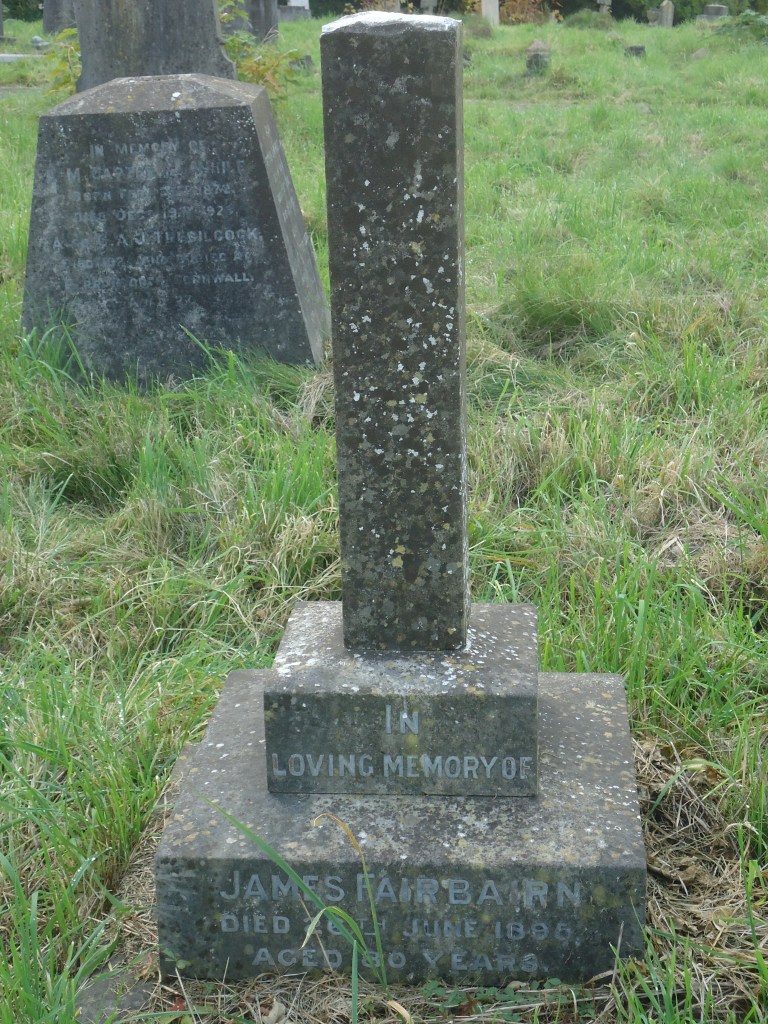
Conditions at the Hay Lane cottages were basic and it was there that Margaret Fairbairn gave birth to twins George and Elizabeth Ann in the Spring of 1842. The babies were baptised at Wroughton parish church on June 5, perhaps they were not expected to survive. George followed his father into the railway works as an engine fitter. He married Catherine Gosling and the couple had one daughter. George died at his home in Havelock Terrace in 1892 aged 49. He is buried in Radnor Street cemetery in plot B2070. His sister Elizabeth Ann married and moved away. Her husband, Charles While, a roll turner, moved to Swindon with the opening of the Rolling Mills in the 1860s. The couple lived at addresses in Workington and Sheffield before settling in Lancashire where Elizabeth died in 1912.
James and Margaret Fairbairn lived at various addresses in New Swindon, including 12 Reading Street, No 2 Fleetway Terrace, 25 Fleet Street and finally at 20 Harding Street where they both died in 1895. Margaret died in March aged 78 and James three months later in June aged 80.
You may also like to read

 Radnor Street Cemetery
I love the way you retell these tales
LikeLike
Thank you so much Deborah.
LikeLiked by 1 person