The re-imagined story …
When David Watson heard about the new railway town being built in Wiltshire, he decided to apply for a job.
He packed his apprenticeship indentures in a leather pouch, kissed his wife and his two daughters goodbye and set off from his home in Scotland. He intended making the journey of 500 miles on foot.
That was the story handed down through generations of railwaymen. Today such an epic effort is unfathomable. In 1843 the railway network was in its infancy and the road system was basic and hazardous. Today a journey by car travelling on the M6 would taken an estimated 7 and a half hours and even a train journey would take more than 8 hours. How long did it take David Watson and which route did he follow? Did he hitch a ride with a passing carter or did he travel part the way by stagecoach? Did he stop to sleep on route at a roadside inn or did he shelter in the hedgerow over night? Did he really walk 500 miles?
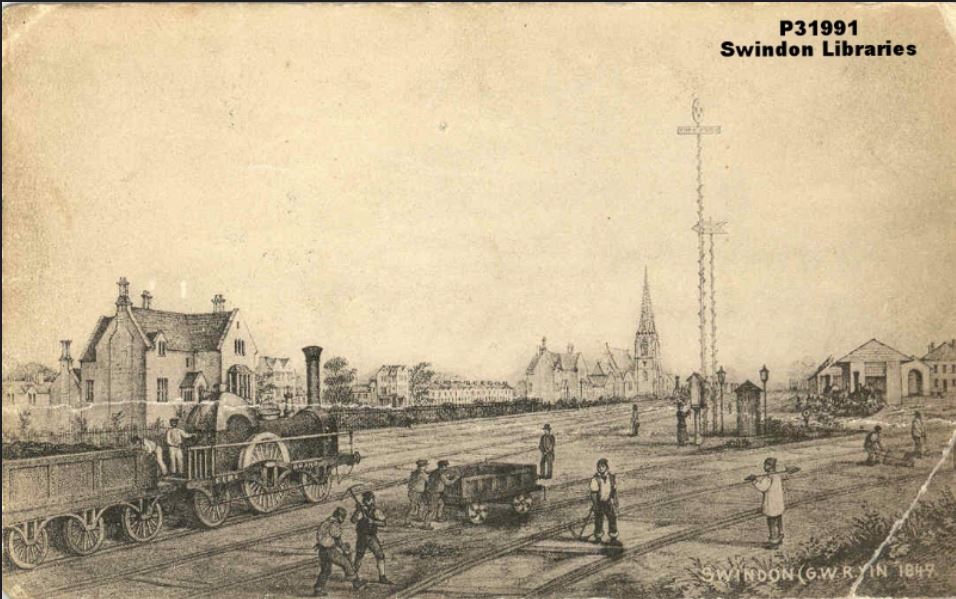
New Swindon 1847
The facts …
Death of Mr David Watson
A Swindon Octogenarian
The news of the death of Mr. David Watson which occurred on Wednesday at the residence of his son, Mr. Alex. Watson, 24 Cambria Place, will be received with keen regret by a host of friends amongst the older generation of Swindonians. Mr. Watson was 89 years old about a month ago, but, notwithstanding his great age, he had until recently been a familiar figure in that part of the town near his home. As recently as a week before his death, the old gentleman was seen out, but on Friday he had an attack of bronchitis, to which he succumbed shortly after noon on Wednesday.
A fine, burly figure of a Scotsman, Mr. Watson was born at Cragie, near Glasgow, in 1824. Serving his apprenticeship as a fitter in Dundee, he came to Swindon as long ago as 1843, and obtained employment in the GWR Factory. For about 30 years, the old gentleman, whose hearty and genial manner soon won him a large circle of friends, was chargeman over the fitters in the R Shop, and even after advancing years compelled him to give up the chargemanship he continued to work “Inside.” Indeed, it was only 11 years ago, in ’99, when Mr Watson had reached the age of 79 years, that he finally left the GWR Company’s employ, thus severing a 56 years’ connection with the Railway Company.
Mr Watson had been a member of the ASE for about 71 years, being superannuated by that Society when he gave up work. One of the first members of the Mechanics’ Institution and Medical Fund Society he was President of the latter on one occasion in the “fifties.”
In politics, the deceased was an ardent Liberal. During the whole of his residence in Swindon he had staunchly supported the Progressive cause, and took a prominent and active part in local contest in the old days.
Mr Watson, it might be mentioned, was one of the earliest contributors to the columns of the “Advertiser.” He was living in Swindon when this paper was founded in 1854, and he was a friend of the late Mr. William Morris, the founder, and, for nearly forty years, editor of this paper. Amongst his most treasured possessions was an old copy of the Swindon Advertiser, dated June 31st 1859, containing a report of a speech given by Mr Watson when presiding over a “Bobbie Burns” Centenary dinner at the Union Hotel, Swindon.
Mr Watson leaves three sons and two daughters out of a family of eleven, to mourn his loss.
The funeral of deceased will take place in Swindon Cemetery tomorrow (Saturday) afternoon.
The Swindon Advertiser, Friday, April 15, 1910.
At the time of the 1851 census David and Elizabeth and their five children were living at 7 Reading Street. By 1881 the widowed David was living at 31 Sheppard Street, his four sons were all working as engine fitters in the railway factory.
David Watson aged 89 of 24 Cambria Place was buried in grave plot B2967 on April 16, 1910. He was later joined by his son Alexander and daughter-in-law Eliza.
You might also like to read:
Elizabeth Lyall Embling – the first woman to be buried in Radnor Street Cemetery.

 Radnor Street Cemetery
One thought on “David Watson – railway and political pioneer”