The re-imagined story …
Tonight I shall raise a glass to Mr William Drew, although sadly not in The Lamb and Flag, a favourite watering hole of mine back in the day. When it came to pubs William Drew knew what he was talking about.
You youngsters might remember The Litten Tree in Fleet Street but of course that building was never designed as a pub, oh no, that property began life as the North Wilts Conservative and Liberal Unionist Club. It was built by Charlie Williams in 1897, the year of the old Queen’s Diamond Jubilee. You can see the commemorative plaque if you look up – past the blocked gutters and peeling paint.
They say some developer has got a plan for the building – well, they all have don’t they?

Death of an Architect. – The death occurred at Swindon on Monday of Mr William Drew, senior member of the firm of Messrs W. Drew and Sons, architects and surveyors. The deceased gentleman was at one time a very familiar figure in Swindon and the neighbourhood, but during the past three or four years he has more or less been confined to his house by illness.
Deceased was in his 68th year, and was one of the oldest members of the Society of Architects, having been admitted in 1887. He commenced practice at Highworth, where he remained for 12 years, and then removed to Swindon, where he has always earned and received the esteem and regard of his patrons and of all with whom he has had business or social relations. As a hotel valuer he was known over a wide district, while the results of his skill as an architect are to be seen in many large buildings in Swindon and the surrounding neighbourhood.
For over 30 years he has held the responsible position of architect to Messrs T. and J. Arkell, of Kingsdown Brewery, and he designed the majority of that firm’s licenced houses at Swindon, Faringdon, Lechlade, Cirencester, and many other towns and villages in the district.
Amongst other large buildings for the plans of which Mr Drew was responsible were the Clarence Street Schools (at that time amongst the finest in the west of England), the Rodborne Road Schools and enlargements, the Gorse Hill Schools (the first in the district conducted on the central hall principle), the Upper and Lower Stratton Schools, the Rodborne Cheney and Haydon Wicks Schools, Mr E. Arkell’s residence at Kingsdown, the Conservative and Unionist Club in Fleet Street, Faringdon Post Office, the Primitive Methodist Chapels at Rodborne Road and Stratton St. Margaret, the Cricklade Road Baptist Chapel and many others. Mr Drew prepared the plans of the original sewage tanks at Rodborne for the New Swindon Local Board; he developed the Kingshill Estate for Mr J. Hinton, the first street laid out being Clifton Street; and he also laid out and developed the Even Swindon Estate for Mr J. Morrison. –
The deceased gentleman has been assisted in the conduct of his business by his sons, Messrs Edward and William Drew, and they will continue to act in the same capacity as their late father.
The Faringdon Advertiser, Saturday, May 20, 1905.
*Rodborne is a spelling error in the original text.
As a valuer his services were constantly in demand, and no man was more conversant with the growth and growing importance of Swindon during the past forty years.
Deceased never took any part in the public life of the town, preferring a quiet life. In politics he was a staunch Conservative, but the only occasion on which he took an active part in the political arena was in support of the late Sir Daniel Gooch, when he was returned for the old Cricklade Division.
Mr Drew leaves a widow and family of nine children:- four sons and five daughters – for whom the deepest sympathy will be felt in their bereavement.
Some few years ago deceased took into partnership in his business two of his sons, Mr Edward Drew and Mr William Drew, by whom the bulk of the work has been carried on during their father’s long illness.

The Funeral
The mortal remains of the late Mr William Drew, were laid to rest in the Swindon Cemetery on Thursday. The funeral cortege left deceased’s late residence in Victoria Road at half-past three. Deceased was a man of great weight – considerably over 20 stone – and the remains were enclosed in an elm shell, within a coffin of immense size, of polished oak, with massive brass fittings. The inscription on the breast-plate was as follows:- “William Drew, born 29th October, 1837; died 15th May, 1905.”
The coffin was conveyed in a hearse, and there were six mourning carriages.
At the graveside there was a large assembly of sympathising friends, the funeral service being conducted by the Vicar of Swindon, the Rev. Canon Estcourt.
The funeral arrangements were satisfactorily carried out by Mr J. Williams, of Bath Road, Swindon, assisted by his son, Mr Fred J. Williams.
Extract from the obituary published in The Swindon Advertiser, Friday, May 19, 1905.
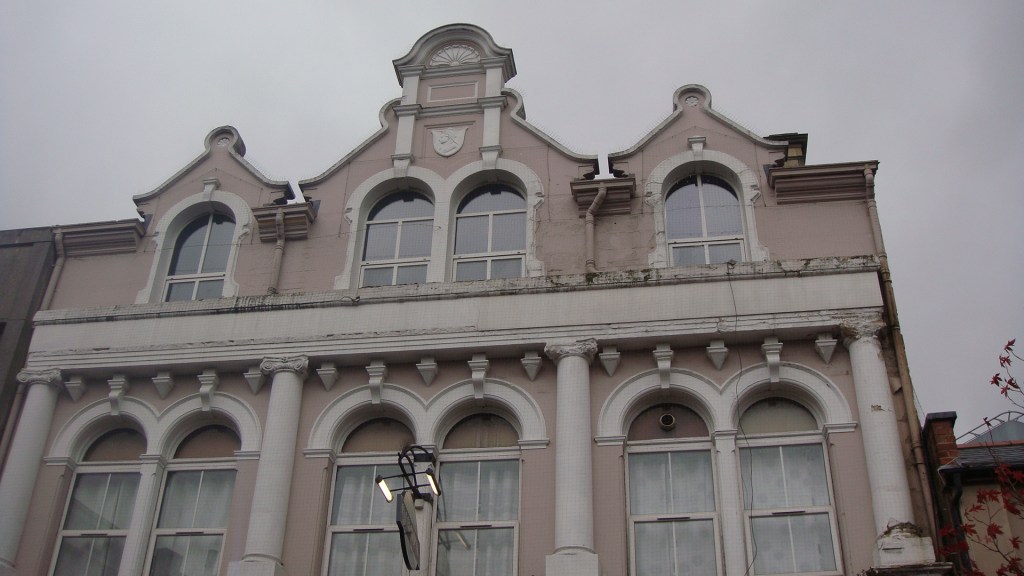
For more and better photographs of this building you might like to visit Duncan and Mandy Ball’s website.

 Radnor Street Cemetery