The re-imagined story …
I went to school with Lucy Hobbs. She lived with her dad and her uncle’s family at 13 Omdurman Road. The two brothers were well known in Gorse Hill. Lucy’s dad was a bricklayer and his brother John was a carpenter. I never knew Lucy’s mother, she had died when Lucy was very young.
It always appeared to be a happy, busy home but you can never tell what pain and sorrow people live with. Neighbours said William had never recovered from the death of his wife. Williams’ bereavement might seem in the past to others, but for him it must have been a daily presence.
I lost touch with the family as we all grew older. I heard that the eldest son, William joined the navy and Beatrice went into service but I don’t know what became of the other son. My friend Lucy married and left Swindon to live in London.
We’ve had tough times as a family, but I can’t imagine the desperation Lucy’s father must have felt. How does anyone do what he did, he could have seen no hope for the future.
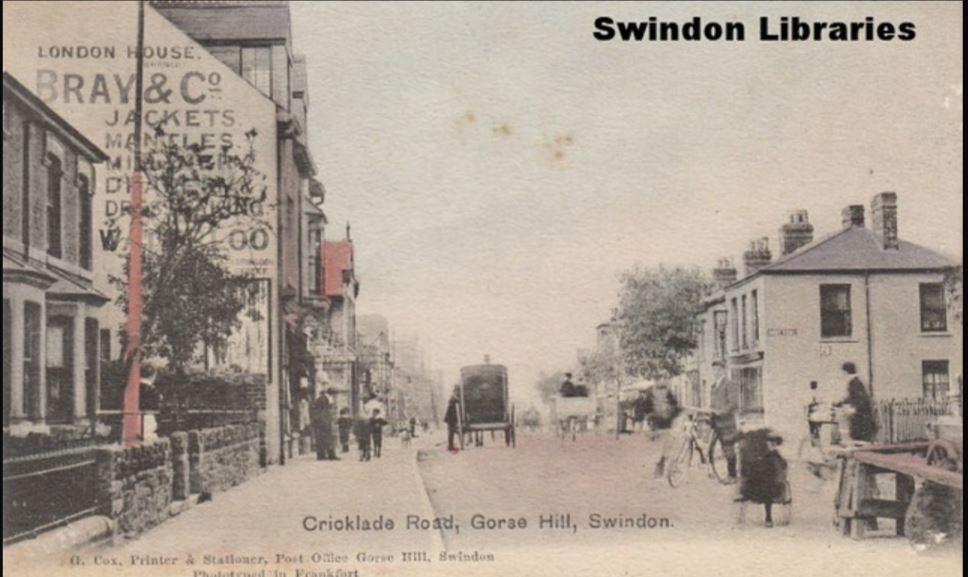
View of Cricklade Road, Gorse Hill published courtesy of Local Studies, Swindon Central Library.
The facts …
William Joseph Hobbs was born in 1868 in Poulton, Gloucestershire, the eldest of William and Sarah Ann’s nine children. William senior worked as a stonemason and both sons William Joseph and John William followed him into the building trade.
William Joseph Hobbs married Jennetta Williams on October 4, 1890 at the parish church in Poulton and by the time of the 1891 census the couple were living at 3 Ferndale Road with the two younger Hobbs brothers, John William and Tom.
William and Jennetta had four children, William Joseph, Henry Charles, Beatrice May and Lucy Amelia Jennetta who were all baptised at St Barnabas Church, Gorse Hill. The youngest child, Lucy, was baptised on April 7, 1911 aged 14 and is described in the register as ‘Candidate for Confirmation.’
Jennetta’s death was registered at Marylebone district in the June quarter of 1899. She was 34 years old and died leaving William with four children to raise. Somewhat surprisingly William did not remarry as most men left in this predicament usually did. At the time of the 1901 census he is living at 53 Ferndale Road with his four children aged 8, 7, 5 and 3, with a housekeeper Emily Button.
The newspaper account reads:
Railway Tragedy
A terribly mutilated and decapitated body of a man was found on the GW Railway Highworth branch line at Swindon at 5.30 Saturday morning. The discovery was made by a shunter, the body lying across the six foot way with the neck across the metals in such a manner as to indicate deliberate design. Enquiries set on foot by the police led to the identification of the body as that of a bricklayer named William James [Joseph] Hobbs, a widower, who, up to a fortnight or so ago, had been lodging in Cheltenham Street, New Swindon. He was stated to be in comfortable circumstance, although he had not been at work lately.
The [Gloucester] Citizen Monday 30 September 1912.
Swindon
A Case of Suicide
During a fit of temporary insanity was the verdict at which a coroner’s jury arrived on Monday, when sitting to inquire into the death of a man whose decapitated body was found on the GWR line near the Swindon goods station on Saturday. It was said that the deceased – William Joseph Hobbs, a bricklayer, 44 years of age – had behaved somewhat queerly of late, but beyond being irregularly employed there was little to worry him. He was a widower.
The [Gloucester] Citizen, Tuesday October 1st, 1912
The entry of William’s death in the Radnor Street Cemetery burial registers reads:
William Joseph Hobbs 44 found on GWRailway 13 Omdurman Street 1st October 1912 plot A5.
William was buried in a public or pauper’s grave with two other unrelated people.

 Radnor Street Cemetery