To give him his proper title, William Bonner was the Railway Station Superintendent at Swindon and the fifth person to fulfil that role.
Railway village builders Joseph D. & Charles Rigby built the railway station, known as Swindon Junction, in 1842. The building accommodated the Refreshment Rooms on the ground floor and a hotel and lounge above. In 1881 the hotel staff numbered 25 members all living on site. The Victorian building was largely demolished in 1972.
William Bonner began his railway career as a clerk before serving as station master at West Drayton, Uxbridge and Wrexham before moving to Swindon in 1873.
His accommodation as Railway Station Superintendent was Station Villa, one of the Managers Houses on Station Road, long since demolished.
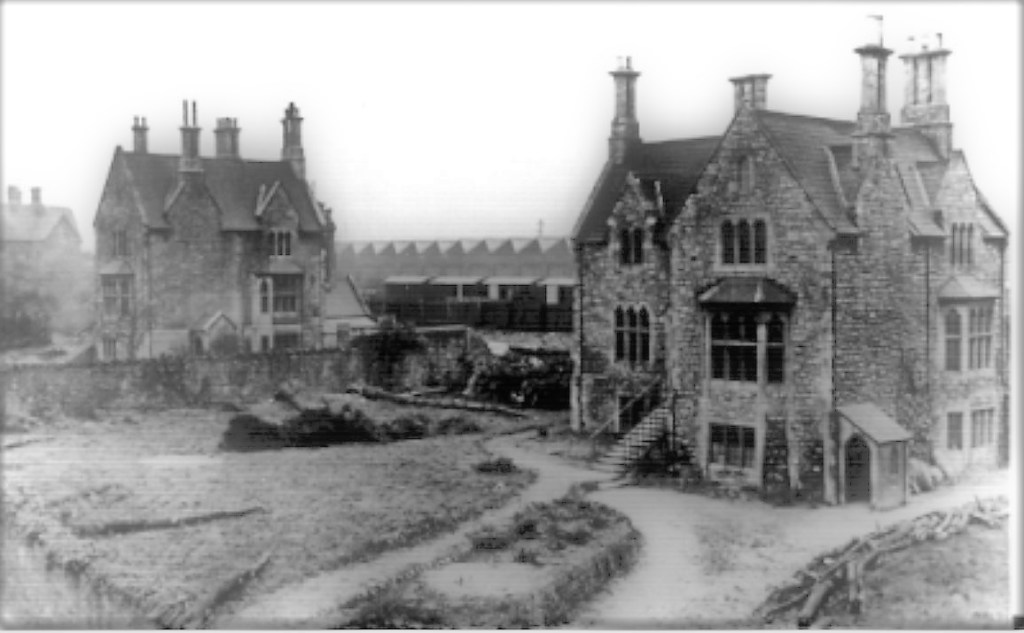
Station Villa is to the right of this photograph pictured in around 1910
Sad Death of Mr Bonner,
The GWR Station Master
A long life passed in the care and preservation of other people’s lives was brought to a sad end on Tuesday last, at Swindon, when Mr W. Bonner, the highly respected but unpresuming, station master at Swindon GWR junction, met with his death whilst in the discharge of his duty. The particulars of the sad event will be found below.
The GWR authorities have been particularly happy in their choice of station masters at Swindon. Mr Holmes, the almost immediate predecessor of Mr Bonner, being as remarkable for his courteousness and urbanity as was Mr Bonner. At such a large and important station, a man of much tact and skill is an absolute necessity, not only for the safety and comfort of the travelling public but for the governance of the large staff of station hands at such a junction as Swindon.
Mr Bonner proved himself the right man in the right place – civil, courteous, and obliging to all, to such a degree that his loss is felt more than by the natural feeling experienced at the sadness of his going from amongst his family and friends.
But like so many, the deceased gentleman went through all the numerous dangers to life and limb incidental to his occupation, only to be overtaken at a time when he might pardonably have been looking forward to a period of retirement and rest after a busy life. Capt. Speke, the explorer, passed through the dangers of the African jungle to come home to shoot himself whilst getting through a hedge: Mr Bonner’s sad ending may be somewhat likened to this, and to many others of a like nature.
Deceased had been in the service of the Company about 40 years, and commenced his duties at Paddington. He had been at Swindon just a quarter of a century, having come here from Wrexham, where he was presented with a gold watch and chain by the station employes as a token of their appreciated of his kindness and consideration. When his body was discovered on Tuesday evening the watch and chain, slight damaged, were found in the six footway. The watch had stopped at 6.47 p.m.; the train reached Swindon at 6.50 p.m.
The Inquest
Was held at the Queen’s Hotel, GWR Station, on Wednesday, before Mr W.E.N. Browne, County Coroner, and a jury of whom Mr H.J. Deacon was foreman, Mr Kislingbury, Divisional Superintendent of Bristol; Inspector Wheeler, of Chippenham; and Mr W. Martin, Locomotive Shed Foreman, of Swindon, were present on behalf of the GWR Company. The following evidence was taken:
Mr Kislingbury, Divisional Superintendent of Bristol, said deceased came to Bristol to see him on Tuesday, and was engaged with him from 11 a.m. till 1.30 p.m. He was in his usual health, and witness had never seen him brighter.
William Readings, a GWR engine driver, said he was driving one of the recently constructed express trains. He left Bristol at 5.50 p.m. Deceased got on the engine at Bath. Witness asked him for his pass and he produced it. During the run from Bath they conversed together and deceased spoke of his son who was a Loco Superintendent in India. He also referred to the difference in the present day lines and the old broad guage.
When reaching Hay Lane signals witness found he had not shut off the train steam warning signal cock. When he shut it off deceased asked him what he had done and witness explained to him. That was the last word he spoke. Directly afterwards when witness shut off the steam he turned round and saw deceased falling off through the opening near the engine tender, and all witness could see was the tail of his coat. – By a juryman: Deceased might have looked over at the side to see if the signals were right, but witness did not see that. – By another juryman: He had never travelled with witness on the engine before. He had his engine pass on this occasion. – By another juryman: The train was going at the rate of 50 miles an hour. Witness had not the least chance of saving him.
George Cole, fireman on the same train, said he did not see deceased fall off the engine. The train was not stopped until it arrived at Swindon. Witness was looking for the signals on his side. Deceased fell in the six foot way.
George Rochester, platform Inspector at Swindon, said that on the arrival of the train at Swindon at 6.50 p.m., the driver Readings reported to him what had happened, telling him that Mr Bonner had fallen off the engine near Major Dean’s house. Witness immediately obtained the assistance of three men, and they took a stretcher and went on an engine down towards Rodbourne Road. They pulled up beyond Major Dean’s house, and then walked along the line in search of deceased, whom they found lying on his face with his two legs on the down line. Deceased’s head was fearfully cut about, and there was not the slightest sign of life. They placed the body on a stretcher and took the train on to Wootton Bassett in order to get on the up line. Witness had previously sent word to Swindon Station for a doctor to be there in readiness, and Dr. Swinhoe attended. There was not doubt that deceased was struck by some part of the train after he pitched on the ground.
The Coroner said Dr Swinhoe was not present, but if he were he could only corroborate what Inspector Rochester had said with regard to life being extinct. He (the Coroner) had no doubt Dr. Swinhoe, like most of them, was suffering from shock at the sad way in which the life of an old friend had been brought to a close. It was only a few days ago that deceased told him (Mr Browne) that he would be retiring shortly on a superannuation. Deceased was always kind and considerate to the staff, and the GWR Co. had lost a most valuable servant. He (Mr Browne) deeply regretted his untimely death, and had hoped he would have lived many years to enjoy a well earned rest. He was sure they all sympathised with the bereaved family in their great bereavement.
The jury concurred; they returned a verdict of “Accidental death,” and gave their fees to the Victoria Hospital.
The funeral which will be of a public character, will take place to-day (Saturday), leaving the deceased’s late residence at 1 p.m., 1.30 p.m. at St Mark’s Church, and 2 p.m. at the Cemetery.
Swindon Advertiser Saturday February 13, 1897
The Late Mr William Bonner
Funeral of Deceased
As announced in our last Saturday’s edition, the funeral of the late Mr William Bonner, for over a quarter of a century the courteous and obliging station master at the GWR Swindon station, took place on Saturday afternoon amidst every token of respect for the deceased (who met his death in such a tragic and sudden manner), and sympathy for his sorrowing children.
The funeral cortege left deceased’s late residence, Station Villa, shortly after one o’clock, and the solemn procession wended its way to St. Mark’s Church, New Swindon where the first part of the funeral rites were conducted.
The body was enclosed in an interior shell, with an exterior coffin of 1¼ inch polished elm, with raised moulded lid, brass furniture and engraved brass plate on panel bearing the following inscription: “William Bonner, died Feb. 9th, 1897, aged 59 years.”
The coffin was conveyed in a pair horse funeral car, and on arriving at the church gates it was carried into the sacred edifice by eight of deceased’s staff in uniform. The first part of the service at church was conducted by the Hon and Rev Canon Ponsonby, vicar of St. Mark’s and rural dean, whilst the lesson, taken from the first epistle to the Corinthians, 15th chapter, and starting at the 20th verse, was impressively read by the Rev. A.G. Gordon Ross, priest in charge of the district church of St. John, in which parish deceased lived. Service over, the procession was re-formed, and way was made for the cemetery, where the service was conducted by the Hon and Rev Canon Ponsonby.
The mourners numbered between 150 and 200, including over 50 of the men employed on Swindon platform, who attended in uniform.
There follows a long list of mourners and floral tributes…
Whilst at the graveside, one of the sons of the deceased, who had only just recovered from a serious illness, was taken with a fit and had to be carried away. He was immediately driven home and placed in bed. On making enquiries on Monday we were glad to find that he had recovered from the shock, and was as well as could be expected under the circumstances.
The funeral arrangements were satisfactorily carried out by Messrs Chandler Bros., Wood Street, and Mr Joseph Williams, Devizes Road, Swindon.
Swindon Advertiser, Saturday, February 20, 1897.
William was buried on February 13, 1897 in grave plot E8365 which he shares with his wife Caroline who had died the previous year.

The grave of William and Caroline Bonner
The Late Mr. Bonner – A handsome memorial to the late Mr W. Bonner, who was for nearly half-a-century superintendent of the Swindon GWR Station, has been erected in the Swindon cemetery. The memorial takes the form of a massive wheel cross, with carved face, standing on a moulded die, raised on two spacious bases, the material of the whole being white marble. The monument, which is 7 ft. in height, is enclosed with massive marble kerbs, and corner block; and its appearance is at once striking and artistic. It has been erected by the officials of the GWR Company, and Mr Bonner’s own personal staff at Swindon Station, also many other friends, to “mark the esteem in which he was held during the 24 years as station superintendent.”
The Marlborough Times and Wilts and Berks County Paper, Saturday, December 18, 1897.

 Radnor Street Cemetery
An aside – The Cpt Speke mentioned will be John Hanning Speke, brother of Matilda who married John Richard Pine-Coffin. There is a memorial window to J H Speke in St Andrew’s Church, Alwington, N Devon, the P-C’s are buried there. Speke explored Africa with Richard Burton.
LikeLike
Thank you so much for this additional information.
LikeLike