As Swindon residents eagerly await the opening of the temporary museum and art gallery space in the Civic Offices, let’s visit the opening of the building in 1938 and the first Mayor to be invested there.
The Civic Offices in Euclid Street were designed in a Moderne style by Oxford architects Bertram, Bertram and Rice and officially opened on July 5, 1938 by the Duke of Gloucester. The North Wilts Herald reported that ‘one of the highlights of the tour was when the Duke, with the Mayor, appeared on the balcony. His Highness was loudly cheered, and he waved an acknowledgement.’
The building was given a Grade II listing in 2020 when Historic England described it in the designation details ‘as a symbolic expression of Swindon’s civic identity during the interwar period.’
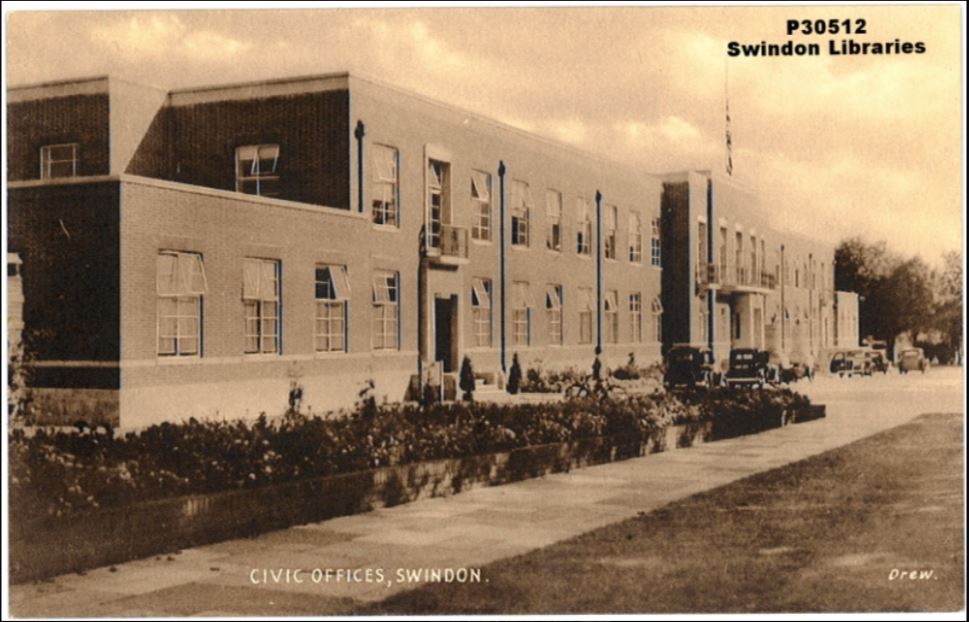
Image published courtesy of Local Studies, Swindon Central Library
Raymond George Cripps was born on December 18, 1877 in Kings Lynn, the son of Primitive Methodist Minister George Cripps and his wife Ursula Ellen. The family moved around the country following George’s ministry, but by 1901 George had retired and the family were living at 134 Goddard Avenue. Raymond was 23 years old and working as a railway clerk.
In 1906 Raymond married Beatrice Maud Raggett, the daughter of another prominent Primitive Methodist Henry Raggett and granddaughter of Charles Morse, one of the founders of the church in Swindon. The couple had two children, Cyril and Marjorie.
Raymond George Cripps first stood for office in the local elections of 1924 but was disqualified owing to his nomination papers not been filled in properly. He sought election the following year and continued to represent the King’s Ward.
Raymond George Cripps died aged 82 years at his home, 85 Croft Road. He was buried on January 25, 1960 in grave plot D85A which he shares with his wife Beatrice Maud who died in 1954.
Swindon’s New Mayor
Unanimous Election of Councillor R.G. Cripps
Labour’s Support
Just an ordinary man, unpretentious, not a Swindonian, but very proud of the town, in which he has lived for 40 years.
That was how Councillor Raymond George Cripps described himself on Wednesday when he was elected Mayor Swindon.
With the usual ceremonial his election was approved by the full Council, in the presence of members of his family and friends and representatives of the public life of the town.
Thirty-ninth in the list of Swindon Mayors, Mr Cripps, a retired GWR clerk, is the first Mayor to be invested in the new Civic Offices.
This year, for the first time in Swindon civic history, the members of the Council and visitors were deprived of the ceremony of robing and investiture with chain of office. This took place in an ante-room during a brief adjournment of the special Council meeting.
Mr Cripps made the customary reference to the work which lay ahead of the Council. He thought the dispute with the Wilts Standing Joint Committee over the police strength in Swindon would be settled on advantageous terms to the Council. The cattle market scheme would call for all the resources possessed by the Council in the way of financial judgment and wise planning. Mr Cripps described Swindon’s educational facilities as unequalled in the country, and he appealed for greater civic pride in the town.
Among those occupying reserved seats at the rear of the Council Chamber were the new Mayoress and members of her family the retiring Mayoress, Mrs Niblett, and Mrs L.J. Newman, a former Mayoress, the Rev. E. Banks and the Rev C.H. Cleal.
Mr Cripps election was proposed by Councillor A.E. Harding, and seconded by Ald. T.C. Newman.
In proposing Councillor Cripps as a ‘qualified person’ to be Mayor, Councillor A.E. Harding described Swindon as one of the best governed towns in the country. ‘Our offices and officials are second to none; we are proud of them.’
Then as an aside he made the suggestion to the Transport Committee that ‘bus conductors should be supplied with spectacles ‘so they might see people hurrying to catch the bus.’
Mr Harding spoke of the new Mayor’s church and Council work as providing excellent training for the exalted position he was to fill.
Tribute to Mrs Cripps and her ability to fulfil her duties was added by Mr. Harding.
Ald T.C. Newman seconded, and referred to his long association with Mr Cripps.
Labour’s Support
On behalf of the Labour group Coun. W.R. Robins supported the nomination and said the Mayor could rely on the support of his colleagues.
‘We differ in political allegiance but we are as desirous of doing the best for the town and people as any other members of the Council.’ Coun Mrs May George and Coun A.H. Wheeler also supported the nomination.
Coun. H.R. Hustings protested against the discordant note brought into the proceedings by the insult to the ‘bus conductors. He was very surprised at the remark being made on such an occasion of dignity. It was a very inopportune time.
The election of the Mayor was then approved unanimously, and the Council adjourned for a few moments while the new Mayor robed and was invested with chain of office.
When the new Mayor returned robed and took his place in the Mayoral chair he was loudly applauded.
The Mayor, speaking of Council work, said he was afraid that Swindon people did not appreciate the educational advantages of the town. He questioned whether any other town of its size could equal them.
Promising to do his work to the best of his ability he confessed that he had been tempted to withdraw after being proposed as Mayor-elect. He realised the responsibility he was assuming.
Referring to a reference in the Press in which it was suggested that he would need good humour, he said he could still see the funny side of things. ‘God help the man in public life who cannot,’ he said. He hoped to serve impartially and he knew the Mayoress would do all in her power to render service and forward any good cause in the town.
Provision had been made in current estimates for erection of a cubicle block at the isolation hospital. It was anticipated that during the coming year the Victoria road improvement would be completed, or at least substantial progress made.
The programme of educational development would, in the main, be completed and proposals for a central education and health clinic were approaching realisation.
North Wilts Herald, Friday, 11 November, 1938
You may also like to read:
Henry Raggett – a humble God fearing Christian

 Radnor Street Cemetery
One thought on “Raymond George Cripps – first Mayor to be invested in new Civic Offices”