William Henry Selby – honourable in all his dealings

Many of the men who built Swindon were incomers to the town, but William Henry Selby was homegrown.

William Henry Selby was baptised at Holy Rood, the old Swindon parish church in the Lawn, on April 27, 1834, the son of Thomas Selby, bricklayer and his wife Mary. On the 1841 census the 7 year old boy is living in Dammas Lane with his parents and four siblings, Daniel 8, John 5, Jane 4 and 3 months old George.

William followed his father into the building trade, working as a stonemason. In 1863 he married Mary Ann Saddington, a domestic servant working for the Goddard family at the Lawn at the time of her marriage. In 1871 the census reveals the couple were living at William’s boyhood home with his widowed mother and their own three children. William would live his whole life in the house where he was born.

William’s name first appears in trade directories in the 1870s and across the years his sons Albert Henry and George Alexander Selby would join him in the business. Between 1896 and 1900 the family business built more than 50 houses across both Old and New Swindon from St. Margaret’s Road and Goddard Avenue to Graham Street and Rosebery Street.

Image of St Margaret’s Road published courtesy of Local Studies, Swindon Central Library.

William died April 14, 1899 aged 66 years. He was buried in plot E8088 on April 19, which he shares with his son George Alexander who died in 1923 and Julia Barnett, possibly a family member, who died in 1953 aged 91 years.

Death of Mr W.H. Selby

Another link between the Swindon of the past and that of the present has been snapped by the painfully sudden death of Mr W.H. Selby, builder. Mr Selby had not enjoyed the best of health of late, but he moved about with his wonted activity, and his friends did not entertain any forebodings. About 9.30 on Friday night, however, Mr. Selby was taken ill in Victoria Street, and within a few minutes he had breathed his last. He was assisted in the direction of his home as far as the Goddard Arms Hotel, where, in view of his condition, it was thought advisable to complete the journey in a cab. Mr Selby was accordingly driven home, where he expired in the course of half an hour, his death having been brought about by a paralytic stroke. The deceased’s figure was very familiar in Swindon, and the news of his death will be heard with great regret. Three generations of Mr Selby’s ancestors have been associated with Swindon, and have carried on successful businesses as builders in the town; and Mr Selby himself well perpetuated the tradition, winning much respect as a tradesman of the best type, upright, faithful, and honorable in all his dealings. Deceased was an enthusiastic horticulturist, and did a lot of hard work as a member of the Swindon Horticultural Society. His chief hobby was fruit and flower growing, and the success of his efforts in this direction may be gauged by the fact that he has won numerous prizes at the Crystal Palace shows against the strongest opposition. His local triumphs have been almost innumerable.

The interment took place on Wednesday at the Cemetery amid many tokens of sorrow and regret. The cortege left deceased’s residence at three o’clock, and proceeded to Christ Church, where the service was read by the Rev N.E. Howe (vicar). The procession then wended its way to the Cemetery, where the last solemn rites were performed by Mr. Howe. The principal mourners were Mr. T. Selby (brother) and Mrs T. Selby, Miss Annie Selby (sister). Messrs Albert, George and Lewis Selby (sons), Miss Louisa Selby (daughter), and Mr and Mrs Smith (cousins). A large number of friends followed. Wreaths were sent by the family, Mr Wheeler, Mr and Mrs F. Williams, Mr and Mrs Fenton, Mr and Mrs Day, Mr and Mrs White, Mr and Mrs Croad, Mr and Mrs D. Lane, Mr and Mrs Cockbill, Miss Kinneir, and the Committee of the Swindon Horticultural Society. The coffin was of polished panelled elm, with massive brass fittings, bearing the inscription, “William Henry Selby, died April 14th, aged 65 years.” The funeral arrangements were satisfactorily carried out by Mr F.J. Williams, acting for Mr. J. Williams.

North Wilts Herald, Friday, April 21, 1899.
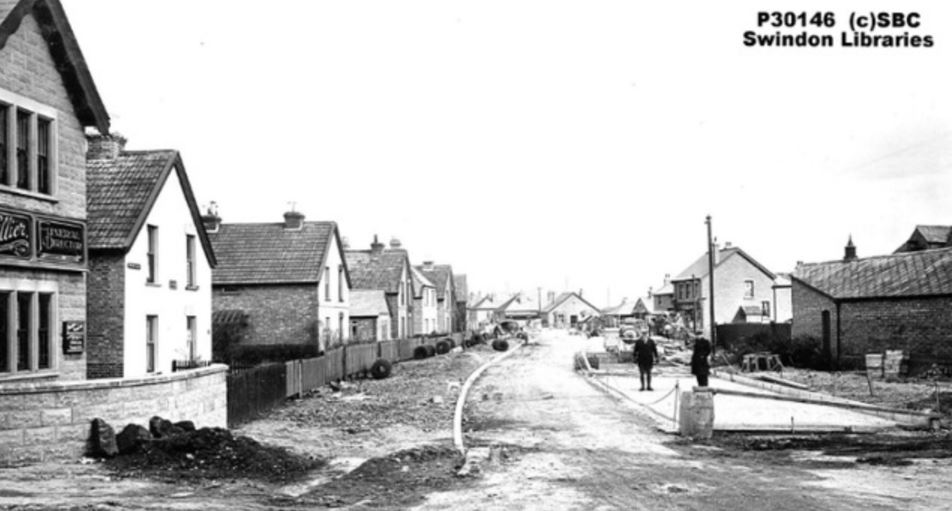

Whitworth Road and the Broadway pictured during the 1930s when William Henry Selby’s firm was building a house for N.L. Selby in 1937. Published courtesy of Local Studies, Swindon Central Library.
Daniel Skinner – Florence Street Mission Hall

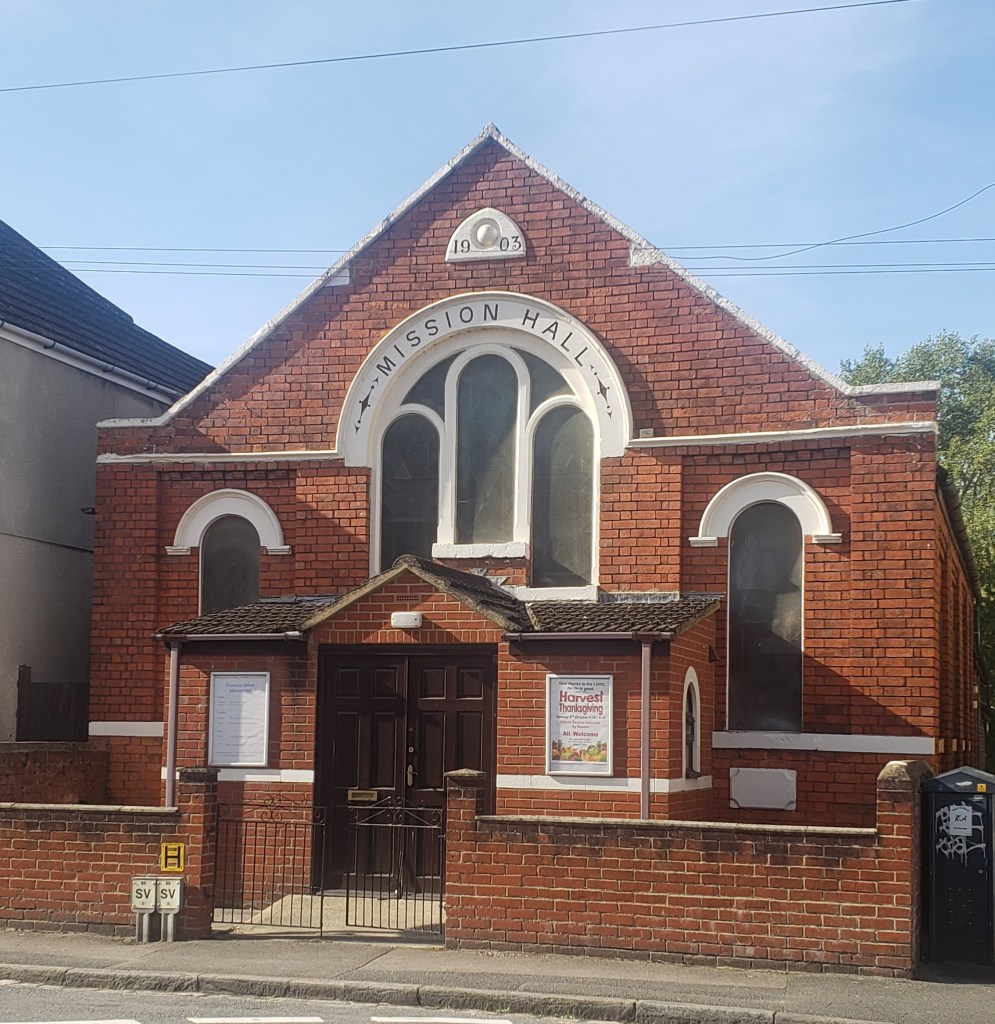
In 1903 baker Daniel Skinner decided to “build a place of worship free for the unfettered preaching of the gospel.” He engaged architect George Davis and local builders Colborne to build his Mission Hall in Florence Street, Gorse Hill. He also built several houses in the same street and moved into No 27, next to the Mission Hall.

Daniel Skinner was born in Whelford, Kempsford, Gloucestershire in 1861 the son of William and Mary Skinner. In 1889 he was working as a baker in Stratton St Margaret when he married Jemima Day Clack in the parish church in Lechlade. The couple had four children who survived to adulthood, William born in 1890, Lilian Mary in 1892, Frank Edward in 1893 and Ethel May in 1896. Jemima died in the summer of 1897. At the time of the 1901 census the Skinner family were living at 198 Cricklade Road, Gorse Hill. Jemima’s sister Fanny Evans Clack was living with them, caring for the young children aged 5-10 years old.

Daniel and Fanny were married in 1907 and the 1911 census finds them living at 27 Florence Street, next door to the Mission Hall. The four surviving children still live at home. William George is 20 and working as a railway clerk, Lilian May is 19 and a dressmaker, Frank Edward 18, works as a shop assistant and 15 year old Ethel May is still at school.

New Mission Hall – The Florence Street Mission Hall was opened on Saturday last. The proceedings commenced with a tea meeting, when about 180 sat down to an excellent repast, the following ladies and gentlemen waiting upon their visitors:- Mesdames Clack, Wakefield, Norton, Rouse, Williams, Elliott, Powell, Flowers, Willis and Harrison. Misses Clack, F.E. Clack, and Richens, the fair sex being ably assisted by Messrs Clack, Beasant, and Norton. After tea a public meeting was held, Mr G. Davis, of Swindon, presiding, supported by the Rev. J. Sprunt (Mission Preacher, of London), Mr J. Stranger (Evangelisation Society, London), Mr J. Stanger (Evangelisation Society, London), Mr Daniel Skinner, and others.

The meeting opened with the hymn, “All hail the power of Jesu’s name,” followed by an address from the Chairman extending a hearty welcome to all present. At the same time he informed his hearers that that Hall was the third it had been his pleasure to assist at the opening ceremony. The Rev Sprunt then offered the dedicatory prayer, and also later in the evening gave an interesting address. Mr J. Stanger also delivered a very interesting address. Mr. Daniel Skinner, of Crichdale [Cricklade] Road, then said it afforded him great pleasure in returning his hearty thanks to so many friends who had so generously responded to his appeal for assistance at the opening ceremony, more particularly those ladies and gentlemen who so kindly got up and waited upon the tea table. He had no doubt many of those present would like to know what induced him to build this hall.  (Mr Skinner built the hall at his own expense). Some three years ago mission services were held in a small room at Gorse Hill. Then, at a later period, tent services and camp meetings were held. He believed that on this side of the railway bridge there were about 10,000 souls, and only church and chapel accommodation for 2,000. Consequently, he felt inspired to do what he could in his power. He added that the building cost £500.

The hall was built for all denominations, and members of all churches were cordially invited, and a hearty invitation would be given to all-comers. In conclusion, Mr Skinner said he felt it his duty to express his entire satisfaction in which the building had been carried out by Mr. Thos. Colborne, of Swindon.

During the evening Miss Clack gave a solo. Master Willie ably presided at the organ. The new edifice is built of red pressed brick, with bath stone dressings. In the interior of the building the walls are plastered, with yellow deal at the sides, and with ornamental dado, the ceiling being of the same. There is a large rostrum and boarded floor. The building is well lighted with twelve incandescent burners. The dimensions of the building are 40 feet by 24 feet, by 20 feet high. The building was designed by Mr George Davis, of Swindon.

Swindon Advertiser, Friday, October 30, 1903.

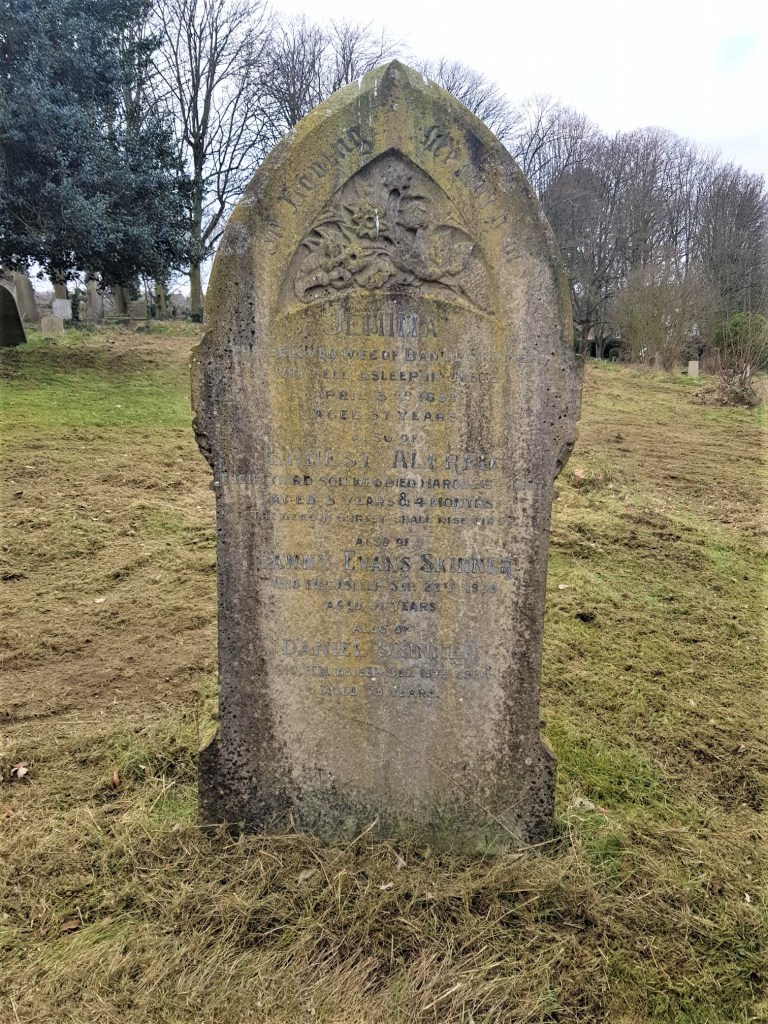
Jemima is buried in Radnor Street Cemetery, grave plot C477. Fanny died in 1928 and Daniel in 1934 and both were buried with Jemima. Daniel and Jemima’s third son, Ernest Alfred, is remembered on the headstone. He died in 1897 aged 3 years and four months and is buried in a neighbouring grave.

John and Alice Hayes

This story was submitted by their great-granddaughter.


‘John Henry Hayes was born 2 Nov 1872 to parents William (ox carter) and Mary of 27 The Street, Broad Hinton. He was the 7th of 8 children, having 3 brothers and 4 sisters.

Living in a rural community he initially trained as a blacksmith before entering the Great Western Railway as a springsmith. (1911 census gives his occupation as Blacksmith Striker GW Railway).

Circa 1898 John Henry, aka Jack, married Alice Maude Mary (nee Pyke born 1879 Wroughton).

They moved to 50 Summers St. Swindon and he became a churchwarden at the Rodbourne Road Methodist Chapel.  My father remembers having to play quietly on Sundays whilst his stern granny read her bible. He also remembers she didn’t cook on a Sunday so there were only ‘cold cuts’ for lunch.

I understand he taught other railway employees in his front room. I don’t know whether this was religious studies or reading/writing.

Their family expanded and by the 1911 census they had 3 living and 2 deceased children. To my knowledge there were a further 2 girls and a boy, 6 in all surviving to adulthood.

My grandfather, imaginatively named Thistle Ewart aka Tom, was his second child. He, together with his only child my father Barrie John, and myself all in our turn ‘went inside’ GWR/BREL.  We have a 4 generation plaque on the wall at Steam.

John Henry lost his wife in 1939 and passed away 11 Feb 1951.  He was buried at Radnor Street Cemetery Swindon, plot C4160′

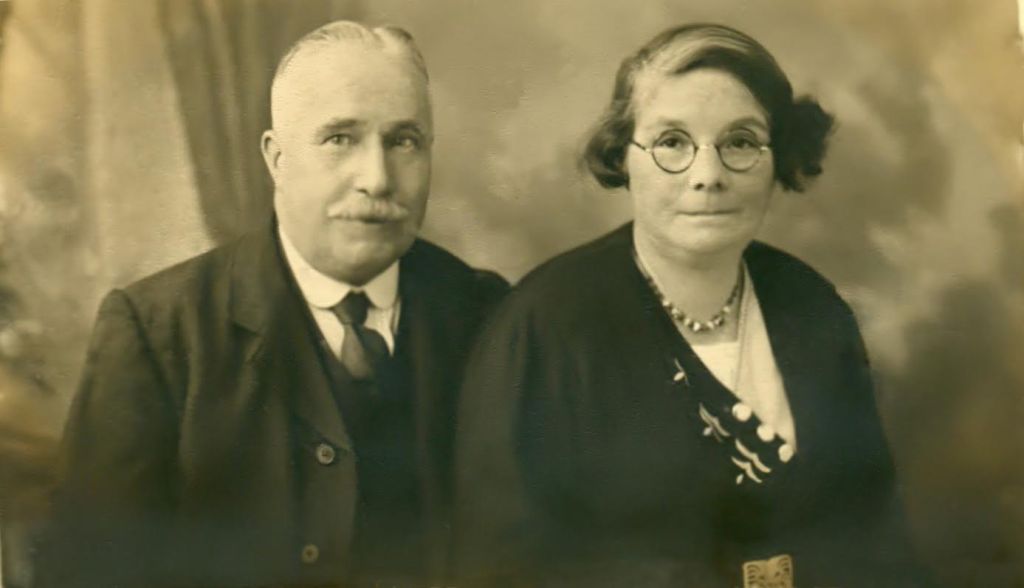
The attached photo is of John Henry and Alice taken in approx. 1934.

*The couple share their grave with Alice’s mother Jane who died in November 1926. Her last address was given as 50 Summers Street.