The re-imagined story …
When the Rolling Mills opened in the 1860s the large contingent of incoming workers from Wales were housed in a building better known as the Barracks. The story goes that the Welsh women couldn’t get along together and that they used to fight and argue, but my Nana didn’t hold with that.

The former GWR lodging house, known as the Barracks, later became a Wesleyan Chapel image published courtesy of Local Studies, Swindon Central Library.
“We had to live in dreadful conditions; if it hadn’t been for the other women, I don’t know how I would have survived. Two years we were there. It felt more like ten.
“We couldn’t keep the place clean, the water closets were permanently blocked and we had nowhere to put our rubbish or the ashes from the fire. There was always someone sick. It was all down to the water see, ‘unfit for drinking purposes,’ the public health inspector said. Two days a week we had water, Wednesday and Saturdays, and then it came from the canal.
Five hundred people there were crammed into that building. I had small children, why we all did, I don’t know how they all survived, many didn’t, I know. My sister Gwen gave birth in that place. I don’t know how they expected people to live like that.
The company cottages were bad enough, but that building. In the early days the men used to call it the Barracks. I don’t know about barracks, more like a prison it was.
When they started building the cottages at Cambria Place I used to go along every day. I used to will that little house along. I loved every square inch of that place. Mind after two years in that hell hole it was like living in heaven.”

Cambria Place
The facts …
“I consider this building in its present state quite unfit for human habitation and dangerous to the health of the district,” Inspector Henry Haynes wrote to the monthly meeting of the New Swindon Local Board held on 2nd August 1866. What had once been intended as a model lodging house for the single men in the railway village was an unmitigated disaster.
Designed to accommodate young men in single rooms with a variety of communal facilities the lodging house, complete with Gothic turrets, was built to ease overcrowding in the GWR company houses. Unpopular from the outset, the building soon became known as the Barracks. Constrained by GWR rules and regulations the young men moved out, preferring to lodge in the cramped conditions of the railway village cottages instead.
The building stood empty until the construction of the new Rolling Mills in 1861 saw an influx of migrant Welsh workers and their wives and children. The GWR Company responded by converting the Barracks into supposedly family friendly accommodation.
This is the final resting place of John Jones, who as can be seen from the inscription on the headstone, was foreman of the Rolling Mills. John was born in Tredegar, Monmouthshire on March 13, 1815.
In 1851 John was living at Thomas Road, Llanelly with his wife Sarah, and their children. Edwin 14, (already working as a forgeman), Elizabeth 13, Isabella 11, Ephraim 9, Emma 7, Enos 5 and Elijah S. who was 5 months old.
John was a highly experienced worker by the time he entered the GWR service here in Swindon on May 25, 1861. As a Foreman Roller he was paid 7 shillings a day (that’s 35p) although worth considerably more 155 years ago.
The Rolling Mills opened in the 1860s and saw the arrival of a large Welsh community in Swindon. In 1869 the manager Mr Ellis told the Advertiser there were about 310 men employed in the Rolling Mills, divided into a day and a night shift working alternate weeks.
The arrival of so many families placed huge pressure on the available accommodation in New Swindon. The first Welsh families in the Barracks lived in appalling, insanitary conditions, and work soon began on Cambria Place and it was here at No 22 that we find John and his family living in 1871.
John died in December 1887 and is buried in Plot E8296 in Radnor Street Cemetery with his granddaughter Evelyn Alder who died in 1917 aged 32 and his daughter in law Harriett Ann Jones (Evelyn’s mother) who was the wife of Elijah Stockham Jones, John’s youngest son.
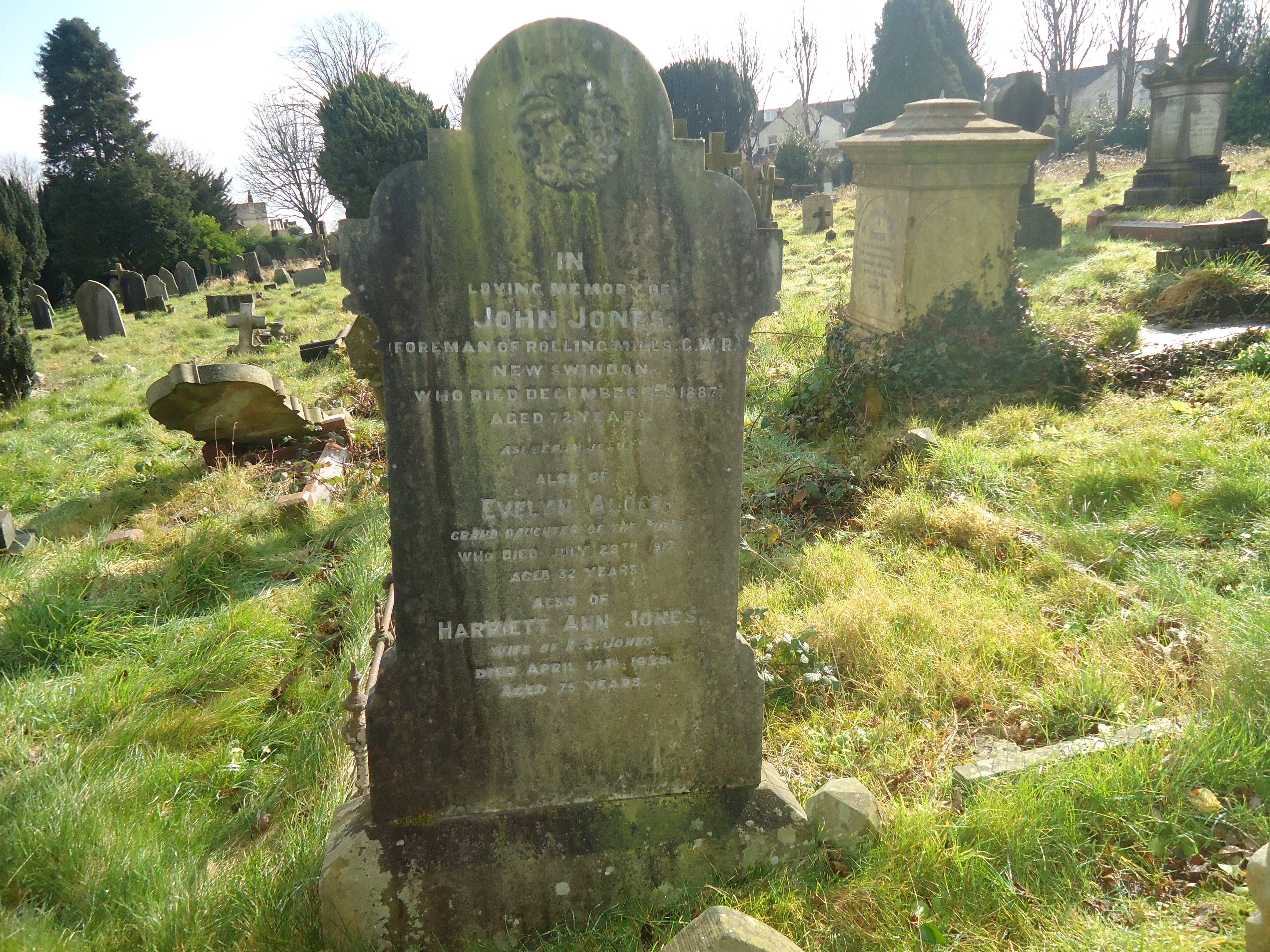

 Radnor Street Cemetery