In 2005 Radnor Street Cemetery was designated a Nature Reserve. A team of Rangers worked to promote the benefits to Swindon residents of having a green oasis on their doorstep. With an earlier band of volunteers they worked on a Garden of Remembrance close to the Radnor Street entrance. They plotted an area in which to grow meadow flowers. They organised events, installed bat and bird boxes and led guided walks. Then came the financial crisis of 2007-8 and subsequent cuts in council budgets and soon Swindon was relying on the work of volunteer rangers, and Radnor Street Cemetery became a casualty of those cuts.
For me, Radnor Street Cemetery is all about the people and the history of Swindon but Spring is most definitely in the air and every good cemetery guidebook (or website) has a section on flora and fauna. As a townie and non-gardener I’m probably not the best person to write this and there are many in our little band of volunteers who would make a much better job of it, but it will be selective, brief and beautifully researched. Please feel free to add your own more knowledgeable comments.
I’ll begin with the snowdrop – everyone knows the humble little Galanthus Nivalis that flowers in late winter and heralds the coming of spring. The snowdrop has inspired stories and poetry, music by Johann Straus II and Tchaikovsky and was a nickname for the US Military Police stationed in the UK during WWII.
The daffodil belongs to the Narcissus genus and is recognisable to even a horticultural ignoramus such as myself. The daffodil has migrated from North Africa and Southern Europe and was adopted by the Welsh as their national flower, although when and why seems largely unknown. The leek has a much older association with Wales, but to the best of my knowledge, we don’t have any in the Cemetery.
The Common Primrose, Primula Vulgaris, is to be found by streams, in orchards and woodland and grows in profusion in Radnor Street Cemetery. Edible, drinkable (primrose wine and tea) and the roots are considered to have an analgesic property – but don’t take my word for it. Apparently the primrose was Benjamin Disraeli’s favourite flower (Conservative Prime Minister in 1868 and 1874 to 1880).
And what about the Muscari Grape Hyacinth (are you impressed – I had to look it up?) The Wikipedia description is of a plant that produces “spikes of dense, most commonly blue, urn shaped flowers” so very appropriate for a cemetery. The Grape Hyacinth is one of the earliest garden flowers to bloom in the spring.
So that is probably the sum total of my flora and fauna knowledge. Is it too early for bluebells – probably? I’ll let you know when I see them. What else should I be looking out for? What are the names of the trees and shrubs – come on cemetery followers, help me out here.
But I do have some pretty photographs for you.


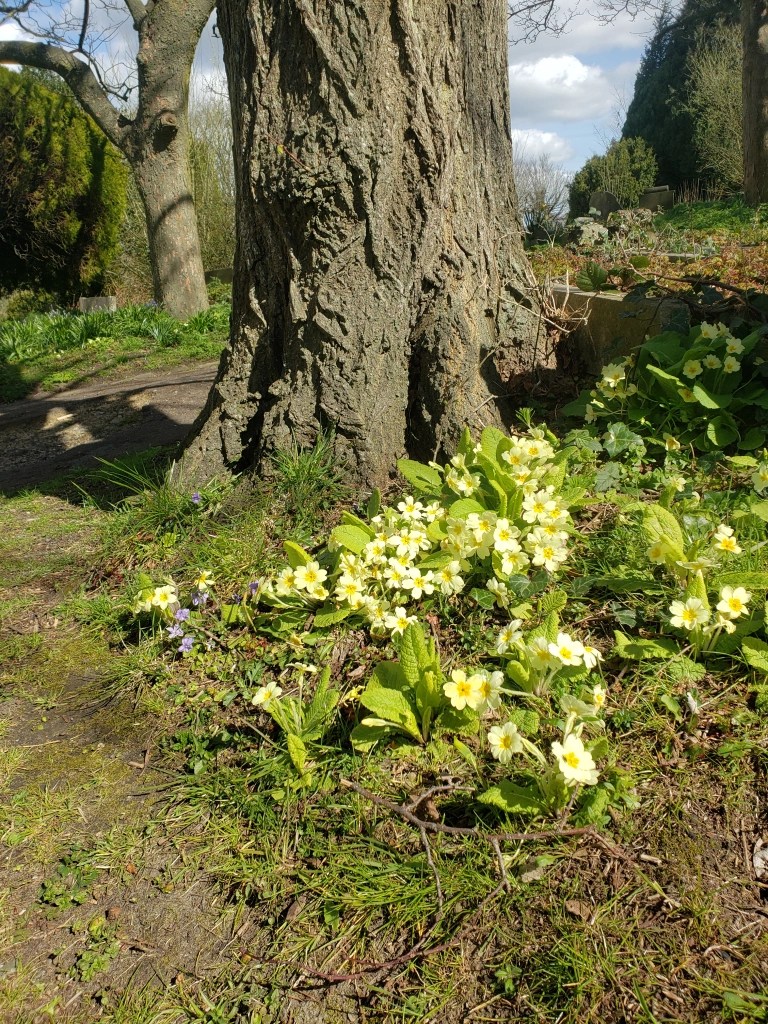


 Radnor Street Cemetery
Your pictures are lovely, thank you.
LikeLike
I love flowers especially daffodils and tulips
LikeLike