Joanna C. Lay – silent, quiet and faithful worker

Today we celebrate International Women’s Day with the story of Joanna C. Lay.

It’s difficult to imagine a farm located in what is now Corporation Street, Swindon but this is where Joanna Cuss Smith and her seven siblings grew up.

When Joanna was born in 1851 her father worked as a master butcher with a shop in Wood Street but by 1861 he also farmed 110 acres at Lower Eastcott Farm, employing three men and two boys.

Joanna married jeweller Edwin John Lay in the summer of 1884. The couple had three sons and lived at 17 Bath Road, an elegant establishment opposite Apsley House.

Sometimes there is not much I can add to a sympathetic obituary published in the local media – so let me hand you over to the Swindon Advertiser.

Death of Mrs E.J. Lay

Well Known Swindon Lady

We regret to have to announce the death of Mrs Joanna Lay, wife of Mr Edwin J. Lay, watchmaker and jeweller of 17, Bath Road, Swindon. The deceased lady was a member of a very old Swindon family, being the eldest daughter of the late Mr Edward Smith, butcher and farmer, who carried on business in the town for many years at High Street and Eastcott Farm.

Mrs Lay possessed a great personal charm, a kindly nature, and thoughtful disposition, which she had always exhibited from her girlhood upwards. She was 62 years of age, and had been ailing a few weeks, but not seriously ill. Then she had an attack of bronchitis.

On Friday her condition was better, but on Saturday she had a relapse, and passed peacefully away.

The deceased lady leaves a sorrowing husband and a family of three sons – two of whom are in South Africa – to mourn the loss of a loving and devoted wife and mother.

Funeral at Swindon

Attended by a large number of sympathising friends, the funeral of the late Mrs Edwin Lay, of Bath Road, took place at Swindon on Wednesday afternoon.

Enveloped in a profusion of beautiful floral tributes, the coffin was conveyed from the deceased’s residence to the Baptist Church on a hand-bier. The deceased lady was a prominent member of the Tabernacle, being for 27 years the Secretary of the Sewing Circle (with Mrs W. Clappen as President), and the respect and esteem in which she was held by the members of the congregation was strikingly testified to by the large number of people who attended the funeral service. Conducted by the Pastor (Rev. J. Ivor Cripps) and the Rev. F.C. Shellard, the service was of an impressive character. The hymns, “Come let us join our friends above,” and “Calm on the bosom of thy God,” were sung, and in the course of the service the Pastor paid a touching tribute to the memory of the deceased. They looked upon something that day, he said, as something incredible, something which they found difficult to believe was true, for less than a fortnight ago Mrs Lay gave, at the annual Church social, a report on behalf of the Sewing Circle, and only last Sunday week was present at the Sacrament. He left to others who knew her more intimately the honour of praising her, but he knew her enough to say that she was one of the silent, quiet and faithful workers on whom the substance of Church life relies and depends. What she did she did faithfully and well, and those who were acquainted with her work could say that hers was indeed a place of honour in the Church.

The interment subsequently took place at the Cemetery, where the last sacred rites were performed by the Rev. J. Ivor Cripps.

Extracts from the Swindon Advertiser, Friday, March 14, 1913.

Joanna Cuss Lay 62 years of 17 Bath Road buried 12 March 1913 in grave plot E7310. Joanna is buried with her husband E.J. Lay.
You might also like to read:

Elsie Wootten White – wartime volunteer

Harriett Annie Veness – political activist
Edith Whitworth – Mrs Great Heart

Celia Morkot – the first woman employed in the Works

Arthur Longman – a victim in the dark

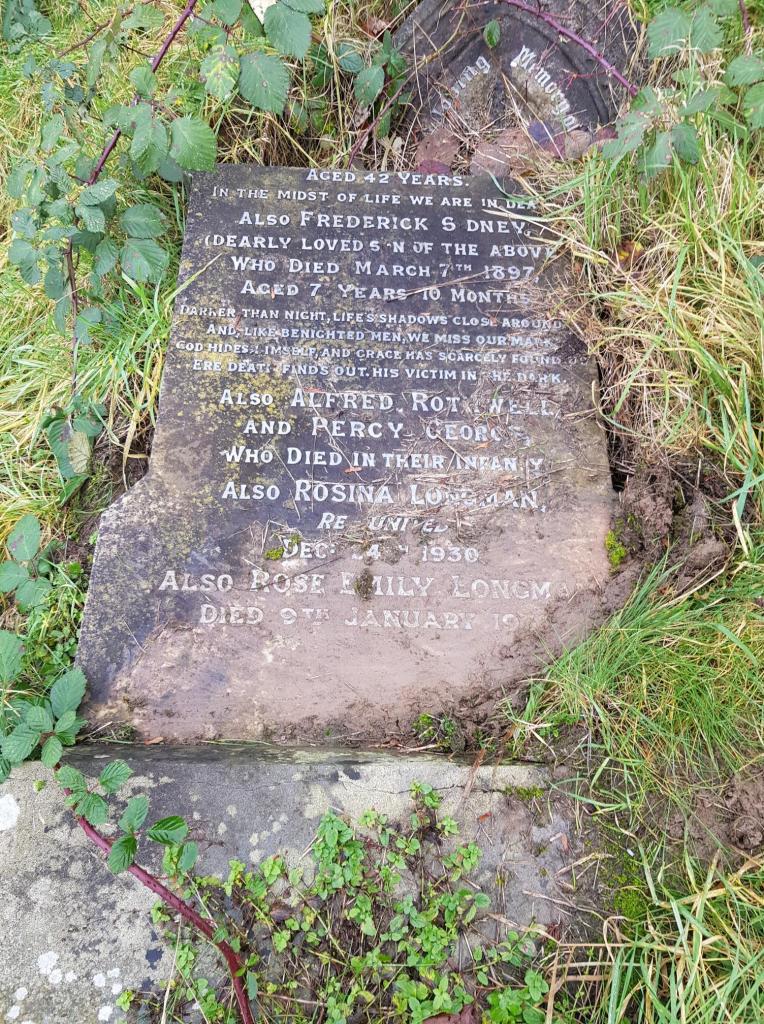
A fallen headstone, a neglected grave and a tragic story.

Arthur Longman’s family recognised the reoccurrence of his depression and anxiety. Arthur himself was obviously frightened and at the inquest it was revealed he had asked for help:

‘Deceased at one time expressed a wish to go to an asylum to be taken care of, but Dr Maclean considered that there was no necessity for him going there.’

Could there ever have been more damaging medical advice?

Arthur was born in 1850 in the village of Penselwood, Somerset, the son of Isaiah and Jane Longman. He married Rosina Flood in the March quarter of 1875.

At the time of the 1881 census Rosina was single handily running the family’s drapery business in Faringdon Street and caring for her five year old son. The census enumerator has written on the census form – Husband in Asylum. Arthur is recorded on that census as a patient in the Wilts County Lunatic Asylum, Devizes.

In 1891, the year before his death, Arthur states his occupation as Draper and Auctioneer. Rosina works as Draper & Milliner & Dress [maker]. Their eldest son Arthur 15, works as a draper & clothier’s assistant. There are a further four children, Charles 9, Rosina 7, Emme 3 and one year old Frederick. The couple have a heavy workload. But despite the family’s concerns little was done to help Arthur.

Sad Death of a Swindon Tradesman – On Monday morning Mr Arthur Longman, draper, of Faringdon street, New Swindon, committed suicide in his own house under painful circumstances. It is supposed that he rose about 4 a.m. according to his custom, and at 6.30 a.m., on his wife going downstairs she was horrified to find the body of her husband. Dr. Howse was at once summoned, but found life extinct. – An inquest was held at the Cricketer’s Arms, New Swindon, on Tuesday morning, by Mr. Coroner Browne and a jury, of whom Mr A. Adams was foreman, and the following evidence taken:-

Sidney Longman, a guard on the Midland and South Western Junction Railway, said deceased, who was 42 years of age, was his brother, and had been in business in Swindon about 20 years. He was sent to Devizes asylum about ten years ago owing to an attack of suicidal mania, being there about six months, when he came out practically cured. Deceased worried a great deal lately about a business which he had put his father-in-law into. He also worried a great deal about his new business at Gorse Hill, but witness thought there was no necessity for it. When he saw deceased last he told him that he had had a letter from his father asking him if he was any better in health, and told witness he wished he could say that he was.

Arthur Longman, deceased’s son, said he assisted his father in managing the business. He had noticed a change in his habits lately and he seemed depressed in spirits. Witness went out with him as usual on Sunday, and deceased went to church in the evening. It was nothing unusual for deceased to get up in the morning before any one else. On Monday morning witness got up about 6.30 and found deceased lying across the table in the kitchen. The room was not deranged in any way with the exception that the lamp on the table was knocked over. Deceased at one time expressed a wish to go to an asylum to be taken care of, but Dr Maclean considered that there was no necessity for him going there.- Dr Howse said he was called to deceased about 7 o’clock on Monday morning. He was quite dead, death being the result of haemorrhage caused by the wound in the throat.- The jury returned a verdict of “Suicide whilst of unsound mind,” and gave their fees to the Swindon Victoria Hospital.

Extracts from the Swindon Advertiser, Saturday November 5, 1892.

What happened to the family in the aftermath of Arthur’s violent death? Well, Rosina stayed in Faringdon Street and carried on with the business with the help of her son Arthur. She died on December 24, 1930 at 32 Faringdon Street and was buried with her husband and their young son Frederick Sidney who died in 1897 aged 7 years 10 months in grave plot A783 . The last person buried in this large plot was daughter Rose Emily Longman who died in 1953. Two young sons who died in infancy are also remembered on the headstone.

The inscription includes a verse from the hymn Hark! Hark, My Soul by Frederick W. Faber.

Darker than night, life’s shadows close around us

And, like benighted men, we miss our mark

God hides Himself, and grace has scarcely found us

Ere death finds out, his victim in the dark.

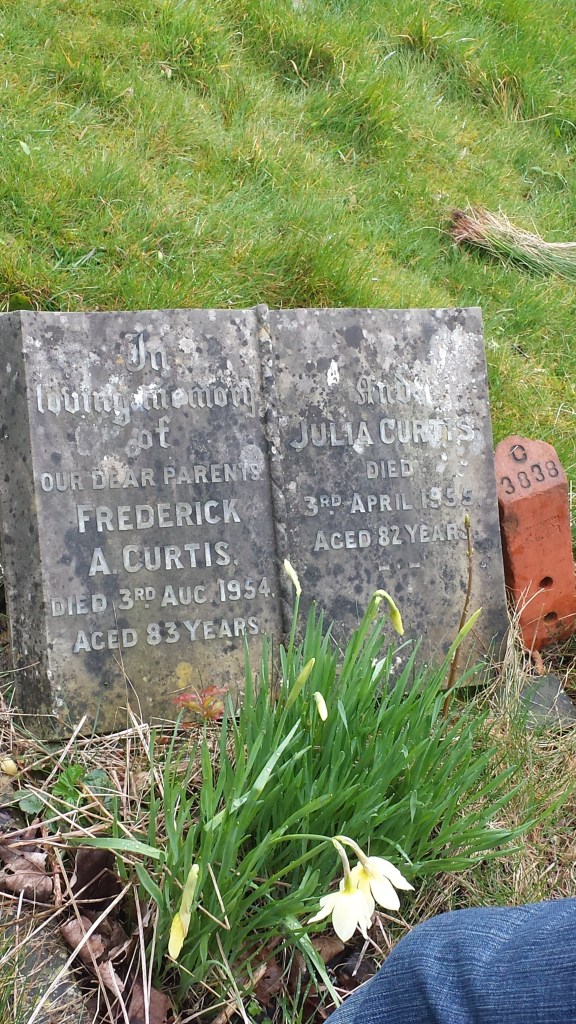
Frederick and Julia Curtis

I am always thrilled to discover information from relatives about those buried in Radnor Street Cemetery. I recently received these details and photographs from Michelle who writes:

‘Please see attached images for Frederick Arthur Curtis and Julia Curtis who are buried in Radnor Street cemetery.

Fred and Julia came from Bristol and moved to Swindon between 1894 and 1896. In the 1901 census they are recorded as living at 31 Clifton Street and in 1911 at 163 Westcott Place and stayed there until they passed away. Their daughter Alice then lived there. Frederick was a shoemaker/boot repairer.

They had a 8 children of whom 3 died and we presume they would be in Radnor Street somewhere.

I hope the above and attached is of interest. If you have any information on whether Elsie Curtis who died aged 7 in 1906, Thomas Edward Curtis who died aged 14 in 1920 (we believe in some sort of vehicle accident and perhaps with a tram) or Frank Albert Curtis who died aged 8 in 1922 are buried in the cemetery we’d love to find them.

This is my husbands family and he grew up living next door to his grandmother at 164 Westcott Place. We now live on Kingshill Road and often take a walk around the cemetery and visit his great grandparents.’

Frederick was born in 1871, the son of William Curtis, also a boot maker, and his wife Ann. At the time of the 1891 census the family lived at 8 Bedford Place, Bristol. He married Julia Watts (dates seem to vary between various Curtis family historians) and by 1901 they had moved to Swindon.

I was able to tell Michelle that Frank is buried with his parents. Sadly, the other two children are in public graves, buried with (probably) unrelated people and with no headstone, but she was happy to receive the details and will now visit these graves as well.

Charles Robert Thompson – a carpenter’s suicide

Below you will read the awful story of Charles Robert Thompson. A story of a broken marriage, a runaway wife and a tragic suicide. It makes for dreadful reading. And in the middle of all this are two girls – the couple’s twelve year old daughter, Mabel Annie Thompson and a young servant girl, Beatrice Ferris.

Mabel was called as a witness at the inquest where she gave evidence about the events that had led up to her mother’s departure and her father’s state of mind and Beatrice told how she found the body of her employer.

It is impossible to imagine how these two girls were affected by the events of that terrible time and whether they ever truly recovered. There would have been no talking therapies available to them then nor probably any other form of help.

Mabel was born in Cirencester on January 11, 1891. In 1901 the family were living at 1 Stafford Street, although Charles’ name does not appear on the census as living with Emily and their three children. Was the marriage already in crisis?

In 1915 Mabel married George Woodward, a butcher with a shop at 107 Cricklade Road, Gorse Hill. At the time of her marriage she was living at Swindon House, The Square, Old Town. In 1939 Mabel was living at 220 Ferndale Road with her husband, three children and her father-in-law. She died in the June quarter of 1972, aged 81. She is not buried in Radnor Street cemetery.

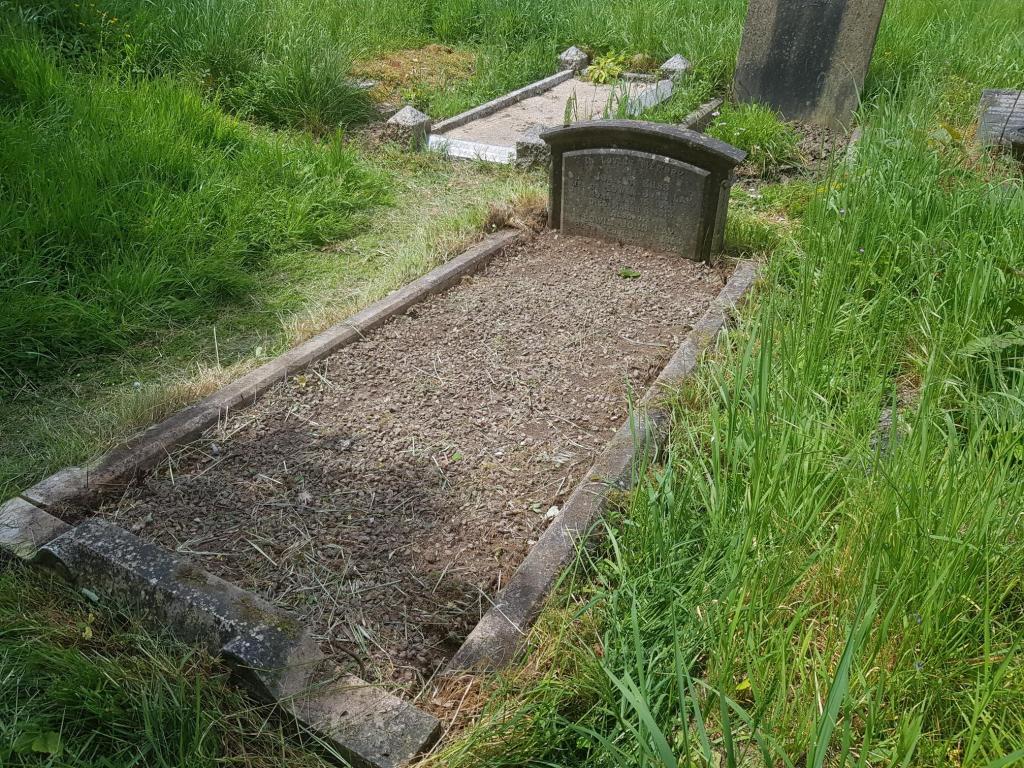
A summer view across the cemetery

A Carpenter’s Suicide

Deserted by his Wife

A Pathetic Story

A further inquest was conducted by Mr W.E. Nicolson Browne at the Ship Hotel, Swindon this afternoon, touching the death of Charles Robert Thompson, carpenter in the employ of the GWR Co., residing at No. 12 Cambria Place, Swindon, who was found with his throat cut on Saturday morning.

Mabel Thompson, aged 12, daughter of the deceased, who gave her evidence admirably, said her father was 39. Her mother went away nine weeks ago with a Joe Barratt, and nothing had been heard of her. Joe Barratt was a lodger at deceased’s house, and was employed in the factory.

The Coroner: Was your father cut up about your mother going away?

Witness: Yes, sir. He mentioned it every day, and went to Cirencester and Glo’ster to try and find her.

Witness further said that Barratt was introduced as a lodger by her mother. One night her father had repeatedly to ask her mother and Joe Barratt to go to bed. They said they would go when they thought they would. A bill had recently arrived for her father who said on receiving it, he could not face it.

Beatrice Ferris, servant at deceased’s house, said she had been with deceased for six weeks. He had not in her presence or to her knowledge stated or hinted that he intended to take his life. He never drank to any extent. On Friday she bought him some brandy.

He frequently exclaimed, “Oh my poor head.” On Thursday he expressed a wish to be let alone when she went to rouse him she could not wake him. A bottle (produced) was found near him by his daughter Mabel. He woke eventually and went to bed. There was no disturbance during the night. On Saturday morning she saw a light in the w.c. She called to ask who was there, and receiving no reply, she pushed the door open and found Mr Thompson dead, with his throat cut. There was a chair there.

Hubert Knew, said he was living in deceased’s house at the time of the death. On Saturday morning he got up before six o’clock. He heard Mr Thompson shout from his room. “Who’s about?” He (witness) replied: “It’s only me,” and Mr Thompson said. “All right.” Deceased had appeared very much depressed lately. He knew that deceased and his wife had had a few words at times. Mrs Thompson had been away nine weeks.

Dr H. Brown, assistant to Dr Swinhoe, said he was called at 7.30 on Saturday morning to the deceased. He found the man dead with his throat cut, and a razor beside him. Death was due to haemorrhage, arising from the wound in the throat.

At this point a letter, which the deceased had left was handed to the Coroner. On the envelope was written: “My purse is on the shelf with all I have.” On looking at the letter enclosed in the envelope the Coroner said that there was no doubt the man had himself cut his throat, and he did not think it necessary that the letter should be read.

The jury returned a verdict of suicide during temporary insanity.

Swindon Advertiser Monday November 23, 1903

Charles Robert Thompson was buried on November 27, 1903 in grave plot C1395. He is buried with his wife Emily who died just three years later in November 1906. Also in the same grave are William S. Stone who died in 1929 and Charlotte Rose Wearing who died in 1933.

Henry Chatten – verdict ’caused his own death’

The jury delivered a verdict of ‘Accidental death’ while the Coroner added that Chatten had evidently been too zealous in attempting to unload the wagon himself, and thus caused his own death. Behind this tragic story is a further one of sorrow and loss.

Fatal Accident in the GWR Works, Swindon

A Labourer Killed

Inquest and Verdict

A fatal accident occurred on Tuesday morning last to a man named Henry Chatten, widower, aged 36 years and recently employed in the GWR Works. Deceased was killed by the falling of a log of wood, weight 16 cwt from a truck on which it was stacked. The log in its fall dashed Chatten against the sleepers of the line, breaking both his legs and killing him on the spot.

The Inquest was held on Thursday morning, in the Lecture Hall of the Mechanics’ Institute, New Swindon, before Mr W.E.N. Browne, County Coroner, and a jury of whom Mr Thomas Pearse was chosen foreman. The following evidence was taken:-

George Keen said deceased lodged with him at Dean-street, New Swindon. He was a sober, steady man and appeared in the best of health when he went to work at six o’clock on Tuesday morning. Witness heard no more of him until he was informed that he was dead.

William Mason, steam crane driver, then, stated that he was on duty on Tuesday morning, and whilst passing the truck of timber in question, he saw deceased laid down by the truck. He stopped his engine and cried out to some men of the staff, but when they reached Chatten he was dead. In answer to the Coroner, witness said he did not see the timber fall. He was about forty yards away when he first saw the deceased. There was no indication as to how the timber fell off the truck.

William Yeo, foreman of the timber gang, said there were 17 men working under him, and on Tuesday morning they were unloading the timber trucks. Deceased’s duty was to sweep up the yard and clear away the ropes, etc. He had no need to touch the trucks at all. In his opinion deceased had loosened the ropes of the truck and thus let the timber fall on him. The weight of the log was 16 cwt. Cross examined by the Inspector: The timber would not fall off the truck without a little jerk.

Dr. Grant, assistant to Dr. Swinhoe and Howse, stated that he was called about half-past seven o’clock on Tuesday morning. He saw deceased lying upon his back, and evidently a log had fallen from the truck and dashed the man against the sleepers, breaking both legs and fracturing the skull. He was quite dead. This was about twelve minutes after the accident, and death must have been instantaneous. A verdict of “Accidental death,” was returned by the jury, the coroner remarking that Chatten had evidently been too zealous in attempting to unload the wagon himself, and thus caused his own death.

Mr T.O. Hogarth watched the case on behalf of the GWR Company, whilst Mr. J.S. Maitland, of Bristol, Inspector of Factories and Workshops, was also in attendance.

Swindon Advertiser, Saturday, June 12, 1897.

Henry Chatten was born in Norwich, Norfolk in 1862, the son of John and Rachel Chatten.

By 1891 he had moved to Swindon and was working as a labourer in the GWR Works. At that time he was boarding with George Keen (the witness at the inquest) in Iffley Road.

The intervening years between 1891 and his death in 1897 are difficult to navigate.* There is a marriage of a Henry Chatten to Elizabeth Siney at St Stephen’s Church, Norwich in 1894 but this Henry Chatten describes himself as a greengrocer living at 73 King Street, Crooks Place, Norwich.

The details given at the inquest indicate that Henry was a widower and I have discovered the death of Elizabeth Chatten during the March quarter of 1897 – was this Henry’s wife? She does not appear to have been buried in Radnor Street Cemetery.

Henry was buried on June 12, 1897 in grave plot C853. He is buried in a public grave with four others. His address at the time of his death was 37 Dean Street.

And then another entry in the registers caught my eye. John E. Chatton, a 7 week old baby, was buried in plot C721 on February 20, 1897. The baby’s address was 37 Dean Street.

It would seem, therefore, that Henry lost both his wife and baby within a period of three months.

*spelling of name in transcriptions vary from Chatten to Chatton and Challen

Frank Chandler – draper and outfitter

The Chandler family was a large one and for many years the business of Chandler Brothers dominated the corner of Wood Street and Devizes Road.

Frank was born in 1860, one of John and Susannah Chandler’s large family and was running the business alongside his widowed father at the time of the 1881 census. He married farmer’s daughter Ada Keziah Edmonds at St Paul’s Church on June 10, 1890. He was 30 years of age and she was 23.

The couple’s first home was above the shop in Wood Street where a staff of eight boarded with them including three draper’s assistants, 2 dressmakers and a milliner.

Their only child, a daughter Ada, was baptised on April 21, 1891, at the church where the couple had married but sadly she died around the time of her first birthday.

At the time of the 1901 census Frank and Ada lived at South View, a house on the Sands in Old Swindon, just a short walk from the family business.

Death of Mr Frank Chandler

We regret to announce the death, which has taken place under painfully sudden circumstances, of Mr Frank Chandler, of South View, The Sands, Swindon, and a member of the firm of Messrs Chandler Bros., drapers and outfitters, 35, Wood Street, and Devizes Road.

The deceased gentleman, who was 46 years of age, and who leaves a wife, but no children, was recovering from a long attack of acute rheumatism. He went to Bournemouth, where he caught a chill, and he was compelled to return home. Unhappily, the chill was followed by complications which necessitated an operation being performed. Accordingly, on Saturday afternoon his medical attendant, Dr J. Campbell Maclean, accompanied him to London, where, at a surgical home, he was attended to. The operation took place on Saturday evening, but Mr Chandler, without recovering consciousness from the anaesthetic, died suddenly from syncope.

Mrs Chandler, who also accompanied her husband to London, and whose own health is by no means satisfactory, returned to Swindon soon after Mr Chandler’s demise.

Mr John Chandler proceeded to London very soon after hearing of his brother’s death.

The painful news was announced to a large congregation yesterday morning by Canon Estcourt before the sermon at the Parish Church, of which the deceased gentleman was a member, and the intelligence came as a severe shock to the many by whom Mr Chandler was intimately known.

The body will be brought to Swindon for interment.

By the death of Mr Frank Chandler, the town has lost an inhabitant who was held in the highest esteem. He was the youngest son of the late Mr John Chandler, and his long connection with the well known business in Wood Street brought him into contact with very many people. His gentlemanly and courteous bearing, his kindly disposition won for him a large circle of devoted friends to whom his sudden loss will occasion keen sorrow. What lends a further degree of painfulness to the event is the fact that, as stated by Canon Estcourt, the deceased gentleman was about to take over control of the whole of the important Wood Street business. Mr Frank Chandler never took any active part in the town’s affairs, though as a sterling business man he was warmly respected by all with whom he came into business contact.

At Swindon Parish Church on Sunday morning, the Vicar, Canon Estcourt, before commencing his sermon, referred to the sad death of Mr. Chandler. He said: As I was on my way to Church this morning I heard the distressing news of the death of Mr Frank Chandler, which took place after an operation which he underwent in London. He was, as you know, just about to take over the management of one of the large business establishments in the town. But God has seen fit to order things otherwise for him. I am sure today our sympathy and our prayers will go forth to his many relations, and to his wife especially.

The Evening Swindon Advertiser, Monday, November 19, 1906.

The Late Mr Frank Chandler

The Funeral

Amid every manifestation of deep sympathy and regret the funeral took place on Wednesday of the late Mr Frank Chandler, of the well known firm of Chandler Bros., Wood Street, Swindon whose sad death in London we announced last Monday.

The body was conveyed from Paddington by the train leaving there at 11.40, and arrived at Swindon GWR Station at 1.20 p.m. Thence it was removed to the Parish Church, where the first part of the funeral service was conducted by the Vicar (Canon E.W. Estcourt), who also officiated at the graveside.

The cortege, headed by a carriage laden with floral tributes, left the Church at 2.30, and proceeded to the Cemetery via Cricklade Street, Wood Street, Bath Road, Lansdown Road, and Kent Road.

Extract from the funeral report published in the Evening Swindon Advertiser Thursday, November 22, 1906.

The funeral took place on November 21, 1906 when Frank was buried in Radnor Street Cemetery in grave plot E8327. He is buried alone.

Stoker Tom Pictor

Tom Pictor was the eldest of John and Emma Pictor’s seven children. He was baptised at St. Mark’s Church on September 1, 1878 and grew up in the Westcott Place/Rushey Platt area where his father worked variously as a timber yard labourer, a railway labourer and a railway watchman.

Tom joined the navy on January 1, 1895 for a period of 12 years. By 1901 22 year old Tom was working as a steamship stoker. His naval records state that his date of birth was July 26, 1876, although his baptismal records and the census returns suggest he might have been two years younger than this. A physical description states Tom was 5ft 5½ ins tall with dark hair and a dark complexion, hazel eyes and tattooed rings on his fingers. In 1907 he joined the Royal Fleet Reserve from which he was discharged on January 8, 1912, declared medically unfit. However, he re-joined the RFR twelve months later.

Tom served on a number of ships including Vivid II, the Stokers and Engine Room Artificers School based at Devonport. The last ship on which Tom served was HMS Teutonic. Built for the White Star Line in Belfast in 1887 and launched in 1889, the Teutonic was one of the first armed merchant cruisers. The Teutonic served as an ocean liner travelling between Liverpool and New York City but reverted back to military use during times of war. During the Boer War, HMS Teutonic served as a troop transport ship and in 1914 it served as a convoy escort and troop transport ship. It was while the ship was berthed in Liverpool dock in December 1915 that Tom’s fatal accident occurred. His records indicate that during 1915 Tom served three periods of detention for being absent without leave.

Drowning Coincidence

Under somewhat similar circumstances two men employed on Government vessels whilst lying in the Canada Dock fell into the water on different dates and died from the effects of immersion. Inquests were held today.

In the first case the deceased man was Tom Pictor (44), a stoker, whose mother resides at Swindon. On Saturday night Pictor, when stepping from the gangway on to the ship slipped backwards and fell into the water and was drowned.

The second case was that concerning Thomas Henry Evans, aged 47, greaser in the Royal Navy, who belonged to Southampton. On the night of the 18th he was going on board his ship when he fell into the Canada Dock. He was rescued, and taken to hospital, where he died on Saturday from pneumonia.

“Death from drowning” was the verdict in each case.

The Liverpool Echo, Monday, December 6, 1915.

Tom Pictor was buried on December 9, 1915 in grave plot B1812, a public grave, which he shares with two others. The burial registers indicate he was 37 years old.