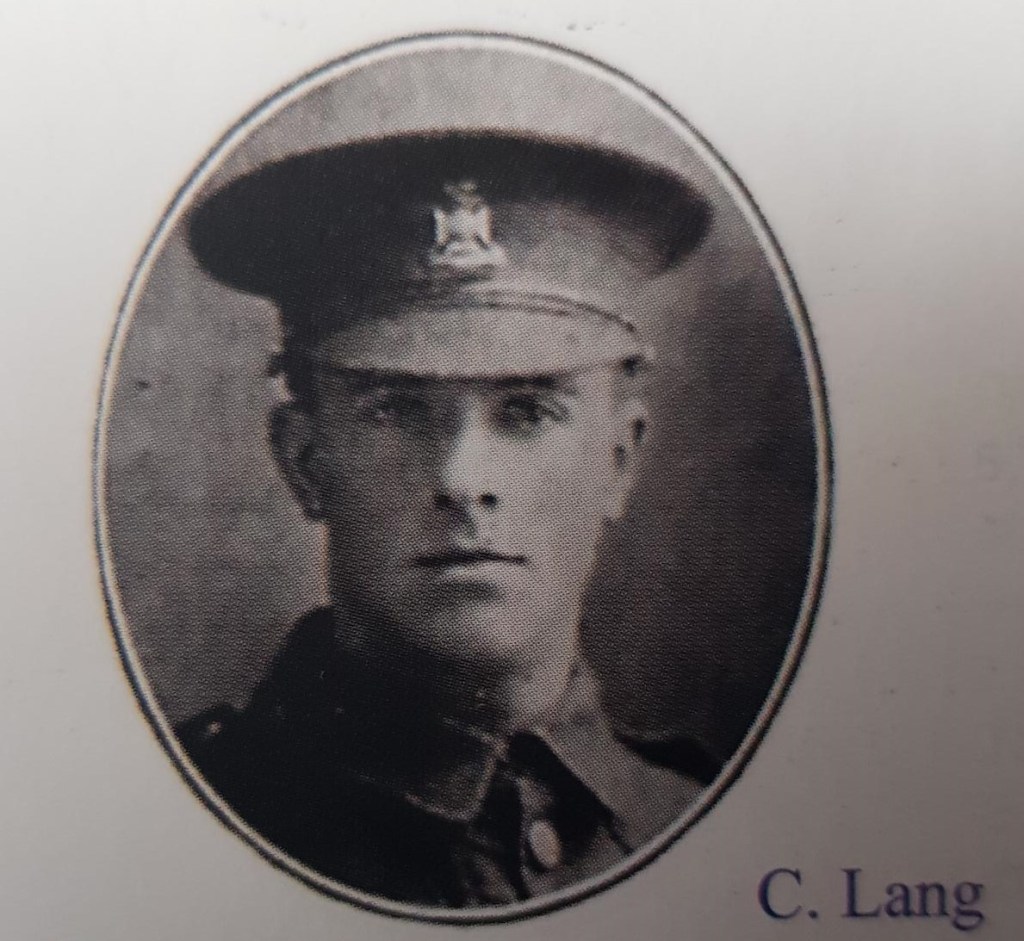
Cecil Arthur Lang and his family

February 1915 – Coach bodymaker Francis Richard Lang had two sons serving in the war and he was sick with worry. At work his foreman showed him a letter he had received from his son at the front; all was well with him. But this good news was of no consolation to Francis. The distraught father left for work as normal that final day but was not seen again until his body was found at Coate Water. He had taken his own life. A razor and empty case and a pocket knife were found in his clothes.

And so, Mercy, his wife, was left alone to worry about her boys until the inevitable happened.

Cecil Arthur Lang was born on March 19, 1882 and baptised at Holy Trinity Church, Dalston, East London, one of 11 children born to Francis Richard and Mercy Caroline Lang. By 1892 the family had moved to Swindon and in 1911 the census of that year states that along with their father, five sons worked in the railway factory. Eldest son, also named Francis Richard, was a Railway Coach Bodymaker, Leonard, Arthur and Walter were Carriage Fitters & Turners while Cecil, aged 21, was a Coach Bodymaker. The census reveals that of Francis and Mercy’s 11 children, 3 had already died. A heavy loss for parents and one that was going to increase.

Cecil Lang 26, was killed in action on June 16, 1915. He is remembered on the Menin Gate in Ypres. On his parents’ memorial in Radnor Street Cemetery, he is reported as ‘missing’. Some families could never accept that their loved ones had been killed, but continued to hope they might be found and eventually return home.

On our recent guided walk, cemetery volunteer Jon explained that in addition to the official Commonwealth War Graves, the volunteers also tend to family graves that include an inscription to a fallen serviceman. It may not be possible to restore this monument with its tall standing stone cross, but the volunteers will maintain the grave.

Mercy died on May 19, 1927 and is buried here with her husband in grave plot B3293.

We will remember them.

#TellThemofUs #MarkSutton

James Ferris – Zulu War Veteran

At our recent guided walk, cemetery volunteer and military historian Kevin told us about an amazing discovery made recently.

Kevin had answered a request on the website Fine a Grave to locate the grave of James Ferris in Radnor Street Cemetery and in so doing discovered the remarkable story of a Zulu war veteran.

Served in the Zulu Wars

Swindon Man Recalls a Lucky Escape

Comrades Killed

Hale and as hearty as any man 20 years his junior, James Ferris, who lives at 171 Westcott place, Swindon, is one of the few Swindon survivors of the Zulu wars. If anyone ever had cause to “thank his lucky stars” then surely that person must have been James Ferris. He took part in the Relief of Echowie and had the experience of seeing two men, fighting on either side of him, shot down with bullets through their hearts. Ferris, who served in the 2nd Wilts, then known as the 99th Foot, joined up in November, 1877, and never received a scratch throughout his service.

“We lived on hard biscuits and meat all the time we were out in Africa,” Mr. Ferris told a North Wilts Herald representative, “but soldiering is a fine life. If a man takes care of himself and knows how to behave himself, he will never regret wearing the King’s uniform. I would join up again tomorrow if they would have me.”

Joined Up At 20

Mr Ferris served in Africa from 1877 to 1881, and was then transferred to Bombay, where he remained for two years.

Born at Lyneham, Mr Ferris entered the Great Western Railway works on leaving school, and he was barely 20 years of age when he joined the Army. When he returned to England from foreign service he found employment as a tram driver at Portsmouth, and remained there for four years until the trams were taken over by the Corporation. He then came back to Swindon, where he again found work with the GWR Company. Mr Ferris has a wife and 11 children – five boys and six girls – living. Two of his sons are in Sidney, Australia.

James Ferris, who is in his 75th year, spends most of his time in his little back garden tending to his pets. “This is my dear old Trip,” he said, as a fine wire haired terrier came prancing up the garden path to meet us. “’Trip’ is the best dog in the world and woe betide any rat that dares to show itself when she’s about. She was born on Trip morning; that’s why I called her Trip.”

Never Broody

Mr Ferris also keeps a number of pigeons, a cat, half a dozen pure bred rabbits, and a black hen named Bett. Bett is a great bird. She follows her master about wherever he goes and responds to her name like a dog or a cat and she is a firm favourite with Trip. She is three years old, but she has never been known to go broody. Last year she laid 136 eggs, and up to the present she has produced 83 this year.

James Ferris still takes a keen interest in the sporting events of the town. Despite the wretched weather he attended the juvenile fete in the Park on Saturday, and he was at the Town Garden on Wednesday to listen to the band of his old regiment.

North Wilts Herald, Friday, August 14, 1931.

James and Eliza Ferris and one of their daughters

James Ferris was born in Lyneham in 1857 the son of James and Mary Ferris. In 1883 he married Eliza Jane Austin and the couple went on to have 11 children.

In 1891, following his military service and his marriage, James was working as a car driver and living with Eliza and their five children in Portsea, Hampshire. By 1901 he was back in Swindon, working as a labourer in the gas works and living at 23 John Street with Eliza, 10 children, a granddaughter and a lodger! In 1911 James was working as a Jobbing Gardener and living at 39 Union Street with Eliza and six of their children (and a boarder). Their 18 year old son William is described on the census of that year as ‘soldier on leave.’

James Ferris died in October 1935 aged 78 years. His funeral took place on October 25 when he was buried in grave plot C1347, an unmarked, public grave which he shares with two others.

Since Kevin’s discovery the grave has now been located and is kept cleared, the grass mown.

And there is a post script to James’s story and his indomitable wife Eliza.

A “Darby and Joan”

A Great-Grandmother Weds a Grandfather

A great-grandmother and a grandfather, one a widow and the other a widower, and both of them aged 72, were married yesterday at St. Mark’s Church, Swindon, after a courtship lasting for less than four months.

The bride was Mrs Eliza Ferris, of Westcott Place, Swindon. Her first husband, Mr James Ferris, was a Zulu war veteran, and there are thirteen children living, several of whom attended the wedding. The bridegroom was Mr Sidney Heath, of Tytherton, near Chippenham and some of his children were also present.

Belfast News-Letter, Thursday, September 30, 1937.

After their marriage Eliza and Sidney lived at 43 Rolleston Street. She died in 1949 but is not buried in Radnor Street Cemetery.

The Amazing Record Breaking Inspector William Greenaway

Continuing the story of the extraordinary William Greenaway …

William Greenaway

Yesterday I wrote about William Greenaway who received the Royal Victorian Medal, which he is seen wearing in this photograph.

Now read about his role in the record breaking train journey when the Prince and Princess of Wales traveled on ‘The City of Bath’ loco.

The Royal Visit

Prince and Princess of Wales in the West

A Record Run

His Royal Highness the Prince of Wales accompanied by his Royal Consort, arrived at Paddington yesterday morning to entrain for Cornwall, in order to attend the ceremony of dedicating the new Nave of Truro Cathedral.  Their Royal Highnesses were attended by Lady Lygon, Sir Arthur Bigge, the Hon. Derek Keppel, and Captain Godfrey Faussett. The train with the Royal party left Paddington precisely at 10.40 a.m. Instructions had been given to keep the line clear for a run to Plymouth without a stop – a distance of 246 miles 5 furlongs.

The Royal train was due, according to the arranged table, to pass Exeter at 2.5 p.m., and just before two o’clock several persons proceeded to St David’s Station with the object of catching a glimpse of the Royal Party. Many, however, arrived too late. The train had favourable weather, and made an unexpectedly rapid run, passing the middle signal box at St David’s at 1.33, exactly 32 minutes ahead of her time.

At Exeter.

About a hundred people had assembled on the station. Of course, there was no opportunity for demonstration, as the train passed through at the rate of about twenty miles an hour. Inspector Greenaway was noticed to be on the engine, which is one of the latest turned out from the Swindon works. She is one of the largest types, having 6ft. 8in. three coupled wheels, and is named “The City of Bath.” Around the funnel she bore the Prince of Wales feathers. Behind the engine was a saloon, then a composite carriage. Next came the Royal saloon carriage, followed by a compo and a brake coach.

The journey is a remarkable one, and establishes, we believe, the long distance record not only for the United Kingdom, but for the world. The train started from Paddington at 10.40 a.m. and reached Exeter, a distance of 194 miles, at 1.33 p.m.: that is to say, she covered the distance in 2 hrs. and 53 minutes or at an average speed of 67 miles an hour.

On the whole, the line is good between London and Taunton, there being a falling gradient for almost the whole distance. The tender of the engine carried about five tons of coal, and water was scooped up from the troughs near Goring and also near Bristol.

In the run to Chippenham the train made a gain of 16 minutes, and, despite the rising gradient from Taunton to Wellington, managed to increase this advantage on the arranged time to 32 minutes by the time Exeter was reached. She gained 21 minutes in the run from London to Bristol, and 15 minutes from Bristol to Exeter.

This, of course, constitutes a record run from London to Exeter, the previous best performance being by the London and South Western’s 11 o’clock express from Waterloo which does the journey in 3¼ hours, beating the Great Western’s first “Cornishman,” which has been put on occasionally to meet heavy traffic, and which is to run permanently from the 18th of this month, by fifteen minutes. The L. and S.W. route is, it must be remembered, shorter by about 25 miles.

The Royal train yesterday knocked off 37 minutes from the “Cornishman’s” time, and beat the L. and S. Western’s fastest express by 22 minutes. She overtook the 9 a.m. express, which, however, arrived at S David’s at 1.54, only four minutes late.

From Exeter to Newton.

Continuing her journey, the Royal train reached Newton Abbot from Exeter in 22 minutes, despite the fact that twice she had to slow down to take up the staff. From Newton Abbot to Plymouth the road becomes rough. The gradients are numerous and stiff, and form a kind of switchback railway. But the train continued to gain time, Plymouth being reached at 2.34. The journey therefore, of 246 miles 5 furlongs was covered in 3 hours and 54 minutes, or an average speed of a fraction over 62 miles an hour. When allowance is made for the fact that in climbing steep banks and in passing through big stations, and in taking in staffs, the pace has to be reduced to about 20 miles an hour, it is evident that on some favourable sections of the line a terrific speed must have been registered, somewhere at least from between 70 and 80 miles an hour. It is probable that the latter speed was exceeded between Whiteball tunnel and Exeter.

The Great Western, however, are not, we understand, likely to run a regular train from Paddington to Exeter in 2 hours 53 minutes. They have done the journey on the present occasion to show what is possible, but they are likely to be content with their ordinary time of 3½ hours, which, after all is fast enough for the majority of people. It is true that they are 15 minutes slower than the London and South Western to Exeter, but they beat the latter on the longer journey from London to Plymouth (North-road) by just two minutes.

Following is the time table, scheduled and actual of the journey:-

                                             Schedule              Actual

Paddington                        10.40                    10.40

Bristol                                 12.04                   12.25

Taunton                              12.35½                 1.03

Exeter                                 1.01                     1.33

Newton                               1.21                     1.56

Plymouth                            3.10                    2.34

Grampound Road             4.30                     3.50

The distances are:- London to Bristol 118½ miles, London to Taunton 162¾ miles, London to Exeter 193½ miles, London to Plymouth 246 miles.

It is said that the fastest bit of running during the journey was down the incline from the Wellington bank to Exeter, where, it is estimated, that a rate of 85 miles an hour was attained.

At North Road

When the train drew up at North road the public attendance was small. The Earl of Mount-Edgcumbe was present accompanied by Mr H. Adye, the Superintendent of the Plymouth division of the GWR. As soon as the train came to a standstill the noble Earl entered the Royal saloon, and was received by the Prince, who presented him to the Princess. Their Royal Highnesses did not leave the carriage. The Princess was attired in a violet coloured dress. Dr. Ryle, Bishop of Winchester, joined the train at Plymouth.

During the stop at Plymouth Mr T.J. Allen, the superintendent of the line, who was in charge, entered the Royal saloon, and was assured that the journey had been covered without discomfort to their Royal Highnesses.

After the engine had been changed, the train left at 2.46 for Grampound-road. Among those on board were Mr Waister, of the locomotive department, Swindon; Mr J.V. Williams, of the timetable department; Mr W. Simpson, of the advertisement department, and Colonel the Hon. Edgcumbe, one of the Directors of the Company.

The nearest approach on the Great Western Railway to yesterday’s performance was on the occasion of the visit of HM the King to the West, when the special train took his Majesty from Millbay to London in four hours and twenty minutes.

The Prince and Princess of Wales arrived at Grampound-road Station, Cornwall, very much in advance of the scheduled time…

The Western Times Wednesday July 15th 1903

A Unique Distinction

The brief official announcement yesterday that the King had presented the Victorian medal to Locomotive Inspector Greenaway, of the Great Western Railway, has created the liveliest interest in railway circles. So far as memory serves the distinction is unique; and if it be so, the Great Western Railway Company and all the employes on that great system have reason to plume themselves on a very gratifying event. The bestowal of knighthoods and other honours on the leading railway managers in this country is not unusual; and individual employes have received marks of Royal favour. But the conferment of the symbol of a special order on a member of the mechanical staff is a departure worthy of more than passing note.

As the railway that links the Metropolis to Windsor, one of the favourite palaces of the late Queen Victoria, the Great Western has, of course, played an unusually prominent part. The medal of which Inspector William Greenaway has been the enviable recipient is designed to recognise the services of that painstaking official. The inspector was in charge of the engine that drew her late Majesty’s Diamond Jubilee train in 1897, and he has travelled with the Royal train on every subsequent occasion, including the removal of Queen Victoria’s remains from London to Windsor. From this it is to be inferred that when Queen Victoria made her long journeys from Windsor to Balmoral the engine of the Royal train was under the sole charge of Inspector Greenaway.

Only those who know something of the elaborate nature of the preparations for the passage of a Royal train, even over a comparatively short length of railway, can realise the amount of responsibility that devolves on the officials concerned. The passage of a Royal train entails the drastic revision of time-tables, the general regulation of traffic within certain hours at certain points, the posting of extensive cordons of platelayers, the issue of special instructions to signalmen, and a thousand and one things that would never even occur to the non-technical mind.

In conferring the Victorian medal on Inspector Greenaway, King Edward has inferentially recognised all this. His Majesty, whilst honouring the individual, has honoured also the class to which he belongs. To the King and the members of the Royal Family, the railways are as essential as they are to the humblest passenger. The special Royal train is, of course, an institution by itself, but the men who take charge of it, either on its long or short journeys, are not trained specially for the purpose. They gain their experience in the service of the general public, just as the soldier who wins a commission gains his knowledge by real warfare in the ranks. It is from the common school of experience that the best men make their way, and there is something distinctly agreeable in the idea that King Edward, in the midst of the urgent pre-occupations of the Coronation year, should have bethought him of the claims of a representative of a service which is nowadays too often regarded as one of the merest commonplaces, though it is well to recollect that when Queen Victoria ascended the throne the railways of Great Britain and of the world had scarcely emerged from their rudimentary stage. Yet we find them, at the commencement of the Edwardian era, a mighty, irresistible, and indispensable force – a force that has been repeatedly recognised by the Sovereign, but never, so far as we are aware, in precisely the same way as King Edward has been graciously pleased to recognise the services of Inspector Greenaway…

Extracts from the Western Daily Press, Bristol, Tuesday, May 13, 1902.

20230413_130555

You may also like to read:

William Greenaway MVO
 

William Greenaway MVO

William Greenaway was one of the extraordinary, ordinary people Swindon has produced over the years.

William Greenaway was born in Purton on August 10, 1843. He entered the Great Western Railway employment as a labourer on January 7, 1860 aged 16 years old. His employment records reveal that he became a fireman on April 19, 1861, an Engineman on August 15, 1867 and an Inspector on July 8, 1889.

He married Emma Jane Ferris Shury at St Mary’s Church, Purton on July 26, 1862 and the couple had 9 children. The family lived at addresses in Purton, Swindon, Bradpole in Dorset and Bedminster, Bristol before returning to Swindon in 1891 when they lived at 37 Reading Street. By 1901 William and Emma were living at 6 Emlyn Square where Emma died in October of that year. She was buried in plot C1976 Radnor Street Cemetery on October 18. William Greenaway died at 6 Emlyn Square on February 20,  1908 aged 64 years. He was buried alongside Emma on February 23 in plot C1976.

A Swindon Railway Official Before the King

His Majesty Confers Upon Him the Royal Victoria Medal

His Majesty the King on Saturday morning conferred the Royal Victorian Medal upon Locomotive Inspector William Greenaway, of the Great Western Railway, Swindon, who was in charge of the engine working her late Majesty’s Jubilee train in 1897, and travelled with the Royal train on every subsequent occasion, including the removal of her late Majesty’s remains from London to Windsor.

The Earl Cawdor, chairman of the Great Western Railway Company, and Major W. Dean were present. The Hon. J.H. Ward, Equerry in Waiting, was also in attendance.

One of our representatives called upon Mr Greenaway this morning, and added his word of congratulation to the many others which have been extended to the recipient.

Although there is an entire absence of anything in the nature of obtrusiveness about Inspector Greenaway, he is pardonably proud of the high honour conferred upon him by the King of England. And, might we add, the pride is felt in an equal measure by all those who know him, for Swindon has reason to be gratified that one of our townsmen should be singled out for such distinction.

The ceremony at Buckingham Palace was of a very private character, and though short in duration his Majesty did not forget to refer to the great run West which he and the Queen took recently, and when Mr Greenaway stood by the driver on the footplate, safeguarding as far as it lay in his power the lives of the Royal travellers.

The Royal Victorian Medal is a small silver one, and bears the image of the late Queen, who on several occasions travelled under the guidance of Inspector Greenaway. The medal has been conferred upon the Inspector for the services he rendered at the Diamond Jubilee, and when, later, Queen Victoria’s dead body was carried to its last resting place.

Apropos this latter sad ceremony, the Directorate of the GWR presented a beautiful bronze medal to several of their officials who took part in the work of conveying the body from Paddington to Windsor, and Inspector Greenaway is the proud possessor of one of these.

Inspector Greenaway’s service dates from 1859, but it was not till the Diamond Jubilee that he was given the privilege of travelling with Royalty.

The Evening Swindon Advertiser, Monday, May 12, 1902.

Swindon – The somewhat sudden death of Inspector Greenaway on February 20th removed from the locomotive world a most interesting personage. From his earliest childhood engines possessed an extraordinary fascination for him, and from the moment when, at the age of ten years, he was allowed to have a ride on a locomotive, his choice of a career was determined. In 1860 he entered Swindon Works and only a year later was appointed fireman. In 1867 he was promoted to the position of engineman and frequently selected for special duties appertaining to the Running Department. In 1889 he was appointed locomotive inspector, and seven years later chief locomotive inspector. One of his duties was that of examining firemen before taking charge of an engine. He was the author of a comprehensive handbook on footplate work which had a very large circulation. In January, 1901, Inspector Greenaway was presented with a bronze medal and in 1902 was brought under Royal notice and personally presented by His Majesty the King with the silver medal of the Royal Victorian Order for the able manner in which he had taken charge of the Royal journeys. In December, 1905, he was commended and awarded a gratuity for prompt action resulting in the avoidance of a collision. He was associated with several records made upon the Great Western, notably that of July 15th, 1903, on the occasion of the visit of the Prince and Princess of Wales to the West of England, when a world’s record was created on the run from London to Plymouth. Inspector Greenaway’s knowledge of the duties of an engineman and the management of locomotives was of a very high order

And to the last the utmost confidence was reposed in him by his chiefs.

Great Western Railway Magazine March 1908

You may also like to read:

The Amazing Record Breaking Inspector William Greenaway

Mayor Tom Butler – Cabinet maker

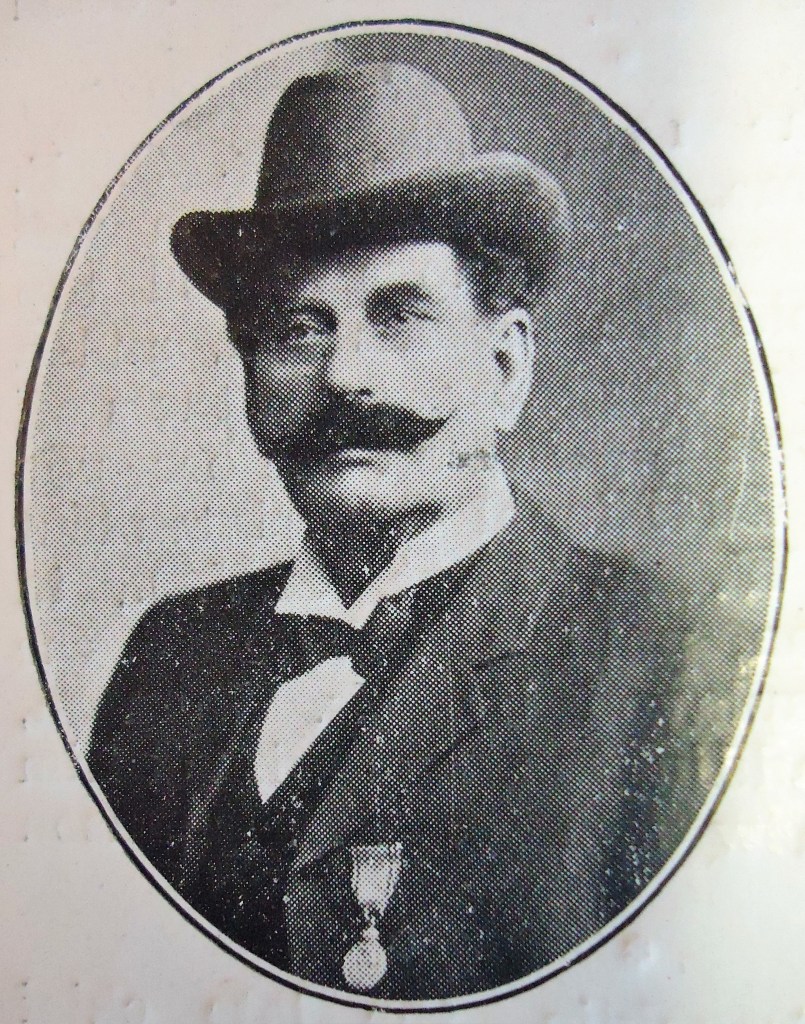
Tom Butler was born in Ramsey, Huntingdonshire in the summer of 1856. By 1881 he had moved to Swindon and was working at premises at 81 Regent Street for master cabinet maker William Pooles. He would later have his own business and an elegant house on Victoria Road named after his birthplace.

In 1883 he married Mary Ann Turner at the Wesleyan Methodist Chapel on Bath Road. The couple had seven children, of whom five survived childhood.

The couple were devout Methodists and both played prominant roles in the church and public life in Swindon generally. Tom was elected to the Town Council in 1903 and served as Mayor in 1910/11 an auspicious year in which the coronation of George V took place and Tom’s much loved wife died suddenly.

Mayor Tom Butler published courtesy of Local Studies, Swindon Central Library.

The Late Mr T. Butler

Funeral of One of Swindon’s Most Prominent Citizens

All Sections of Public Represented

The very high regard in which the late Mr Tom Butler, ex-Mayor of Swindon, was held by all sections of the public was eloquently reflected on Saturday in the scenes that attended his funeral. From an early hour in the afternoon many people gathered in the sunlit Cemetery to witness the last phase of the passing of a noteworthy man, and long before the service was due to start the Faringdon Street Wesley Chapel was filled.

The funeral service was impressively conducted by the Rev J. Rogers (superintendent minister), who paid glowing tribute to Mr Butler’s work in the town. Mr Butler came to Swindon, said Mr Rogers, in 1878. He became a teacher at Wesley Church the same year, and after a break of some years, resumed the work in 1887. Most of them were familiar with the main incidents of his public life; he built up a prosperous business and made a competence. No aspersion had been cast upon his character or methods; he was a man of honour and integrity. There were certain dates prominent in his career which the speaker wished to recall. In 1886 he was converted, and by definite and intelligent choice made Christ the Lord of his life. To the vows then made he remained faithful. His experience of religion was real and vivid, and he was always earnest, warm-hearted and generous. In 1887 he entered the school as a teacher, in 1888 he became treasurer to the Sunday School and in 1889 he was appointed superintendent, remaining in office until his health broke down. He relinquished the office in 1914. Mr Butler was a trustee of that church and was a liberal supporter of its funds. He helped very materially in the erection of the monumental Sunday School premises, while as Circuit Steward he discharged his duties with urbane and faithful efficiency. His life of usefulness and devotion had its source in mystic fellowship with God. He was loyal to the work in the days of his activity. They all knew what Mr Butler was to the community, but they did not know what he was to that church.

Referring to Mr Butler’s public life, Mr Rogers reminded them that he was elected to the Town Council in 1903 and held office as Mayor in 1910-1911. During that year he suffered a bereavement from which he never fully recovered.

“Servant of God! Well done,” concluded Mr. Rogers, and the fervent murmurs of the congregation was an endorsement of his eulogy.

North Wilts Herald, Friday, October 20, 1922. (extracts)

Tom Butler was buried in grave plot A1033 where he lies with his wife Mary Ann who died in 1911 and their two young children, Hilda Mary who died aged 6 years in 1898 and Denis Stanley a 3 month old baby who died in 1899.

You may also like to read:

Mayoress Mary Ann Butler and the Coronation

The Palphramand family

This large family plot has many stories to tell. From Joseph Strong, a pattern maker, who moved to Swindon from Bolton in Lancashire in the 1850s to his son-in-law George Palphramand, who in retirement moved to Coventry and in death returned to Swindon to be buried with his family.

But I am beginning the story of the Strong and Palphramand’s with a family tragedy and the death of a little boy.

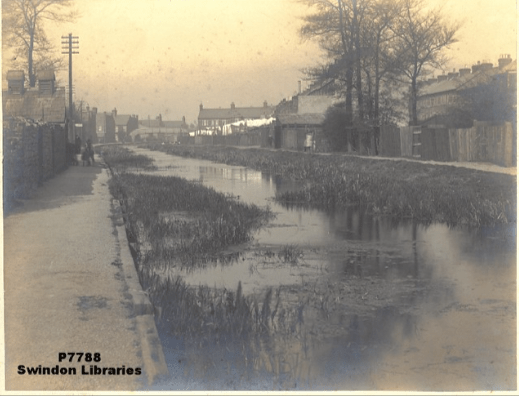
George Palphramand and Mary Ellen Strong married in St. Mark’s Church on April 13, 1876. Their first child Isabel was baptised on November 4, 1877 in the church where they were married. At the time of the 1881 census George and Mary were living at 24 Read Street with their three children Isabel 3, George 2 and 7½ month old baby Ernest. Mary’s brother Joseph Strong and his family lived next door at number 25. In the 1880s Read, Marlborough and Andover streets abutted the Wilts & Berks Canal.

Work began on the Wilts & Berks Canal at Semington in 1795 expressly for the transportation of Somerset coal to the towns in Wiltshire and Berkshire. However, with the completion of the Great Western Railway line from London to Bristol, trade on the canal diminished. It was closed by an act of parliament in 1914 and eventually filled in from about the 1930s. Today the short stretch of the former canal provides a route into Swindon town centre from the bottom of Kingshill.

At the inquest into the death of Ernest, a witness drew attention to the fact that there was really no fence there to keep little children from getting on the canal side, and ‘it was a great inducement for children to play there.’ Returning a verdict of accidental death the jury ‘expressed a wish that the Canal Company should endeavour to carry out such improvements to their fences that would hinder the occurrence of similar fatalities.’

Was this recommendation acted upon? Would this have been any consolation to the Palphramand family?

The Wilts & Berks canal looking east towards Marlborough Street footbridge c1914 published courtesy of Local Studies, Swindon Central Library.

Another Death From Drowning – On Tuesday afternoon, Mr Baker held an inquest at the Ship Inn, New Swindon, on the body of Ernest Strong Palphramand, aged three years and eleven months, son of George Palphramand assistant foreman in the P Shop, G.W.R. Works, of 24, Read street, who was drowned in the canal at the end of Read street, on Sunday afternoon. Mr George Thomas was foreman. The father of the deceased deposed that he last saw his son alive at about half past four o’clock on Sunday afternoon. The deceased was then playing with his brother in the backyard. The two children then went out at the back-gate, down the yard, and round by the front. The deceased went on to the path, and must then have fallen into the water. The other brother did not go on the path, but saw the deceased in the water, and gave the alarm. Witness ran up the street and jumped in, but could not find the child. His wife called the children back when they first went out of the gate, but they did not come; the elder of the children was five years old. When his older son came back from the water he seemed confused and could not tell where his brother was. No one really saw the child fall in the canal; and he must have been in the water for quite a quarter of an hour. Every effort was used to restore animation by those on the bank before the doctor arrived. Witness wished to call the attention of the jury to the bad state of the fences, and the path; there was really no fence there to keep little children from getting on the canal side, and it was a great inducement for children to play there. Henry Fraine, carpenter, of 44, Albion street, who helped to get the child out of the water, and Dr. Swinhoe also gave evidence. The jury returned a verdict of accidental death, but expressed a wish that the Canal Company should endeavour to carry out such improvements to their fences that would hinder the occurrence of similar fatalities. The jury also expressed their deep sympathy with the bereaved parents.

Wilts and Gloucestershire Standard, Saturday, July 26 1884.

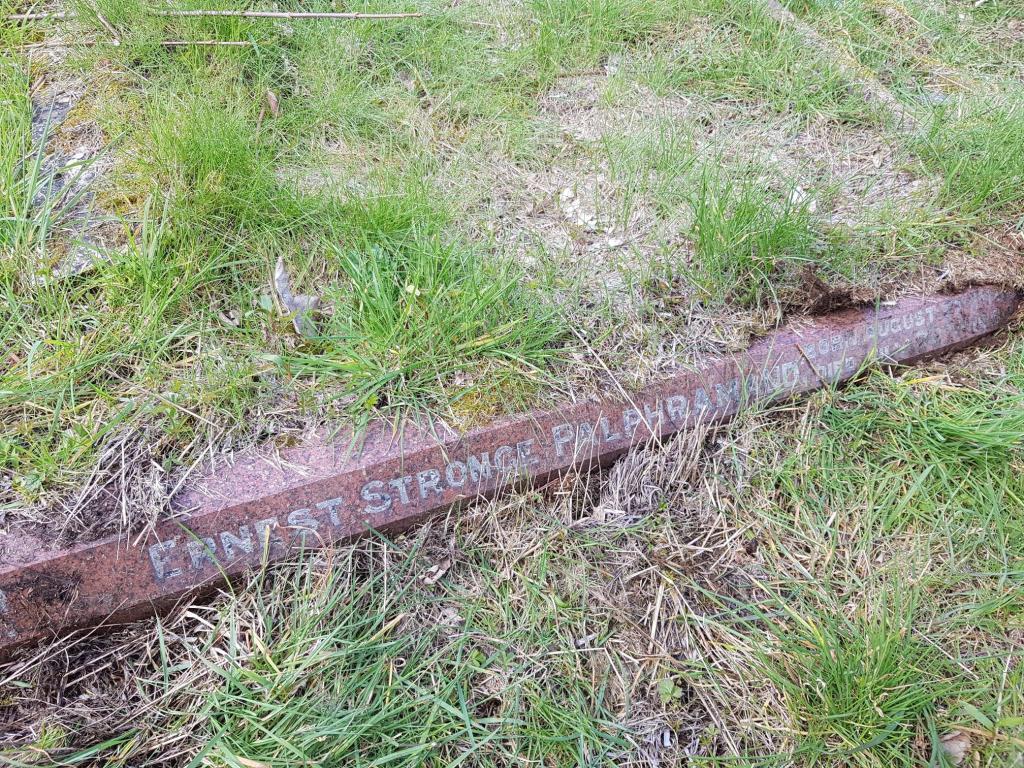
Ernest Strong Palphramand was buried on July 23, 1884 in grave plot E8469. The burial registers record that he was 3 years old and that his place of death was ‘The Canal near Read Street’.

John and Florence Sterry

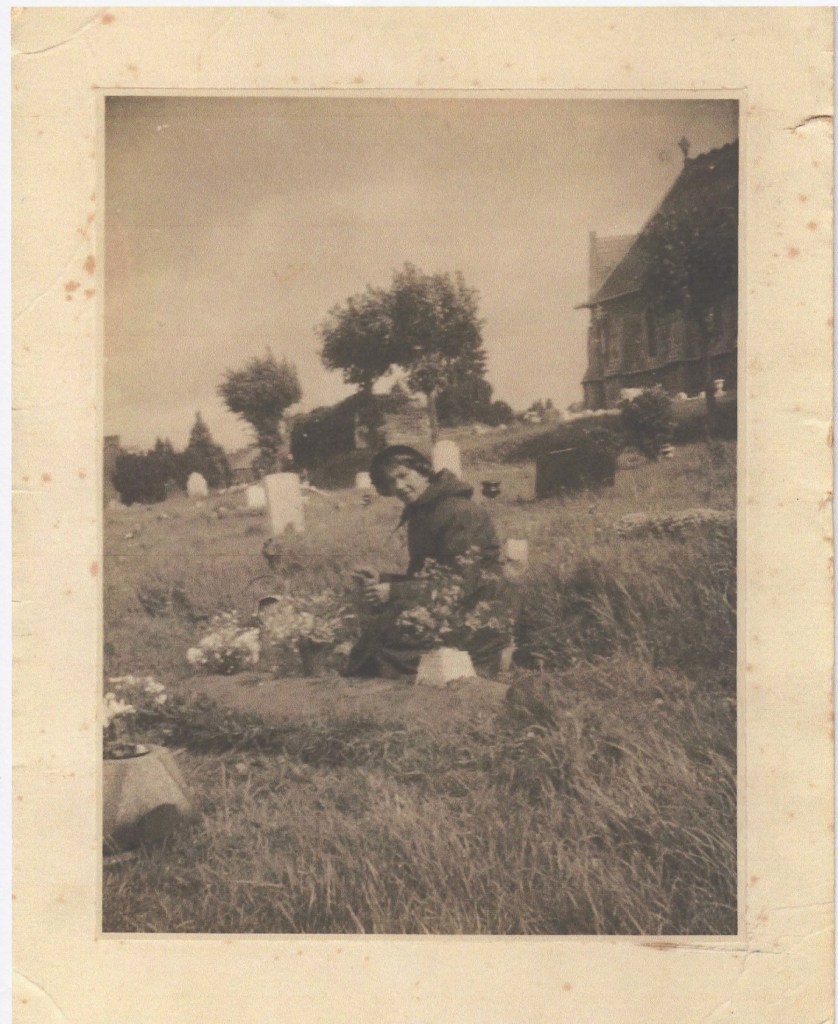
Old photographs of the cemetery are rare and always prove very intriguing and we don’t come across them very often. This one was sent to me several years ago by Sue and pictures her grandmother, Florence Sterry attending the grave of her husband John.

John Charles Howard Sterry, a rail carriage examiner, married Florence Nellie Hiscocks in St. Mary’s Church, Rodbourne Cheney on February 19, 1912. They were both 22 years old. Some Sterry family researchers with Ancestry online family trees record that John Charles Sterry served as a Driver in the Royal Field Artilery (RFA) during the First World War. However, a local source informs me that railwayman John was in a reserved occupation and did not go to war. The couple had three sons, Albert born 1914, William 1916 and Ronald in 1920.

At the time the 1939 List was compiled the family were at 129 Albion Street where John and Florence would remain for the rest of their lives. John died in St Margaret’s Hospital 1954 and was buried in grave plot C598. Florence died in 1957 and was buried in the same plot.

When I frst saw this photograph I was surprised at how long the grass was in the cemetery and that everywhere looked rather unkempt. This came as a surprise to me as I was under the impression that these were the years when the cemetery was still busy and where a staff (although probably small) of groundsmen were employed. If anyone has any memories (or photographs) of the cemetery in the 1950s and 60s we would love to share them here.

An extremely interestisng feature of this photograph is the glimpse of a small building in the background opposite the cemetery chapel. This building has long gone but appears on the map of the cemetery as ‘urinal’ – see below.

George ‘Yorky’ Bramley

In her comprehensive and readable book Swindon Works – The Legend, Rosa Matheson devotes a section to the legend that was ‘Nicknames.’

She writes:

‘The Works’ sense-of-humour is a notrious legend in its own right from its earliest times.

And it came as no surprise to me that Andy Binks, cemetery guide and fellow volunteer at Radnor Street Cemetery, had contributed a few nicknames for Rosa’s book, for example – ‘Melvyn, otherwise known as Drill Head from when a drill fell on his head and floored him!’

From ‘the Clockie’ to Big Arthur, Arthur and Little Arth, all members of the same family, none of whom were called Arthur, it would seem every man in the Works had a nickname.

This is the story of George Bramley who hailed from Yorkshire. Guess what his nickname was?

George Bramley was born in Leeds in 1831, the second child of William Bramley, a weaver, and his wife Mary. George married Margaret Dunwell in 1852 and at the time of the 1861 census he was working as a labourer in an Iron Foundry and living in Tallow Hill, Worcester. By 1871 the family had moved to Swindon and were living at 10 High Street (later named Emlyn Square) with their four children James 16, Lucy 15, Maria 8, William 3 and three boarders. They later moved to 18 Oxford Street, which would be their last home.

Death of an old GWR Servant – The death took place on Sunday last, after a short illness of Mr George Bramley, of 18, Oxford Street, New Swindon. Mr Bramley passed away in his sleep at the age of 66 years. Deceased, who was better known throughout the Works by the soubriquet of “Yorky” (from the fact that he hailed from Yorkshire), came to Swindon in 1859*, and has been employed in the GWR Works, under the late Mr. Holden, and the late Mr Edward Brittain, ever since. He was one of the first Volunteers in the town, having joined the New Swindon Corps when it was formed in 1859, and did a considerable amount of work in assisting to make the first shooting range. He had been in failing health since the death of his wife last February, but continued to go to his work regularly up to last Saturday week. Deceased leaves two sons and two daughters. The funeral will take place on Saturday next, leaving the residence at 2.45 p.m., and proceeding to St. Mark’s Church at three o’clock. Friends will please accept this intimation.

Swindon Advertiser, Wednesday, November 22, 1899.

The backsies in the Railway Village

Margaret died in February 1899 and George in November of the same year. They are buried in grave plot C98 where their daughter Maria joined them when she died in 1933.

*census returns indicate that George may have moved to Swindon later than 1859.

Mayoress Mary Ann Butler and the Coronation

As the UK prepares for the Coronation of King Charles and his wife Camilla on Saturday May 6, how did it all go back in 1911? The Coronation of King George V took place on June 22, 1911 and it all went very well here in Swindon. In fact, the Mayor Tom Butler said as much when he thanked the people of Swindon in the pages of the Swindon Advertiser.

The Mayor’s Thanks

His Worship the Mayor (Mr Ald. Tom Butler) desires to congratulate the inhabitants of Swindon generally on the success with which the arrangements for celebrating the Coronation in Swindon on Thursday last were carried through, and on the enthusiastic yet orderly way in which the inhabitants generally showed their loyalty and so readily assisted in making the day such an enjoyable one to all concerned, and especially to the old folks and the children.

The Mayor also desires to express his high appreciation of the decorations and illuminations, which were so artistically and beautifully carried out in all parts of the own.

In tendering his warmest thanks to all, he would also like to acknowledge the patience and courtesy with which the police carried out their duties during a long and arduous day.

The Swindon Advertiser, Friday, June 30, 1911.

By the time the newspaper was published Mayor Tom Butler’s much loved wife Mary Ann had died.

The Late Mrs T. Butler

Funeral

Impressive Scenes

The sad death of the Mayoress of Swindon has keenly touched the hearts of Swindon inhabitants, and when the funeral took place yesterday there was a demonstration of sympathy and respect almost without parallel in the town. In the streets, in the chapel, and at the graveside thousands testified by their presence and sad demeanor the sorrow they felt at the great calamity which had befallen the Mayor and his family and also the community at large, and representative men and women of all ranks and professions accompanied the remains to their last resting-place.

The first part of the service was held at Faringdon Street Wesleyan Chapel, where the late Mrs Butler had been a worshipper with her husband for many years. The Cortege left Ramsey House, Victoria Road, shortly after 2.30, the streets being thickly lined with spectators. The official representatives, who had previously met at the Town Hall, included Messrs. L.L. Morse, A.W. Deacon, J. Clark, J. Longland, S.B. Cole, W.H. Stanier, C. Hill and A.W. Haynes borough magistrates), Mr T. Free (Mayor of Marlborough), Mr W. Small (Mayor of Chippenham), Mr W.H. Lawson (Deputy Mayor of Swindon), Mr R. Hilton (Town Clerk), Prebendary W.B. Pitt, Messrs W. H. Williams, W.W. Dickson, J. Henderson, J. Spackman, R.W. Menham, G. Brooks, H.D. Piper, F.W. Marillier, A.E. Harding. T. George, J. George, J.G. Cox, W.E. Morse, A. Church, W. Sloan, W.H. Kinneir, A.J. Gilbert, A. Balch, R. Evans, A.H. Wheeler, J. Powell, J.J. Brown, W. Johnson, W.J. Bray and H.J. Gregory (members of the Town Council) cont…

The service in Faringdon Street Wesley Chapel, where from her youth onwards the late Mayoress had been a constant attendant, was of a painfully impressive character. Long before the cortege had reached the entrance, the side aisles had been filled by members of the congregation, the central aisles having been reserved for the mourners and followers.

In his address the Rev W.J. Chant said – ‘They were in the presence of a very great sorrow, a bereavement which was very mysterious, which was beyond them. Their deceased sister seemed to have been taken away at that particular time when she was very necessary; necessary for the home, for the church and for the town. But they could not raise God’s hands, and could only ask Him to help them to trust in their darkness.’

He continued – ‘It was with pleasure and encouragement that they thought of the kindness of the late Mayoress – ever happy when she was thinking of other people, trying to help them. The Lord of kindness was in her heart. They thought of her evenness of disposition. She was always the same, no matter when one met her. They also thought of the great love which she had for her home, how the heart of her husband trusted in her and her children rose up and called her blessed. They thought of her specially during the last few months, more than ever before, when she had been called upon to serve the town, counting no effort too great, no sacrifice too much, and her efforts culminated in that wonderful day of rejoicing so recent as Thursday week, when she was one of the most active, faithful, and unselfish and devoted workers in connection with the Coronation festivities.’

The cortege then left for the Cemetery, and as the sombre procession moved down the aisle the organist played Handel’s Dead March in “Saul.” While the body was being carried away practically every eye was tear-dimmed.

On leaving the chapel the procession re-formed and proceeded to the Cemetery, where a considerable space round the grave had been roped off. A dense mass of people witnessed the brief concluding ceremony. Supt. Robinson directed the arrangements. The grave was at the east end of the chapel. The coffin of polished English oak had an elm shell and brass fittings, and the inscription was:-

Mary Ann Butler

Born 14 July, 1862

Died 28 June, 1911

The coffin was borne upon a hand bier and was covered with floral tributes. Five mourning coaches followed, the family mourners being the Mayor (Mr T. Butler) and three sons – Messrs. R.W., T.R. and F.G. Butler – Mr Turner (brother of deceased) and Mr W. Watts (cousin). Amongst others following were Mr and Mrs A.G. While. The final portion of the service was said by the Revs J. Rodwell and W.J. Chant. At the last moment the Mayor, who had borne up bravely, was quite overcome with grief.

North Wilts Herald, Friday, July 7, 1911 (Extracts)

Mary Ann was buried on July 3, 1911 in grave plot A1033. She lies with her two young children, Hilda Mary who died in 1898 aged 6 years and Denis Stanley a 3 month old baby who died in 1899.

Bob Menham – a larger than life character

“He is active and decides what to do quickly, is a good punter, fists out well, and kicks cleanly and surely. – Sporting Life April 10, 1897.

Measuring 6ft 1ins tall, Bob Menham certainly stood out in a crowd!

Robert William Menham was born in North Shields in 1871, the son of cabinet maker Henry Menham and his wife Annie and grew up in Burley, Leeds. In 1891 he enlisted with the 3rd Battalion Grenadier Guards and in 1894 he married Bessie McKay.

Meanwhile, his football career quickly took off seeing him play for Luton Town, Everton and Wigan County before being transfered to Swindon Town where he is still considered to be one of the most talented goalkeepers the club has ever had. During the 4th round FA Cup replay against Staple Hill FC he even managed to score a goal, electing to take a penalty securing a 6-0 win for the Town.

And when Swindon Town F.C. found itself in dire financial straits in 1901, Bob joined a money saving initiative, which ultimately rescued the club.

Swindon Town F.C.

Players’ Wages Fund Subscription List

The following subscription list showing the amount received up-to-date has been opened on behalf of the Swindon Town F.C. Players, who a short time ago, when the financial condition of the club was in a very critical state, agreed to accept a greatly reduced wage in order that the club might exist, at least, till the end of the present season. As a matter of fact, the wage bill was reduced to practically half the former amount, and it is on that account that the players have been compelled to appeal to the public to assist them in carrying out their resolve. It is hoped that all lovers of sport will respond to the appeal, and all subscriptions and donations will be thankfully received, and duly acknowledged on behalf of the players by Mr R.W. Menham (capt.) Radnor Street, Swindon.

The Evening Swindon Advertiser, Saturday, March 16, 1901.

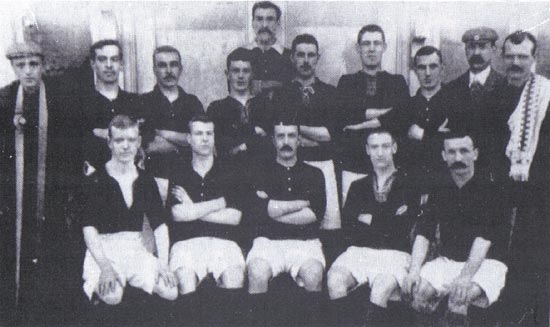
The Swindon Town FC 1902/3 squad

Bob retired in 1903, taking up a role on the team’s Board of Directors, while the family moved to the Castle Hotel, Prospect where he was licenced victualler for many years and was the president of the Swindon and District Licensed Victuallers Association. He served on the Swindon Town Council from 1907-1920 representing the East Ward.

Old-time Everton followers will regret to hear of the death of Bob Menham former Everton and Swindon goalkeeper, later a director of Swindon, and a well-known licensee there. He is still regarded at Swindon as the best goalkeeper the Wiltshire club ever had. His nephew Gordon, was also associated with Everton about twenty years ago.

The Liverpool Echo, Wednesday, January 31, 1945.

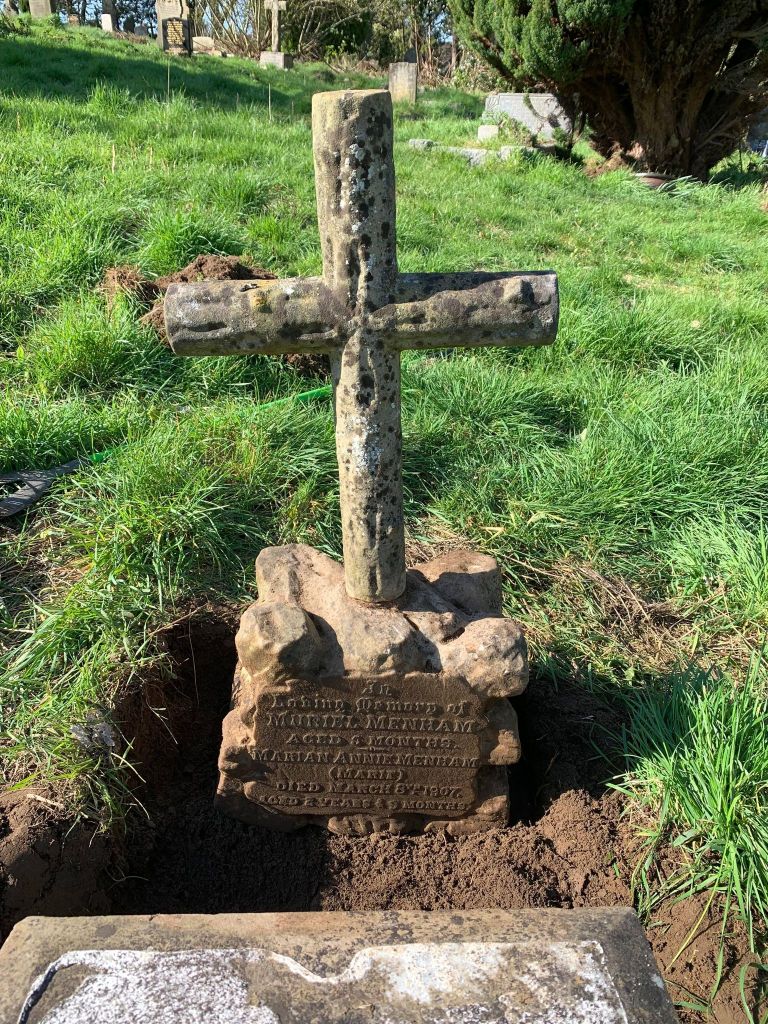
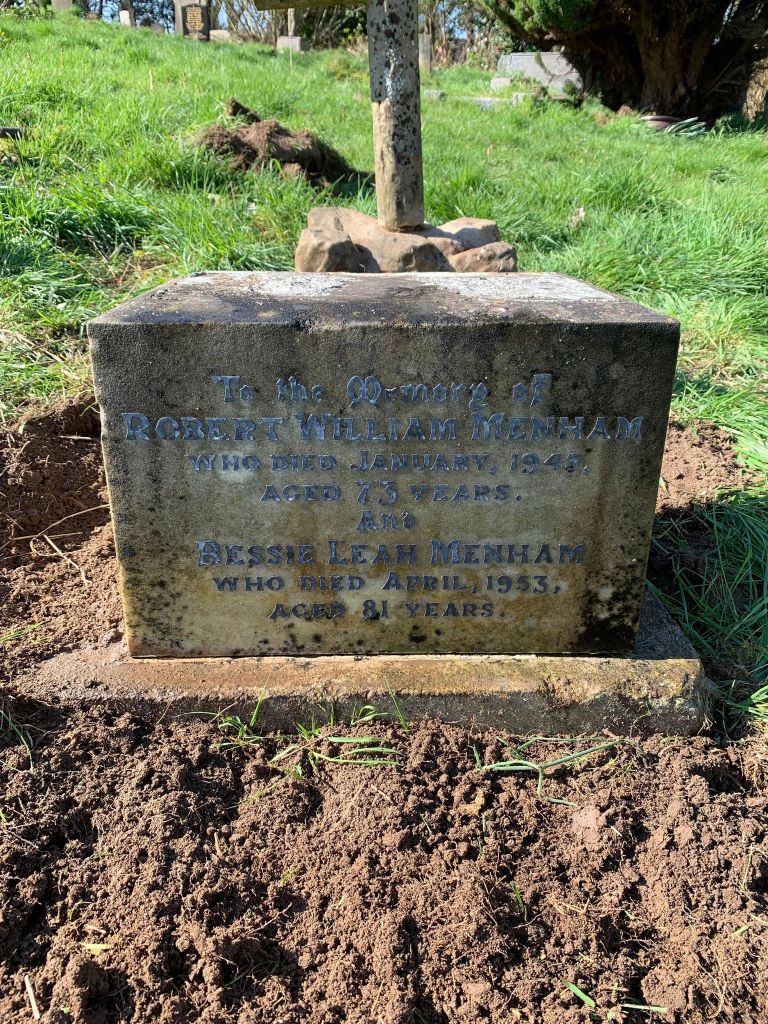
Robert William Menham died at his home, 67 Eastcott Hill, on January 30, 1945 aged 73 years old. His funeral took place on February 1, when he was buried in Radnor Street Cemetery in grave plot C1057 with his two little daughters, Muriel who died in 1900 and Marian Annie who died in 1907. Bessie Leah, his wife, died in April 1953 and is buried in the same plot.

Bob Menham’s memorial cleared and cleaned today by Kevin.