I’ve spent a couple of hours browsing the Local Studies flickr site, looking at photos of Swindon during the 1970s and 80s. This was a period when the town centre, still largely Victorian in design and layout, was modernised. Rows of red brick terrace houses came down as multi storey office blocks (now themselves out of date and unfit for purpose) went up. Granville and Morley streets were two victims, most of the properties sacrificed to create – a car park.
In 1891 our own home grown Liberal MP, Levi Lapper Morse, financed the construction of two town centre streets, which he named after Earl Granville, Liberal politician and former Foreign Secretary and Viscount John Morley, Liberal MP for Newcastle upon Tyne.
In 1901 Charles Watkins, a blacksmith, was living at No 19 Granville Street with his wife Margaret and their son Charles 27, also a blacksmith. Charles Watkins senior died in 1907 but Margaret was still living at number 19 Granville Street in 1911 with her son Charles. Living with her were her three grandsons, Thomas 18 an apprentice blacksmith in the GWR Works, George 16, an apprentice shoeing smith and 11 year old schoolboy Archibald, the children of her son Thomas. The grandsons were living with Margaret following the death of their mother Blanche Louisa Watkins that same year.
Margaret and her younger sister Fanny spent their early childhood in Loughborough Street, Kennington, pretty close to where I spent mine in Brixton. Margaret would remain living at 19 Granville Street until her death in 1923. She chose a perfect place to rest for all eternity.
Charles Watkins senior died in 1907 aged 71 years and was buried in Radnor Street Cemetery in plot B2618. Buried with him are his wife Margaret and their daughter-in-law Blanche who died in 1911. George Sydney Watkins, Charles and Margaret’s second son, was buried with them on November 2, 1936 and their youngest son, Charles John following his death in November 1943.
You can’t help but wonder what the Watkins family would make of the 20th century improvements to our town – or the 21st century ones either, come to that!
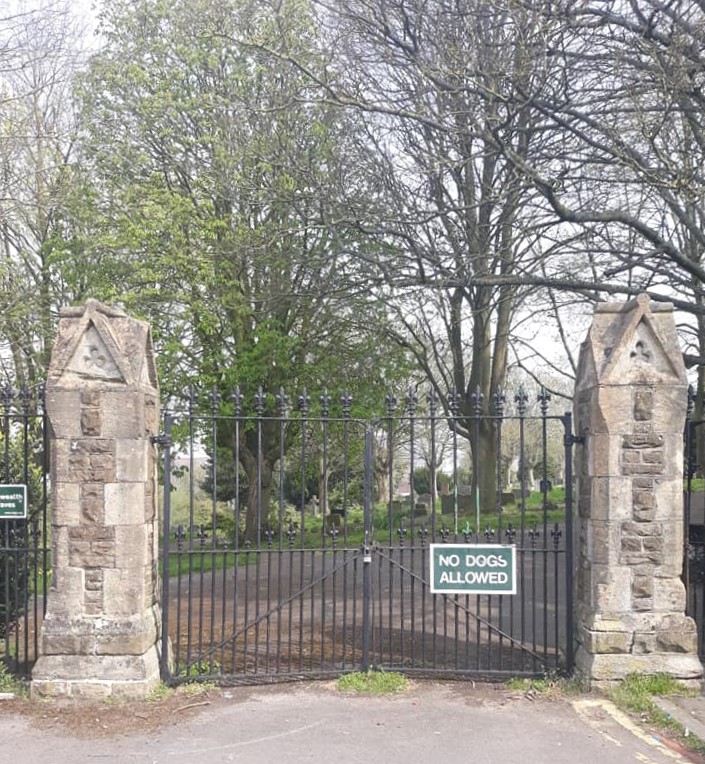
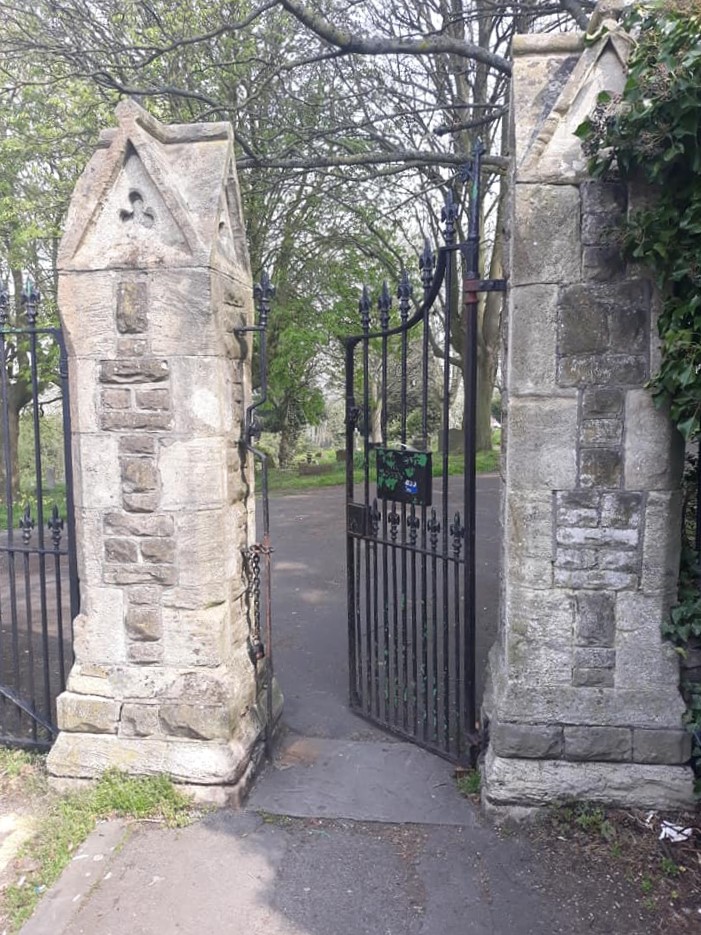
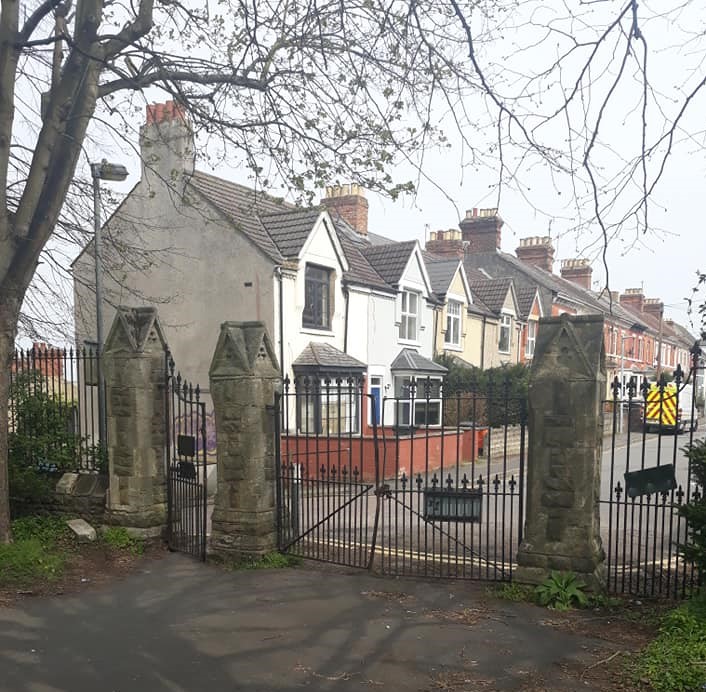
It was always Mark’s dream to see the cemetery gates and railings painted black with the fleur de lis finials burnished in gold. Custodian of the military history of the cemetery, Mark was a painter and decorator by trade and the state of the cemetery railings was a source of professional frustration for him. Today the gates and railings reveal a motley coat of green and black paint, which came first is difficult to work out.
In 1885, just four years after the cemetery had opened, it would seem the railings were already in need of maintenance.
The Swindon Burial Board are desirous of receiving tenders for the following work:- Clean and Paint, with two coats of good oil paint, the whole of the iron fencing around the Cemetery; Paint twelve seats with three coats of good oil paint; Size and Varnish the outside of the chapel door.
For further Particulars, apply to the Caretaker, The Cemetery Lodge.
Tenders to be sent to me the undersigned, on or before the 11th day of May, 1885.
The Board do not bind themselves to accept the lowest or any Tender.
This is a tale of two disintegrating headstones and a misplaced grave marker. What began as an attempt to trace the occupants of two neighbouring graves has involved some confusing paperwork, but I’ve got there in the end.
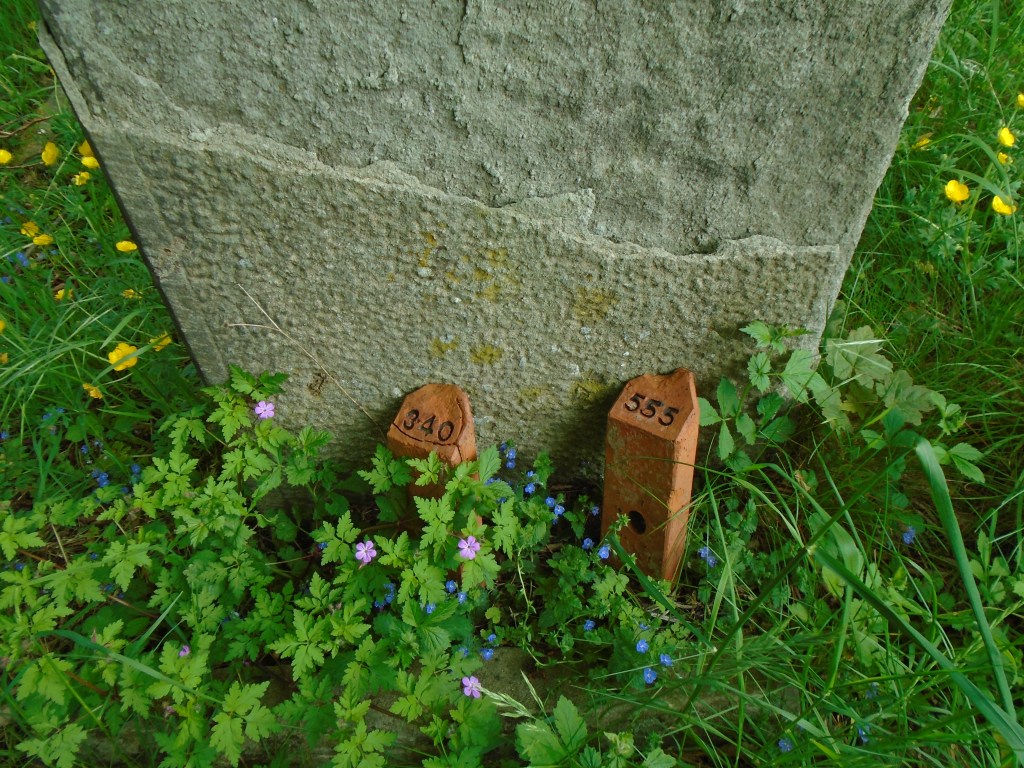
This is a cautionary tale of relying too heavily on the terracott grave markers in the cemetery. These portable brick like markers stamped with a letter and a number can be a big help when trying to pin point a plot, however they are very often in the wrong place. Perhaps back in the working day when there was a team of staff caring for the cemetery these markers were a useful identification aid. Unfortunately today they can be more of a hindrance, leading those searching for a grave on a confusing journey.
Many of the earliest burials in the newly opened cemetery took place here in Section A in the 1880s. In this area there are many public graves with numerous unrelated occupants. Funerals have always been an expensive business for the poor and frequently they had to bury their loved ones in a communal grave without a headstone. However, there are surviving headstones in Section A, among them several like these two badly weathered examples. Sadly, the inscriptions are completely lost and so it would appear is the identity and history of those buried here.
Someone has at some point propped up two of these grave markers at the back of one of the headstones, so I decided to see if they helped unlock the identity of who is buried here.
A consultation of the cemetery map quickly revealed that these are not the numbers of the two adjacent headstones. Grave plot A555 is a few rows removed from A340, as you can see from this image. However the marker for A340 is probably in the right location. The number of the neighbouring grave is plot A341 so now it was time to hit the burial registers, firstly the grave plot register.
After some research I was able to confirm that the two plots belong to the same extended family; the first of these to be buried in the new cemetery was Sarah Fortune, wife of William Fortune. She was 81 years old and her last home was at 1 Vilett Street, New Swindon where she lived with her daughter and her family. Her funeral took place on December 21, 1881 in plot A340.
The second family member to be interred in the cemetery was Mary Pickett, Sarah’s daughter. Mary was 67 years old and her funeral took place on May 3, 1890. Her last home had been Alderley, Gloucester, which has a connection to her husband’s family. Mary was buried in plot A340.
On October 11, 1904 Kate Minnie Brond was buried in plot A341. Kate was 35 years old and the granddaughter of Sarah Fortune. Her last home was at 25 Devizes Road where she lived with her parents Richard and Charlotte Fortune, her three younger sisters and her son Wilfrid Brond.
The last burial in this plot was on December 7, 1904. Wilfrid Percival Brond aged 5 years old died just weeks after the death of his mother.
Entries in the burial registers are slightly confusing. Sarah Fortune is described as being buried in plot A340 but the entry for her daughter Mary suggests she is the only one buried there. The details for plot A341 list Kate Brond, W.P. Brond and S. Fortune. All that we can be sure of is that Sarah Fortune is buried in one of these family graves. No doubt the lost inscription on the headstones would have settled the matter.
So, now all that is left to do is discover if there is a headstone on plot A555 and find out who is buried there.
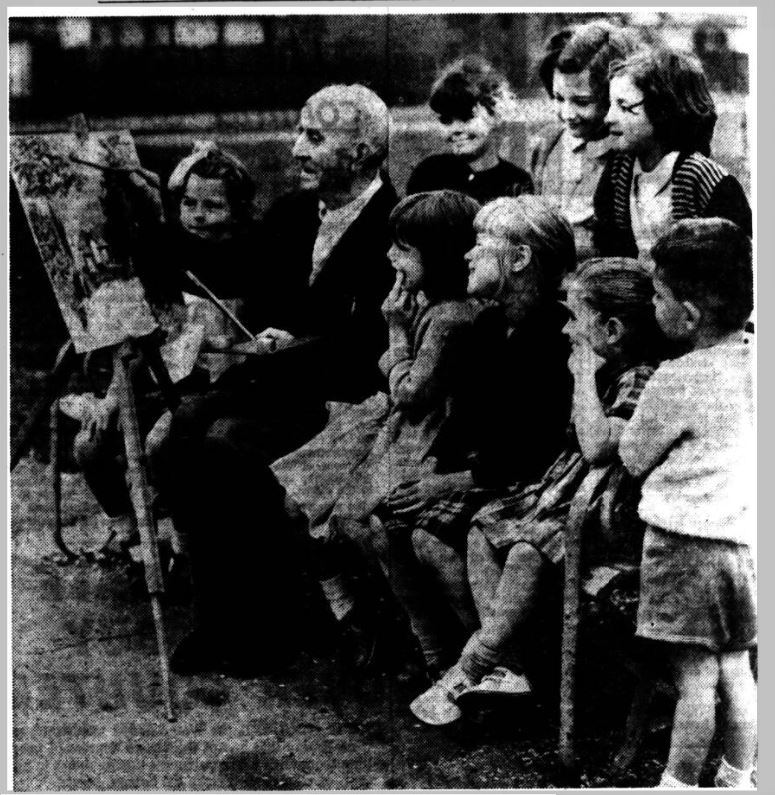
When the Hammersmith & Shepherds Bush Gazette and Post interviewed George Puckey in 1961 they reported how the 74 year old pensioner had developed a profitable hobby in his retirement.
Any self-respecting local art enthusiast would be quick to point out that George had honed his talent here in Swindon where we have a clutch of his work, once available to view in the Swindon Museum and Art Gallery.
George was born in Plymouth in 1888, the son of Charles and Sarah Puckey. The family had moved to Swindon by 1901 when they lived at 2 John Street Terrace where Charles worked as a Butcher journeyman. By 1911 23 year old George was working as a van driver for a house furnishing firm; his 16 year old brother Frederick was a general labourer in the GWR Works.
George’s work is hung Down Under
A 74 year old Acton man has found a novel way of supplementing his old age pension. He is Mr. George Puckey, of Northfield-road, North Acton, and since he retired eight years ago he has been painting pictures.
As Mr Puckey’s fame as a painter spread, so more and more orders for his colourful pictures, most of them of Kew Garden scenes, have rolled in.
Two of them are the proud possessions of an Australian family. They were bought by an Acton shopkeeper who sent them to her Australian relatives.
Exhibition
Mr Puckey, an Acton resident for 30 years and a former packer for the Metal Box Co., has just reached a proud highlight in his painting career.
He told the Gazette last week that he has had a picture accepted for the Middlesex County old people’s handiwork exhibition, to be held at Wembley Town Hall.
The picture is of Queen’s Cottage, in Kew Gardens.
Mr Puckey started painting when a young man living at Swindon. “I attended the Swindon College of Art but since then I have done very little painting. It was only when I retired that I seemed to find the time.
But I was very successful with my pictures at Swindon and a number of them of interest to local historians were bought by the Swindon Museum.”
Mr Puckey’s views on modern art? “It is awful, terrible, most of it,” he said.
Gazette and Post, Thursday, September 28, 1961.
George’s younger brother Frederick died in 1926. He is buried in Radnor Street Cemetery in grave plot C3760 where he lies alone.
The family later moved to Acton, Middlesex, where George remained for the rest of his life. He died in 1963, a couple of years after the newspaper article appeared in the local press.
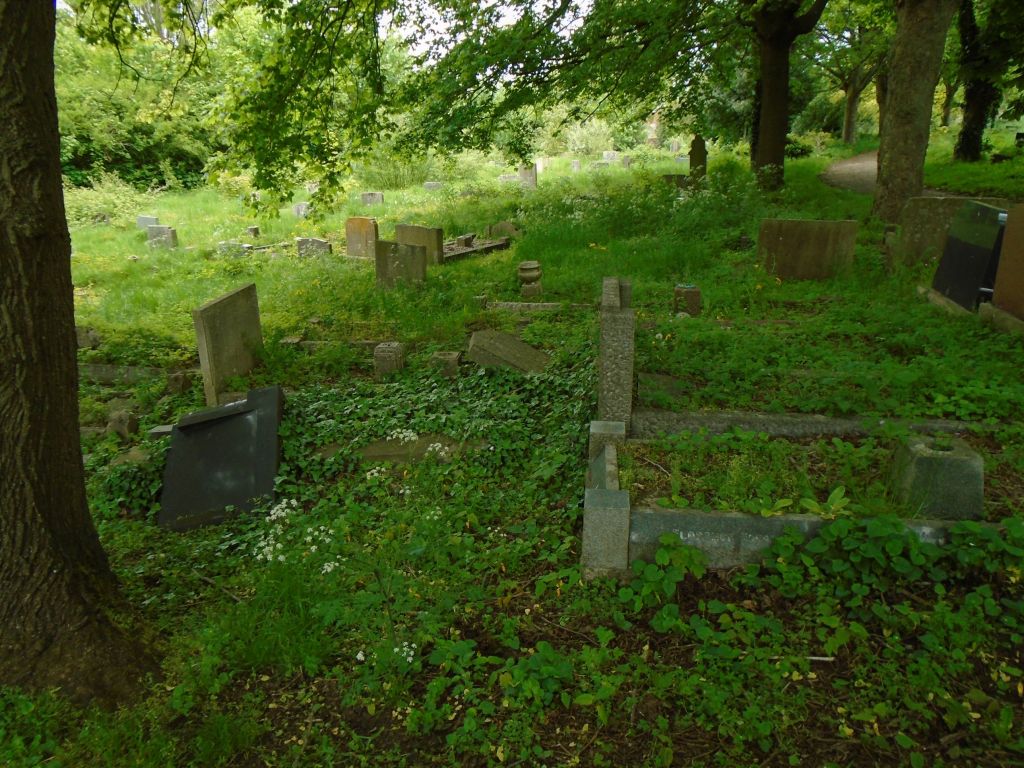
On my way to conduct a guided cemetery walk for the Old Town Belles WI group recently, I met a woman who emerged from Section Lower C where the grass is as high as an elephant’s eye (to misquote the famous song from Oklahoma).
Ilse was visiting from the Netherlands on a week long, whistle-stop, family history tour of Wiltshire. She had spent the morning in Box and the afternoon in Gorse Hill before a quick visit to the cemetery.
She had no cemetery map and had by happenstance arrived at Section Lower C. She had hoped there would be numbers on the graves, but sadly that is usually not the case. She did have a grave number she had taken from a well-known website, but it was one that I had an ‘mmmn’ about – you know what I mean? However, Radnor Street Cemetery burial registers record the grave numbers which range from a single digit up to a four digit number and always preceded by a letter (and occasionally with a letter at the end e.g. D12A). But this was a five digit number without any letter. Mmmn!
Ilse wrote her email address and the name of her great-aunt on the back of my notes and today I’ve done some research for her. As I suspected the number she had was not a Radnor Street Cemetery grave plot number – but, guess what? Where she was exploring in the wilder reaches of Section Lower C was exactly where her great aunt (and great-great-grandmother) are buried. What a coincidence!
She has a wealth of family stories, which I am hoping she will share with me when she gets home. One of these was of how her great aunt met her husband-to-be when her hat blew off on Swindon station platform and he rescued it. Ilse says she has family photographs – obviously not of the hat retrieval incident – but what others might be revealed! What a fortuitous meeting. (And the guided walk with the Old Town Belles was most enjoyable as well).
Section Lower C
An overall view of the cemetery and a scan of Section Lower C where Ilse was searching.
When Elizabeth King died in 1908 her family had the following inscription placed upon her headstone ‘The Beloved Wife of Robert Albion King of Swindon, Freeman of London.’ They were obviously very proud of Robert’s status.
However, in 1868 coach builders H. & E. King were forced to make the following announcement in the North Wilts Herald.
We are requested by Messrs. H. and E. King, coach builders, of Swindon and Stratton St. Margaret, to state that Mr Robert Albion King, recently charged before the magistrates with assaulting a Mrs Jennings, is not a coach builder, and is in no way connected with their firm.
North Wilts Herald, Saturday, April 18, 1868.
Robert Albion King appeared before Swindon Police Court on Thursday April 2, 1868 charged by Mrs Mary Jennings with damaging an unoccupied house, belonging to her, at Stratton St Margaret, by breaking two panes of glass, and with assaulting her, with intent to do her bodily harm.
Mrs Jennings said she had visited a property in Stratton which she had recently bought where she found Mr King in possession. Upon entering the property Mr King ordered her out tearing her shawl, and putting his fist in her face in a threatening manner; he was very much excited, and said he would shoot anybody who came on that property.
In his evidence King told the court he had previously informed Mrs Jennings that the property had been in his family since the 17th century and could not be sold, and if she bought it she would lose her money as he was heir-at-law to it.
He in turn accused Mrs Jennings of assaulting him on a previous occasion, insulting his wife and children and scratching his face.
In summing up the Chairman said these family feuds were most disgraceful, and the bench would bind over both parties in their own recognizances of £20 each to keep the peace for six calendar months.
You can read more about the disputed property and the family connection in The North Wilts Herald, Monday July 20, 1868.
Robert Albion King died quietly (or perhaps he was arguing the toss at the time) at his home on December 23, 1909.
Death of an old inhabitant – One of Swindon’s oldest inhabitants passed away on Thursday, December 23rd, in the death of R.A. King. Deceased, who had been suffering from heart disease for some time, died at his residence in County Road. He was the only surviving son of the late John and Ann King, of Little Britain and Moor Lane, London, and also of Stratton. Deceased’s father was a Freeman of the City and also of the Goldsmith’s Company, while deceased himself also enjoyed the same distinctions. He leaves three sons and six daughters. The remains were interred at the Swindon Cemetery on Wednesday, the coffin being of polished elm with brass fittings, bearing the following inscription: “Robert Albion King, died Dec. 23rd, 09, aged 85 years.” A number of floral tributes were sent by relatives and friends.
North Wilts Herald, Friday, December 31, 1909.
Elizabeth King died in March 1908 at 166 Beatrice Street. Her funeral took place on March 6 when she was buried in grave plot B2820. Her husband Robert Albion King died in December the following year aged 85 years at 33 Country Road. He was buried on December 29 with his wife. Their daughter Olive Magdalene Manners is buried with them. She died in December 1926 aged 37.
Those embarking on their family history research are always told to talk to older relatives first; to ask questions and make a note of family ‘legends’ which often contain valuable information. When Marilyn Beale began her research there were plenty of stories still circulating within her large family.
I recently had the good fortune to meet Marilyn, who I am sure many Swindonians will know, especially those who live in Penhill.
Marilyn moved to Penhill as a young, newly married woman and has spent more than 50 years volunteering in her local community. Beginning with a gardening club and then involvement with the Penhill Forum, the Seven Fields Conservation Group and the Penhill Community Orchard, Marilyn loves her neck of the woods.
We met to talk about Rodbourne where Marilyn grew up. Marilyn is an avid reader and has a great curiosity and interest in history. We talked about the past and her redoubtable grandmother Susan Legg born in 1868 – imagine the changes she would have experienced in her lifetime. She had lived through the reign of five monarchs and had survived the deprivations of two world wars.
Susan was the daughter of agricultural labourer Job Simpkins and his wife Elizabeth. She grew up in Purton and at the age of 14 was working as a ‘nurse girl’ at Dudgmoor Farm, Cricklade for farmer Charles Kennett, his wife Agnes and their two young daughters. In 1890 she married Richard Legg, a general labourer and they went on to have a large family of 13 children. Susan would survive at least three of her children. A daughter Mabel died in 1918 aged 11. Her son George was killed in action during the First World War and is remembered on the La Ferte-Sous-Jourarre Memorial in France. He was 20 years old. Another daughter Elizabeth Jane died in 1921 aged 30 of tuberculosis.
Marilyn remembered hearing stories about her resourceful grandmother who steered her family through financial vicissitude. A go-to woman who those in search of a reliable servant would consult as she always knew of a good, hardworking girl looking for a job.
Susan died at 31 Hawthorne Avenue in 1951 aged 82 years. She was buried on February 26 in Radnor Street Cemetery in grave plot C3544 which she shares with her two daughters – Mabel and Elizabeth Jane and her husband Richard who died aged 70 in 1934.
Marilyn continues to volunteer in her community, serving as a Parish Councillor for the Penhill Ward where she attends the Leisure & Recreation; Environment & Planning and Community Wellbeing committees, which pretty much describes her life’s work.
Ellis Herbert Pritchett was born in Chiswick in 1861, the son of Robert Taylor Pritchett and his wife Louisa. His father is a most interesting character who at the time of Ellis’s birth was a rifle manufacturer for the War Department employing 150 men and two boys. He later went on to be a water colourist.
Ellis was articled to the prestigious Scottish architect Charles Forster Hayward from 1880-1884. He then took a year off to travel through France and Belgium before setting up in his own practice in 1885.
He appears to have arrived in Swindon in the late 1880s and at the time of the 1891 census he was living in Ivy Cottage, Purton with his mother and a little niece, Johanna C. Taylor who was just a year old.
He became partners with Charles and Ernest Bishop and the firm of Bishop and Pritchett was established as auctioneers and estate agents by 1893, a year after he married Mary Campbell Maclean.
Pritchett was Chief Officer of the Swindon Fire brigade and like so many of these professional men he was a freemason, joining the Royal Sussex Lodge of Emulation in 1890 and Gooch Lodge the following year.
Among the buildings Pritchett designed was the Euclid Street High Elementary School and several houses on The Sands and Bath Road.
Ellis died suddenly on March 16, 1905 at Poole and his body was brought back to Swindon where he was buried on March 22. His wife Mary Campbell Blythe (she later remarried) and her parents Dr John Campbell and Ellen Maclean are buried in this large, double plot E8371 and E8372.
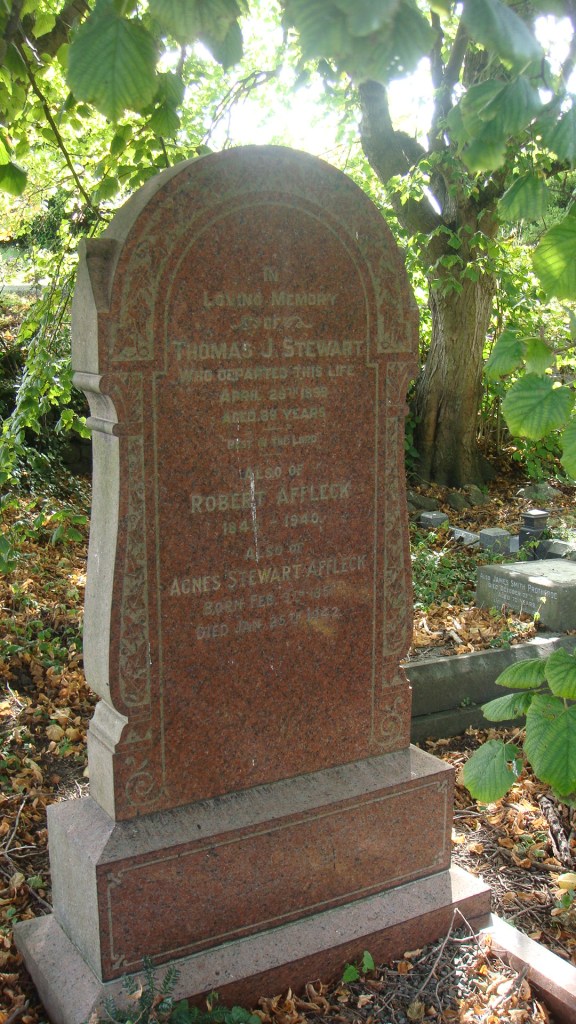
I had read the story of Thomas J. Stewart in the writings of the late Trevor Cockbill, railway and local historian, but sometimes the story you start out researching turns into something a little different.
Thomas Stewart was one of the very first railwaymen to arrive at the frontier town of New Swindon, travelling in an open railway truck, it is said. He started in the Works on Monday, December 20, 1842, a fortnight before the official opening and lit the very first smith’s fire in the factory.
Thomas was born in 1811 in Lanarkshire and on arriving in Swindon he first lodged in Stratton St Margaret. He appears on the first census taken in the railway village in 1851.
Thomas Jack Stewart died on April 26, 1899 aged 87 years at the home of his son-in-law Robert Affleck and left effects valued at £11 4s to his daughter Agness Stewart Affleck. But Thomas had never married.
Agnes was born on February 9, 1851 the daughter of Maria Smith and baptised at Christ Church on March 23. The entry in the baptism registers includes the name of Thomas Stewart but this has been crossed through and the words ‘illegitimate daughter of Maria Smith’ remain.
Maria Lucy Smith was the eldest daughter of Edward and Elizabeth Smith and at the time of the 1851 census, taken shortly after the birth of her daughter Agnes, she is living with her parents in Cricklade Street. The census records that Edward and Elizabeth have three other daughters and a niece living with them and the last entry is that of their granddaughter Agnes aged 1 month.
Thomas obviously had some involvement with his daughter. When she married Robert Affleck at Christ Church in 1875 Thomas was a witness at the wedding ceremony, although his name does not appear as ‘father’ on the marriage certificate, which is left blank. In 1891 he was living with Agnes and her husband and family at 37 Prospect Place where he is described on the census as Thomas Stewart father-in-law 79 years old retired blacksmith born in Scotland. And at the time of his death in 1899 he was still living with the Affleck family.
The Late Mr t. Stewart,
Funeral on Saturday
The funeral of the late Mr Thomas Stewart, an old GWR foreman whose death we announced last week took place on Saturday afternoon. The funeral cortege left deceased’s late residence, Southfield House, The Sands, Old Swindon, at three o’clock. The coffin was borne on a handbier, and covered with a pall, there being no flowers by request. The bier was attended by eight bearers, from the F Shop, all workmen who were formerly employed under deceased.
The coffin was of polished panelled oak with massive brass fittings and engraved plate bearing the words:- “Thomas Jack Stewart. Born June 7th, 1811. Died April 26th, 1899.” The chief mourner was Mr R. Affleck (son-in-law), the other coaches containing deceased’s grandsons, and Messrs T.B. Watson, and W. Chivers.
There were three mourning coaches, and between 20 and 30 mourners on foot, including the following:- Messrs. R. Baker, T. Patterson, J. Sykes, W. Morgan, Enoch Smith, W.S. Dawson, John Fox, E. Tomkinson, Ellison, ? ? Broadbear, Alf Bowker, Pickard, Robert Fawcett, J. Clark, W. Sewell, R. Gadd, Burrows, D. White, E.L. Pugh, etc.
The first portion of the service was conducted at St. Mark’s Church, and the remainder in the Cemetery, the Hon. Canon Ponsonby officiating.
The funeral arrangements were most satisfactorily carried out by Mr. Fred. J. Williams, on behalf of Mr. Joseph Williams.
Writing from London to Mr T.B. Watson, of New Swindon, on Saturday, in reference to the death of Mr. T.J. Stewart, Mr John Fawcett, whom we mention in our last week’s issue, says:- “I was transferred from Bristol to Swindon on January 1st, 1843, and found Stewart had been at work here about a fortnight. He lit up the first fire in the new smiths’ shop, and I the second. There were, of course, the ordinary staff of men in the Running or A Shed, under Mr Appleby, but Stewart was, I believe, the first man Mr Sturrock (the first manager at the Works), engaged for the opening of the new Works. Mr Stewart had built a couple of houses at Patercroft, where he must have been residing some four or five years before coming to Swindon. He used to go regularly to Patercroft to look after the repair of these houses long after he came to Swindon. I have made out a list of the names of all the foremen and contractors up to the time I left Swindon in 1866, and I am sorry to find that out of about 30 contractors there is scarcely one left beside myself. The same may be said of the foremen, managers and draftsmen. I was pleased to hear a few days ago that Mr Sturrock is still living and residing at Chelsea like myself, he is an octogenarian, and well into his 83rd year. I feel I am the only shopmate left who could give reliable information as to Mr Stewart’s career at Swindon in the early days.”
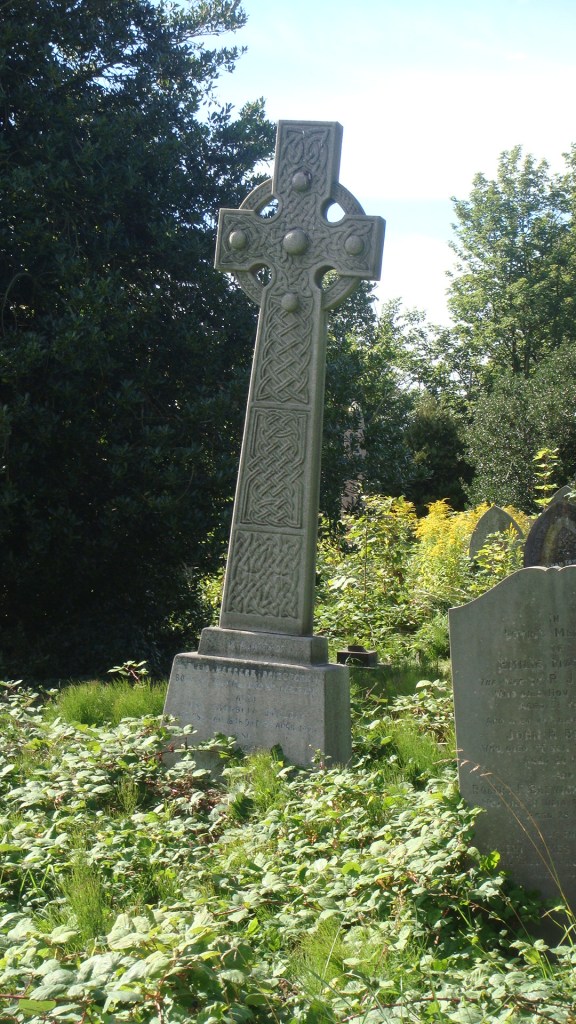
Thomas was buried in grave plot D1a. Robert was buried with him in 1940 and Agnes in 1942. The elegant, pink granite headstone is decorated with entwined ivy, a symbol of friendship, fidelity and immortality.
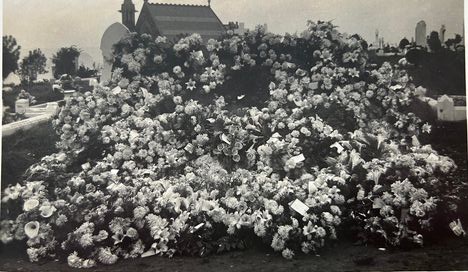
I have recently received several old photographs of Radnor Street Cemetery and how I wish there was one of this funeral where the report says ‘there was a wealth of floral tributes.’
Lilian Pitt was just 19 years old when she died suddenly in 1928. Her two brothers Charlie and Willie travelled up for the funeral with their mother from Abercynon in the Rhonnda Valley while sister Violet came down from her home in Hampstead, London. Other mourners included various cousins and Rose Pitt, the aunt with whom Lilian lived.
The Late Miss Pitt – An impressive tribute to the memory of Miss Lilian Pitt (aged 19), whose death occurred suddenly at 182, Victoria Road, where she lived with her aunt, Miss Rose Emily Pitt, and who was a very popular scholar at the Trinity Presbyterian Church, was paid by the Rev. J.H. Gavin, B.D., at the funeral service at the Victoria Road Presbyterian Church. Mr Gavin mentioned Miss Pitt’s connection with the Sunday School and the Bible Class, and said she was always a good scholar. Miss Pitt was formerly a scholar at Clarence Street School and later was a very popular student at the Euclid Street Secondary School. Her school colleagues subscribed and sent a beautiful wreath to be placed on her grave. Another beautiful wreath was received from the Presbyterian Sunday School. The Rev. J.H. Gavin also officiated at the burial service at the Radnor Street Cemetery.
The chief mourners were: Mrs L.G. Anderson, Abercynon (mother), Miss Violet Pitt, Hampstead (sister), Osborne, Charlie and Willie Pitt, Abercynon (brothers), Miss Rose Pitt, Swindon (aunt), Miss Phyllis Lewis and Miss Cissie Lewis, Swindon (cousins) Mr and Mrs Tom Lewis, Swindon (cousins), Mrs Caswell (Rodbourne Cheney), and Mr Ernie Strange. There was a wealth of floral tributes.
North Wilts Herald Friday, January 27, 1928.
Photograph taken at the funeral of Ethel Mary Franklin
Photograph taken at the funeral of Robert Powell
Today you are more likely to find primroses and daffodils on the Radnor Street Cemetery graves – just as beautiful.
Lilian Gertrude Pitt aged 19 was buried on June 23, 1928 in grave plot C3678. Her grandfather Thomas Pitt was buried with her in 1921 and her aunt Rose Emily Pitt joined them when she died in 1938. There is also a child buried with them. Beryl Davies who died aged 17 months old in 1941, It is not known if the little girl is related to the Pitt family.











 Radnor Street Cemetery