There were a lot of words written about William Nicholson following his death in 1880.
We are sorry to notice the death, on the 13th instant, at New Swindon, of Mr William Nicholson, who, for the long period of nearly 45 years, was a valued and trusted servant of the Great Western Railway Company, and who at the time of his death was, we believe, the oldest foreman in the employ of that company, having served in that capacity very close upon 40 years.
Leaving his native place, Bolton, in Lancashire, very shortly after serving his time as an apprentice to the engineering business, he went to Liverpool, where he married, and obtained employment in an establishment where Daniel (now Sir Daniel) Gooch and his brother were serving their articles as pupils. He, however, did not stay there long, but removed to Paddington, where the Great Western Railway Company had just opened their first engineering works, and when the Swindon works were opened Mr Nicholson came to Swindon, now 39 years since, and after a very short time was appointed foreman over the turning and fitting department, and in this important position he remained until about 15 years ago, when the whole of the Swindon works were considerably enlarged under the direction of the late Mr Armstrong, and the new gas works were then put under the sole charge of Mr Nicholson, and in this position he remained until his death, which took place on Tuesday week, after a somewhat protracted illness caused by heart disease and dropsy.
During his lengthened connection with Swindon and the Railway Company Mr Nicholson enjoyed the respect and esteem of all who knew him. He was devoted to his duties and the interests of his employers, and was strictly conscientious in all his dealings, whilst to the thousands of men who had been placed under his superintendence he was always kind and courteous.
Having known Mr Nicholson from the time when he first came to Swindon, it affords us some satisfaction to be able to bear our testimony to the sterling character of a strictly honest and upright man, and one who, although never ostentatious in any of his dealings, by his general demeanour set a good example before those under him or who came in contact with him. We have been asked to publish the following, which has been forwarded to us by an old workman under Mr Nicholson:
“Another old servant of the Great Western Railway Company has gone to his long home. Mr William Nicholson, who was one of the earliest arrivals from Paddington to Swindon on the opening of the line, and who for many years occupied the position of foreman in the fitting and turning shops in the local department, but latterly that of superintendent of the gas works recently erected by the GWR Company, he having only survived to witness the completion of the extensive and elaborate works of which he was so proud. He was followed to his last resting place, in St. Mark’s Churchyard, by numerous foremen of the works, and a large number of old hands who served under him, who attended to bear testimony to the respect they bore him while living. His widow, with whom he has lived for upwards of half a century on the most affectionate terms, is left to mourn her loss.”
The Swindon Advertiser, Saturday, January 24, 1880.
And in 1992 railway and local historian Trevor Cockbill wrote a few more in his excellent book A Drift of Steam, describing William Nicholson as a devout Wesleyan Methodist who founded the New Swindon Wesleyan Methodist Society and became the first Superintendent of its Sunday School.
But when it comes to his wife Betsey no one appears to have written about her.
William married Betsey Langdale at St Anne’s Church Liverpool on May 17, 1830. We find them on the 1851 census living at Westcott Place, Swindon with four of their children, Betsey’s sister Jane Langdale, a lodger and a 12 year old servant girl. Apart from the official census records the only words I have discovered about Betsey appear on her headstone – and even this isn’t how things might first appear.
William died in 1880 and was buried in the churchyard at St. Mark’s. Betsey died in 1884 but by then the churchyard at St Mark’s had closed and the new cemetery at Radnor Street had opened, which is where Betsey was buried on August 30, 1884 in grave plot A55. She lies in an unmarked grave where she was later joined by the sister who had lived with her for so many years, Jane Langdale who was buried on February 17, 1890. However, the family had made sure that both Betsey and Jane were remembered by adding their names to William’s headstone – interred in Swindon Cemetery.
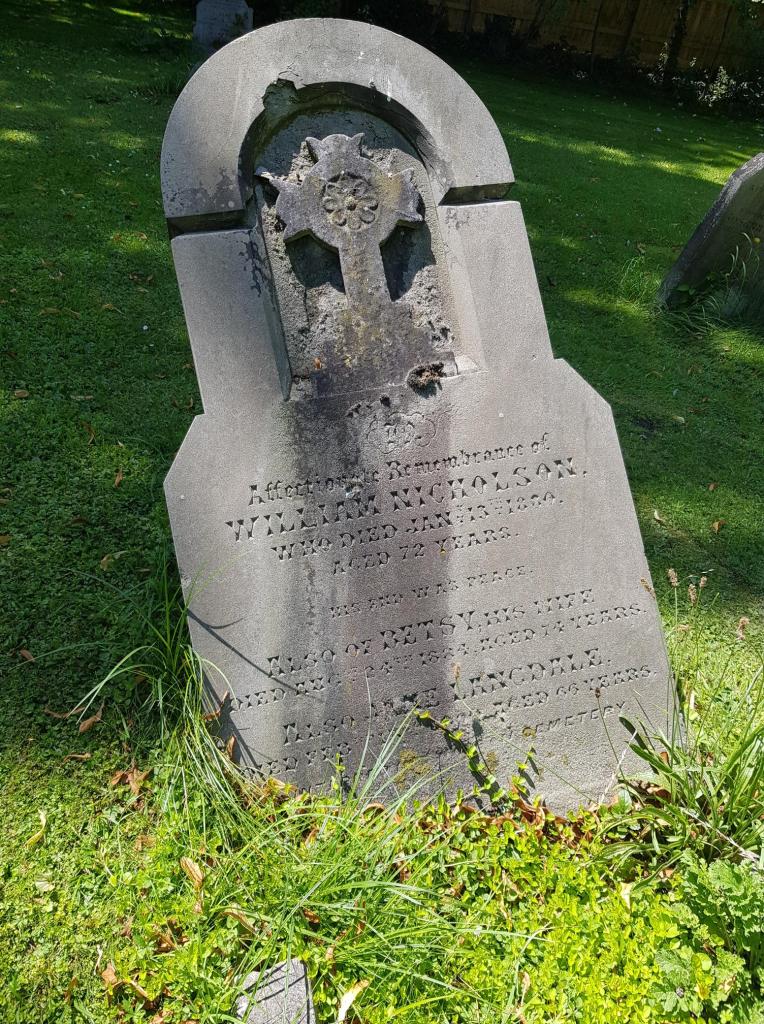

 Radnor Street Cemetery