I had read the story of Thomas J. Stewart in the writings of the late Trevor Cockbill, railway and local historian, but sometimes the story you start out researching turns into something a little different.
Thomas Stewart was one of the very first railwaymen to arrive at the frontier town of New Swindon, travelling in an open railway truck, it is said. He started in the Works on Monday, December 20, 1842, a fortnight before the official opening and lit the very first smith’s fire in the factory.
Thomas was born in 1811 in Lanarkshire and on arriving in Swindon he first lodged in Stratton St Margaret. He appears on the first census taken in the railway village in 1851.
Thomas Jack Stewart died on April 26, 1899 aged 87 years at the home of his son-in-law Robert Affleck and left effects valued at £11 4s to his daughter Agness Stewart Affleck. But Thomas had never married.
Agnes was born on February 9, 1851 the daughter of Maria Smith and baptised at Christ Church on March 23. The entry in the baptism registers includes the name of Thomas Stewart but this has been crossed through and the words ‘illegitimate daughter of Maria Smith’ remain.
Maria Lucy Smith was the eldest daughter of Edward and Elizabeth Smith and at the time of the 1851 census, taken shortly after the birth of her daughter Agnes, she is living with her parents in Cricklade Street. The census records that Edward and Elizabeth have three other daughters and a niece living with them and the last entry is that of their granddaughter Agnes aged 1 month.
Thomas obviously had some involvement with his daughter. When she married Robert Affleck at Christ Church in 1875 Thomas was a witness at the wedding ceremony, although his name does not appear as ‘father’ on the marriage certificate, which is left blank. In 1891 he was living with Agnes and her husband and family at 37 Prospect Place where he is described on the census as Thomas Stewart father-in-law 79 years old retired blacksmith born in Scotland. And at the time of his death in 1899 he was still living with the Affleck family.
The Late Mr t. Stewart,
Funeral on Saturday
The funeral of the late Mr Thomas Stewart, an old GWR foreman whose death we announced last week took place on Saturday afternoon. The funeral cortege left deceased’s late residence, Southfield House, The Sands, Old Swindon, at three o’clock. The coffin was borne on a handbier, and covered with a pall, there being no flowers by request. The bier was attended by eight bearers, from the F Shop, all workmen who were formerly employed under deceased.
The coffin was of polished panelled oak with massive brass fittings and engraved plate bearing the words:- “Thomas Jack Stewart. Born June 7th, 1811. Died April 26th, 1899.” The chief mourner was Mr R. Affleck (son-in-law), the other coaches containing deceased’s grandsons, and Messrs T.B. Watson, and W. Chivers.
There were three mourning coaches, and between 20 and 30 mourners on foot, including the following:- Messrs. R. Baker, T. Patterson, J. Sykes, W. Morgan, Enoch Smith, W.S. Dawson, John Fox, E. Tomkinson, Ellison, ? ? Broadbear, Alf Bowker, Pickard, Robert Fawcett, J. Clark, W. Sewell, R. Gadd, Burrows, D. White, E.L. Pugh, etc.
The first portion of the service was conducted at St. Mark’s Church, and the remainder in the Cemetery, the Hon. Canon Ponsonby officiating.
The funeral arrangements were most satisfactorily carried out by Mr. Fred. J. Williams, on behalf of Mr. Joseph Williams.
Writing from London to Mr T.B. Watson, of New Swindon, on Saturday, in reference to the death of Mr. T.J. Stewart, Mr John Fawcett, whom we mention in our last week’s issue, says:- “I was transferred from Bristol to Swindon on January 1st, 1843, and found Stewart had been at work here about a fortnight. He lit up the first fire in the new smiths’ shop, and I the second. There were, of course, the ordinary staff of men in the Running or A Shed, under Mr Appleby, but Stewart was, I believe, the first man Mr Sturrock (the first manager at the Works), engaged for the opening of the new Works. Mr Stewart had built a couple of houses at Patercroft, where he must have been residing some four or five years before coming to Swindon. He used to go regularly to Patercroft to look after the repair of these houses long after he came to Swindon. I have made out a list of the names of all the foremen and contractors up to the time I left Swindon in 1866, and I am sorry to find that out of about 30 contractors there is scarcely one left beside myself. The same may be said of the foremen, managers and draftsmen. I was pleased to hear a few days ago that Mr Sturrock is still living and residing at Chelsea like myself, he is an octogenarian, and well into his 83rd year. I feel I am the only shopmate left who could give reliable information as to Mr Stewart’s career at Swindon in the early days.”
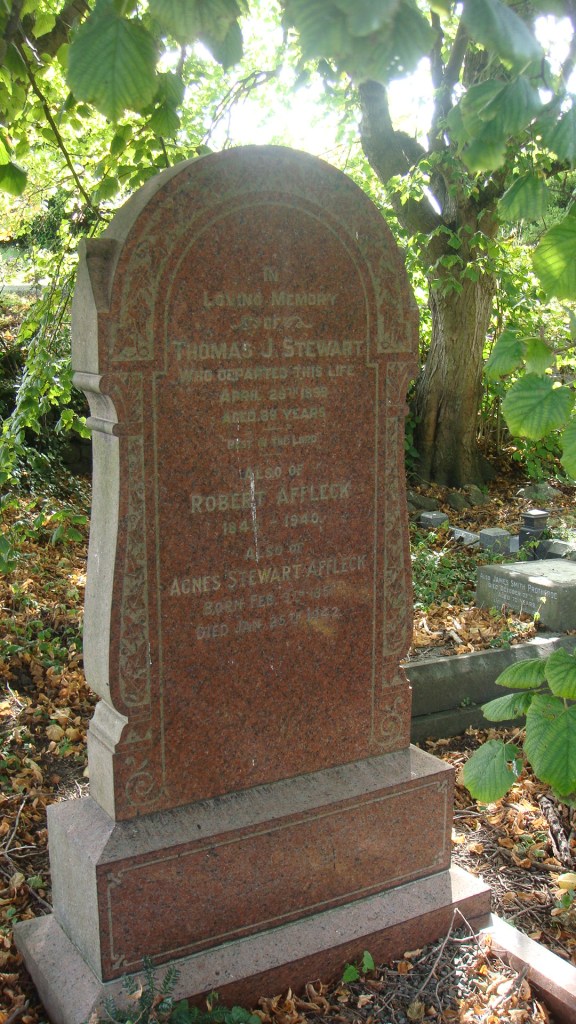
Thomas was buried in grave plot D1a. Robert was buried with him in 1940 and Agnes in 1942. The elegant, pink granite headstone is decorated with entwined ivy, a symbol of friendship, fidelity and immortality.

 Radnor Street Cemetery