During a period when we might have thought people stayed in the area in which they were born, railwaymen and their families were frequently on the move.
Born in about 1805 in Lamesley, Durham, Robert had already moved about a fair bit by the time he arrived in Swindon. His route can be traced by the birth place of his children in Penshaw and Shields in Durham, Paddington and then Swindon.
Engine driver Robert Patterson appears on the 1851 census in Swindon when street numbering was still to be established. He lived in No. 2 or 5 Farringdon Street with neighbours Robert Laxon at No. 1 or 4 and William Laverick at No. 3 or 6, although that was not the end of his travels. Between 1871 and 1881 (when he was 78 years of age) he was still working as an engine driver and living in Milford Haven, Pembrokeshire, which is a bit of a coincidence as I lived there as well exactly a hundred years later.
The couple had seven children – two sons Thomas and Michael, who sadly died aged 20 in 1856, and five daughters, two of who died aged 22 and 24. Hannah and Barbara Patterson died in identical circumstances in 1862 within just five weeks of each other, their tragic deaths reported in the local press.
New Swindon
Singular Circumstance – Four weeks ago to-day we recorded the death of Miss Barbara Patterson, of New Swindon, in a peculiarly sudden and lamentable manner, and we have to-day to announce the death of her elder sister, Miss Hannah Patterson, under similar circumstances.
It was be remembered that Miss Barbara Patterson was taken ill on the Sunday evening after having been about as usual during the day, and after lingering until about the same hour on the following day she expired. A post mortem examination of the body subsequently disclosed the cause of death to have been the rupture of an internal abscess, the discharge from which had flooded the heart.
On Sunday week, Miss Hannah Patterson was apparently in her usual state of health, and was out walking both in the afternoon and evening. Some time after she had returned home in the evening she complained of sudden illness; medical aid was at once procured, and, notwithstanding that Mr. Swinhoe was in almost constant attendance upon her, she, after being ill to within half an hour of the period of her sister’s illness, expired; and from the symptoms under which she laboured, there appears to be no doubt whatever but that the cause of death in both instances was precisely the same.
The death of two young women – the one 22 and the other 24 years of age – in so sudden and peculiar a manner, has produced quite a sensation in New Swindon.
Wiltshire Independent, Thursday, November 6, 1862.
The late Trevor Cockbill, railway and local historian, writes in his book A Drift of Steam that the Choral Society arranged a Sacred Concert, conducted by Mr Albert Sykes, which included Mozart’s Twelfth Mass to be held in the Mechanics’ Institution. The proceeds were donated to provide a memorial for Miss Hannah Patterson’s grave in St. Mark’s churchyard. Trevor writes that the programme included a tribute to Miss Patterson “who for so many years past contributed, by the aid of her great vocal talent to the edification and pleasure of this and the surrounding neighbourhood. Her services were at all times cheerfully and gratuitously rendered.”
Robert Patterson died in December 1884 aged 82 at 2 Gloucester Terrace, Swindon. He was buried in grave plot A1093. Margaret died in August 1887 aged 77. Her last address was in Brigstock Road, Bristol. She was buried with her husband on September 1, 1887.
There were a lot of words written about William Nicholson following his death in 1880.
We are sorry to notice the death, on the 13th instant, at New Swindon, of Mr William Nicholson, who, for the long period of nearly 45 years, was a valued and trusted servant of the Great Western Railway Company, and who at the time of his death was, we believe, the oldest foreman in the employ of that company, having served in that capacity very close upon 40 years.
Leaving his native place, Bolton, in Lancashire, very shortly after serving his time as an apprentice to the engineering business, he went to Liverpool, where he married, and obtained employment in an establishment where Daniel (now Sir Daniel) Gooch and his brother were serving their articles as pupils. He, however, did not stay there long, but removed to Paddington, where the Great Western Railway Company had just opened their first engineering works, and when the Swindon works were opened Mr Nicholson came to Swindon, now 39 years since, and after a very short time was appointed foreman over the turning and fitting department, and in this important position he remained until about 15 years ago, when the whole of the Swindon works were considerably enlarged under the direction of the late Mr Armstrong, and the new gas works were then put under the sole charge of Mr Nicholson, and in this position he remained until his death, which took place on Tuesday week, after a somewhat protracted illness caused by heart disease and dropsy.
During his lengthened connection with Swindon and the Railway Company Mr Nicholson enjoyed the respect and esteem of all who knew him. He was devoted to his duties and the interests of his employers, and was strictly conscientious in all his dealings, whilst to the thousands of men who had been placed under his superintendence he was always kind and courteous.
Having known Mr Nicholson from the time when he first came to Swindon, it affords us some satisfaction to be able to bear our testimony to the sterling character of a strictly honest and upright man, and one who, although never ostentatious in any of his dealings, by his general demeanour set a good example before those under him or who came in contact with him. We have been asked to publish the following, which has been forwarded to us by an old workman under Mr Nicholson:
“Another old servant of the Great Western Railway Company has gone to his long home. Mr William Nicholson, who was one of the earliest arrivals from Paddington to Swindon on the opening of the line, and who for many years occupied the position of foreman in the fitting and turning shops in the local department, but latterly that of superintendent of the gas works recently erected by the GWR Company, he having only survived to witness the completion of the extensive and elaborate works of which he was so proud. He was followed to his last resting place, in St. Mark’s Churchyard, by numerous foremen of the works, and a large number of old hands who served under him, who attended to bear testimony to the respect they bore him while living. His widow, with whom he has lived for upwards of half a century on the most affectionate terms, is left to mourn her loss.”
The Swindon Advertiser, Saturday, January 24, 1880.
And in 1992 railway and local historian Trevor Cockbill wrote a few more in his excellent book A Drift of Steam, describing William Nicholson as a devout Wesleyan Methodist who founded the New Swindon Wesleyan Methodist Society and became the first Superintendent of its Sunday School.
But when it comes to his wife Betsey no one appears to have written about her.
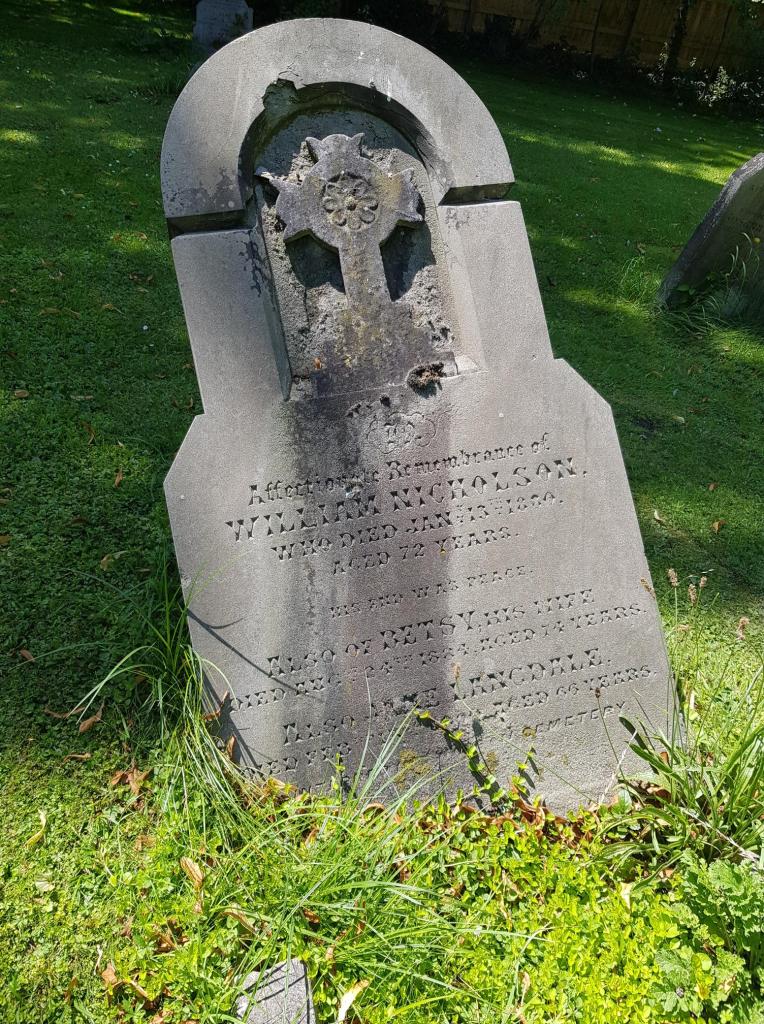
William married Betsey Langdale at St Anne’s Church Liverpool on May 17, 1830. We find them on the 1851 census living at Westcott Place, Swindon with four of their children, Betsey’s sister Jane Langdale, a lodger and a 12 year old servant girl. Apart from the official census records the only words I have discovered about Betsey appear on her headstone – and even this isn’t how things might first appear.
William died in 1880 and was buried in the churchyard at St. Mark’s. Betsey died in 1884 but by then the churchyard at St Mark’s had closed and the new cemetery at Radnor Street had opened, which is where Betsey was buried on August 30, 1884 in grave plot A55. She lies in an unmarked grave where she was later joined by the sister who had lived with her for so many years, Jane Langdale who was buried on February 17, 1890. However, the family had made sure that both Betsey and Jane were remembered by adding their names to William’s headstone – interred in Swindon Cemetery.
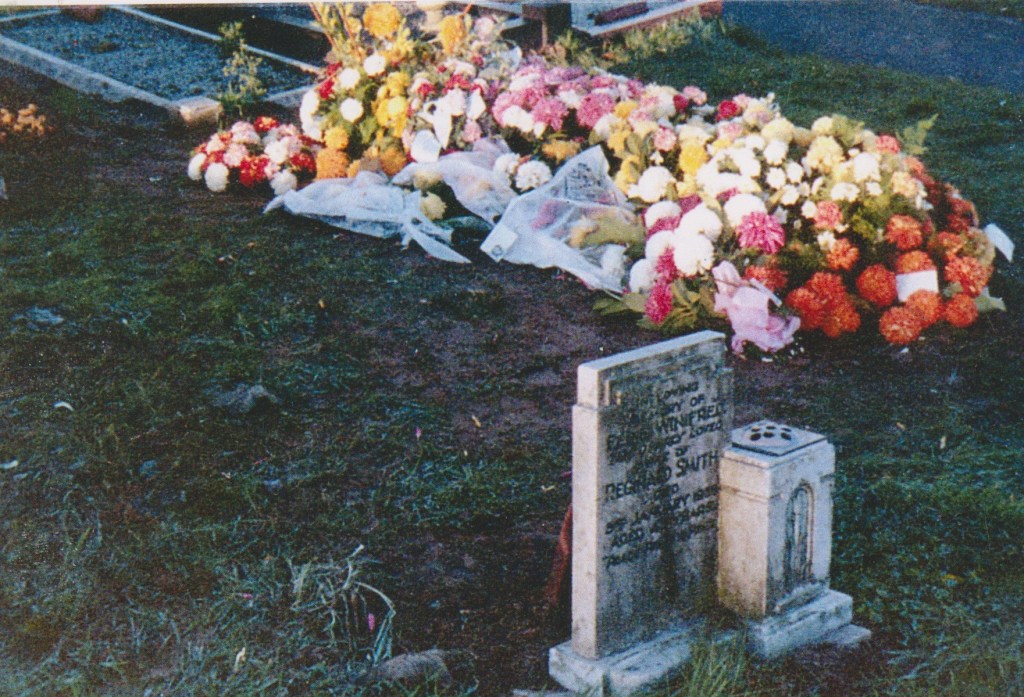
And all this time I’ve had not just one but two old photographs of the cemetery sitting in my archives. Several years ago Rose kindly gave me some documents and photographs relating to family burials in Radnor Street Cemetery. Among them are two photos of grave C1177 – one taken at the time of a funeral and another some time later when the headstone was in place. But a headstone doesn’t always tell the whole story!
It is likely this plot was originally a public grave. The first burial to take place here was that of Emily Ridlinton in 1903.
The Jefferies family probably bought the plot in 1922 upon the death of Daisy Louisa Jefferies. Daisy was the first wife of Reginald Harold Jefferies and was 27 years old when she died at her home, 43 St Mary’s Grove. She was buried in plot C1177 on November 15.
In 1924 Reginald married Violet Ruby Hillier and when the wartime census was compiled in 1939 they were living at 43 St. Mary’s Grove with their 11 year old daughter Beryl. Although Reginald had previously worked as a machineman he describes his occupation in 1939 as Music Teacher. At the outbreak of war he was also an ARP Warden.
Further research is required to discover what happened to Violet, but in 1951 Reginald married for a third time. His bride was Dorothea E.M. Keylock, the daughter of William Barnes Keylock and granddaughter of William John White Keylock. Reginald was 59 and Ruby 50, but although this was rather a late marriage for both of them it lasted for 18 years until Dorothea died in 1969. Reginald died the following year.
What better place to rest for all eternity than in the shade of a tree in Radnor Street Cemetery?
Thomas had spent a lifetime working as an engine fitter, a skilled job but hardly a glamorous one, except in nostalgic retrospect. Ann had given birth to at least 8 children – there may have been others who were born and died in between the ten yearly census count.
Thomas Barefoot was born in about 1835 in Maidenhead, Berkshire, the son of James and Elizabeth Barefoot. On census returns James is recorded as a ‘policeman’ with the GWR. During this period this means that he was a guard, according to railway historian Trevor Cockbill.
Like many railway employees the Barefoot family moved around a lot but by 1851 both James and his younger son Thomas were living in Swindon. His eldest son George was living in Boston, Lincolnshire where he worked as a coppersmith, although he too later returned to Swindon.
Thomas married Louisa Bizley at Christ Church in 1857. They were both very young, Thomas was 21 and Louisa only 18. Sadly, she died in 1859 and was buried in the churchyard at the church where she married.
During the 1860s Thomas married for a second time and appears to have lived in London for several years where five of his children were born. By 1871 the family were back in Swindon and living at 22 Tabernacle Terrace, Stratton St. Margaret.
Thomas’s brother George was a member of the Mechanics’ Institute Council but so far I have not discovered whether Thomas took such an active role in the civic life of the town. Perhaps it was enough for him that he paid his way and raised his family.
Both Ann and Thomas spent their last years living at 9 St Paul’s Street, Swindon with their daughter Florence Hatter and her family.
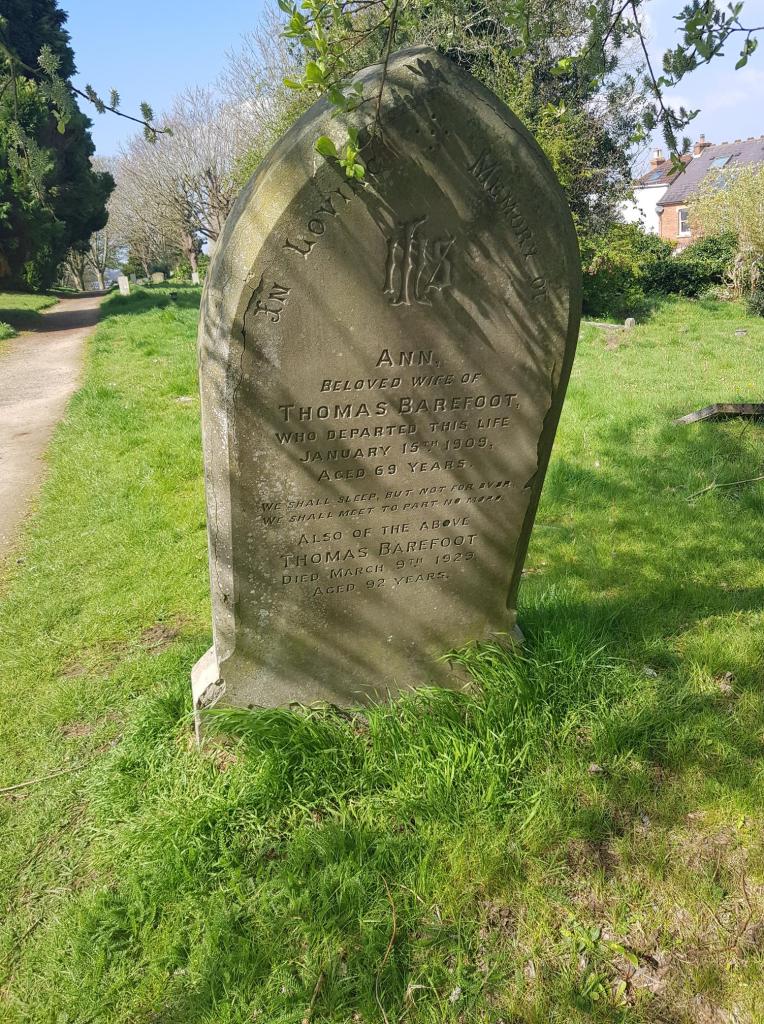
Ann died on January 15, 1909 aged 69 and was buried in this shady spot on January 19. Thomas died 20 years later at the age of 92. He was buried with Ann on March 14, 1929 in grave plot B3032.
Regular visitors to our cemetery walks will know my pet hate – the under recording of married women’s work on the Victorian census returns. Despite official instructions to the enumerator regarding the recording of women’s work e.g. ‘women who are regularly employed from home, or at home, in any but domestic duties to be distinctly recorded,’ much was lost in translation. Casual and seasonal work was frequently omitted, as was work in a family business, so often all we see here in on the census returns for railway dominated Swindon is, for example ‘boilermaker’s wife.’
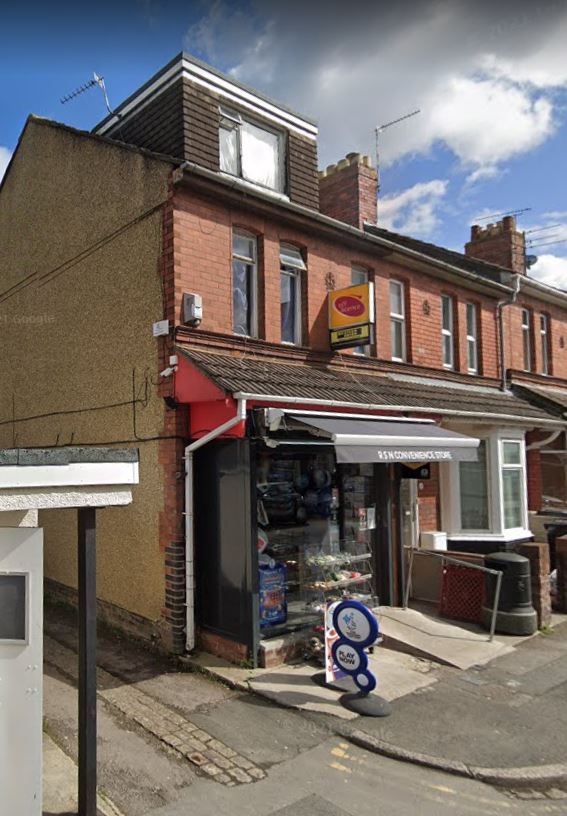
The 1939 list compiled at the outbreak of WWII also reveals most married women described as being engaged only in ‘unpaid domestic duties’ – really! Well I have found an exception – Lucy Dash who was recorded as ‘assistant to newsagent’ at 3, Kent Road. Yes, it only tells half the story, but it’s an improvement.
The newsagents in Kent Road where Lucy ‘assisted’
Lucy was born in 1893 in Gateshead, the third child of John, an engine fitter, and his wife Lucy Peters. The family arrived in Swindon sometime during the 1890s and a home in Stafford Street.
At the time of the 1911 census 17 year old Lucy was working as a Draper’s Assistant in Maidenhead, Berks and lodging with Mrs Edward and three other young, single women all employed in the drapery business (the occupation of single women was usually recorded). In 1923 she married Herbert George Dash and the couple went on to have four children.
In 1928 A.R. Leach occupied the newsagents at 3 Kent Road but by 1939 Herbert and Lucy (assisting, of course) were in residence.
Following their retirement the couple lived at 10 Grovelands Avenue, Swindon. Lucy died on October 14, 1955 and was buried in grave plot E7773 with her parents and her sister Phyllis.
The strapline for this blog is ‘Remembering the ordinary people of Swindon.’ This grave story is about one such ordinary family. George worked as a platelayer with the Great Western Railway, a job described by Will Thorne, a platelayer during this periodas The most neglected man in the service. The poorest of any railway employee with little or no opportunity for promotion or advancement.
In 1870 George married Martha Robinson at the parish church in Wroughton where they had both grown up. George and Martha would have 10 children but sadly four of them died young. In 1881 they were living at 13 Oxford Buildings, Rodbourne with three of their children, George’s mother and an unnamed lodger described on the census returns as having “left house.”
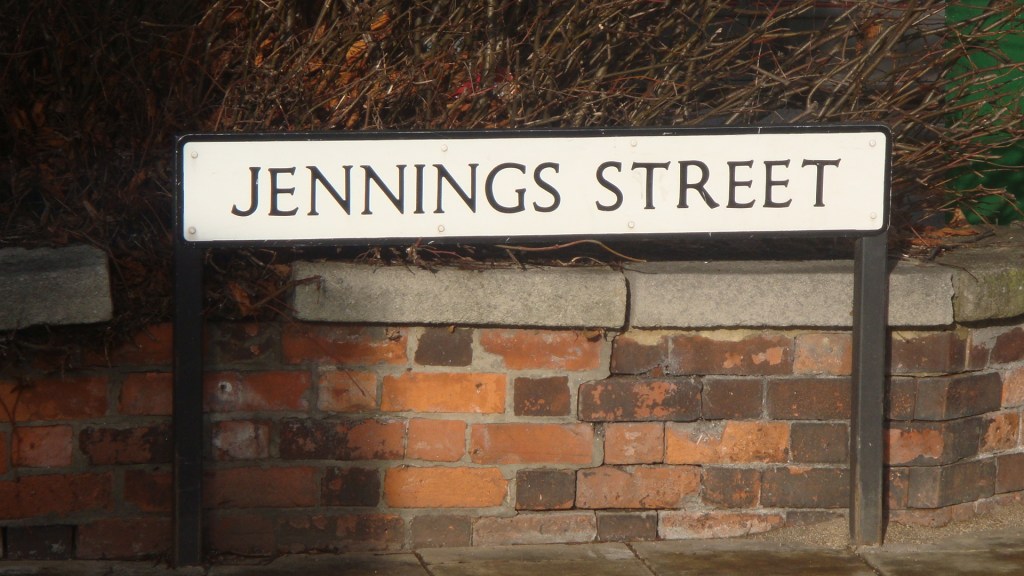
By 1891 they were living a 21 Jennings Street where they would remain for more than 20 years. It was where Martha died in 1918.
How many meals did the family sit down to eat in the kitchen? How many Mondays had Martha toiled over the boiler in the scullery, pegging out washing on a line that stretched the length of the garden. Did she dust and polish or was there little furniture to fuss over in the house at No 21 Jennings Street?
Was George a keen gardener, when all that washing wasn’t hanging in the way? Or was he too exhausted after a day’s work to do yet more digging and shifting earth? Was he a member of the Even Swindon Working Men’s Club and Institute, cutting along the backsies for a swift half? Or did he prefer to drink in the Dolphin? But then again, perhaps as a Methodist he didn’t partake of Mr Arkell’s finest.
And what about Hilda, the daughter who was buried with George and Martha. She never married and worked as a domestic servant, that much we know. She died on July 6, 1936 at 30 Twickenham Road, Isleworth, not at her home in Maze Road, Kew, nor at 49 Paxton Road, Chiswick, the address recorded in the burial registers.
So many unanswered questions about one ordinary Rodbourne family.
Martha Coster died at her home in Jennings Street in May 1918 aged 70 years old. She was buried in grave plot C1952 on May 9. Her husband George Coster died at 92 Beaufort Terrace, Rodbourne Road on January 31, 1922. He left effects valued at £266 18s 8d to his daughter Kate Fisher. He was buried on February 4 with Martha. Hilda Coster died on July 6, 1936 aged 53. She was buried with her parents on July 10.
Yesterday I published the story of William Barnes Keylock who died in 1955. Today I am sharing the documents concerning the burial of his father in 1894.
One of the most poignant revelations of reading the Keylock family burial documents was the cost of a basic burial in 1894, yet so many Swindon families were unable to afford even that.
The two accounts published here were issued by the Swindon Burial Board for Charges and Fees, for Interment at the Cemetery.
The first invoice is dated April 28, 1894, the day following William John White Keylock’s death (the burial board didn’t hang around!) and was addressed to his son Mr W.B. Keylock of 11 College Street.
The costs include 5s for a burial in grave plot A856. An additional charge of 2s 6d was for the services of the officiating minister and 3s for the Sexton. There was a 6d charge for a grave space indicator (presumably the terracotta markers seen about the cemetery today) and finally 1s to toll the bell. The cost of a burial (not the funeral itself) amounted to 12s, little more than 50p in today’s money, but so much more in 1894 – more than many Swindon residents could afford. But the Keylock family had not been such a family.
William John White Keylock was born in 1853 the son of John, a painter and glazier, and his wife Ann. He grew up in Albert Street and began work with his father. He married Susannah Ponting on July 20, 1872 at the Wesleyan Methodist Chapel, The Planks and by 1889 he was working as a beer retailer at 12 High Street, later known as the Baker’s Arms.
The second invoice addressed to Mrs S. Keylock was issued on January 31, 1895, some nine months after her husband’s death. Susannah has paid for the Purchase of Grant of Right or Burial in Grave Space No 855 & 856 Section A at a cost of £2 2s. She paid a further 2s 6d to have her husband’s details entered in the Burial Register. These are the registers vital to our research and it had never occurred to me that some names might be missing due to an inability of the family to pay. Finally, Susannah paid 2s 6d for a burial certificate. There is no entry for erecting a monumental stone so maybe there never was one. Susannah paid £2 7s (less than £2.50 today) but a big expense in 1895 and of course the funeral costs would be in addition to this.
William John White Keylock, retired publican, died on April 27, 1894 at 11 College Street. He left effects valued at £74 (worth around £9,000 today) to his wife Susannah.
Susannah remarried. She died aged 72 in March 1925 at the house she had shared with William. She was buried on March 21 in grave A856 with William and in the plot next to her son and daughter-in-law.
Finding these records that Rose so very kindly provided several years ago has been a thought provoking experience.
After some 15 years of research the Radnor Street Cemetery archives are becoming quite extensive. Between us Andy, Noel and I have many hundreds of photos and items of ephemera and it was while looking through one of my boxes that I came across this cache of documents.
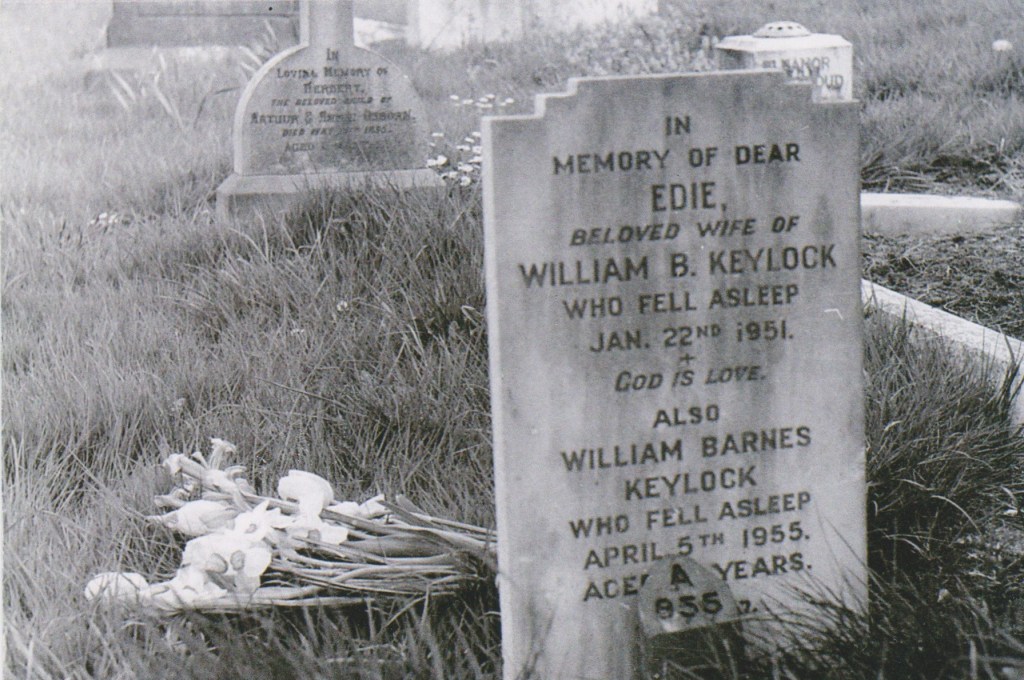
Rose contacted me some years ago as she feared her family headstones had been removed from the cemetery. The passage of time had seen the memorials sink and tilt and become very discoloured and almost unrecognisable, but I was able to confirm they were still there. At the time Rose provided me with family documents regarding graves and burials and several photographs including one of the grave of William Barnes Keylock and his wife Edie.
William was born on December 2, 1872 and baptised at Christ Church on December 10. He was the only surviving child of William John White Keylock and his wife Susanna. In 1881 William J.W., a pattern maker, Susanna and William B. were living at 9 Read Street. William B. started work as a Railway Clerk on April 2, 1888 and at the time of the 1891 census he was living with his parents at the Bakers Arms in the Railway Village where his father was the inn keeper.
William Barnes Keylock married Edith Prideaux Dymond on July 27, 1895 at the parish church in Porlock. The couple had two children, William Harold and Dorothea Edith May. Sometime after Dorothea’s birth in 1901 the family moved to London where William was licenced Victualler at the White Hart, Clerkenwell and later The Eagle in Woolwich.
By 1939 the family had returned to Swindon and William, Edie and Dorothea were living at 11 College Street.
Edie died aged 77 at the Victoria Hospital. She was buried in plot A855 on January 26, 1951. William died aged 82 on April 5, 1955 at St Margaret’s Hospital. He was buried here with Edie on April 9, 1955.
My thanks to Rose for providing so much information and my apologies for taking so long to publish her family story.
To be continued …
Photograph believed to be William Barnes Keylock as a boy – published courtesy of Ancestry
Untangling the Knights family history has proved to be a bit confusing. My research began with the account of George Samuel Knights death in 1908.
The report in the Swindon Advertiser states – For many years Mr Knights acted as local and district agent for Messrs Brown and Plummer, wine and spirit merchants, and he was in charge of the branchshop in Faringdon Street. In fact, Mr Knights and his late father had been sole agents in New Swindon and District for some forty years, and they were both held in the highest esteem by the firm, and by all with whom they had business transactions. However, at the end of the account a disclaimer is added We are asked to state, in order to correct a misapprehension which has apparently got about, that Messrs Brown and Plummer were in no way connected with the late Mr. G.S. Knights as a wine and spirit merchant.
All very confusing. So, what do we actually know about George? Well, we know about the circumstances of his death.
Swindonian’s Tragic Death
Cycling Fatality at Hannington
Mr Geo. S. Knights killed by a Fall
General regret will be felt in Swindon and district at the news of the tragic death of Mr. George S. Knights of Faringdon Street, Swindon.
For many years Mr Knights acted as local and district agent for Messrs Brown and Plummer, wine and spirit merchants, and he was in charge of the branchshop in Faringdon Street. In fact, Mr Knights and his late father had been sole agents in New Swindon and District for some forty years, and they were both held in the highest esteem by the firm, and by all with whom they had business transactions.
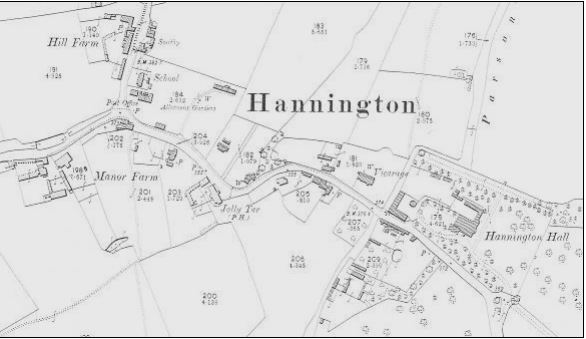
It was while out cycling near Hannington last Tuesday afternoon that the accident, which so suddenly terminated his life, happened. He was riding a bicycle to Hannington, and as far as can be ascertained in Swindon, had arrived at the top of what is known as Nell Hill, just outside Hannington. While on the brow of the hill, and on the point of descending, a sudden gust of wind blew off Mr Knights’ hat. In attempting to catch the hat, Mr Knights lost control of his machine, and overbalanced, with the result that he fell heavily to the ground. How long he lay by the roadside is not definitely known, but it is clear that he was so severely hurt that he was unable to help himself, and it was not until a little boy passed along and saw him that assistance was procured. A doctor was as soon as possible summoned, but in the meantime Mr Knights had succumbed to his injuries, which, it is stated, were chiefly confined to the spine. The body was removed to the “Jolly Tar” Inn, Hannington.
Mr Knights’ untimely end will be deeply deplored by his many friends in Swindon. The deceased was a highly respected townsman. For some time he has been Churchwarden at St. Mark’s Church, where he was held in the warmest esteem, and had been for many years a devoted worker. He was 49 years of age, and leaves a wife and a grown up family of three – two sons and one daughter, for whom the keenest sympathy will be felt.
The funeral will probably take place on Saturday.
The Jolly Tar, Hannington published courtesy of Arkells and Local Studies, Swindon Central Library.
Inquest at Hannington
On Wednesday afternoon, Mr. A.L. Forrester, Coroner for North Wilts, held an inquiry at the “Jolly Tar” Inn, Hannington, into the circumstances of the death of the late Mr. George S. Knights, wine and spirit merchant, of 39 Faringdon Street, Swindon.
Mr E. Tytherleigh was chosen foreman of the jury, and the following evidence was taken:-
George Robert Knights, of 84 Dixon Street, Swindon, son of the deceased, identified the deceased as his father, George Samuel Knights, aged 49 years, wine and spirit dealer, lately residing at 39 Faringdon Street, Swindon. Witness last saw his father alive on Saturday night.
The Coroner: Then you know nothing about the accident. We are all very sorry for you and desire to express our sympathy with you.
John Henry Payne, a lad of 13 years, residing at Hannington, said that at the time of the accident he was at work on the Hannington Wick Road, between Hannington and Kempsford. He saw a bicycle coming down the hill (Nell Hill) in the afternoon.
The Coroner: What did you see?
Witness: I saw him fall off his bicycle. It was nearly at the bottom of the hill.
The Coroner: Did you watch him go down the hill?
Witness: Yes.
The Coroner: Did you see a straw hat or something?
Witness: No. He was wearing a black bowler hat, and it would have fallen off if he had not put his hand to it.
The Coroner: Was that at the bottom of the hill?
Witness: Nearly at the bottom. The bicycle got shaky, and he fell off sideways. Witness added that he told the man he was with and they went down to the man’s assistance.
Joseph Hedges, of Hannington, the man who accompanied the previous witness, deposed to going up Nell Hill about 3.50 p.m. on Tuesday afternoon. He saw the gentleman going down the hill on a bicycle. He was waring a bowler hat. Witness saw nothing amiss until the boy Payne told him the man had fallen off his machine. Witness went to his assistance, and found him lying on his face, bleeding, and in an unconscious condition. The bicycle was on the other side of the road. There was a rim brake on the front wheel.
Dr. J. Powell (Highworth) said that about 5.30 p.m. he received a telegraphic message, in response to which he proceeded to Hannington Wick Hill, and there saw the man now identified as George Knights, lying dead by the side of the road. Witness examined him and found he was bleeding freely from the nose and ears, evidently caused by a fracture of the base of the skull. The injury was probably caused by the deceased falling off the bicycle.
The jury returned a verdict in accordance with the medical testimony, and expressed their sympathy with deceased’s relatives.
Extracts from The Swindon Advertiser Friday July 24, 1908.
The Late Mr G.S. Knights
Impressive Funeral
On Saturday afternoon the remains of the late Mr George S. Knights, whose tragic death as the result of an accident whilst cycling was reported in these columns, were laid to rest in the Swindon Cemetery amid very many manifestations of sincere sympathy and unfeigned regret.
The funeral cortege left the residence of the deceased gentleman, 39 Faringdon Street, Swindon, Shortly before half past twelve, and proceeded to St. Mark’s Church, where Mr. Knights was an esteemed churchwarden.
Other organisations associated with the Church represented in the procession were the General Purposes Committee of St Mark’s parish, the Sunday School teachers and among the representatives of the CFTS was Mr A. Cross, the Secretary.
Several of the deceased’s old shopmates in the GWR Works also followed. Mr Knights being formerly in the Carpenters’ Shop under Mr Abell. Among those who followed were Mr G. Hutchings, foreman of the Wagon Shop; Mr Smith, foreman of the Carpenters’ Shop; Mr Nevill, under-foreman of the Carpenters’ Shop; Mr Hayward, under-foreman of the Saw Mills and others.
The large congregation in the Church included many others to whom Mr Knights was known, and by whom he was warmly respected. The service, though short, was of a most impressive character, and was fully choral. Among the clergy present were the Vicar, the Rev. A.G.G. Ross, M.A., the Rev. H.R.B. Morgan, B.A., in charge of St. Luke’s’ Rev. H.C. Brocklehurst, M.A., in charge of St. Saviour’s; Rev. K.M.S. Graeme, M.A. , Rev. C.E. Prior, and the Rev. E.F. Winnington-Ingram.
As the solemnprocession entered the Church they hymn, “Brief life is here our portion,” was sung, after which the 90th Psalm was chanted. The Rev. H.R.B. Morgan read the lesson from I. Corinthians, 15th chapter, and then the hymn. “On the Resurrection Morn,” was sung. As the procession left the Church, the organist, Mr. John Newton, played the “Dead March” in Saul, the congregation standing meanwhile.
The mournful procession was added to by many sympathizing friends as it proceeded to the Cemetery, where it was joined by a further assembly, and where the second portion of the solemn rite at the graveside was conducted by the Rev. A.G.G. Ross.
The remains were enclosed in an elm shell within an elm coffin with brass furnishings, the breastplate bearing the following inscription: “George Samuel Knights died July 21st 1908, aged 49 years.”
The funeral arrangements were carried out by Messrs. H. Smith and Son, Gordon Road, Swindon.
We are asked to state, in order to correct a misapprehension which has apparently got about, that Messrs Brown and Plummer were in no way connected with the late Mr. G.S. Knights as a wine and spirit merchant.
The Swindon Advertiser Friday July 31, 1908
George was baptised at Holy Trinity Church, Mile End Road and consistently states on census returns that his birth place was Tower Hamlets. Some family historians researching the Knights family make a link to Haddiscoe in Norfolk. However, at the time of his marriage to Marion Emily Ellen Timpson in 1884 George was living in Swindon where he was employed as a carpenter. The couple were married at St. Stephen’s Church, Paddington on February 23, 1884 and at the time of the 1891 census they were living at 48 Radnor Street with their two young sons George and Arthur. A daughter Gertrude was born the following year.
George was buried on July 25, 1908 in grave plot C1997. His wife Marion Emily Ellen died in 1932 and was buried with him on January 26. Their son George Robert died in 1941 and was buried with them on April 2. On July 13, 1946 Joan Lloyd Wyndham Rawlings was buried in the Knights family grave. Whether Joan had any connection to George and his family has yet to be established.
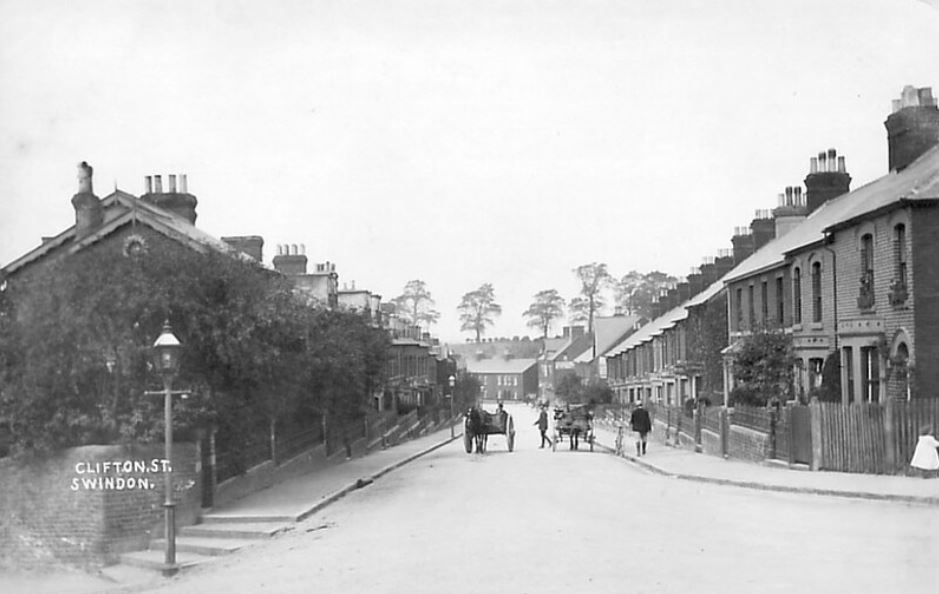
Clifton Street published courtesy of Mr P. Williams and Local Studies, Swindon Central Library.
It’s surprising that there is no road named after the entrepreneurial Edwin Harvey.
Edwin Harvey was born in Keynsham in 1843 one of William and Mary’s large family of 12 children. Edwin began his apprenticeship in the building trade working as a plasterer, most probably alongside his father, a plasterer journeyman. By 1871 aged 28 Edwin describes himself as a painter.
He married Alice Elizabeth Baker at St. Paul’s Church, Bath on November 26, 1878. Edwin, aged 36, then described his profession as Builder and his place of residence as New Swindon where he had already begun to make his mark!
In 1877 he was building a hotel and cottages on the Kingshill estate and in 1878 he built 4 houses and shops on Cambria Bridge Road with business partner William Crombey.
In 1879 he describes himself as builder and beerseller when he makes an application for a license to “Sell by Retail Beer and Cider, to be consumed on the House and Premises thereunto belonging, situate at William Street.” This beerhouse was most probably built by Edwin and occupied the corner plot of William Street and Cambria Bridge Road. It was owned by his deceased brother William and in 1879 by his widow Ann.
William Street and Park Hotel
Edwin was a busy man during the 1880s building houses in Albion Street, William Street, Clifton Street and Exmouth Street where he would eventually make his home. In addition to his building work he was elected a member of the New Swindon Local Board in 1885 and in 1887 a member of the Swindon Hospital Committee, acting on behalf of the Building Committee.
In 1881 he lived at William Street with his wife Alice and their baby daughter Ethel. By 1891 they had moved to 50 Exmouth Street where the family had grown considerably and then numbered 6 children. Edwin’s brother John lodged with them. By 1911 No 50 Exmouth Street (now named Glenthorne) was still a busy household with 4 twenty something children still living at home with Alice and Edwin, now aged 68 and retired.
Edwin Harvey died at his home in 50 Exmouth Street on October 21, 1925. He was 82 years old. The funeral took place on October 24 when he was buried in grave plot D1525 with his wife Alice who died in 1917.
With no street named in his honour, I’m hoping there will be a headstone on his grave when I find it.
*Harvey Grove off Cheney Manor Road, was built in 1936 and named after Albert Harvey who once farmed at Manor Farm, but so far I haven’t come across a road named in honour of Edwin Harvey.











 Radnor Street Cemetery