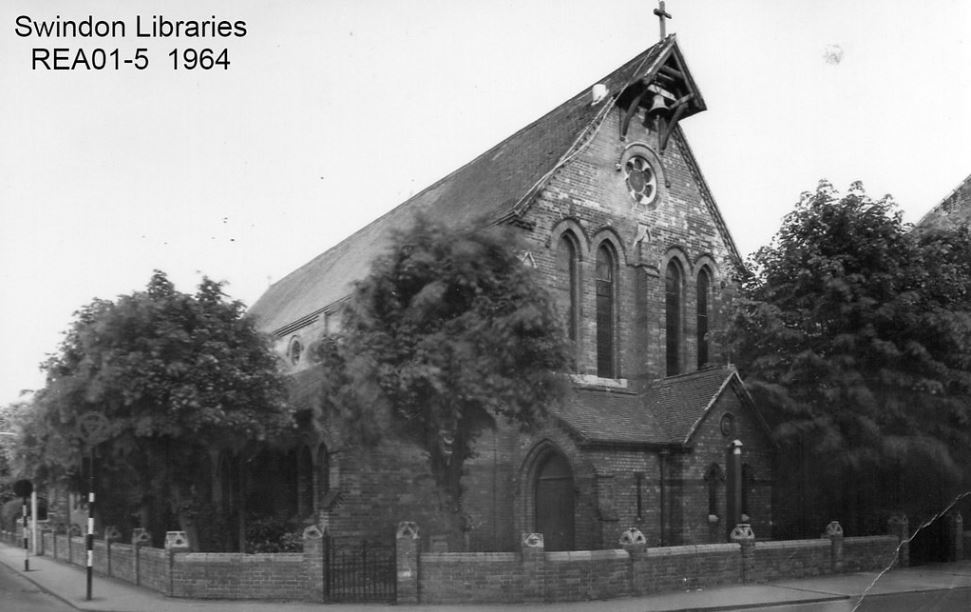
St Paul’s Church, Edgware Road, Swindon published courtesy of Local Studies, Swindon Central Library
You could be forgiven for never having heard of St Paul’s Church. It used to stand on the Woolworth’s site, although that won’t help you either as that store too has disappeared from Swindon’s town centre.*
The church of St Paul was designed by Edmund Ferrey and built in 1881 with a chancel added in 1883. St Paul’s served the myriad of town centre streets – Regent Place, Brunel Street, Gordon Gardens and others – all demolished during the 1960s re-development. An estimated population of 4,500 people were moved to housing estates on the outskirts of town and the prime retail site went on the market at £90,000. The church was demolished in 1965 when the valuable plot was acquired by F.W. Woolworth & Co. The St. Aldhelm’s Chapel stands on a small section of the former church plot.
The Rev Hanworth Hart Rackham arrived in Swindon following the death of Rev Douglas Ware in 1899. Born in Liverpool in 1860, Hanworth Hart Rackham was the son of Matthew Rackham, a Shipping Master Board of Trade, and his wife Katherine.
Swindon Clergyman’s Death
Rev. H.H. Rackham Passes Away in His Church
Death on Saturday evening carried away one of Swindon’s best-known clergymen, the Rev. Hanworth Hart Rackham, who had ministered as vicar of St. Paul’s parish for nearly 16 years. Happily there had been no long weary struggle for life, for the passing took place suddenly during vespers on Saturday evening in the church which he loved so well. It was a wonderfully peaceful end, and those who stood around the remains noted how the face was illumined with a happy smile.
Comparatively few of the congregation heard the sad news on Saturday night, and were greatly shocked with the intelligence which greeted them on reaching the church on Sunday morning.
Mr. Rackham, who was a native of Liverpool, was 55 years of age. He was educated at Worcester College, Oxford, where he took the BA degree in 1889 and the MA degree four years later. He was ordained deacon at Coventry, in the Worcester Diocese, in 1890, and priest in 1891. The first ten years of his ministerial life he spent as a curate at Kidderminster, where he had charge of a district church; but on the death of the Rev. D. Ware, he was presented by the Bishop of Bristol to the living of St. Paul, New Swindon, where he continued to labour until the moment of his death.
The late Vicar of St. Paul’s was a man of remarkable energy, which he displayed almost to the last, despite the fact that he suffered severely at times from disease of the heart. On taking charge of his parish he found its finances far from satisfactory, and he has left them thoroughly sound, besides building the Dowling Street Mission Hall and a new vestry to the church. This he accomplished owing to his splendid persuasive powers and his great faith in voluntary effort. He inaugurated in the parish a scheme of regular voluntary contributions, called the Sacred Treasury, to which members of the congregation undertook to subscribe week by week such sums as their means enable them to afford. The scheme soon became the backbone of the church’s finances in this thoroughly working-class parish. The outstanding feature of Mr Rackham’s work was not merely his energy, but his personal influence, which has been shown by the fact that his advice on spiritual matters has been sought by people living in all parts of England.
At St. Paul’s Church on Sunday morning, and again in the evening, when there was a large congregation, the Rev. H.J.W. Wrenford, in place of a sermon, made a short statement concerning the late Vicar’s passing. There was nothing in his condition to make one apprehensive that the end was coming. He was, as he had been on many previous occasions, obviously in pain and short of breath; but all through the day he was cheerful and bright, as he always was, surmounting all his pain and trouble. In the morning he was for a short time tending his roses in the garden, which showed that he was happy. Just before evensong, which he conducted in his usual bright and happy way, he came into the vestry, and we noticed that he paused for a moment, as he had often done before, to gain his breath. He went into the church to say evensong. He said the Confession and Lord’s Prayer. We noticed that he seemed in pain. We started the Psalms, and we had just finished the first of the Psalms for the evensong, which closed with the words “Put not your trust in man; put your trust in God, for vain is the help of man.” As soon as we had said these words he quietly collapsed on the floor. We did what we could to help him, but it was of no avail. It was God’s will; his time had come. I am sure of this – that he seemed to be conscious of no pain. It was certainly the most peaceful passing that one can imagine that one had ever seen. Immediately after he had passed from this world he lay with a smile on his face. I noticed that particularly, so I think we had great cause for thankfulness to God. We thank God that He gave him just the kind of death that he would have desired. Our Vicar, as you all know, would prefer to die in harness. I am sure there was no way in which he would sooner have passed from the world than in the presence of God in His Sanctuary.”
At the Cemetery
Thousand of people lined the streets as the coffin was taken up the steep declivity to the Cemetery, by way of Regent Circus, Eastcott Hill and Dixon Street. Such a funeral procession has probably never before been witnessed in Swindon. It stretched in a close line from St. Paul’s Church to the Town Hall.
The grave had been dug on the high ground near the Church of England chapel,** and in order to keep back the general public a large space was roped off and guarded by policemen.
Extracts from the North Wilts Herald, Friday, January 28, 1916.

Hanworth Hart Rackham 55 years old, priest of Edgware Road Vicarage was buried on January 27, 1916 in grave plot E7370 where he lies alone.
The Rev. Rackham’s grave has recently been rediscovered in Radnor Street Cemetery.
*The former Woolworth’s store is now occupied by OneBelow discount shop and Peacocks.
**The cemetery chapel was a non-denominational chapel.

 Radnor Street Cemetery