In the beginning the cemetery was simply called Swindon Cemetery, but it could so very easily have become known as Redcross Street Cemetery.
Today this is the only reference to Radnor Street’s previous name.
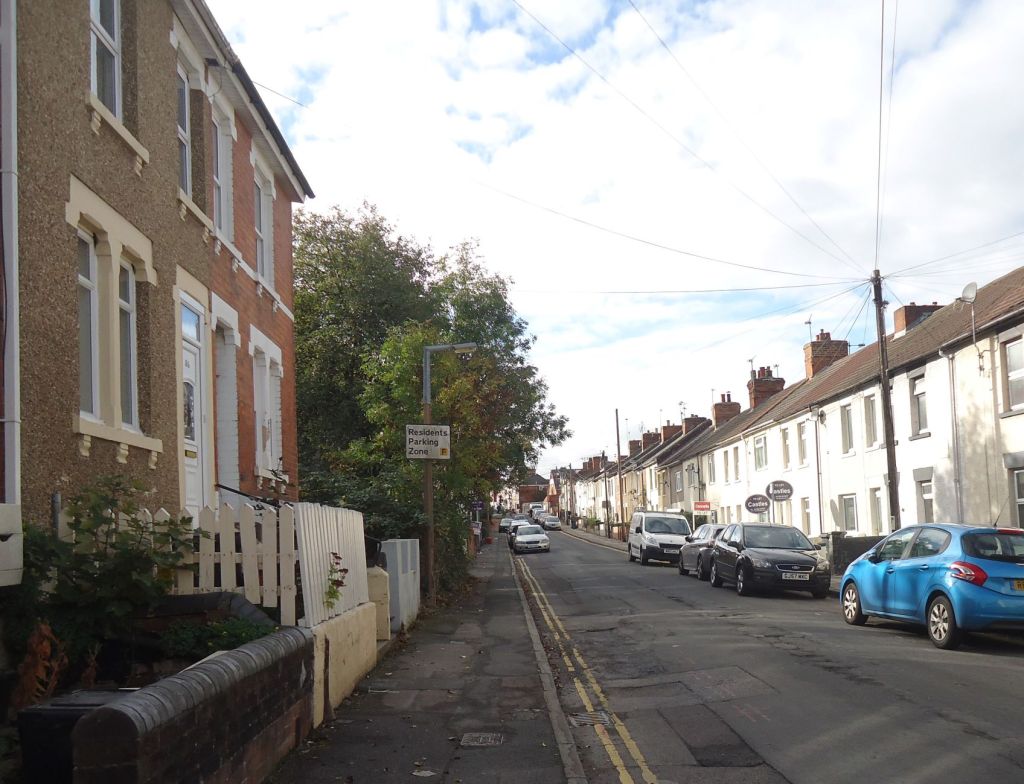
When building began in the street that would begin at the top of the precipitous Stanmore Street and continue to the junction with Shelley Street and Cambria Bridge Road it was known as Redcross Street.
Mr James Hinton, auctioneer, announced that on January 29, 1879 there would be a sale of ‘All those EIGHT NEWLY-ERECTED SIX ROOMED, COTTAGES with GARDENS thereto, Situate on the North side of Redcross-street, Kingshill, Swindon, being Nos. 177, 178, 179, 180, 181, 182, 183, And 184 on the Plan of the Lower Kingshill Estate, which Plan will be produced at the time of Sale.’
Just a week later more properties and additional building plots in Redcross Street came under the hammer. Lot 1. All those five newly-erected six-roomed COTTAGES, and five similar COTTAGES not quite completed, with gardens thereto, situate on the north side of Redcross-street, Kingshill, Swindon, being Nos. 185, 186, 187, 188, 189, 190, 191, 192, 193 and 194 on the plan of the Lower Kingshill Estate, which plan will be produced at the time of sale. Lot 2. All those ten PLOTS of valuable FREEHOLD BUILDING LAND, situate on the south side of Redcross street aforesaid, being Nos. 223, 224, 225, 226, 227, 228, 229, 230, 231, and 232 on the plan of the Lower Kingshill Estate. Each plot has a frontage of 15 feet to Redcross-street.
By 1881, when negotiations for the new cemetery were under way, the street was already being referred to as Radnor Street, however at the time of the census taken in April 1881 it was still called Redcross Street and was apparently renamed sometime later that year.
Jacob Pleydell-Bouverie, 4th Earl of Radnor served as Lord Lieutenant of Wiltshire from 1878 until his death in 1889. The Pleydell-Bouverie Wiltshire base was at Longford Castle, near Salisbury and closer to home, they owned the stately pile that was Coleshill House. Maybe Swindon thought it advantageous to name one of their many streets of red brick terrace houses after the local aristocracy.
Building continued in Radnor Street throughout the 1880s with properties built by S. Spackman, J. Longland and B. Jefferies.
If you look carefully as you walk around the cemetery you will see the name Bartlett on many of the headstones, usually inscribed discreetly on the kerbstone surround.
Alfred was born in Cricklade in 1865 the son of William Bartlett, a master stonemason, and his wife Mary Ann. In 1881 16 year old Alfred was employed as a pupil teacher at the National School in Cricklade, perhaps with the intention of making teaching his career. But maybe the death of his father in January 1889 compelled him to take up his father’s occupation. In 1890 he married Leah Annie Brown when he states that his occupation is that of stone mason.
By the mid 1890s Alfred had established his business as a monumental mason in Bath Road where it remained for many years. Today the firm has premises on Victoria Road.
Alfred’s end was a sad one as his death in 1916 reveals he was a patient at the Wiltshire County Asylum in Devizes. It is recorded that between 1915-1920 there were high levels of TB and dysentery at the Asylum; perhaps one of these illnesses was the cause of his death.
Leah Annie never remarried and lived out her days at 22 Bath Road. She died in 1934 and left effects worth £265 10s 4d to her executors, her sons William Alfred and Charles Bartlett, both monumental masons.
Alfred Bartlett died aged 51 years. He was buried here in plot C2021 on October 7, 1916. Leah Annie Bartlett died aged 66 years and was buried with her husband on March 28, 1934.
In 1900 the Great Western Railway employed more than 12,000 people in the Swindon Works. It has to be said that most Swindon families were a Great Western family.
This is the story of the Cook family.
John Cook was born in Wootton Bassett. He married Emily Smith at Christ Church, Swindon in 1852. At the time of the 1861 they were living in Oxford with their four children. In 1871 John returned to Swindon and brought his family (5 sons and a daughter) back to a home at 22 Westcott Place where two more children were born.
John worked as a boilermaker and by 1881 all five sons were employed in the Works. George 23 was an engine fitter, Henry 21 and Walter 19 were both boilermakers like their father, Alfred was an engine fitter and even 14 year old Frank had begun a boilermaker’s apprenticeship.
Alfred Guess Cook was born in 1863 and baptised at St. Thomas’s Church, Oxford where the family lived at 71 Bridge Street, Osney Town. At the time of the 1871 census the family were still living in Oxford, although it seems likely John had already returned to Swindon and a job in the Works.
By 1911 Alfred 48, lived at 25 Westcott Place with his two sisters Alice 42, and Emily 37, and his youngest brother James Irving Cook 33, a locomotive engine erector.
Six brothers all employed in the GWR – a fact observed in the newspaper report of 1931 when 228 men retired under the compulsory retirement age. It would be interesting to work out how many years combined the members of the Cook family gave to the GWR. They could hardly have anticipated there would come a time when the mighty Works would be no more.
Mr A.G. Cook, chargeman fitter, of 25, Westcott place, worked in the GWR works for 55 years, and held the position of chargeman for 42½ years. During the past 23 years he has inspected and put into traffic about 16,000 locomotives and rail cars.
Swindon Veterans of Industry – North Wilts Herald, Friday, January 2, 1931.
Mr A.G. Cook, who retired from the Company’s service on December 24, was a chargeman erector in the locomotive works for over 42 years. He had been in the Company’s employment a total of 55 years. Mr Cook comes of a Great Western family; six of his brothers are, or have been, chargemen under the Company.
Great Western Railway Magazine 1931
Alfred died at his home in March 1934, aged 71 years old. He was buried in grave plot D242 where he was later joined by his brother James, who died in 1944 and his sister Emily who died in 1947.
The problem with being steeped in the history of Swindon is that sometimes you miss the gems a short journey away. This week I have spent three glorious days at the Gloucester History Festival and heard talks by eminent historians such as David Olusoga, Michael Wood and the dynamic Janina Ramirez, Life President of the Festival.
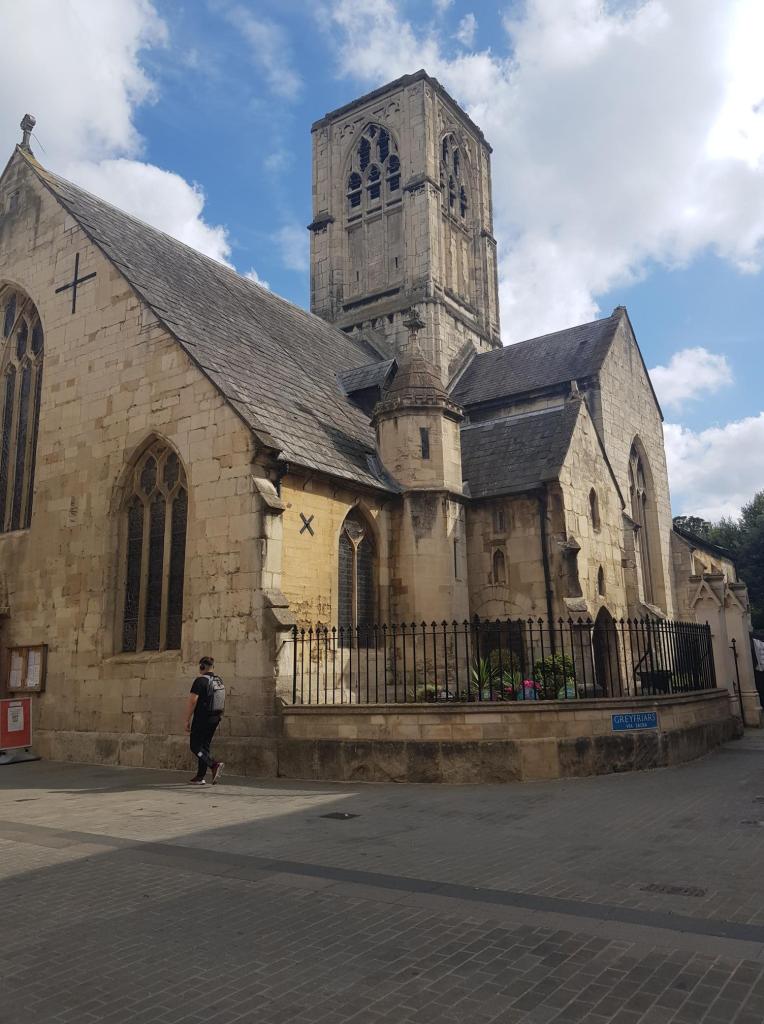
The Gloucester History Festival events take place in the Blackfriars priory in Ladybellegate Street. Founded by Henry III in about 1239 some 40 Dominican friars lived in the priory during the Middle Ages. In addition to their ecclesiastical duties within the priory the friars were also involved with the community beyond its walls, preaching, hearing confessions and taking part in funeral processions.
The priory was closed during the Reformation and the Dissolution of the Monasteries when Henry VIII broke with the Catholic Church in Rome in order to divorce his first wife, Catherine of Aragon and marry his second, Anne Boleyn.
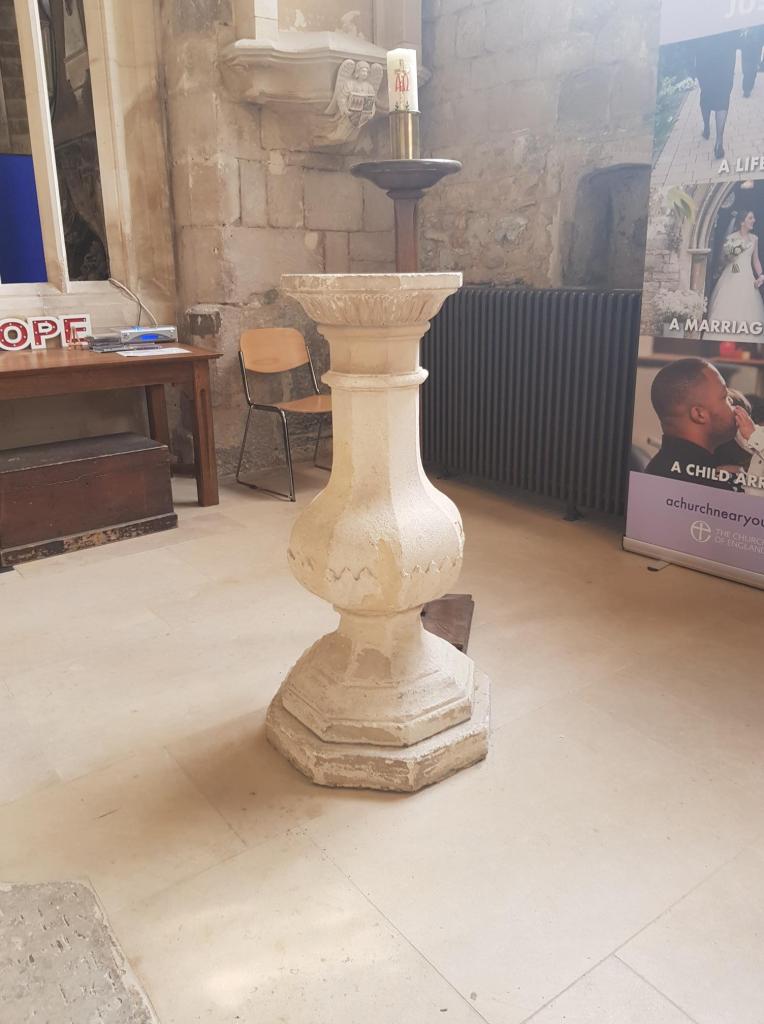
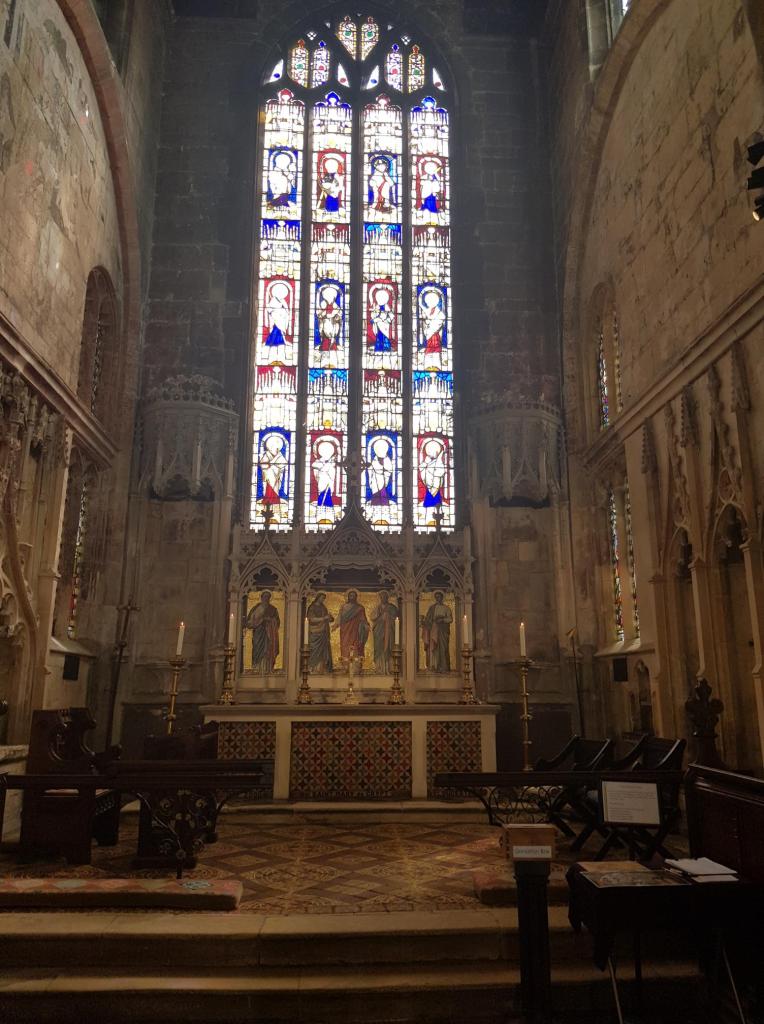
During breaks in the festival talks I took the opportunity to visit the church of St Mary de Crypt in Southgate Street. First recorded in c1140 the medieval church received extensive restoration throughout the 19th and early 20th century. Stepping out of the 21st century Southgate Street into the Grade I listed building, revealed a busy group of volunteers hard at work. However, there was plenty to see with 14th, 15th and 16th century features.
I don’t know if there was ever a cemetery around the church, but as usual those with influence (and money) were able to secure a burial inside the church.
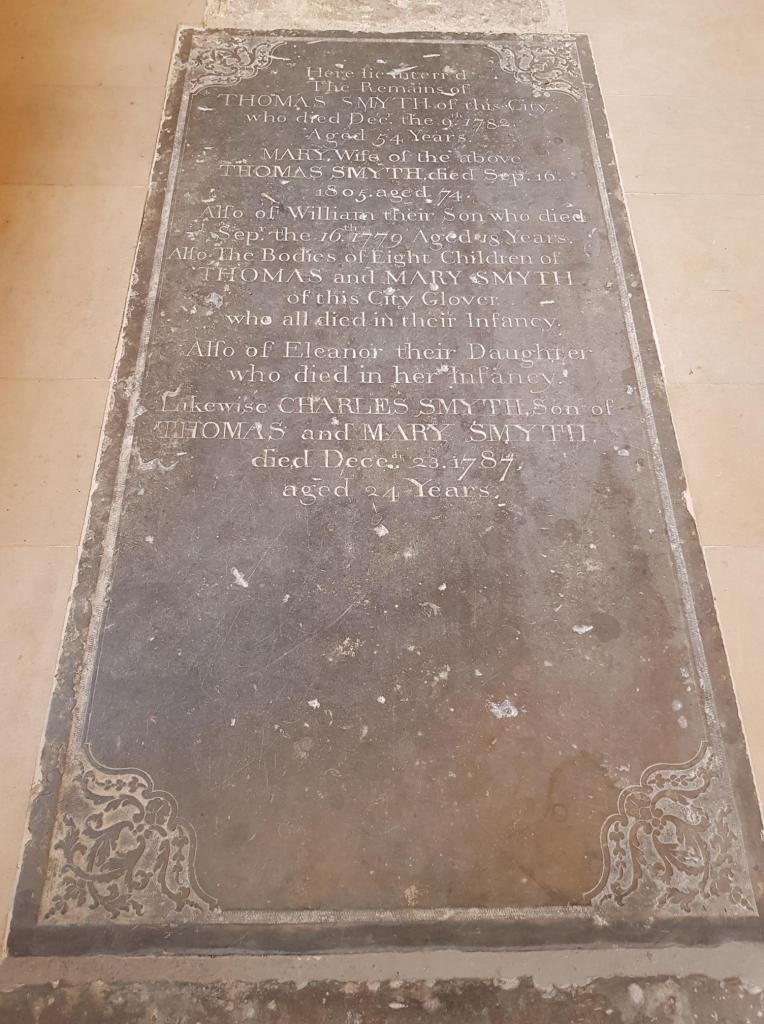
Remembered here is the Smyth family. Thomas who died on December 9, 1782 aged 54. Buried with him are his wife Mary, eight of their children, and a daughter named Eleanor, who all died in infancy, two sons, William who died in 1779 aged 18 and Charles who died in 1787 aged 24.
I would like to know more about Thomas and Mary Smyth and I’m sure someone has at sometime researched this family. I would especially like to know more about Mary, the wife and mother who lost so many children during her own lifetime and died in 1805 at the age of 74.
Margaret Ridley Farr was born on February 28, 1902 in Swindon, the only child of Frank George Farr, a coach body maker in the GWR Works, and his wife Elizabeth.
Margaret was baptised at St Mark’s Church on March 31, 1902 when the family lived at 8 Westcott Place and by the time of the 1911 census the Farr family were living at 51 Exeter Street, one of the company-built houses in the Railway Village, with Elizabeth’s brother and his little daughter.
In 1916 the UK Railway Employment Records reveal that 14-year-old Margaret was working as a temporary clerk in the Loco Department, possibly employed due to staff shortages during the First World War. She left on August 2, 1919 again, possibly as military personnel began to return after the end of the war, but by March of the following year she was once more employed as a clerk in the Loco Department where she remained for five years.
In 1927 Margaret married William Alfred Preston, who worked as a coach body builder in the Carriage and Wagon Works. The couple do not appear to have had children and in 1939 they were living at 31 Westmorland Road, a leafy road just off the town centre with Queens Park at one end and Groundwell Road at the other.
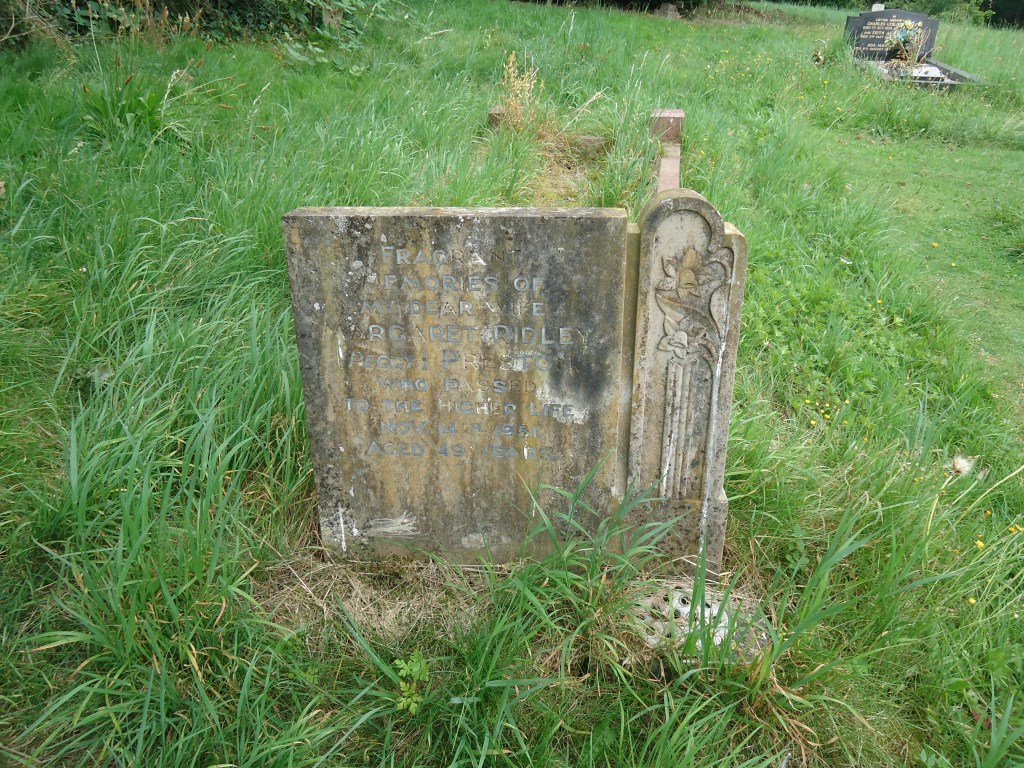
Then just when I thought I had it all nicely sorted out, Margaret’s grave presented a bit of a mystery. The cemetery burial registers reveal that Margaret died in the Victoria Hospital and that her funeral took place on November 17, when she was buried in plot C293. According to the registers this is a public plot and Margaret is buried with four other unrelated people. It is very unusual to have a headstone erected on a public grave and not something that routinely happens in Radnor Street Cemetery. And then I noticed that the neighbouring plot number C292, is that of the Preston family. The first burial in this plot took place in 1896 and was that of Ina Preston, the first wife of Alfred Ernest Preston (William Alfred’s father). His second wife (William Alfred’s mother) Maud Ellen Veal was buried in 1937 and Alfred Ernest himself in 1952. The last burial to take place was that of Irene Helen Preston (William Alfred’s sister) in 1962.
It would appear that William installed the stylish headstone with the sentimental inscription on his parents’ grave?
Fragrant Memories of my dear wife Margaret Ridley [Peggy] Preston who passed to the higher life Nov 14th 1951 Aged 49 years.
William died in 1969 and does not appear to be buried in the cemetery.
I was recently asked by a blog reader why so many of Swindon’s ‘worthies’ were members of the non-conformist faith. Charles Hill is another such example.
Referring to the obituary published in the North Wilts Herald, Rev. A. Brown said it was a fine resume of the life of Mr Hill and could have gone on for another two or three columns had there been space.
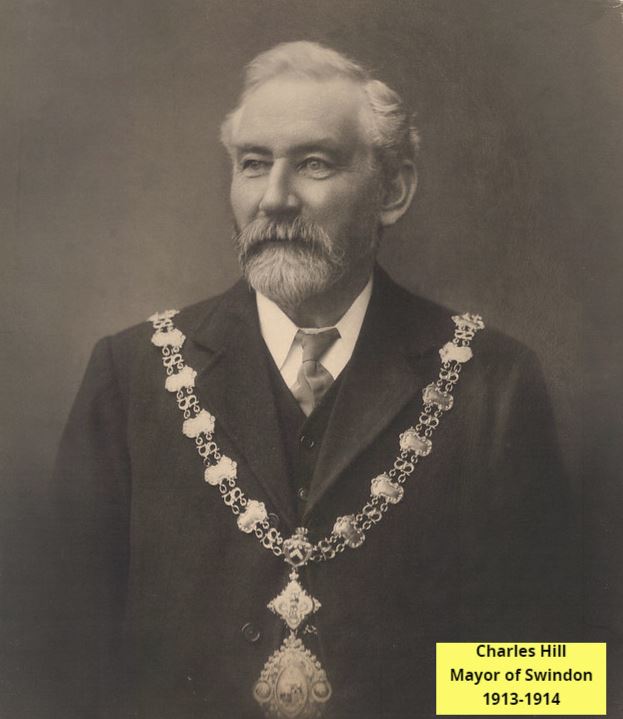
Charles Hill was born in Newton Abbot in 1853. He married Elizabeth Ann Spackman in 1878 and the couple had three children, Mabel, Elsie and Percival. The story of his life follows here:
image published courtesy of Local Studies, Swindon Central Library.
Death of Mr C. Hill, J.P.
Former Mayor of Swindon and Chairman of the Education Committee for 12 Years.
The news of the death in the early hours of Saturday of Mr Charles Hill, of 32 Victoria road, Swindon, will come as a severe shock to thousands of people in Swindon and Wiltshire who knew him so well.
The news will be the more unexpected in view of the fact that right up till Friday he was apparently in his usual health and good spirits, and as recently as Thursday was seen walking in the streets of Swindon, and, indeed, recorded his vote in the municipal elections.
It was only last month that he retired from the many public offices he held in the town.
Foot Amputated.
Mr Hill underwent a severe illness about 18 months ago and had his foot amputated, but though this entailed a temporary retirement from public duties, he returned to them zealous as ever on his recovery.
Mr Hill’s life is the romance of the orphan of a farm, who, by dint of hard work combined with good spirits and geniality, rose to become the Mayor of the town of his adoption, and a magistrate of the county in which he came to live and work.
In April, 1853, he was born near Newton Abbot, and spent his early years working as an orphan boy on a Dartmoor farm. He came to Swindon in 1872, and obtained employment as a porter on the GWR station, later going into the factory.
Then when the old broad gauge track from Swindon to South Wales was converted in 1872, he was a member of what was known as a transport.
Then he went into the R Shop, where he worked for 12 years, first as a labourer, then as a machineman, and finally as chargeman. Leaving the Works, he became a part time agent for several insurance agencies, and in 1896 he was appointed local superintendent of the Sceptre Life Insurance Society.
Service on the Council
In 1894 Mr Hill was elected as a member of the New Swindon Urban District Council and on the incorporation of the borough in 1900 he was elected a councillor. With the exception of one year – 1896 – he completed, on his retirement for the council a week or two ago, 40 years’ continuous service.
There had been 13 Mayors of the borough before Mr Hill became Mayor, and he had served under every one of them. Then in 1913-14 he became Mayor himself, during the year the great war broke out.
For many years he had also served on the Wilts County Council, and until last March, when he retired, had held an aldermanic seat on the County authority for 21 years. His work also extended to the Wilts Standing Joint Committee, and though he had severed his connection with the County Council, he still held a seat on the County Small Holdings Committee.
Work for Education
But it was his work for education which had made him best known. He was appointed to the Education committee when it was established in 1903, and served continuously since that time until he retired about a fortnight ago, being vice-chairman from 1913 to 1919, and chairman since 1922.
In that position he won the affection and respect of his colleagues, and the hearts of children in the schools. He was a familiar visitor to all the schools, and at each of them he had some quaint little story, or a knotty problem with which to amuse the children.
At the time of his death he was the principal and director of C. Hill and Co., insurance agents.
In politics Mr Hill was a progressive Liberal. He was hon. secretary of the North Wilts Liberal and Radical Association, and took part in the winning contest of 1898, 1900 to 1906.
He had been one of the pillars of Methodism and for some 40 years was superintendent of the Sunday School connected with the Regent Street Primitive Methodist Church – now the Methodist Church. He was for some time secretary of the church trustees.
The Funeral
Many public bodies were represented at the funeral service at Regent Street Methodist Church, on Wednesday afternoon.
Mr Hill requested that there should be no flowers and no mourning, and amongst his papers there was found a message asking that those who thought of sending floral tributes should send instead a donation to the Mayor’s Unemployment Distress Fund.
Extracts from North Wilts Herald, Friday, 9 November, 1934.
Charles Hill died at his home, 32 Victoria Road, aged 81 years. He was buried on November 7, 1934 in grave plot E7419 which he shares with his wife Elizabeth Ann who died in 1921 and his daughter Mabel Emma who died in 1965.
Horace Lett Golby was born on April 18, 1887 the youngest of five children. He grew up living at various addresses in Gorse Hill where his father James worked as a house painter. As a 15 year old boy he began a 6 year carpentry apprenticeship in the GWR Works.
On April 5, 1915 he married Ethel Florence Phillip at the parish church in Seend, Wiltshire, the bride’s home parish. He was 28 and she was 25. Their daughter Dorothy Mary was born on January 22, 1916 and later baptised in the church where her parents had married.
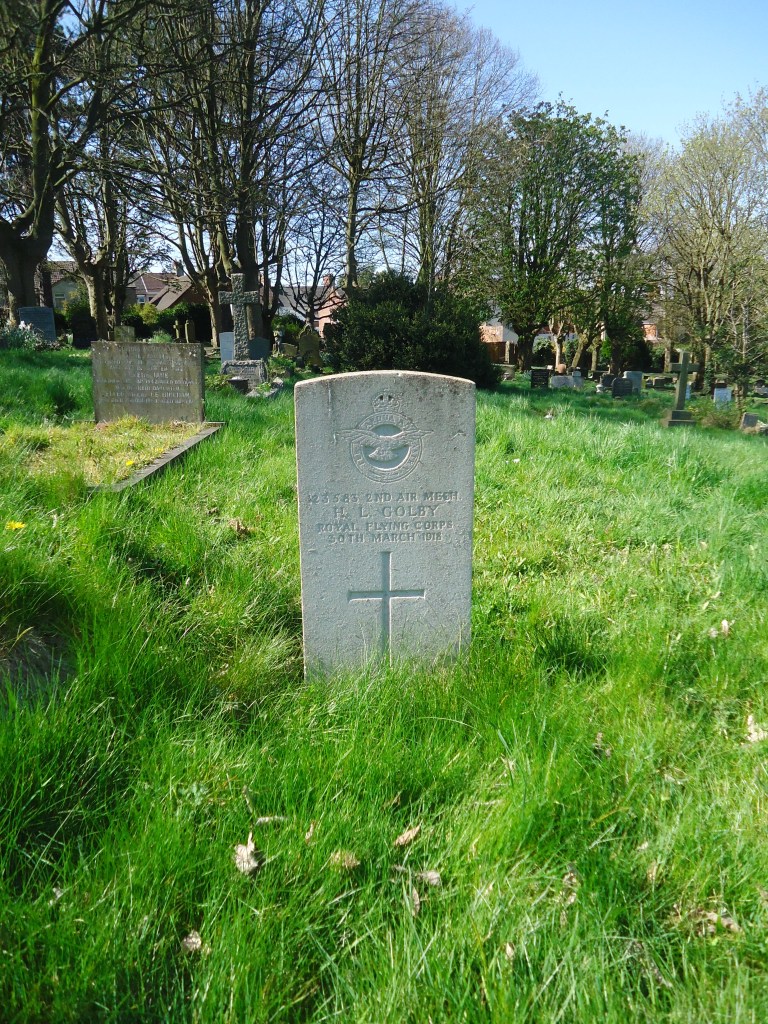
Most of Horace’s military records are lost. All we know is that he served as an Air Mechanic 2nd Class in the Royal Flying Corps, the precursor of the RAF. He died on March 30, 1918 at the Military Isolation Hospital in Aldershot. The Army Registers of Soldier’s Effects reveal he left £7 8s 6d to his widow.
We know nothing about his military service, nor about the kind of man he was. What were his hobbies, did he play football or cricket, did he like gardening? A life sacrificed in war, but still remembered 105 years later.
Horace was buried on April 3, 1918. He shares a grave with his mother Mary who died in December 1913 and his father who died in 1939.
I wonder what Fred Kiddle looked like. I imagine him as the loveable rogue Del Boy Trotter from the 1980s sitcom Only Fools and Horses, complete with medallion and sheepskin coat.
Fred had numerous jobs, including that of a ship brokers clerk, a traveller, pub landlord, shopkeeper, greengrocer but he is probably best remembered as a Turf Commission Agent – a bookies runner. Infact, we know he even had a nickname ‘Speedy.’
Fred’s great nephew David contacted me with a chapter from the Fred Kiddle story:
‘Most of Fred’s money came from bookmaking – both on course and off, with Duart House (his home) being furnished with antiques and silver ‘redeemed’ from unlucky gamblers in lieu of their debts. I understand Fred gloried in being nouveau-riche, owning many cars, from the windows of which he liked to scatter coins for local boys to run after! At the start of WWII he donated premises for the local Red Cross to use as their HQ – a wise investment, as they had preferred access to petrol, and made sure his car was never without, despite rationing.’
Now that is pure Del Boy.
Frederick Charles Kiddle was born in Gloucester in 1879 the son of Charles Kiddle, a railway foreman, and his wife Harriett. He first married Dora Henrietta Stephens in 1903. I’ve been unable to discover what happened to this marriage (or to Dora) In 1921 Fred married his second wife Ethel Maud Dunn but by that date they already had two children, Hugh born in 1914 and John in 1916. Their daughter Marcia Mary was baptised at St. Mark’s on February 13, 1922. During this period the family lived at 13 Cambria Bridge Road where Fred had a grocer’s shop.
By 1939 Fred was recorded as a Turf Commission Agent with premises at 26 Clarence Street, Gloucester and 2 College Place, Cheltenham. He died on died March 25, 1943. Probate was awarded to William Edward Kiddle (his younger brother) and William Canniford, insurance officials and Joseph Thomas Weston commission agents clerk and secretary. He left effects valued at £18,623 13s.
Fred was buried in grave plot C4878 in March 1943 where he joined his son John who had died in 1939. The inscription on the grave reads – ‘To my dear Speedy who I loved/No tongue can ever tell what we would give to have you back.’ Ethel died in 1964 and was buried in the neighbouring plot C4879. She is buried with the couple’s daughter Marcia, well known for her charitable works during the war, who died in 1994.
Clara Acton was born in 1864. She married Rueben George in 1887 and the couple had three sons, Herbert, Granville and Stanley. By 1901 they were living at 132 Goddard Avenue.
Reuben George came from humble beginnings and spent a lifetime working for the good of the poor man. He became a local politician and founder of the Swindon branch of the Workers’ Education Association. Clara was described as being deeply interested in her husband’s work for the WEA and served on the Executive Committee for a number of years. Clara supported her husband as Mayoress during his mayoral year and reference is also made to the fact that she was connected to the Co-operative Society and also served on the Education Committee for some years.
But as we remember the great and many good works both Rueben George and Clara performed, there is no mention of the son they lost during the First World War. Their eldest son Herbert Gladstone George was a Battery Sergeant Major in the Royal Field Artillery, 6th Bde and serving in Lahore in 1917 when he took his own life. His military records state that he ‘Committed Suicide on May 7, 1917 whilst temporarily insane.’
Suicide, along with soldiers shot for military offences, was frequently seen to have brought disgrace upon their families. Today we are able to bring some humanity and compassion to the situation and on November 7, 2006 the British Government granted posthumous conditional pardons to all soldiers executed in WWI for military offences. It remains unknown whether Reuben and Clara were informed of the cause of their son’s death, and if so whether they would have been able to share that knowledge with anyone. The grief was probably too great.
Reuben George died in June 1936. Clara attended her husband’s funeral at Christ Church against the advice of her doctor. Just hours after the funeral on June 10 she was admitted to the Victoria Hospital where she lay seriously ill for several days. An emergency operation to amputate her arm was undertaken but Clara died hours later. She died on June 20, 1936, just 16 days after her husband.
Former Mayoress of Swindon
A large number of mourners attended the funeral, yesterday, at the parish church, Swindon, of Mrs Clara George, a former Mayoress of the borough, who died in Swindon Hospital exactly a fortnight after her husband, Alderman Reuben George, who died in the same hospital.
Mrs George was buried in the same grave as her husband. Both were 72 years of age, and had been closely identified with the Workers’ Educational Association and other social movements in the town.
The chief mourners were deceased’s two sons, Mr Granvill George, of Manchester, and Mr Stanley George, of Swindon; also a sister (Mrs Symonds) and three brother-in-law, all from Gloucester, of which city Alderman and Mrs George were natives.
Mr A.E. Douglas Smith represented Bristol University and the WEA (Bristol Centre), and Mr A.H. Shipman represented Sir James and Lady Currie.
Letters of condolence were received from the Archbishop of York and Mr Ramsay MacDonald, also from Miss May Morris of Kelmscott, daughter of the late William Morris.
Western Daily Press and Bristol Mirror, Thursday, June 25, 1936.
Sometimes there is only so much information that can be found about the ordinary people buried in the cemetery and Catherine Jarman is one of them.
Catherine Jones and James Jarman married in 1842. The couple lived first in Panteg, Gwent before later moving to Swindon after the opening of the Rolling Mills in the 1860s.
By 1871 they were living at 21 Cambria Place next to the Greyhound pub. Living with them in 1871 was their son Josiah 21, a hooker in the Rolling Mills, and their daughters Catherine 16 and Annie, aged 9, the only one of their seven children to be born in Swindon.
James died in 1873 aged 57 and is buried in the churchyard at St. Marks. Catherine continued to live at 21 Cambria Place for the rest of her life.
Then, sometime before 1881 Catherine would appear to have married for a second time. In the census of that year she calls herself ‘Evans’ but there is no one by that name living with her and her daughter Annie at No. 21. Ten years later Catherine returns to the name Jarman on the census returns. However, in 1901 her son-in-law, Albert Smith, now recorded as the head of the household, names his mother-in-law as Catherine Evans. He states that she is married (not widowed) but her husband does not appear to be living with them at No. 21.
Her death was registered as Catherine Evans and the same name appears on the details of her will while the entry in the burial registers reads Catherine Jarman Evans.
Mr Evans remains a mystery.
Catherine was buried in grave plot D1564 on November 16, 1903. The first name mentioned on this elaborate headstone is that of her husband James Jarman, buried in St. Mark’s churchyard. She is buried with her daughter Annie and son-in-law Albert Smith.






 Radnor Street Cemetery