Robert Astill – Commercial and General Printer

Window bills, confectioner’s bags and sermons are just a few of the seemingly endless list of printing services produced by Robert Astill at his works in Victoria Street.

Born in Coventry in 1833, Robert Astill married Margaret Delphi Considence Hall in 1866 and by 1871 the couple were living at 18 Victoria Street with their two young children. Employed as foreman at the printing works established by auctioneer William Dore, Robert Astill later became proprietor probably after Dore’s death in 1877.

Astill’s premises occupied the large corner plot at the top of Victoria Street where Queen Victoria House now stands. With a Victoria Street frontage measuring 93ft (28.3 metres), the area was known locally as Astill’s corner. Astill had bought the property in 1885, signing a conveyance between Charles Richards Plummer and his wife Mary (most probably the former Mary Dore and daughter of Astill’s former employer, William Dore).

By the turn of the century Robert was widowed, the youngest of his eleven children, Lily Blanche, had recently emigrated to Australia where she worked as a domestic servant in the Brisbane/Gold Coast area. With the business now in the hands of his sons, Robert was preparing to retire to Zeals, a small village near Warminster.

The whole complex was placed on the market in 1903 when it was described as being ‘suitable for any Large Business or Offices with Stable, Coach House, Out Buildings, Yard and Garden ground.’

The 1903 sale catalogue describes a complicated arrangement of domestic and workplace accommodation. On the ground floor there were two entrance lobbies, one opening on to Bath Road and the other on to Victoria Street.

The Breakfast Room facing Victoria Street was used by Astill as a ‘Stationery and Fancy Shop’ while W.H. Bush used the Drawing and Reception Rooms on the Bath Road side as a ‘Hairdressing Establishment.’ The stables and use of the yard were let to Mr Greenman on a weekly tenancy.

A selling feature was made of the bressummers (strong beams supporting the superstructure of the building) thus enabling a conversion into two shops if the purchaser so desired.

With a dining room, seven bedrooms, a dressing room, WC and linen closet on the two upper floors, this building presented a serious undertaking.

A short account of the auction was reported in the Swindon Advertiser.

Sale of Property – An exceptionally large and influential gathering of property owners and speculators assembled at the Goddard Arms Hotel last (Monday) evening to witness the disposal by public auction of that very desirable corner freehold block of buildings situate in Bath Road and Victoria Street, and for many years in the occupation of the owner Mr Robert Astill. Mr T. Hooper Deacon was the auctioneer, and after a short introductory speech, the bidding was started by Mr James Hinton at £2,000, who became the new owner at £2,600. The solicitors for the vendor were Messrs Kinneir and Co.

Swindon Advertiser, Tuesday, February 17, 1903.

Kelly’s Directory of 1915 reveal that the Astill brothers still occupied the premises, then described as 103 Victoria Road after renumbering of the built up road linking former Old and New Swindon.

Margaret Delphi Considence Astill died in December 1899 and was buried in grave plot E8601 where her husband joined her on June 19, 1915. The last burial to take place in this plot was that of their daughter Ellen Victoria Astill who died in 1946 and was buried on April 12.

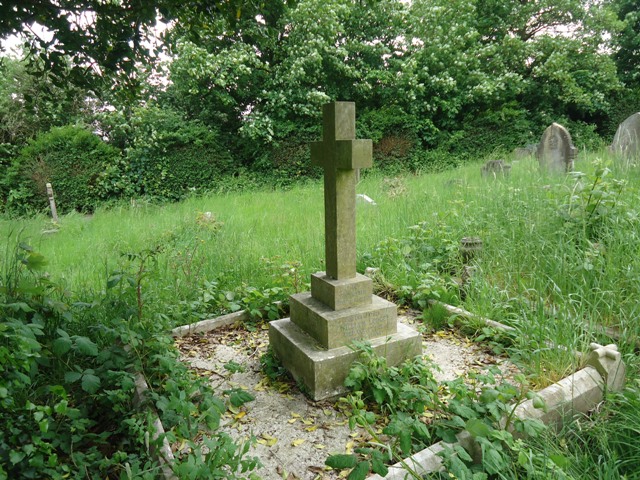
If there was ever a memorial on the Astill family grave here between the Thatcher and Chum family plots, it is no longer visible. We fully appreciate the financial constraints upon Swindon Borough Council – that the coffers are depleted and there is barely enough money to pay for essential services. But it is such a shame that an important heritage site such as Radnor Street Cemetery receives so little maintenance. Here lies, quite literally, the history of our town – remembering the ordinary people of Swindon.

Albert Edward Tunley

Tunley might be another familiar name to local people.  This firm of builders’ and decorators’ supplies had a town centre shop for more than a hundred years.

Albert Edward Tunley was born in 1873, the first of William and Matilda Tunley’s family to be born here in Swindon. Albert married Eliza Snell in Swindon in 1892 and by 1901 they were living at 73 Gloucester Street.

William, a plumber and decorator, opened his shop on the corner of Milford and Cheltenham Street in 1880.  Although the business was established by William the shop bore the name A.E. Tunley, the initials of William’s son and later that of his grandson as well.  This photo dates from around 1890.

The Tunley’s business continued to expand, as did their shop.  In 1900 they applied for planning permission to build a stable and warehouse on Milford Street.  Further additions were made in 1905 and 1910.  By 1929 their premises stretched into Gloucester Street.

The business moved to 40-41 Fleet Street where it remained until relatively recently.

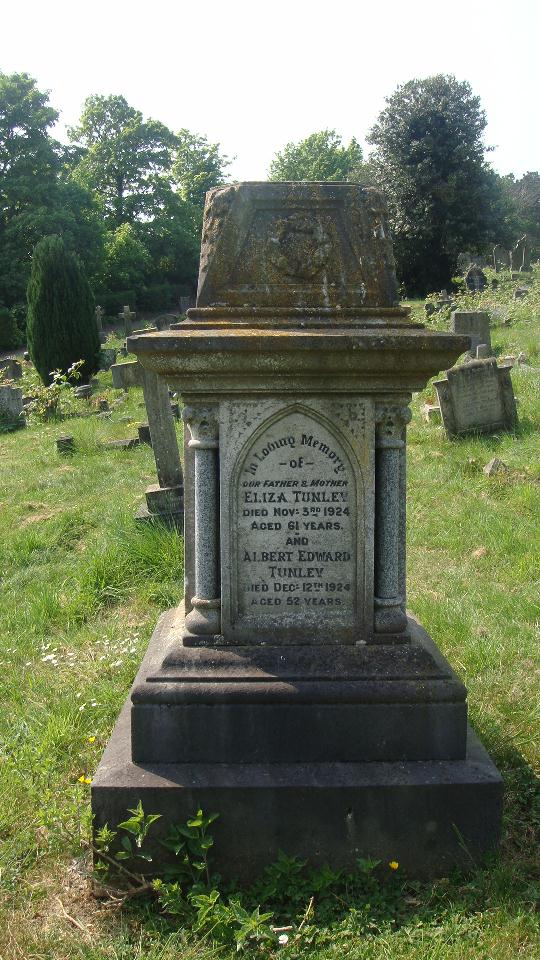
This distinctive monument is the final resting place of Albert Edward Tunley and his wife Eliza.  Albert died on December 12, 1924, not at his home, 8 Wellington Street, but at 7 Mandeville Place, Manchester Square in London.  His wife Eliza had died just six weeks previously.

Water banned from any kind of use in the Cemetery

As this unseasonal September heatwave looks set to continue for the next few days, I revisit September 1929 when Swindon was hit by a devastating water shortage.

Additional inspectors were assigned to locate cases of wilful misuse, and Mr Thompson, Borough Engineer and Water Engineer, said it was the duty of the housewife to be sparing in the use of water, adding somewhat threateningly “if she is not she will have to be taught how to be sparing.” A total ban was imposed upon the use of water in the cemetery.

Water Shortage

Alarming Situation in Swindon: Utmost Economy Needed

News regarding the position of Swindon’s water supply is of an alarming nature. During the week-end there was a most serious drop in the amount of water available.

The townspeople have already effected some economies in their usage of water; but it is now vitally necessary that the present consumption should be cut down by at least another 50 per cent.

It is therefore the immediate duty of everyone to use only half the amount of water they have been doing. For the present the use of baths should certainly be given up, and their place taken by an ordinary sponge-down with the minimum quantity of water.

Housewives can do much to help. They must look on water as a precious fluid, and cut down their usage to the least possible quantity.

Every step is being taken by the Borough Engineer and his staff to augment the supply; but the co-operation of the general public is essential.

Mr J.B.L. Thompson, the Borough Surveyor and Water Engineer, tells the North Wilts Herald that the fall in the available supplies which has taken place over the week-end is unprecedented, and has forced the Water Committee to reconsider the whole position.

Unless still more drastic economies are made, Swindon is going to be faced with a very unpleasant situation.

The use of water for certain specified purposes must, under heavy penalty, be absolutely discontinued. Leakages, however small, must be reported at once.

Warning to Wasters

The Borough Engineer has been instructed to employ further inspectors to locate cases of wilful misuse.

Official Notice

In an official notice, signed by the Town Clerk, to be distributed to householders, it is stated:

“Owing to a rapid and unprecedented decrease during the past two days in the water supplies available in the well belonging to the corporation, the attention of all consumers of water is drawn to the urgent necessity of preventing waste and of strictest economy in the use of water.”

It is further stated that water must not be used for the purpose of washing foot-pavements, yards, cars or garage floors, nor used on allotments, tennis courts, bowling green, cricket patches or gardens.

Prosecutions will be instituted where there is evidence of waste of water.

A Critical Three Months

“It will be the end of December before we can hope for the wells to recover,” said the Borough Surveyor to a North Wilts Herald representative.

“The next three months are going to be very precarious from the point of view of obtaining water sufficient to keep the town going.

“Unless people limit their consumption by at least 50 per cent, it will mean that as a last resource the town will have to be shut off from the regular supply and that we shall have to draw it from certain points.”

Meanwhile wells at Ogbourne continue to diminish, and though water is being drawn from the GWR supply at Kemble the time will come when this supply must stop.

It is the duty of the housewife to be sparing in the use of water. If she is not – to use Mr Thompson’s words – “she will have to be taught how to be sparing.”

Owing to the acute shortage, the Swindon Corporation have stopped the use of water for growing plants in the Swindon Cemetery. Water has now been banned from any kind of use in the Cemetery.

The supply in the Highworth parish at present is fairly satisfactory, this being attributed mainly to the fact that some two or three years ago the district council constructed auxiliary works at Eastrop.

North Wilts Herald, Friday, September 13, 1929.

The Dadge family

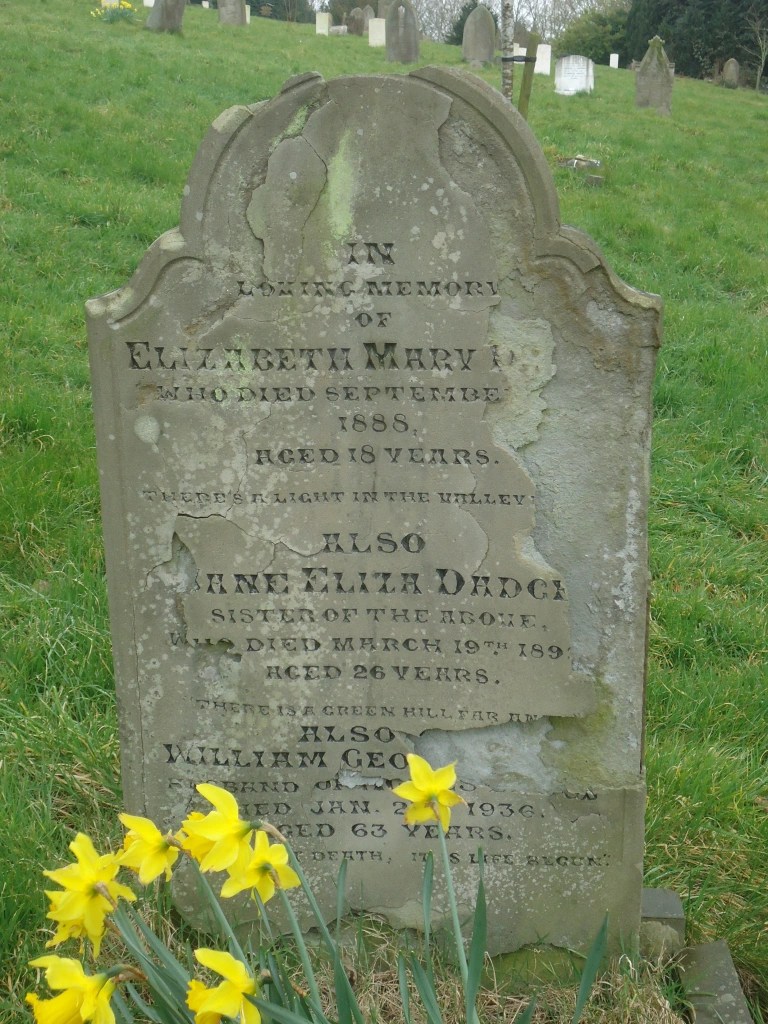
As you will see the front of the headstone with all the family details on it is gradually coming away. This is caused by frost getting into the stone and you will see many headstones like this in the cemetery. Sometimes the whole front comes away in one sheet.

Fortunately there were enough details left on this one to allow me to piece together the family history.

Elizabeth Mary Dadge was born in 1871 the daughter of William Dadge, a smith’s striker, and his wife Martha.

From 1881 to at least 1901 the family lived at No 3 Brunel Street, a town centre street that has long since vanished. For most of that time William had his brothers Albert and George lodging with the family. As young men they worked as iron dressers in the Works, then labourers until in 1901 Albert, then aged 41, was working as a storekeepers assistant. William meanwhile worked as a striker into his 60s.

Sadly, little is known about Elizabeth who died very young. As an unmarried young woman we can safely assume she didn’t die in childbirth, but without ordering her death certificate her cause of death is unknown. Next on the headstone is her sister Jane who died four years later at the age of 26, again unmarried.

The last name on the headstone is William George Dadge the girls’ brother. At 15 years old he followed his father into the railway works to begin a 6½ year boilermaker’s apprenticeship. However the UK Railway Employment Records show that he absconded in January 1888.

I can’t find him on the 1891 census records. This may be due to a transcription error. Perhaps he called himself George. That and a spelling mistake would make it very difficult to find him.

Anyway, by 1901 he is back home with his parents living at No 3 Brunel Street where he is working as a joiner. In 1905 he married Agnes Brown and by the time of the 1911 census they were living with their baby daughter Winifred on the Hursley Park estate, Winchester where William was employed as estate carpenter.

In the last years of his life William was back in Swindon living at 74 William Street. He died on January 21, 1936.

I don’t think this stone will weather many more winters, but with the use of the cemetery records and online genealogy sites, the family will not be lost.

Swindon and District History Network

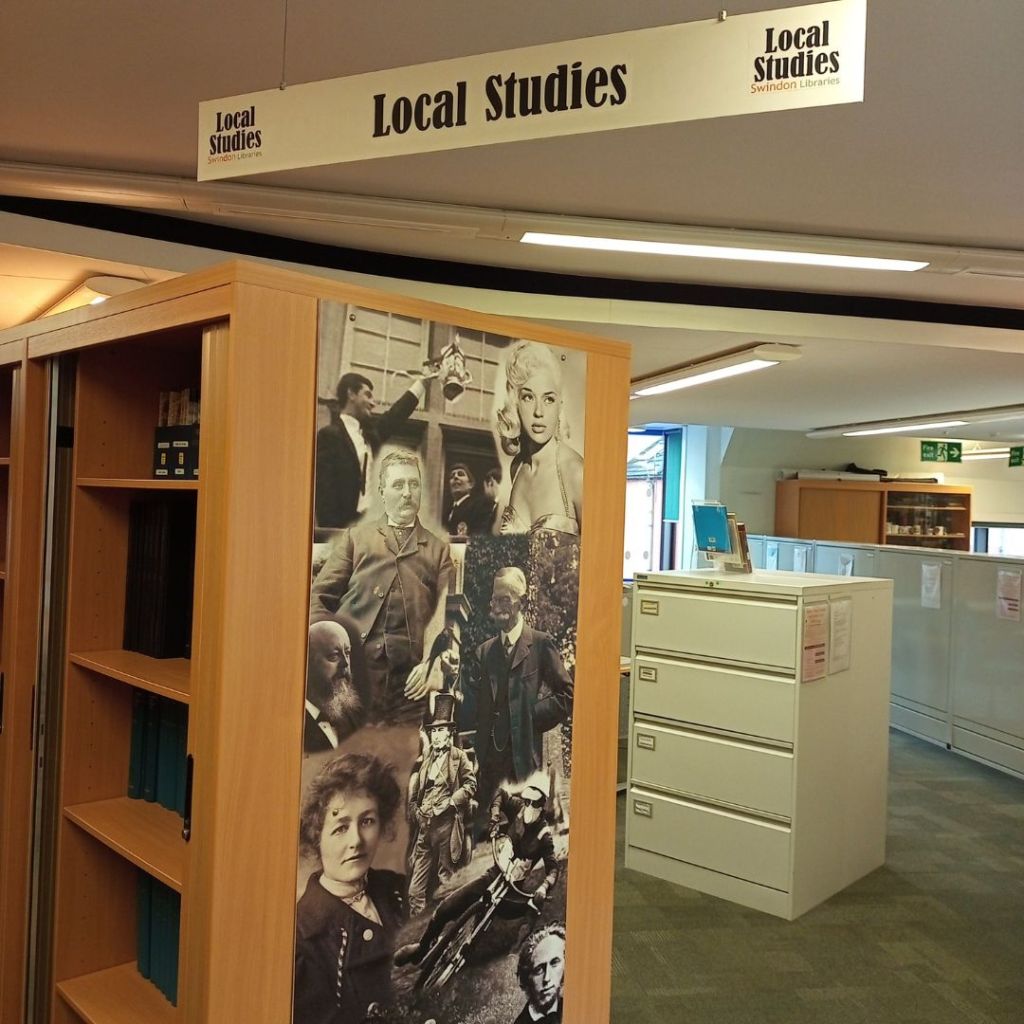
Last evening I attended the 50th meeting of the Swindon and District History Network. The Network was formed as an initiative by staff in Local Studies at Swindon Central Library to bring together all the various history societies, writers and researchers who regularly used the resources there, to share and support their work. More than thirteen years later the Network continues to thrive and this week saw new and existing members squeeze into the Reading Room in Central Library to celebrate and share our projects.

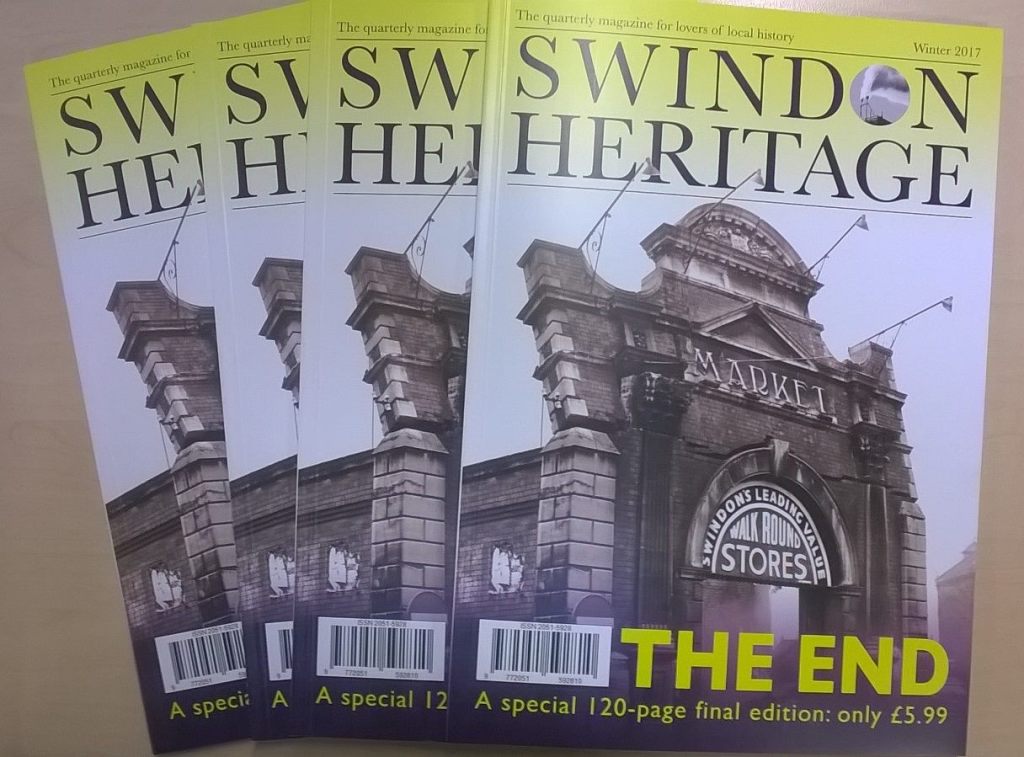
The Network has been hugely supportive to me as both an individual and as a member of the Swindon Heritage magazine team (published 2013-2017). As one of the original members of the Network, I took the opportunity to thank those societies who opened their archives, contributed articles and supported the magazine across five busy years of publication. I spoke about Mark Sutton, military and local historian, author and co-founder of Swindon Heritage who sadly died last year and is greatly missed on the local history scene in Swindon.

This coming weekend – September 9 and 10 – sees Swindon’s history on display during the Heritage Open Day events (8-17 September) when local history groups show Swindonians what a fascinating history their town has. I will be at the Heritage Apple Day event with the Friends of Lydiard Park in the Walled Garden at Lydiard House on Sunday, September 10 – 11-4 pm.

Our next guided cemetery walk takes place on Sunday September 17. Meet at the Chapel in Radnor Street Cemetery for 2 pm.

Local history is alive and busy in 21st century Swindon – come and join us.

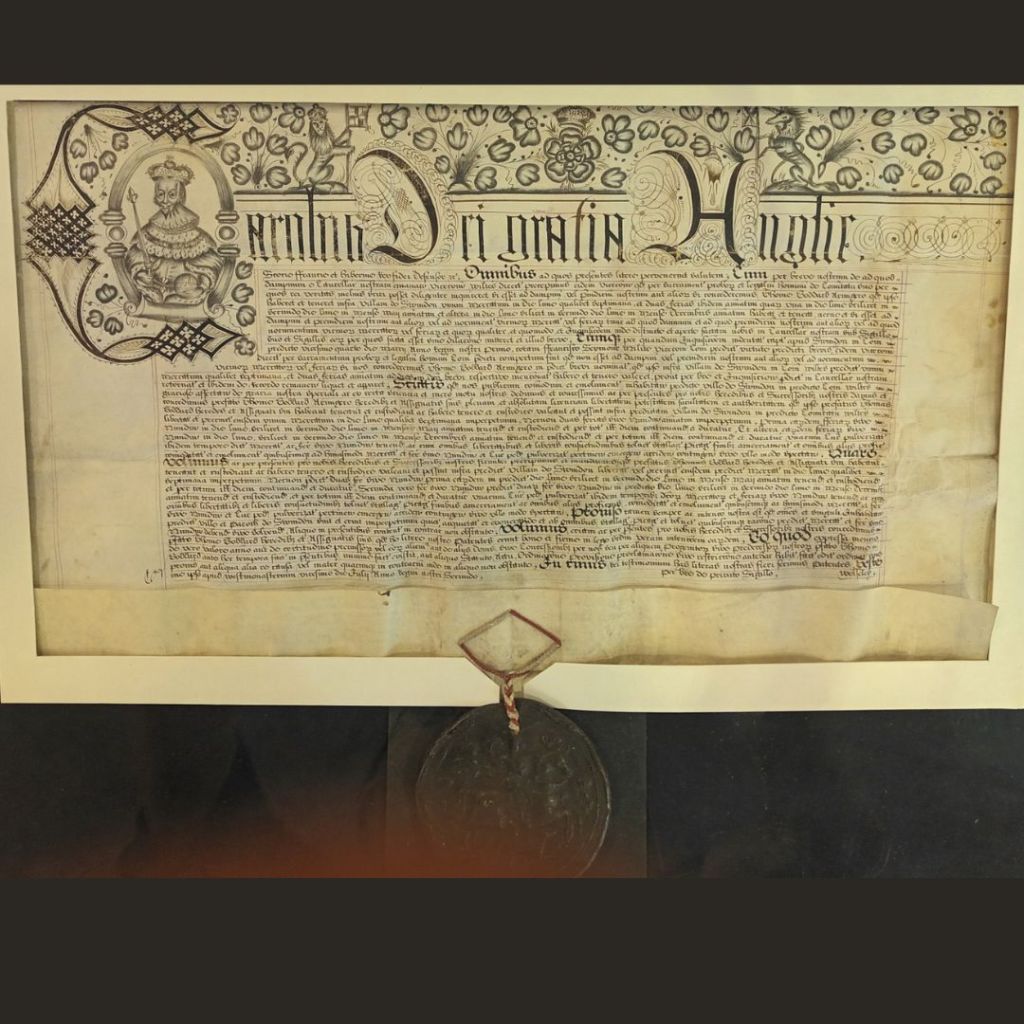
Swindon’s Market and Fair Charter 1626 on display in Central Library, ground floor.

Swindon Veterans of Industry

In the 1880s and 90s it was not unusual to find men like Robert Laxon still employed in Swindon’s GWR Works into their 80s. However, by the 1930s there was a state pension and an official retirement age. In December 1930 more than 200 men retired from the Great Western Railway Works, an event of such importance to warrant a detailed article in the first January edition of the North Wilts Herald published in 1931.

The names and address of those men forced to retire under the introduction of the 66 years age limit were recorded in appreciation of their long years employed in the Works. Men who had joined the company in the 1880s and 90s; men like Tom Solven who had completed 52½ years’ service and George Edge, of 39, Medgbury Road, 43 years a chargeman wagon builder. Chargemen in the Locomotive Department such as E.P. Cave, a fitter who lived in Pleydell Road, G.A. Hallard, turner, 70 Jennings Street and G.F. Randell, fitter, 19 William Street.

Mr William George Woodward, 43, Havelock street, retires after 50 years’ service in the GWR works, and he has spent the whole of that time in one shop – No 7 Finishing Shop, Carriage Department.

A native of Oaksey, Mr Woodward came to Swindon on 11 October, 1880, and started work as a machineman in the factory. He was made chargeman 32 years ago last July.

He has served under three Chief Mechanical Engineers, the late Major William Dean, Mr. G.J. Churchward and Mr. C.B. Collett. His first foreman was Mr. Thomas Rose. He has seen the number of employees in his particular shop grow from 50 to between 300 and 400.

Mr. Woodward has a vivid recollection of a bit of the first work he did during his initial year in Swindon. It was to help clear the line between the railway station and the transfer sheds during the great snowstorm in January, 1881. Greatly interested in Friendly Society work, Mr. Woodward has been a member of the Oddfellows Society for many years. He has been for 19 years secretary of the juvenile branch, and 17 years secretary of the Stratton St. Margaret lodge.

Last Saturday he was appointed secretary to the Widows’ Hope lodge – one of the oldest and largest in the Swindon district – to fill the vacancy caused by the death of Mr. A.C. Nethercot. He is Past Grand Master of the Swindon District, and was one of the delegates who attended the Centenary A.M.C. of the Order at Southampton in 1910.

Perhaps for many of the men it was a relief to no longer have to work. But no doubt for others it was more akin to a bereavement. What would they do with their time?

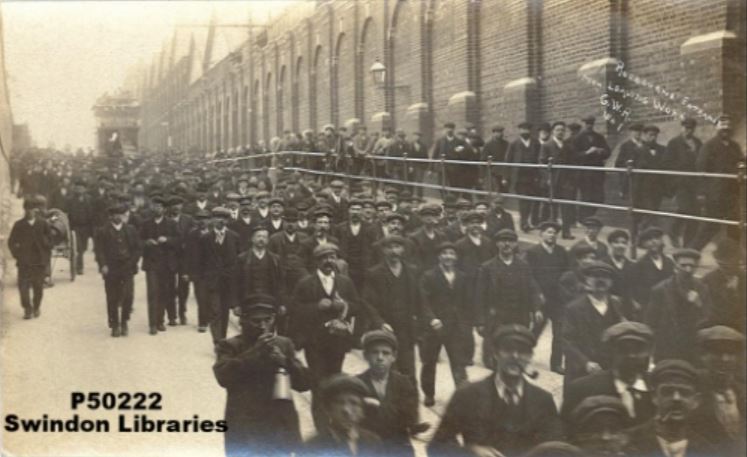
Home time – men leaving the Works. Image published courtesy of Local Studies, Swindon Central Library.

William George Woodward’s retirement was not a long one. He died in December 1939 and was buried in grave plot D573 with his father-in-law Harry Ball who died in 1928 aged 96. William’s wife Hannah died in 1960 and was buried with them both.

Tom Tindle – on the move

Today many families live at opposite ends of the country (and the world) and we tend to think of this as a modern phenomenon brought about by improved methods of transport. But people have always travelled to where there was work and Radnor Street Cemetery has many residents who came to Swindon and a job in the Great Western Railway Works.

Tom Tindle, or to give him his full name Tom Henry William Tindle, was born in York on April 18, 1855, the eldest of six children. In 1871 the family were living in Ashford in Kent, but when you look at the birth places of Tom’s siblings you can see they had also lived in Scarborough and London before settling down in Ashford, Kent.

Tom married Phillis Sarah J. Alderton, an elementary school teacher, at St George the Martyr in Southwark on April 24, 1878 when they both lived in the Old Kent Road area.

By 1881 the young couple were living in Stratton St. Margaret. Tom worked as a Coach Body Maker. He joined the Great Western Railway on May 23, 1887 as a Carriage Body Maker later becoming a foreman. By 1891 they had moved to 37 Regent Street where Phillis describes herself as a postmistress. In 1901 they lived at 10 Victoria Road with their four children. Phillis 18 and Nellie 14 were both working as pupil teachers. The boys Stuart 12 and Tom 5 were still at school. The 1911 census provides us with the additional information that Tom and Phillis had 6 children and that sadly 2 had previously died.

Tom lived in Swindon until at least 1920 when his address was 166 Victoria Road. He died in 1933 by which time he was living in Luton. The family returned the body to Swindon where he was buried with his daughter Phillis who died in 1905.

His wife Phillis out-lived him by eleven years. When she died in 1944 she was living in Bournemouth.

The Lodge family grave revealed

In recent years we have been fortunate to have the occasional assistance of the Community Payback Team in the cemetery. This group does some sterling work, often tackling the most overgrown sections of the cemetery. It was on one such occasion some years ago that they cleared a huge amount of shrubs and brambles and in doing so revealed several graves that had been hidden for years. Among those newly revealed graves was this magnificent memorial to the Lodge family.

William Lodge and Elmira Faville were both born in Gloucester and married in St James’ Church, there on October 13, 1867. By 1871 they had moved to London where they were sharing accommodation at 33 Desborough Lane, Paddington with James Affleck (another Swindon connection). In 1881 they were living in William Street, Swindon where William worked as an engine driver. By 1901 William was working as Railway Engine Inspector and the family lived at 36 Rolleston Street, one of the few houses that remain after the demolition work of the 1960s and now tucked away behind the doomed Regent Circus development.

So, who is buried beneath this memorial in this spacious, double plot E8482/3.

First we have Elmira who died in 1905, then Mary who died in 1917. William Lodge died in 1922 followed by another daughter, Emma who died in 1926. Eldest daughter Ellen died in 1950 and son Charles and his wife Annie are buried here, they died in 1945 and 1963 respectively.

Looking at this impressive memorial it is difficult to imagine it was once hidden by brambles. When so little maintenance is done by the local authority it would be great to see the Community Payback Team back in the cemetery.

Inkerman John Garlick

Photograph taken at the funeral of Daisy Garlick’s brother. Daisy and Inkerman are the second couple on the right.

The Battle of Inkerman took place on November 5, 1853 during the Crimean War between Russia and the UK and her allies. Inkerman later became popular as a street name, although we don’t have one here in Swindon but it is curious how battle names were chosen for the naming of children. During and immediately after the First World War children named Ypres, Verdun and Arras appear in birth registration records.

Inkerman John Garlick was born in October 1863 in Wootton Bassett, the son of John and his wife Julia. He grew up at the Pack Horse Inn, Chippenham where his parents were the publicans. He married Ada Jane Barnes in 1889 and the couple had five children. In 1891 they were living at 26 Carfax Street, with their baby son Percy and Ada’s two brothers, Ernest and Sholto Barnes. Inkerman worked as a wood sawyer. Sadly, Ada was admitted to the Wiltshire County Lunatic Asylum where she died in 1903 aged 39.

In the summer of 1904 Inkerman married Daisy Ayers and at the time of the 1911 census they were living at 69 Port Tennant Road, Swansea. Inkerman was 47 and worked as a Railway Timber Inspector. Daisy was 29. They lived with children from both his marriages – Elsie 19, Frederick 15, Arthur 13, Iris 5 and one year old Myrtle.

This stylish art deco headstone marks the grave of Daisy Garlick who died in 1938 aged 57 and was buried in grave plot C1821. Inkerman died less than three months later and was buried with her on September 5. He was 75 years old.