William George Driver – soldier

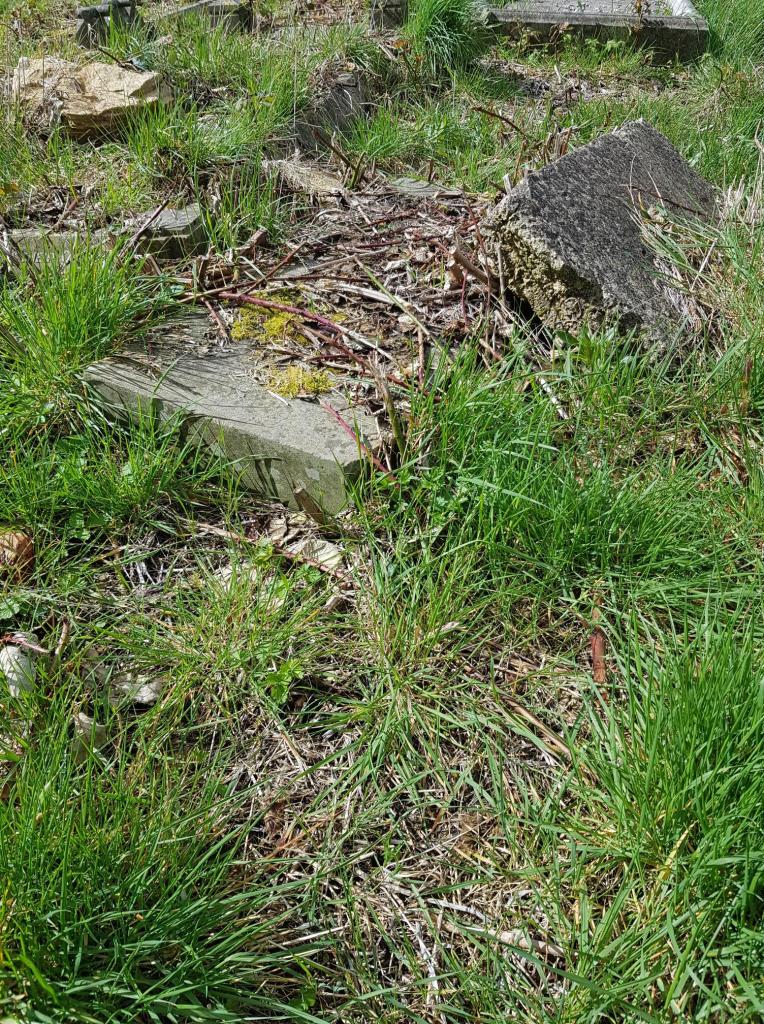
I am closing this month of remembrance with the story of William George Driver. Born in Torquay in 1892 William Driver had no obvious connections with Swindon but this is where he lies buried in an unmarked grave in Radnor Street Cemetery. Volunteers Jon and Kevin are presently making an application to the Commonwealth War Graves Commission to have his death recognised as being the result of his military service and to have an official headstone installed. We know this consultation is likely to take a long time so I am publishing William’s story now in hopeful anticipation.

William George Driver married Emily Dorothy Pretious at St. Anne’s Church, Wandsworth on August 21, 1911 and the couple had two children, George William and Patience. William and Emily were both 19 years old at the time of their wedding and William was working as a clerk in the Civil Service, although he apparently later set up business as a watchmaker and jeweller.

William enlisted at Hounslow on March 19, 1915. He served first in the Army Cyclist Corps and later transferred to the Yorks & Lancaster Regiment.

On William’s attestation papers there was no mention of any health problems but by January 1917 he was suffering from chronic bronchitis and asthma and by February he had been transferred to Bicester VAD Hospital. By June of that year he was in the 2nd General Hospital, Chelsea. His medical notes tell that he was admitted from the Expeditionary Force, France on January 1, 1917 with bronchitis & asthma. He looked ill and presented the usual signs and symptoms of an old standing Asthma & Bronchitis – his condition was not considered to have been caused by active service, climate or ordinary military service, although none of these symptoms had been evident when he enlisted. At the same time there was an enquiry received concerning his son. It appears that seven year old George William was in a home for Waifs and Strays at this time, so his wife was obviously in great distress.

Driver was discharged from the army on September 24, 1917 as unfit for military service suffering from Asthma & Emphysema aggravated by exposure on active service. By then William’s eyesight had also deteriorated and he was unable to resume his work as a watchmaker and jeweller. His service records show that he expressed a desire for outdoor employment in munitions work. He was awarded a pension of 11s 8d a week, which was later reduced to 11s.

William didn’t return to his wife who was then living in Plaistow, East London, but came instead to Swindon where he lodged with Mrs Howard at 49 Cambria Bridge Road.

William died aged 26 years old in the Victoria Hospital on November 14, 1918 from broncho pneumonia. He was buried on November 18, 1918 in grave plot C573.

A propeller, a plaque and a piece of artwork

This year we have welcomed some significant additions to the cemetery chapel.

August saw the installation of the Airspeed Oxford propeller once mounted on the front of the RAFA Club in Belle Vue Road.

Then in November we were the proud recipients of another war memorial. Scout leader Steve Milner has placed in our safe keeping a plaque dedicated to the North Wilts Boy Scouts Association. The Roll of Honour commemorates those former scouts who lost their lives in the Second World War. We were proud to have this displayed in the chapel on Remembrance Day 2023.

We have also kindly been donated an original piece of art work made by local artist Lynette Thomas. The mosaic was inspired by a guided cemetery walk Lynette came on in July, where she describes the cemetery as ‘a tranquil place and a haven for wildlife with beautiful stone carvings and grotesques.’ To see more of Lynette’s work visit the Artsite website and her Facebook page.

Joseph Wilkinson – a link with Swindon’s Past

Sometimes an obituary is written so evocatively that there is little I could possibly add. This is the story of Joseph Wilkinson who moved to Swindon in the 1870s and worked in the new Carriage and Wagon Works under Joseph Armstrong.

Death of Mr Joseph Wilkinson

A Highworth Octogenarian

Link with Swindon’s Past

By all the older generation of Swindonians, and especially by those who have been connected with the GWR Works, the news will be received with unfeigned regret that Mr Joseph Wilkinson, formerly a foreman over the Wagon Works, has passed away at Highworth, at the ripe age of 83 years.

Mr Wilkinson was an interesting link with Swindon’s past. Born at Marshe (Yorkshire), in 1828 he migrated at an early age to Chester where he followed his occupation as a coach builder. Thirty-five years ago he came to Swindon with the late Mr. Holden, and took up the position of foreman over the new wagon works, under Mr. Armstrong. Mr Wilkinson held the foremanship continuously for many years. Until 13 years ago he enjoyed capital health, even for his advanced age, and then, acting under medical advice, he retired at the age of 70 years. It is interesting to note that Mr. Wilkinson is believed to be the first foreman who received a pension under the superannuation scheme, which was initiated shortly before his retirement.

Upon his retirement the old gentleman went to live at Highworth, where he was liked and respected by all with whom he came in contact. Since this time Mr Wilkinson’s health had been gradually failing. He had been ailing off and on every since; and a couple of months ago he was taken ill with heart disease. Dr. Powell and Dr Lewty did all that medical skill could devise but inspite of their attentions Mr Wilkinson passed away on Saturday evening.

While he was in Swindon, Mr. Wilkinson took an active interest in the affairs of the Faringdon Street Wesley Church, where he was an assistant class leader but since his removal to Highworth failing health prevented him from participating in this branch of public service. His first wife predeceased him by 28 years, and it was while in Swindon that Mr Wilkinson married his second wife. Thirteen years ago Mr. Wilkinson’s second wife also died; but a family of one son and three daughters are left to mourn their loss.

The Swindon Advertiser, Friday, May 19, 1911.

Joseph Wilkinson was buried on May 17, 1911 in grave plot A641 where he joined his first wife Eliza who died in 1883

Lance Corporal Thomas Neate Harding – Tell Them of Us

The First World War was all about loss; loss of life and loss of prospects. Landed property was lost with the death of an heir; local businesses were lost when sons did not return, and in this case, families fell on hardship with the loss of a breadwinner.

Within the records of the UK World War I Pension Ledgers and Index Cards 1914-1923 published on Ancestry are claims mostly made by service personnel incapacitated by their military service, and war widows. However, Thomas Henry Harding, the father of Lance Cpl. T.N. Harding, made an application declaring he was a dependant of his son.

Thomas Neate Harding was baptised on July 15, 1888 in the parish of Holy Trinity, Slad. He was the only child of Thomas Henry Harding, a labourer, and his wife Caroline.

The family moved to Argyle Street, Gorse Hill, Swindon three years after Thomas’s birth. By the time of the 1911 census both father and son were employed in the GWR Works. Thomas Henry Harding worked as a wood sawyer and 23 year old Thomas Neate Harding as a Blacksmith’s Striker.

Caroline Harding died in March 1913 and is buried in a public grave in Radnor Street Cemetery. So now father and son carried on alone at home.

At the outbreak of war in 1914 Thomas Henry Harding was about 54 years old, his son 26. Thomas Neate Harding was not one of the early volunteers to join the army. Perhaps his responsibilities at home were too great. But with the introduction of conscription in 1916 he would eventually be called up, enlisting in July 1917 with the Royal Engineers and serving with the Inland Waterways and Docks.

Thomas Neate Harding died on February 12, 1920 at the Northern Hospital, Liverpool. He was 32 years old. His father made an application to the War Office for the cost of his son’s funeral expenses.

Administration of Thomas Neate Harding’s will was granted to his father in April 1920. His effects were valued at £173 7s 1d.

Thomas Neate Harding was buried in a public grave plot number B1271. The same grave in which his mother Caroline was buried.

Lance Corporal Thomas N. Harding is commemorated on plaque in St. Barnabas Church, Gorse Hill.

First published November 3, 2022.

Albert William Howard

We frequently receive comments on the condition of the graves in Radnor Street Cemetery. ‘Why is the cemetery not better cared for? Why doesn’t someone look after the graves? It’s a disgrace!’

The cemetery is more than 140 years old. It opened in 1881 and was full by the 1970s when it was closed to new burials. Today the finances of the local authority are severely constrained and restricted to essential services only. Where once there was a team of groundsmen and gravediggers employed in the cemetery now only essential maintenance takes place.

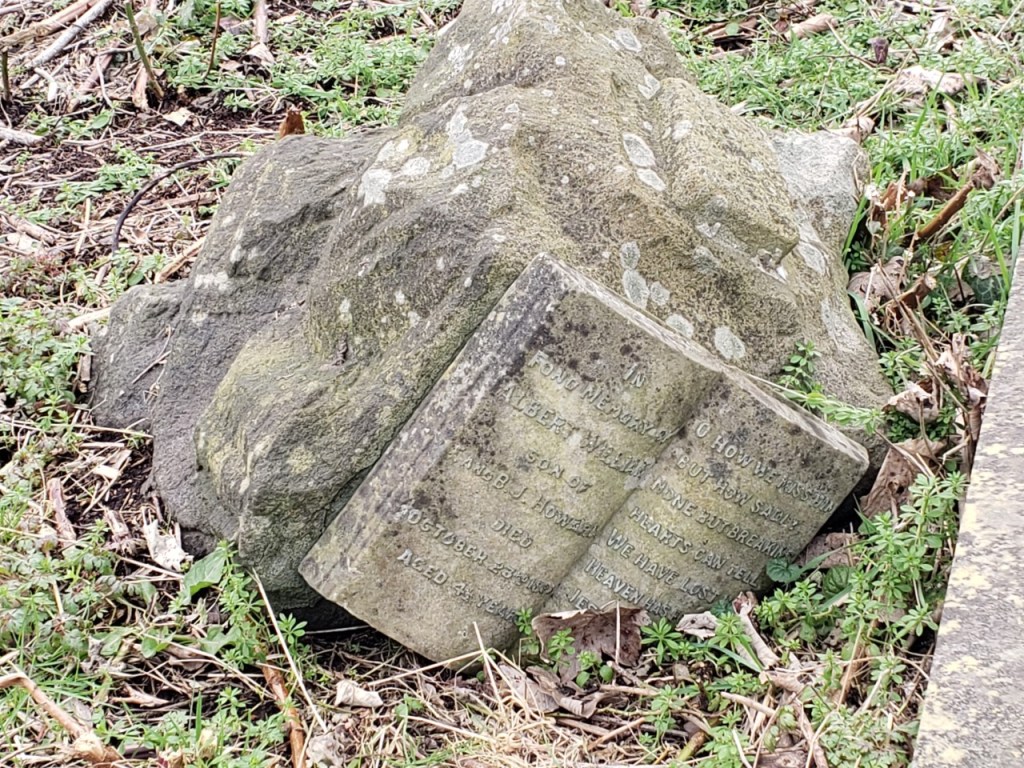
The graves were once cared for by family members, but circumstances change, people move away and I’m guessing that is the case with the grave of little Albert William Howard. Has the memorial always stood at this angle where now the inscription is sliding into the soil? His parents were able to purchase a grave plot (not everyone could) and this substantial memorial must have cost a fair bit of money. The inscription begins ‘O how we miss him’ the names of his parents weathered and difficult to read. A death certificate might provide further details but without financial resources this is not possible. The burial registers have already provided essential information – there is probably little more to learn.

When Albert died in 1899 the family lived at 13 Medgbury Road, but by the time of the 1901 census this was the home of Arthur Doell, a weighbridge clerk, and his family. What happened to Albert’s parents? Why did they move away from Medgbury Road? Where did they go? More than a hundred years later it is hardly likely there is anyone left who even knows about Albert or where he is buried.

It’s easy to put a disparaging remark on a social media platform, but not very helpful. Better still, why not join our dedicated band of cemetery volunteers? Contact us via this blog and we’ll get back to you.

Albert William Howard was buried on October 28, 1899 in grave plot C45. The burial registers state that he was 4 years old – his memorial says he was 4½.

The Pickett family

This week our volunteers uncovered a collapsed and partially buried headstone and in so doing revealed a whole family history.

The newly discovered inscription reads:

Thomas Pickett

Who entered into rest

March 19, 1903

Aged 65 years

Also of Lucy

The beloved wife of the above

Who died August 27th 1913

Aged 74 years

Also in memory of Elizabeth

Wife of Arthur Thompson

Their daughter

Who died March 20th 1948

Aged 77 years

Also Edith their daughter

Who died March 22nd 1955

Also two sons and two daughters

Interred in St Mark’s Churchyard

Thomas’s record of railway employment reveals he was employed as a fireman on February 4, 1864 on a daily rate of 3 shillings. By 1871 he was working as an Engine Turner and in 1873 as a Goods Engineman. He resigned on February 12, 1898 when he received a cheque for £70 ‘on account of old age.’ His service record includes a handful of disciplinary cautions and fines during a career spanning more than 30 years.

On the domestic front Thomas married Lucy Telling in 1858. By 1871 they were living at 42 Fleet Street with their three children Thomas 11, Emily 2 and Elizabeth 5 months. By 1881 they were at 15 Sanford Street with Elizabeth 10, Emily 7 (the earlier child by this name had died) and Edith 4 years old.

At the time of the 1911 census Lucy was still living at 15 Sanford Street. She states that she is a widow and that she has had 10 children of whom 4 are still living and 6 had died. She lives with her daughter Edith who states her profession as that of Head Teacher.

Lucy died at her home in Sanford Street on August 27, 1913. Her effects were valued at £208 15s with administration awarded to her son Thomas Pickett, also a schoolmaster.

Before and after photographs – an amazing discovery by our volunteers, enabling the story of the Pickett family to be told and remembered.

George Pakeman – regimental tailor and Crimean Veteran

During more than 100 years in business, Pakeman Brothers advertised themselves as a Civil and Military Tailor, which is hardly surprising!

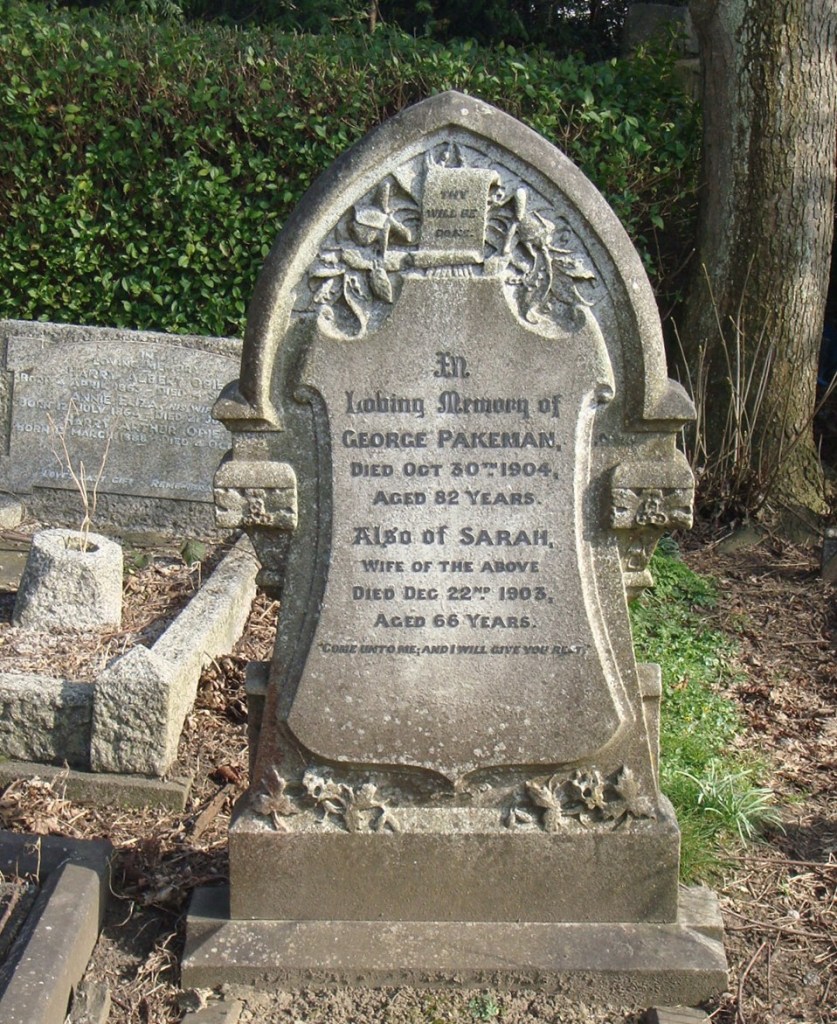
Founder George Pakeman was born in Uxbridge, Middlesex in 1822, the son of John, a tailor, and his wife Jane Pakeman. He followed his father into the tailoring business, but not the family firm. In 1859 he married Sarah Philpott and by 1863 the couple had moved from Canterbury, Kent and set up in business at 22 High Street, Old Swindon.

But prior to that George can be found on the 1851 census as ‘Master Tailor in the Regiment’ at Ashton Barracks, Hartshead, Ashton Under Lyne, Lancashire. However, it was only when I searched for George’s obituary that I discovered the full extent of his military career.

The remains of Mr George Pakeman, one of Swindon’s Crimean veterans, were on Wednesday interred in the Cemetery, Swindon. Deceased, who had served in the trenches before Sebastopol, and had been engaged at the battles of Alma and Inkerman, left the army with the rank of sergeant, after having acted for about ten years as master tailor in the depot of the 50th Regiment at Canterbury.

The Western Daily Press, Bristol, Thursday, November 3, 1904.

George died at his home (appropriately named Inkerman) 129 Goddard Avenue, on October 30, 1904. He was buried on November 2 in grave plot E8617 joining his wife Sarah who died the previous year.

This newly discovered history reveals George Pakeman as a member of the growing number of recently located Crimean veterans buried in Radnor Street Cemetery.

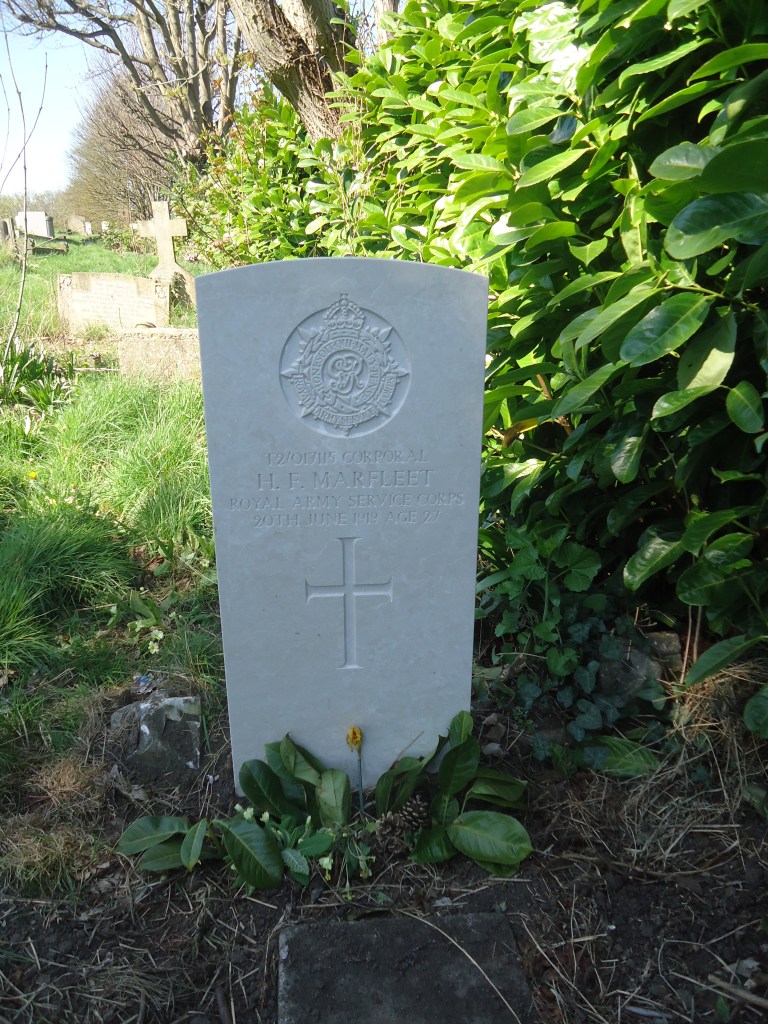
Herbert Marfleet – CWGC official recognition in 2015.

The re-imagined story …

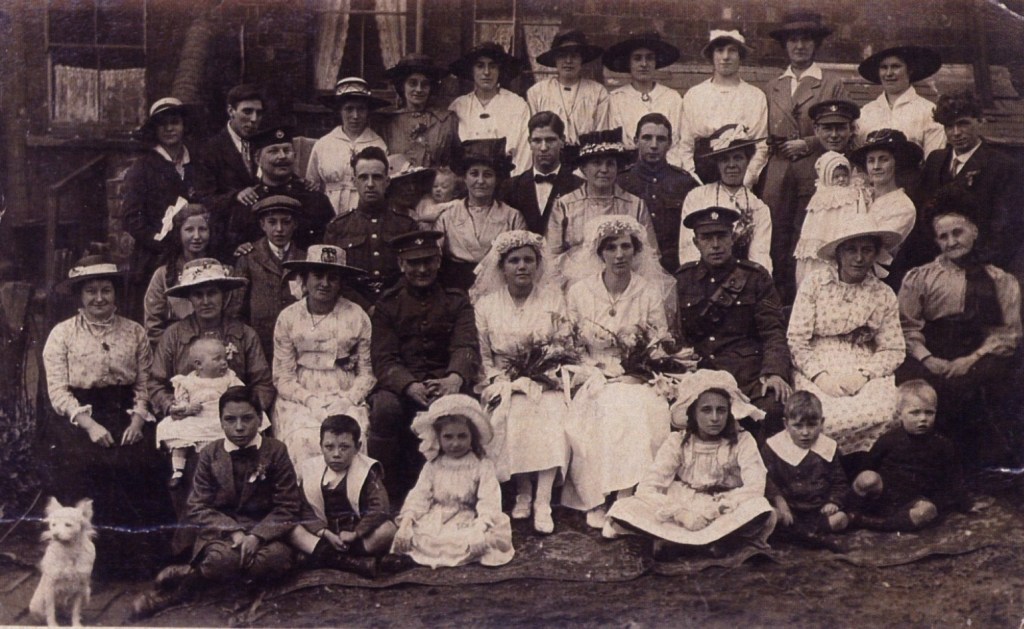
There are two surviving photographs taken that day and in each of them our Elsie looks so sad. You shouldn’t look sad in your wedding photographs – I keep thinking. People say it’s the happiest day of your life. And she looked so beautiful as well.

It was a proper family wedding. All the aunts and uncles were there and three little babies. My was little Joyce noisy, and would she keep her bonnet on? Granny’s dog was better behaved!

Six men in uniform were there that day, including the two grooms. Bert came home, but Elsie lost him anyway. Perhaps she already knew that then, on the happiest day of her life.

The facts …

Herbert Frederick Marfleet, the son of Benjamin James Marfleet a sergeant in the 2nd Dragoon Guards, was born in the Punjab in 1891. By 1901 the family had returned to England and Benjamin was working as a Railway Shop clerk in the GWR Works. On leaving school Herbert followed his father into the railway factory as an apprentice coach finisher.

In 1915 Herbert joined the Royal Army Service Corps serving first in Egypt. In 1917 he briefly returned home to Swindon to marry his sweetheart Elsie Morse. Elsie was the eldest of William and Agnes Morse’s seven children.  By 1911 Elsie’s father had died and Elsie, aged 18, was working as a finisher in a clothing factory.  This could have been either Cellular Clothing in Rodbourne or John Compton’s in Sheppard Street.  The family lived at 4 Albion Street where these wedding photographs were taken in the back garden in 1918 when Elsie and her sister Agnes married in a double wedding.  Agnes’ bridegroom was a Canadian by the name of Hooper Gates.  Hooper survived the war.

Immediately after the wedding Herbert returned to his regiment in Salonika where he contracted malaria. He was discharged from the army and returned to Swindon in the spring of 1919 but died just a few weeks later.

It was at first thought that he lie in an unmarked grave in the cemetery but it was later discovered that he was buried with his aunt and uncle, Matilda Hammett and Edward Johnson. He was, however, entitled to a Commonwealth War Graves official headstone as his death was a direct cause of his military service. The official application process began in May 2011 and the headstone was erected in June 2015. Guest of honour at the dedication ceremony was 98 year old Joyce Murgatroyd, his only known living relative, who as a baby is pictured in the wedding photograph.

Joyce with Andy and Mark

First published on April 20, 2022.

Private F.J. Kent – farm labourer

A career in the modern armed forces offers today’s young people a wide range of opportunities, and perhaps it was ever thus. When 18 year old farm labourer Frederick John Kent enlisted in 1906 did he take stock of his life and decide he wanted more – wanted to do more, see more?

Frederick John Kent was born in Blunsdon St. Andrew in 1888, one of the younger of Thomas and Ann Kent’s ten children. Thomas worked as a farm labourer and shepherd and Frederick looked destined for a life on the land as well, until he decided to join the army.

After six months training, which included a gymnastic course, his physicality had improved considerably. He stood 5ft 4½ ins and had gained 19lbs in weight. It would be another 18 months before he was posted overseas, first to India where he served for a year and 12 days and then Africa where he spent more than 3 years.  

On September 4, 1914 Frederick returned home following Britain’s declaration of war on Germany on August 4. On October 6 he arrived in Belgium as part of the British Expeditionary Force (BEF). An experienced soldier with eight years’ service, he was involved in the first bloody Battle of Ypres during which British losses numbered more than 54,000 killed, wounded and missing. After just 18 days of fighting in atrocious weather conditions, Frederick was taken prisoner of war. He would spend 4 years and 32 days in a German prisoner of war camp Kom 2, Lager 1, Munster.

Frederick was repatriated in November 1918 and his medical records state:

“Was taken prisoner of war in 1914 at Ypres with the 2nd Wilts. Whilst prisoner suffered from hardship & starvation.” He was declared 80% disabled, suffering from valvular disease of the heart (V.D.H.). He looked ‘old and feeble – rather depressed.’ He was 31 years old.

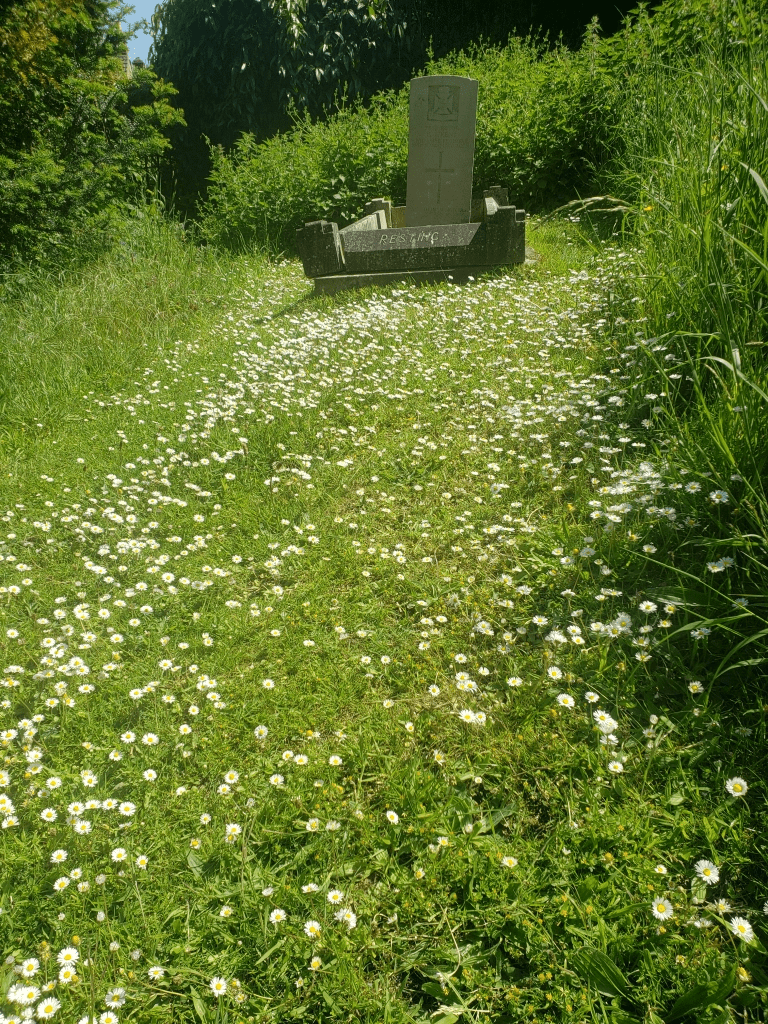
Frederick died at Bath Hospital on March 15, 1920 and was buried in Radnor Street Cemetery in grave plot A2539 on March 20. He remained alone in this plot until the death of his sister Ada Townsend who was buried with him on November 16, 1950 followed by her husband Albert Henry Townsend who died ten years later.

This war grave is one of the many maintained by our group of dedicated volunteers. In the summer months a carpet of daisies is spread before the grave.

Image of funeral account kindly provided by A.E. Smith & Son, Funeral Directors.

Originally published June 10, 2022.

Wally Richardson – Swindon Town footballer

When William ‘Wally’ Richardson died suddenly in 1911 he was known to have a collection of football memorabilia including his own medals and team photographs of Swindon Town FC. Wally’s football career as left back with Swindon Town began in 1890/1 and spanned the teams’ transition from an amateur club to a professional one in 1894/5.

William ‘Wally’ Richardson was born in Edinburgh in 1869 and came to Swindon in around August 1889 – not as a professional footballer but as an engine fitter and a job in the GWR Works. At the time of the 1891 census he was lodging with Charles E. Chappell and his family at 17 Marlborough Street and was already playing with the Swindon team.

The 1911 census taken shortly before Wally’s death records him living at 8 Marlborough Street with his wife Kate. The couple had been married for 20 years. Sadly, two of their three children had died in childhood.

Photograph published courtesy of Swindon Town FC

Death of Mr. W. Richardson

A Well-Known Local Footballer

Funeral on Wednesday

On Wednesday afternoon the mortal remains of the late Mr William Richardson, who was a popular member pf the Swindon Town F.C. in the old amateur days, and for the first few seasons after the Club embraced professionalism, were interred at the Swindon Cemetery amidst many tokens of sympathy and respect.

“Wally” Richardson, as he was known to his intimates, was by birth a Scotsman, and it was in his native City of Edinburgh that he served his apprenticeship as a fitter. Twenty two years ago last May he came South, and after working for the GWR Co. at Newton Abbot, until August of the same year, he was transferred to Swindon. As soon as he came to the railway town, Mr Richardson commenced playing for the Town Football Club, and very soon made himself indispensable to the team in the left full-back position. Wally Richardson’s first season with the Club commenced in 1890, and when the Club became a professional Club, he signed forms for them and continued playing for several seasons. It was exactly 19 years ago, last Easter that “Wally” went down to Warminster to play in a six-a-side contest for a silver shield. The Swindon party won the shield, and, if we remember rightly, the trophy was given to the Swindon Schools’ League to be played for annually by the boys. Mr. Richardson had a most interesting collection of photographs of Swindon football teams for various seasons, and the medals won in his favourite pastime. Everybody regarded “Wally” as an excellent sportsman in the best sense of the word, and his rather sudden death on Saturday, after an attack of dropsy, will be regretted by a large following of friends.

Extracts from the Swindon Advertiser Friday July 7, 1911.

William ‘Wally’ Richardson was buried on July 5, 1911 in plot E7317, a grave he shares with his daughter Daisy who died in 1903.