A career in the modern armed forces offers today’s young people a wide range of opportunities, and perhaps it was ever thus. When 18 year old farm labourer Frederick John Kent enlisted in 1906 did he take stock of his life and decide he wanted more – wanted to do more, see more?
Frederick John Kent was born in Blunsdon St. Andrew in 1888, one of the younger of Thomas and Ann Kent’s ten children. Thomas worked as a farm labourer and shepherd and Frederick looked destined for a life on the land as well, until he decided to join the army.
After six months training, which included a gymnastic course, his physicality had improved considerably. He stood 5ft 4½ ins and had gained 19lbs in weight. It would be another 18 months before he was posted overseas, first to India where he served for a year and 12 days and then Africa where he spent more than 3 years.
On September 4, 1914 Frederick returned home following Britain’s declaration of war on Germany on August 4. On October 6 he arrived in Belgium as part of the British Expeditionary Force (BEF). An experienced soldier with eight years’ service, he was involved in the first bloody Battle of Ypres during which British losses numbered more than 54,000 killed, wounded and missing. After just 18 days of fighting in atrocious weather conditions, Frederick was taken prisoner of war. He would spend 4 years and 32 days in a German prisoner of war camp Kom 2, Lager 1, Munster.
Frederick was repatriated in November 1918 and his medical records state:
“Was taken prisoner of war in 1914 at Ypres with the 2nd Wilts. Whilst prisoner suffered from hardship & starvation.” He was declared 80% disabled, suffering from valvular disease of the heart (V.D.H.). He looked ‘old and feeble – rather depressed.’ He was 31 years old.
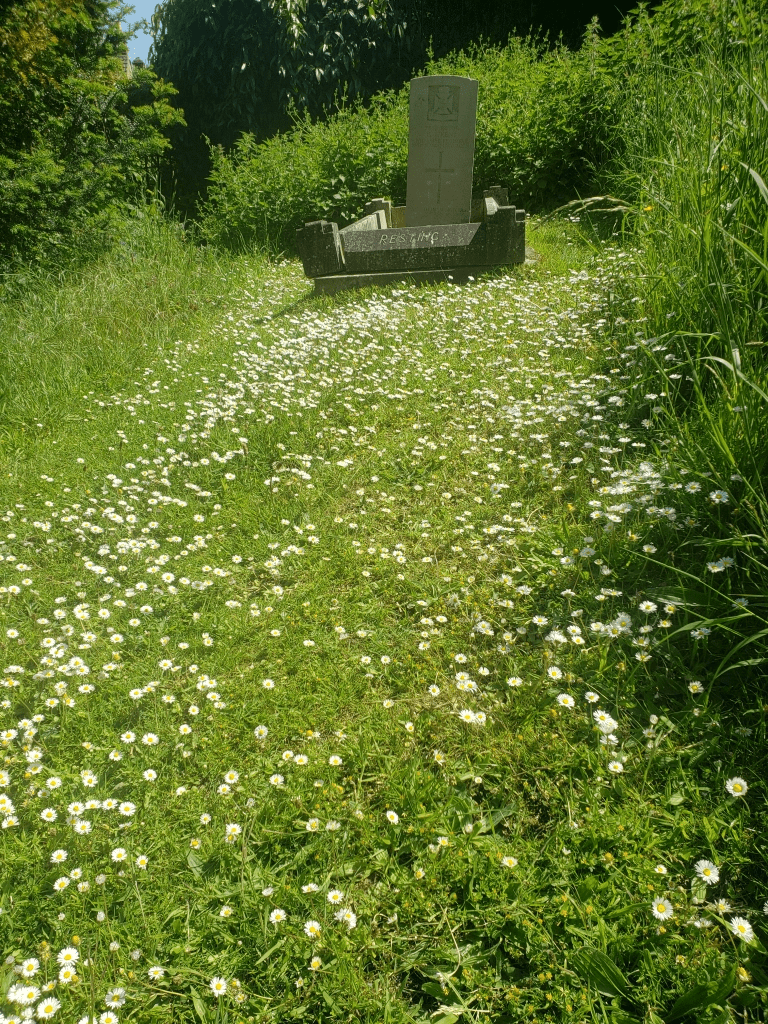
Frederick died at Bath Hospital on March 15, 1920 and was buried in Radnor Street Cemetery in grave plot A2539 on March 20. He remained alone in this plot until the death of his sister Ada Townsend who was buried with him on November 16, 1950 followed by her husband Albert Henry Townsend who died ten years later.
This war grave is one of the many maintained by our group of dedicated volunteers. In the summer months a carpet of daisies is spread before the grave.

Image of funeral account kindly provided by A.E. Smith & Son, Funeral Directors.
Originally published June 10, 2022.

 Radnor Street Cemetery