Death Notice – Swindon Advertiser Friday, December 31, 1909.
Long, Dec 24, at the residence of his daughter, 16 Curtis St. Swindon, William Thomas Long, aged 73 years.
When William Thomas Long died in 1909 his personal effects were valued at more than £900 – worth around £100k today. He had spent a lifetime working as a boilersmith, most of that in the Great Western Railway Swindon Works.
William Thomas Long was baptised at Holy Rood, the old parish church in Swindon, on July 31, 1836, the son of baker John Long and his wife Louisa. He grew up in Newport Street where his mother took over the business as Pastry Cook following the death of his father.
By 1861 William was a married man with two young daughters living in Newton Abbot where he worked as a boilersmith. William and Ann would complete their family with another five daughters plus Margaret born in 1879 who is first described as ‘granddaughter’ and later as ‘daughter.’
Yet, there is still so much we don’t know about Ann and William.
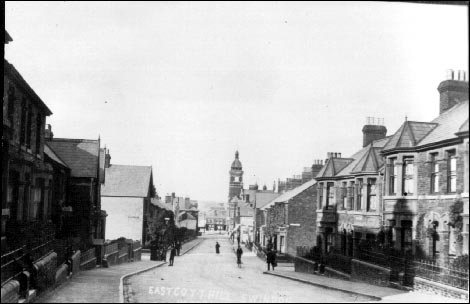
Looking down Eastcott Hill
For more than 20 years they lived at No. 8 Eastcott Hill – they may even have owned the property; Swindonians were renowned for investing in bricks and mortar.
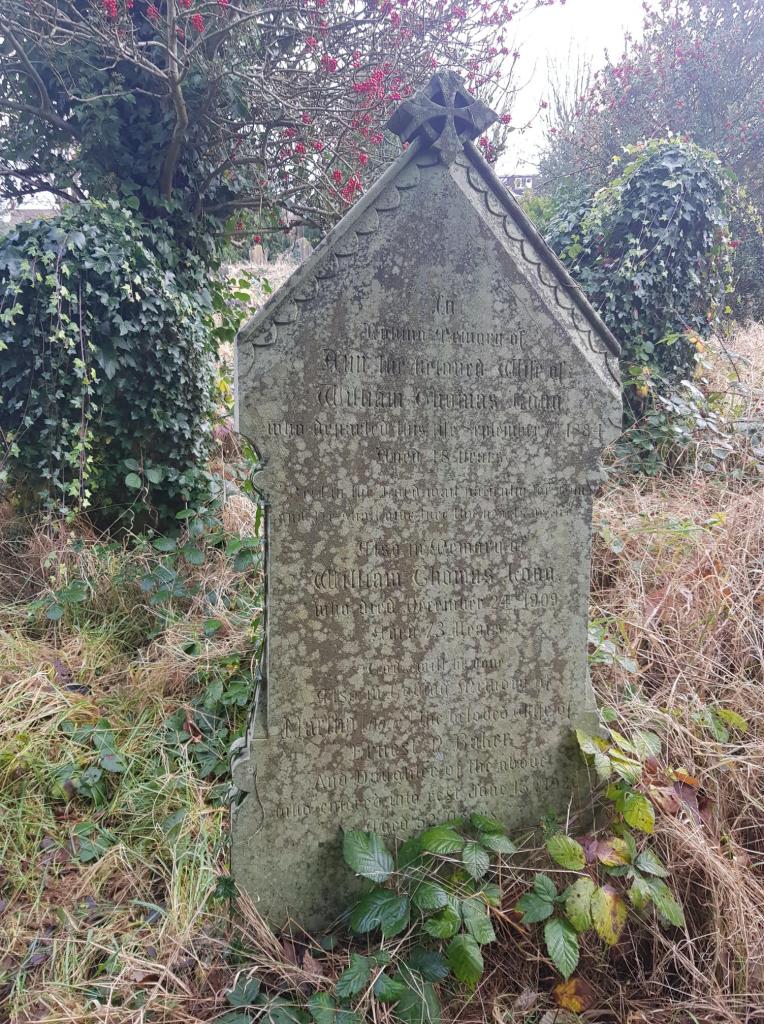
Ann died in September 1884 aged 48. When his wife died William had been able to purchase a grave plot in Radnor Street Cemetery where an impressive headstone was later installed; not everyone could afford to do this. He didn’t remarry after Ann’s death, which was is also quite unusual. He still had young daughters at home but presumably the elder ones took over the household duties and childcare; perhaps he could afford to employ a maid-of-all-work.
Ann was buried in grave plot E8306 on September 12, 1884 where William joined her in 1909. The cremated remains of their grandson William Clarence Heath and his wife Alice Ruth were interred in the same plot some 60 years later.
In the 1970s and 80s West Swindon was built as a cluster of village centres – it seemed to be a plan particularly favoured by Swindonians. In the 1840s there was the Railway Village followed by development in Even Swindon and then a satellite suburb Gorse Hill built in the late 1890s and 1900s. And it seemed that once people put down roots they seldom moved away. Take, for example, Nellie Bull, daughter of George and Maria Bull.
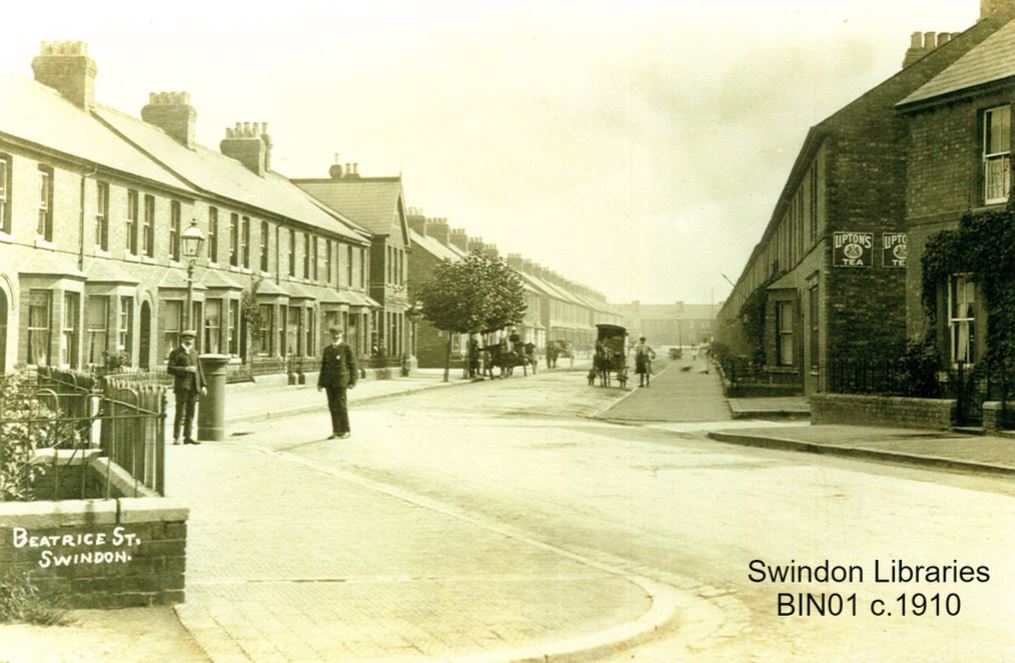
This image of Beatrice Street taken in around 1910 is available to view with a selection of Gorse Hill photos at Local Studies, Swindon Central Library.
Nellie and her brother George grew up in spanking, brand new Gorse Hill in the 1890s. In 1891 they lived at 70 Hinton Street, built in 1890 by entrepreneur James Hinton, Swindon Mayor in 1903/4 who also once owned the land on which the cemetery was built. By 1901 the family had moved to 119 Beatrice Street, another new build, and it was here that William George Bacon came to lodge with them. On Christmas Day that same year he and Nellie were married at St. Mark’s Church.
The young couple continued to live with Nellie’s parents in Beatrice Street where their baby daughter Nellie Gladys was baptised at St. Barnabas’ Church in 1902. They were still living at 119 Beatrice Street when Berty was born two years later, although he was baptised at St. Luke’s Church, Barton Hill, Bristol. By 1909 the family were at 7 Suffolk Street, just around the corner, when George Stanley was baptised at St. John’s the Evangelist. In 1939 William and Nellie were living at 33 Beatrice Street with their daughter Nellie and her husband Percival and Anna (Maria) Bull.
This stylish headstone with discreet art deco features marks Nellie and William’s last resting place, the only time they left Gorse Hill. William James Bacon died on June 18, 1948 at his home, 33 Beatrice Street. Nellie died March 2, 1956 at 33 Beatrice Street.
If you’d like to know more about Swindon’s 1980s West Swindon development – West Swindon – What the eye doesn’t see by Angela Atkinson,Roger Ogle and me is available from Hobnob Press, Bert’s Books, Amazon and other Swindon bookstores.
If ever a family provides a snapshot of life in Swindon at the turn of the 20th century, it is the Messiter family. A story of Swindon’s growth and the development of the railway works encouraging migration from across the country; a story of non-conformity and close family ties. Even Benjamin’s death took place during that iconic event in the Swindon calendar – the GWR Trip.
Image published courtesy of Local Studies, Swindon Central Library.
Benjamin was born in Trowbridge in 1845 and began his working career as a wool worker, arriving in Swindon in the 1860s for a more lucrative job in the railway works. He married Ann Ferguson in 1869 at the Wesleyan Methodist Chapel ‘near the market place, Swindon’ (the Planks).
The young couple began married life at the newly built Cambria Place living with Ann’s parents and six siblings at No. 34. Her father Charles was a fitter who had moved down from Scotland in the 1860s to a job in the railway factory. Ann and her brothers and two of her sisters were all born in Scotland.
Benjamin and Ann’s only daughter Louisa Ann, was born in 1872 and at the time of the 1881 census they were all still living with Ann’s parents in Cambria Place.
By 1901 Benjamin and Ann had moved to 11 Deacon Street where they lived with their married daughter Louisa, her husband Frank and their 5 year old son, Stanley.
An old and highly respected resident of Swindon, in the person of Mr Benjamin Messiter passed away with painful suddenness at Bristol early in the evening of last Saturday. Mr. Messiter had been spending his “Trip” holidays with his sister at 31, Hayward Road, Barton Hill, Bristol, and, not desirous of coming back to Swindon with the “Trip” train on Friday, he had arranged to return on Saturday evening.
After having completed all the preparations for his return, Mr Messiter was partaking of tea at half past five o’clock, when he collapsed and passed away immediately.
With all speed, medical aid was summoned, and in less than five minutes from the sad occurrence a doctor was in attendance, but could only pronounce life extinct.
News of the occurrence was immediately despatched to Mr. Messiter’s relatives at Swindon, his son-in-law, Mr. Matthews, at once leaving for Bristol
A Coroner’s inquiry touching the death was held on Monday, when a verdict of “Death from syncope” was returned.
Mr Messiter, who had been ailing for the past two years, was a native of Trowbridge and was 64 years of age. Coming to Swindon from his native town some 32 years ago, the deceased gentleman had since that time followed his occupation in the GWR Saw Mills.
During his many years’ residence in Swindon, he had gained the warmest esteem and respect of a very large circle of friends amongst the older generation of Swindonians, among whom the news of his death will occasion the keenest regret. He had a large number of relatives in Swindon, who have been the recipients of many tokens of sympathy in their sad bereavement.
Extracts from The Swindon Advertiser, Friday, July 16, 1909.
Swindon’s story – photograph taken from Radnor Street Cemetery
Benjamin Messiter was buried on July 15, 1909 in grave plot E7956 which he shares with his wife Ann who died in 1902 and his son-in-law Frank Matthews who died in 1935 and daughter Louisa Matthews who died in 1958.
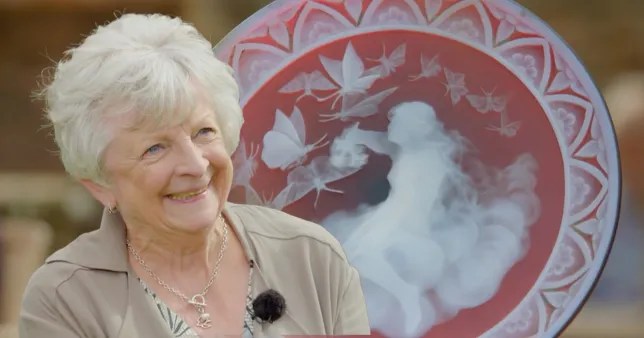
An episode of the Antiques Roadshow filmed at Kenilworth Castle and screened in 2021 featured two exquisite pieces of engraved glassware; a charming scent bottle and an ‘unfinished’ cameo plaque/plate. The visitor explained that these were two family pieces and that her great grandfather was Frederick Englebert Kny ‘a well known glass engraver in Stourbridge.’ Well, Roadshow expert Will Farmer lost no time in telling her what important objects these were, valuing the scent bottle at £1,500 and the ‘unfinished’ plate at a whooping £10-15,000.
The visitor was astounded, as we were when Noel found Frederick’s grave in Radnor Street Cemetery in 2019. What was he doing in Swindon at the time of his death in 1905?
Death of Mr F.E. Kny of Wordsley
The sudden death of Mr Frederick Englebert Kny of Camp Hill House, Wordsley, last week, came as a great shock to his family and friends. A short time since Mr Kny had complained of feeling somewhat run down, and on consulting his medical adviser, Dr. Grindlay, a change of air was recommended, and arrangements were accordingly made for a visit to his eldest daughter, Mrs Santley-Jones, Paradwys, Lansdowne Road, Swindon, Wilts, who came over this day fortnight and returned the same day with her father. During the ensuing week he took short walks accompanied by his daughter, and it was on nearing home, after one of these on Thursday evening, the 30th ult., that he suddenly stopped. Mrs Santley-Jones at once saw that her father was very unwell, and on his being conveyed to the house, medical aid was speedily summoned. Unhappily this proved of not avail, and he expired in a few minutes. The funeral took place at the cemetery, Swindon, on Monday last, amidst many manifestations of grief and sorrow.
Mr Kny was a native of Bohemia, and migrated to London in the sixties, where he shortly afterwards met the late Mr Wilkes Webb, at that time senior partner in the firm of Thomas Webb and Sons, Dennis Glass Works, under whom he held an important and responsible position for many years.
He was recognised as an artist of no mean ability, and by those qualified to judge was considered the best figure engraver yet known. His work was always of the highest order, and without doubt the local glass industry will be the poorer by his loss. Many of his designs were beautifully conceived and carefully executed, and it has often been said that the great care and attention he bestowed upon them never really brought its proper reward.
Among his numerous achievements may be mentioned that of the Halton Industrial Exhibition in 1868, when a piece of his workmanship gained the silver medal, and was purchased by Sir Anthony de Rothschild. At the Wolverhampton exhibition of 1869 the beautiful design representing the British Queen Boadicea resisting the Roman forces, was favourably commented on by the Daily Post in the following terms… “If the engraver is not English his influence is none the less valuable, and we honour those captains of industry in glass. The works of such an able artist will stimulate and instruct English artisans in the decoration of glass and educate them.”
Again in 1876 the Worshipful Company of Glass Merchants, of London, awarded a medal to him for his original and artistic work. Awards were also gained at Paris and London exhibitions, the most important piece of work being some copies of the Elgin Marbles engraved in relief and executed on a handsome claret jug. Another specimen greatly admired by most of the leading art critics at the time of its execution was one entitled “The council of the gods.”
Always of an obliging and unassuming disposition, Mr Kny never entered the field of politics or municipal matters. Although well informed upon all the chief topics of the day, his attention was solely devoted to the perfecting of new ideas in connection with his work. Deceased leaves a widow with fours sons and five daughters to mourn his loss.
The Advertiser, Saturday, April 8, 1905.
Frederick Englebert Kny was buried on April 3, 1905 in grave plot E8037 where he lies alone (and as Noel points out, the wrong date is inscribed on the headstone).
It’s not very often I find an error in the Radnor Street Cemetery burial registers, but this one could have proved rather confusing.
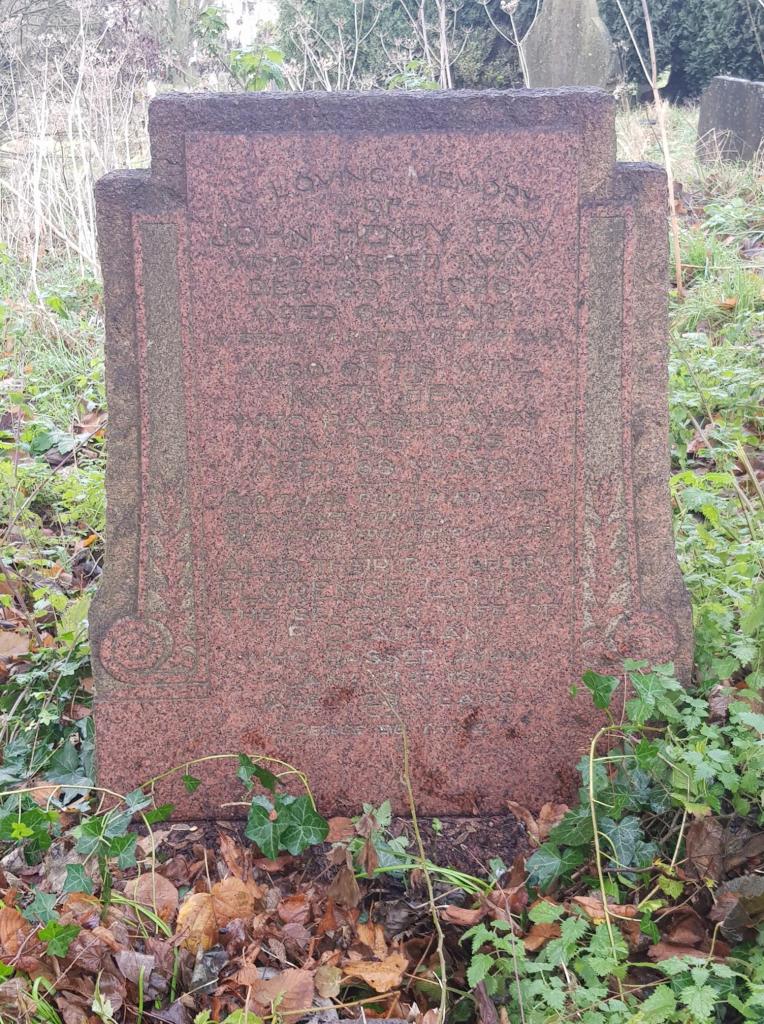
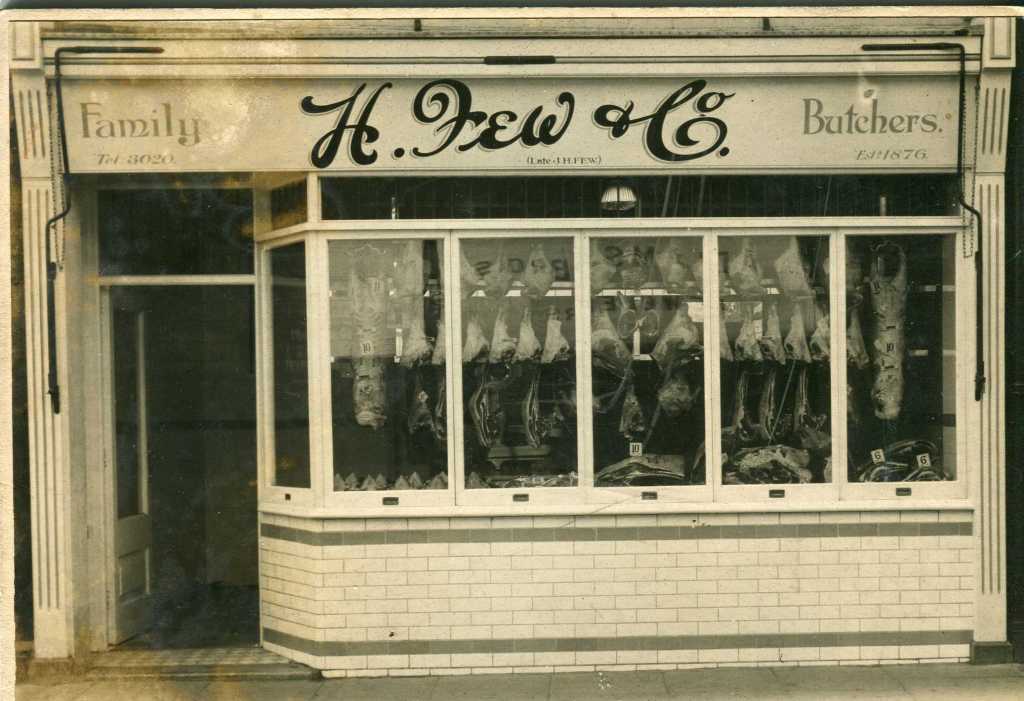
Florence Louise Few was baptised on August 27, 1888 at St. Mark’s Church, the eldest child of John Henry Few, a butcher and his wife Kate. John must have been a very enterprising young man as he was already in business at the age of 19 when he ran a butcher’s shop at 26 Prospect Hill. By 1891 he had moved the business down to New Swindon and a premises in Bridge Street. In 1891 he was based in at 59 Fleet Street and by 1911 he was at 61 Fleet Street (possibly some renumbering of Fleet Street had taken place).
In 1911 Florence was working as a shop assistant in the butchers. Her younger sister Freda was employed at ‘housework’ while 18 year old Gladys Elizabeth also worked in the shop. Younger brother Jack was still at school. Another brother, Harold Bastable Few, was born the following year.
Florence married Frederick Clapham, a Fitter, on November 17, 1913 at St. Mark’s Church and began married life in Weston Super Mare. She died there in January 1917 aged just 28 years of age.
Florence’s remains were returned to Swindon where she was buried on February 5, 1917. Her name is recorded in the burial registers as Florence Louise Clappen, which could cause confusion for those researching both the Few and the Clappen families. William Clappen had a Tailor and Outfitters shop in Wood Street, Old Swindon and another at the junction of Fleet Street and Bridge Street in New Swindon. This became known as Tram Centre where the tram drivers would check their departure times by the clock set in the shop front.
Florence lies in grave plot C2017. Her mother Kate was buried with her following her death in 1933, but there may yet be another mystery to solve. Although John Henry Few is remembered on the headstone, he is not buried in this plot. Only Florence and her mother Kate are buried here.
The Late Mrs F. Clapham – The funeral took place on Monday at Swindon Cemetery of Mrs F.L. Clapham, the wife of Mr F. Clapham, of Weymouth, eldest daughter of Mr and Mrs J.H. Few, of 61, Fleet Street, Swindon. The cortege left the residence of the deceased’s parents at 1.45 p.m. and proceeded to St. Mark’s Church (where the first part of the service was read), and thence to the Cemetery.
There were many beautiful wreaths and expressions of sympathy sent by relatives and friends. The coffin was made of polished elm with brass fittings and was inscribed: “Mrs Florence L. Clapham, aged 28 years, died Jan. 31st, 1917.” – Mr F. Clapham and Mr and Mrs J.H. Few desire to express their sincere thanks for the many expressions of sympathy received during their recent sad bereavement.
Extracts from North Wilts Herald, Friday, February 9, 1917.
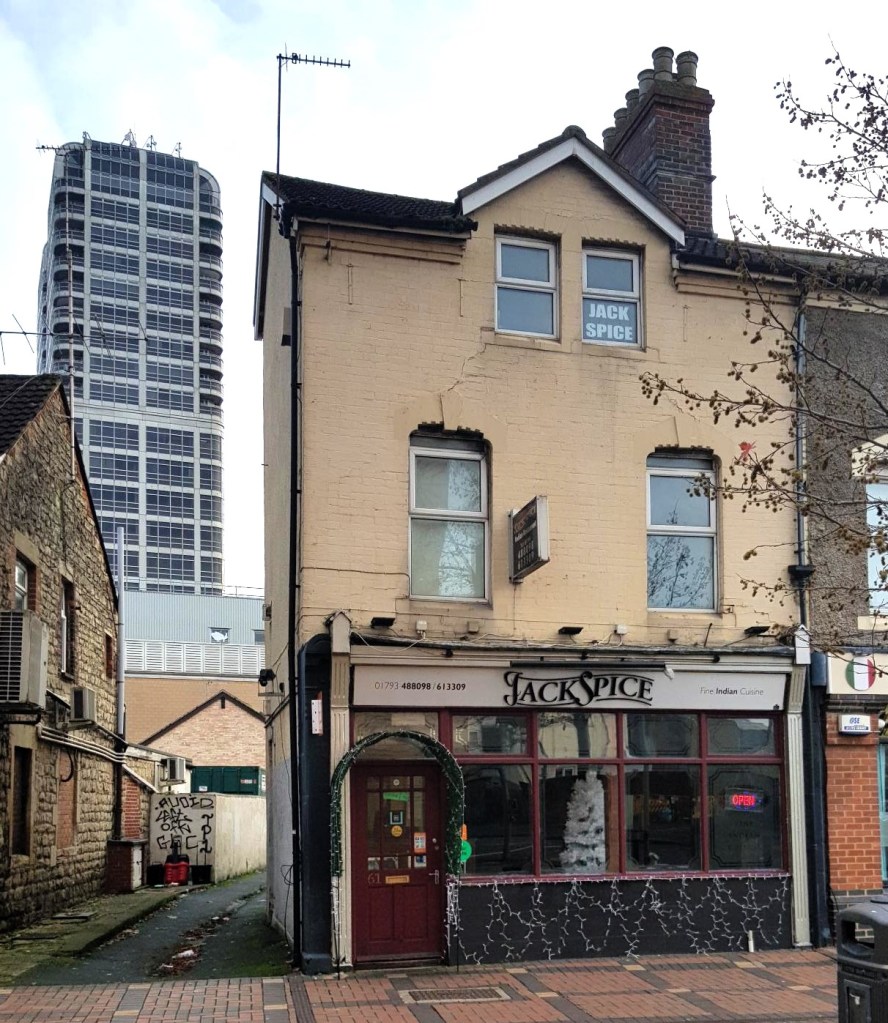
John Henry and Kate’s youngest son took over the business; the butchers’ shop is pictured here and we are able to confirm that the shop still survives.
Then …
and now
No 61 Fleet Street with the iconic David Murray John Tower in the background.
I am grateful for a lot of things, and like most of us I sometimes need to be reminded to stop moaning and reflect upon them.
Two of my children suffered an appendicitis in their early teens. It was a painful experience for them and an anxious time for me, but thanks to modern medicine and our marvellous NHS they both recovered.
Little Ella Saunders was not so fortunate.
Ella’s father was a Pork Butcher. The family business was a shop next to the Rolleston Arms pictured in this postcard view of Commercial Road. The 1911 census tells us that William and Maria had been married for 12 years and had four children, Ethel 10, Edna 8, Ella 5 and two year old Erica. The four girls were baptised together on May 1, 1911 at St. Mark’s Church.
Obituary – Much sympathy will be felt with Mr and Mrs W.T. Saunders, of 72 Commercial Road, Swindon, in the loss which they have sustained by the death of their six years old daughter, Ella. The child was operated upon for appendicitis at the Victoria Hospital, but died after a only six days’ illness. The interment took place at Swindon Cemetery on Good Friday amid many manifestations of sorrow, a very touching feature being the presence of a number of the deceased child’s fellow scholars.
The service was conducted by the Rev. E.F. Winnington-Ingram. There were a large number of beautiful floral tributes including one “With deepest sympathy from the staff, College Street Infant School” and “In loving memory to Ella from teachers and scholars, St. Mark’s Sunday School ‘Jesus called little children to Him’”.
North Wilts Herald April 12, 1912.
Image published courtesy of Local Studies, Swindon Central Library
Ella was buried on April 9, 1912 in grave plot B2938. William died in 1928 and Maria in 1953 and were both buried with her.
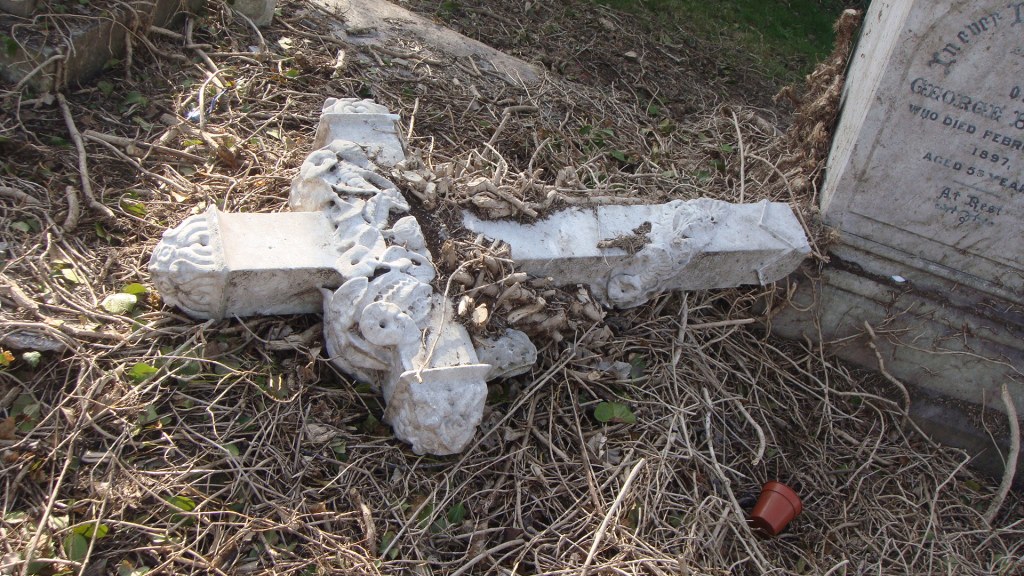
How magnificent must this memorial have looked when first installed?
In 2010/11 Swindon Borough Council conducted a major tidy-up at the cemetery. Memorials and monuments that had been hidden by ivy and brambles were seen again, possibly for the first time in years. And so the Bosley memorial was revealed, although unfortunately the ornate cross had already tumbled down.
The Bosley family ran a drapers shop in Fleet Street – an area of the town centre that has been significantly redeveloped (though not improved) in the 20th century. Their shop was numbered 55 and 57 so maybe renumbering took place even earlier.
Clara ran the business following George’s death and in 1911 she employed Charles Hiskins as manager.
Clara died on February 28, 1917. Administration was awarded to her daughter Clara Edith Burrows (wife of George Burrows) and her effects were valued at £7948 5s 8d.
Death of Mr G. Bosley – The hand of death has been busy amongst Swindon tradesmen during the last few months, as our columns have shown week by week. Today our obituary column contains the announcement of the death of Mr George Bosley, draper, who had been in business in Swindon for the past 23 years. Mr Bosley, who was 52 years of age, died somewhat suddenly at the residence of his brother-in-law at Ealing last Friday. Mr Bosley had suffered for many years from asthma, and left Swindon about three weeks ago to consult a London specialist. He had paid several visits to his doctor from Ealing, and it was thought he was improving, but he died somewhat suddenly in the presence of his wife and other members of the family. Deceased leaves a widow and nine children. The funeral took place at Swindon Cemetery on Wednesday last.
The Swindon Advertiser, Saturday, February 13, 1897.
This seemingly large burial plot contains the remains of just George who was buried on February 10, 1897 and Clara who was buried on March 5, 1917.






 Radnor Street Cemetery