Sometimes there is little I can add to the words written in an obituary. This is a lengthy report but well worth reading.
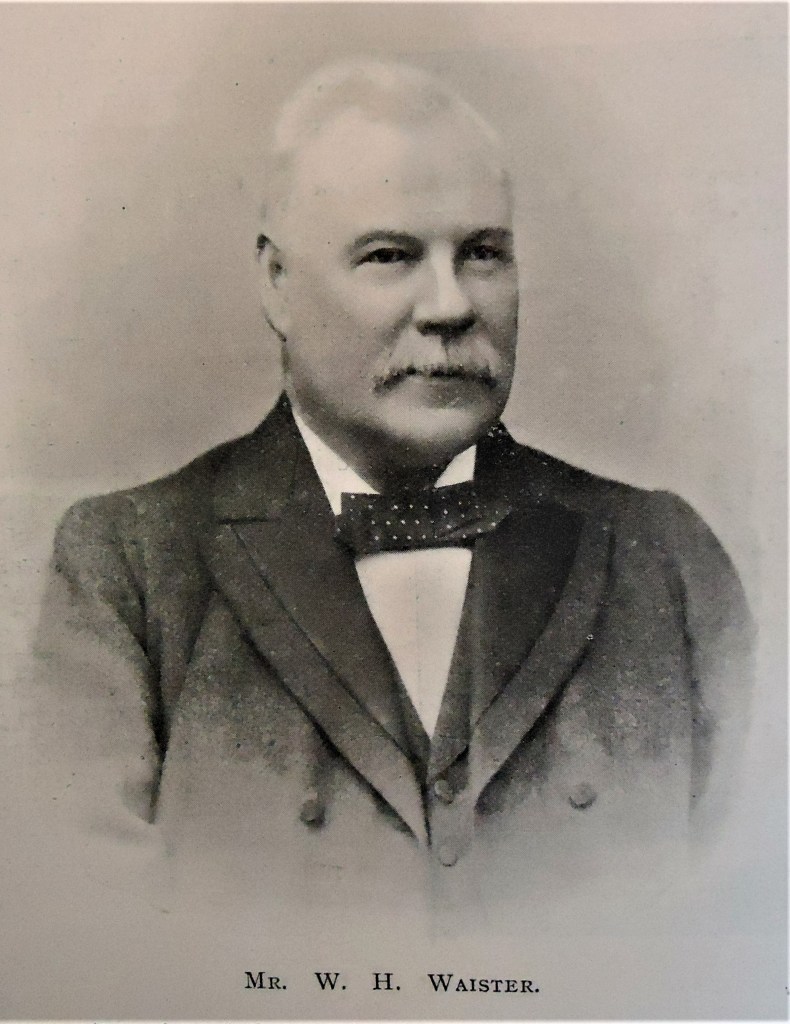
Death of Mr W.H. Waister
Interesting Career Recalled
Honoured by the German Emperor
Many Swindonians will hear with regret of the death of Mr William Henry Waister, of Clifton House, Swindon, which occurred on Saturday, after a long illness.
Mr Waister, who was 66, had been in failing health for the last five years, and during that time his sister-in-law, Mrs Clarke, had resided with him. Three weeks ago he went to Weston-Super-Mare, in the hope that the change would be beneficial, but when he returned home on Thursday his state of health was about the same, and he passed away as stated. Deceased leaves two sons and two daughters. The elder son is in the service of the GWR and occupies the position of Assistant Divisional Locomotive Superintendent at Newport, while the younger son is in Canada. Of the two daughters one is married and resides in London. Mr Waister’s wife, who was a daughter of Mr. William Elliott, of Wolverhampton, pre-deceased him 11 years ago.
Mr Waister’s association with the GWR was a long and honourable one, and was marked by the bestowal of many more honours than fall to the lot of the average railway official. Under the age limit he retired from the Company’s service at the end of 1912, and was succeeded by Mr W.H. Williams, who for some years had acted as his assistant. For 15 of the 48 years he was connected with the GWR he occupied the position of Chief Outdoor Assistant to the Locomotive, Carriage and Waggon Superintendent, and when he retired into private life he took with him several tokens of the high regard in which he was held, opportunity being taken of the occasion by the members of his own personal staff, over 60 in number, to present him with a handsome silver salver. The presentation was made, in felicitous terms, by Mr T. Piggott (chief clerk in Mr Waister’s department) and many tributes were then paid to Mr Waister’s services and high personal qualities.
Mr. Waister was a Tynesider, and, following some experience in the Marchioness of Londonderry’s workshops at Seaham Harbour, he was in 1865 apprenticed to the mechanical engineering in the GWR Works at Wolverhampton. As time went on he made satisfactory progress in his passage through the various departments, and after having acted as relieving foreman he eventually became Chief Draughtsman. In 1885 Mr Waister was transferred to Swindon to take charge of the Drawing Office, and a year later he became Locomotive Superintendent of the Swindon Division. In 1888 he returned to Wolverhampton in the capacity of assistant to Mr. George Armstrong (the Superintendent of the Northern Division) and as manager of the Stafford Road Works. His second stay at Wolverhampton extended over a period of nine years. In February, 1897, on the retirement of Mr. Armstrong, he became superintendent of the Northern Division, and the following October witnessed his return to Swindon as Chief Running Superintendent, under the late Mr. W. Dean, and from June, 1902, until the date of his retirement he was under the Chief Locomotive and Carriage Superintendent (Mr G.J. Churchward).
Mr Waister had a very interesting career. He served under no fewer than six General Managers, and it worthy of note that from 1886 onwards he accompanied practically every royal train running over the GWR system. He was with the train in which the German Emperor and Empress and their suite travelled over the line in 1907, and the Kaiser then conferred upon him the Order of the Red Eagle. He also accompanied the Czar and Czarina on their journey from Wolverhampton to Basingstoke in October, 1896. For the services he rendered in arranging accommodation for Royal personages he several times received the thanks of the General Manager and Chief Superintendent, and it is also interesting to note that he was one of the recipients of a medal from the Company commemorating the reign of the late Queen Victoria.
Mr Waister’s organising and administrative abilities were little short of remarkable, and for the services he rendered in connection with the removal of troops from one part of the system to another for the purposes of manoeuvres and mobilisation he received the thanks of the War Office on more than one occasion.
Funeral
The remains were laid to rest in Swindon Cemetery on Tuesday afternoon the funeral being attended by several of the deceased gentleman’s old colleagues and representatives of the Great Western Railway Company. The Vicar of Swindon (the Rev. C.A. Mayall) conducted the service in the Cemetery chapel and also performed the last rites at the graveside. The coffin, which was of polished elm with brass furnishings, was covered with beautiful wreaths, and the inscription on the breast plate was as follows:-
William Henry Waister
Died October 3, 1914.
Aged 66
Extracts from the North Wilts Herald, Friday, October 9, 1914.

William Henry Waister was buried on October 6, 1914 in grave plot E7949, a plot he shares with his wife Annie Maria who died in 1902. Their daughter, Lilian Waister, died in Newport in July 1950 and was buried with her parents here in Swindon.
This is all that remains of the Waister family memorial.

 Radnor Street Cemetery