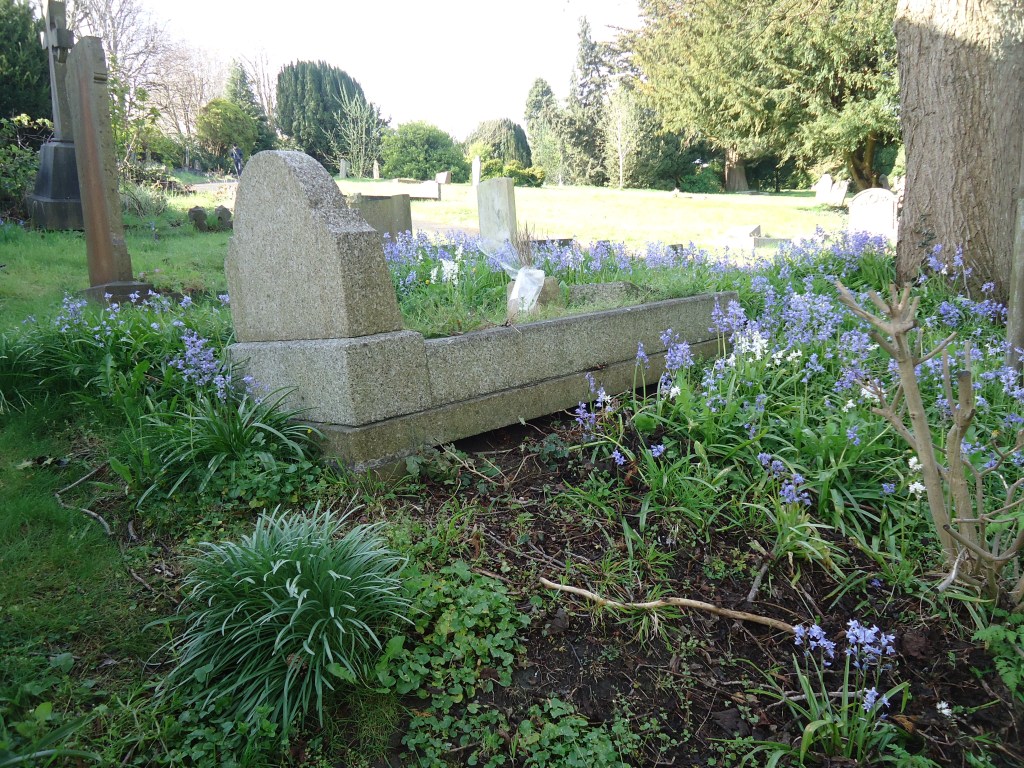
This grave always looks particularly beautiful at this time of year, although sadly my photographs don’t do it justice. This is the grave of Eliza Chirgwin and her husband Richard James Chirgwin, just by the Dixon Street cemetery gate, close to their former home at No. 27. I have long meant to research this couple and every year when the bluebells bloom I resolve yet again to see what I can find out about them, and there is a surprisingly extensive amount.
Richard James Chirgwin was born on September 20, 1850 at Phillack, Cornwall, the youngest child of George, an engineer, and his wife Honor. He married Eliza Callaway in 1873 and by the time of the 1881 census the couple were living at 19 Read Street where Richard James worked as an Engine Fitter in the GWR Works.
You can read more about Eliza and Richard in the obituaries published in the North Wilts Herald (see below) and if you should pass through the Dixon Street gate while the bluebells are in bloom you might like to pause awhile, as I usually do.

Death of Mrs R.J. Chirgwin – Mr Richard J. Chirgwin, J.P., of 27 Dixon Street, has suffered a great loss by the sudden death of his wife. The deceased lady was 77 years of age. She was about the house as usual on Wednesday, although her health had not been good of late. Early in the evening she went upstairs, intending to take a short rest, but she had a seizure, and before her husband, who was downstairs at the time, could reach her she had passed away. Dr. Lavery was fetched, but he could only pronounce life extinct. Both Mr and Mrs Chirgwin have been well known residents in Swindon for the past half a century, and they celebrated their golden wedding on December 23rd last. They are both natives of Cornwall, and came to Swindon 50 years ago. Mr. Chirgwin was for many years employed in the GWR Works but has been living in retirement for a number of years. There are two daughters. One is the wife of Mr Joseph Williams, who holds an appointment on the United Havana Railway in Cuba. The other daughter is Mrs. Anderson, wife of Mr Walter Anderson, Headmaster of Lethbridge Road Schools. The funeral will take place tomorrow.
North Wilts Herald, Friday, November 28, 1924.

A Swindon Social Worker
Death & Funeral of Mr R.J. Chirgwin, J.P.
Public Tributes
While on a visit to Exmouth, Mr Richard James Chirgwin of 2[7], Dixon Street, Swindon, passed away in his sleep, and the town has thus lost a devoted worker in social and religious causes. He had been in indifferent health for some time, and on medical advice had recently given up a number of his activities.
Mr Chirgwin was a native of Cornwall, but early went to live in South Wales, and after staying there six years came to Swindon in 1873, as an employee in the GWR Works. He gradually worked his way up, and at the time of his retirement four years ago was a leading foreman.
He was a very active Liberal, and had taken a prominent part in the work of the Party in Swindon and district for many years. He was a borough magistrate for a number of years, and was a very regular attendant at sittings of the Bench. Mr Chirgwin was well known in educational circles, and at one time was a tutor at the science classes before the Technical School was built. He was keenly interested in the work of the Workers’ Educational Association, and attended the meetings of the local branch until quite recently. He was also very fond of their summer rambles, and was a lover of long walks.
The deceased had occupied every position open to a layman in the Wesleyan Methodist Church. He had been a local preacher for 55 years, and last year, in company with Messrs. T.B. Jefferies, W. Chilton, E. Ransome, J. Clark, J.P., and T. Hiscocks, he received a special certificate from the Connexional Local Preachers’ Association. He began preaching in Cornwall in 1871, and frequently occupied the pulpit while in Wales. In Swindon he did service as a fully-qualified local preacher until 1924, when, on medical advice, he had to give up some of his preaching work. He was local secretary for the Aged Local Preachers’ Fund for 30 years, and also held the office of President of the Free Church Council for a time.
Mrs Chirgwin pre-deceased her husband three years ago, just after they had celebrated their golden wedding.
At Swindon Borough Police Court on Monday the Chairman (Mr. W.E. Morse) said he had to record the passing away of a member of their bench, Mr R.J. Chirgwin, who, as long as he (Mr Morse) could remember, had been a well-known citizen of Swindon. Five-and-a-half years ago he was appointed a magistrate, and he was always very regular in his attendance and diligent in the duties he was called upon to perform. He (Mr Morse) thought it would be the desire of the justices and the Court that a letter of condolence be sent to the members of the family of deceased.
This was carried in silence, all in Court standing.
The Funeral
The funeral took place on Wednesday in the presence of a large company at the Faringdon Street Wesleyan Church by the Rev. H.B. Turner (Bath Road).
The Rev W. Kelson (Superintendent Minister of the Swindon Wesleyan Circuit) conducted the service, being assisted by the Rev. W.B. Turner (Bath road), the Rev Montague Ashdown and Pastor Stocking.
The Hymns sung were “O God, the Rock of Ages,” and “Who fathoms the Eternal Thought.”
Voluntaries on the organ were played by Mr. Cassell.
Mr Kelson said when he first came to Swindon he and Mr Chirgwin were comparative strangers, but he had been able to enter into Mr Chirgwin’s life from the very first. Mr. Chirgwin had attained the most worthy objects in life. He was a man – a man after the type of the Supreme Man whom he came to know in his early years.
His religion was not merely an emotional one. It occupied all his heart, and also his mind. One could not wish to come into contact with a better character. His heart was warmed with the love of Christ, and his intellect had passed into his religion as well as his soul. He was not afraid to die.
His was a life of social and religious activity. There were a great many in Swindon who could speak of him with the highest appreciation of his services and all had a great esteem for him. His religion was comprehensive, a life embracing thing. They did not mourn for the life which had just been taken from them. Mr Chirgwin was a man who passed worthily through life: his end was peaceful, and his latter days were serene, which was fitting for one who took such an interest in life until the last.
Mr. Kelson referred to Mr Chirgwin’s debating powers, and added that although he regarded life seriously, he had learnt to smile at life’s troubles.
Not only the church with which he was so closely associated but also the town of Swindon would be greatly the poorer by his death.
The interment took place at the Swindon cemetery, the chief mourners being: Mr and Mrs Joseph Williams (son-in-law and daughter), Mr and Mrs Walter Anderson (son-in-law and daughter), Mr Kenneth Anderson, Miss D. Gibbs, Mrs C. Clack (niece), Mr and Mrs Ronald Clack, and Miss L. Symons (niece).
Long list of mourners and floral tributes.
North Wilts Herald, Friday, February 11, 1927.

 Radnor Street Cemetery