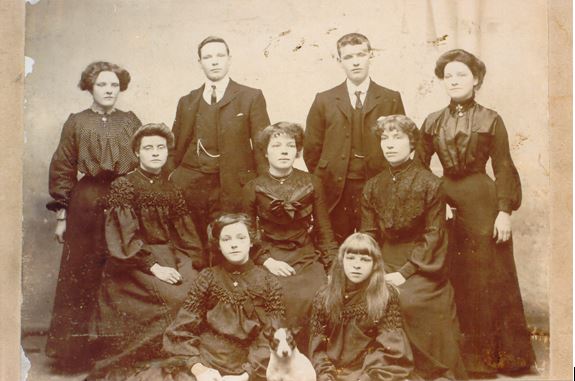
Edith Stevens – Communist

“Don’t just say, what a world, change the world,” is the advice Edith Stevens would give to a disaffected electorate who complain there is no point in voting – quite an appropriate quote to begin with as we approach a General Election on July 4.

Born in Swindon in 1884, Edith Stevens was the eldest of railwayman George and his wife Harriet’s six children.  The 1901 census finds the family living at 11 Theobald Street where Welsh born George is described as an iron turner in the engine shop.  His 15 year old son Stanley worked alongside him as an apprentice turner, Edith, aged 17, was a pupil teacher; the four younger daughters were Elsie 14, Olive 12, Winifred 8 and five year old Edna.

Edith grew up against a backdrop of political awareness and activity.  Her father George was secretary of No 3 branch of the AEU and served as a Labour Councillor for eighteen years and Edith, a women’s rights campaigner, was one of the first women to record her vote in Swindon.
In 1903-05 Edith attended Southlands College, Battersea where she gained her certificated teacher qualification, after which she returned to Swindon to teach at Clarence Street School. Throughout the interwar years Edith worked with families battling against unemployment and poverty, organising food for the children in her care that frequently came to school hungry.
Edith served as president of the Swindon National Union of Teachers and was a member of the Retired Teachers Association.  She was also an active member of the Swindon branch of the National Federation of Old Age Pensions Associations.


During the 1930s Edith became involved in the Friends of the Soviet Union organisation.  A former member of the Independent Labour Party, Edith nailed her colours firmly to the mast, and subsequently joined the Communist Party.  She became one of the founder members of the Swindon branch and in 1942 along with Bill Sargent and Ike Gradwell, Edith secured party headquarters at 1 Bridge Street.  The house was named in her honour and when the party moved across the road in 1970 to 77/78 Bridge Street the new property was named Edith Stevens House.

Edith’s lifelong involvement with the former Soviet Union included fund raising efforts during WWII when she became secretary of the Swindon Anglo-Soviet Friendship Committee.  In 1968, aged 84, Edith took part in a peace tour organised by the British Peace Committee, attending a peace conference in Helsinki and making her sixth and final visit to Russia.

Edith died at Stratton St Margaret Hospital on September 10, 1970 aged 86. She remained president of the Swindon Communist Party until her death.

At a subsequent memorial meeting held for Edith in the Les Bates Hall at the AEU House in Swindon, Dick Pearce, one of the founder members of the Swindon Communist Party, led the tributes.

“Throughout my life, he said, “I learned that anywhere in Swindon in working class and progressive movements you would find Edith Stevens in the thick of the struggle.”

Unfortunately, Edith is not buried in Radnor Street Cemetery. Further research is required to establish where she lies.

George Henry Stevens – Swindon Mayor 1928-29

Today I am publishing the first of a two part family story. George Henry Stevens devoted his life to public service – as did his eldest daughter Edith Harriett Stevens. George was described as ‘a foremost figure in trade union and Labour movements’ while Edith was a lifelong member of the Communist Party.

George was born in Mumbles, Swansea, the eldest child of Samuel and Eliza Ann Stevens. By 1851 the Stevens family had moved to Clifton where Samuel worked as a gardener.

In 1881 22 year old George was lodging at 27 Sheppard Street, Swindon with William and Mary West and working as an Engine Turner in the GWR Works.

He married Harriette Nash on March 24, 1883 and the couple went on to have six children.

Death of Mr G.H. Stevens

A Former Mayor of Swindon

Funeral Tributes

A former Mayor of Swindon, Councillor George Henry Stevens, J.P., of 62 County road, died on Saturday morning after a long illness.

His passing, at the age of 74 years, is a great loss to the town, for Mr Stevens’ record of public service was a notable one and he was a man who was swayed by the broadest sympathies and interest in all phases of the town’s administrative life.

Councillor Stevens’ devotion to his work is emphasised by the fact that he was a member of the Town Council for 18 years without a break and was honoured with the Mayoralty in the year 1928-29. His career was crowded with activity for the benefit of his fellow men.

46 Years’ Service

Born at Mumbles, Swansea, Mr Stevens came to Swindon in 1881 when 23 years of age, having served his time as a fitter and turner at Bristol. For 35 years he was a chargeman in W Shop at the GWR Works and retired in January 1928, after 46 years’ in the service of the company. For eight years he was a member of the council of the Mechanics’ Institute and for a quarter of a century was secretary of Swindon No. 3 branch of the AEU.

His first entry into the public life of the town was in 1914, when he was elected a member of the Town Council for King’s Ward. Later he represented the ratepayers of North Ward and continued to do so up to the time of his death. For seven years he held the position of chairman of the Electricity Committee and at the time of his death was a member of that committee as well as of the Works and Streets Committee, the Lighting Sub-Committee, the Staff and Stores Sub-Committee, the Finance and Law Committee, the Wages, Salaries, Superannuation and Loans Committee and the Rating and Valuation Committee.

Employed by Admiralty

During the war he served under the Ministry of Munitions for twelve months and afterwards was in the employ of the Admiralty as Labour Regulation officer for the North-Western area, stationed at Liverpool. He also served on the National Advisory Services Committee in Swindon, and was one of the first members elected on the National Health Insurance Committee for Wilts, serving in that capacity for 12 years.

Another important service he rendered was in connection with the Labour Exchanges for the South-West of England, and on that body he was the only Wiltshire representative during a period of three years.

Mr Stevens had been a member of the Ancient Order of Foresters for more than 60 years, and was one of the founders of the Swindon Brotherhood.

Trade Union Interests

He had been associated with the local Trades and Labour Council since its inception following upon a visit to Swindon of Mr. John Burns in 1885, and generally had been a foremost figure in trade union and Labour movements.

Extracts from North Wilts Herald Friday June 17, 1932.

George was buried in grave plot D1125 where he joined his wife Harriett who died in 1928 and two of their children – Stanley George who died aged 28 years in 1914 and Edna Gertrude who died in 1921 aged 25.

Read about Edith Stevens here tomorrow.

Henry Alfred Money – lost on a lads’ day out

A broken column like this memorial (see below) is symbolic of a life cut short, someone who died young and the story that goes with this grave in St. Mark’s churchyard has a very modern feel to it. 

Henry Alfred Money was the son of Thomas, an engine painter, and his wife Mary and in the 1860s the family lived at 8 Oxford Street in the railway village. 

Henry was a talented musician and played the violin. He was a member of the New Swindon Musical Classes and for many years had taken part in most of the New Swindon Musical entertainments. 

On the morning of Monday March 5, 1877 a body was found by the side of the railway track between Chippenham and Corsham. The young man had not been hit by a train but was lying in the ditch, his face covered by 3 or 4 inches of water.  The body was identified as 19-year-old Henry and at the inquest the following day the story unravelled.   

Henry and his friend Sutherland Polson set off for a lads’ day out on Sunday, March 4. They went first to Shrivenham, then to Wootton Bassett and then onto Bath. Arriving in Bath the two young men pretended they had come to the station to see some friends off. They were clearly larking about.  

They caught the 1 am mail train to Swindon and both fell asleep immediately they got on the train. When Sutherland awoke as the train pulled into Swindon he found his friend missing, his hat and stick left behind.   

At this point Sutherland must have panicked. He had no train ticket and no money on him. He gave his friends hat and stick to a porter and when asked for his details he gave a false name and address.   

Those called as witnesses at the inquest made no mention of the lads being drunk and in fact William Morrison, station inspector at Bath who was on duty that morning, made a point of saying that all the passengers who came out of the waiting room to board the mail train ‘seemed apparently sober.’  

The jury returned a verdict: Found dead by the side of the railway, apparently killed by a fall from the mail train.  

The funeral of the unfortunate young man took place on Saturday afternoon at St Mark’s burial ground, New Swindon, and was made the subject of a great demonstration, the route from the residence of the deceased’s mother in Oxford Street to the church being crowded by several thousand spectators.

The funeral cortege was made up as follows: – Firing party of 12 members of the 11th WRV Corps – Members of the Corps – The coffin, with deceased’s belt and hat, and several beautiful wreaths of flowers on the top, carried by rifle volunteers – The band of the 11th Wilts Rifles, 25 strong, wearing crape, with muffled drums, and playing the Dead March – About 60 friends, fellow clerks, and workmen of the rail mills – Upwards of 100 of the 11th and 16th WRV Lieut. Armstrong – and between 50 and 60 members of the Ancient Order of Foresters. The service was conducted by the Rev. George Campbell. The blinds at most of the houses on the route were drawn, and the utmost order prevailed.   

The inscription on the memorial reads:

Erected from the proceeds of a concert given by the New Swindon Amateur Minstrels (of which he was a prominent member) as a memento of their esteem.   

A young man with so much promise, lost on a lads’ day out.

Wentworth Joseph Evans – impressive funeral of late GWR foreman

The magnificently named Wentworth Joseph Evans was born on October 17, 1857 and spent his early childhood in Melcombe Regis, Dorset. By 1871 the family were living at 18 Gloucester Street, Swindon when Wentworth joined the GWR aged 14. He finished his apprenticeship in 1877 and went on to become an Assistant Foreman in 1897 and then a Foreman in 1905 working in A Shop, B & C Sheds and the Tender Shop before his death in 1912.

Wentworth married Eliza Ann Bugler in Weymouth, Dorset on December 29, 1880 and the newly weds began married life at 20 Carr Street. The couple went on to have three children and lived for many years at 10 Queens Terrace, Station Road.

The 1911 census provides lots of information about the family. Wentworth and Eliza had his widowed father and her widowed mother living with them in 1911. Wentworth’s father, Jabez [James] Evans is described as 79 years old, a retired Engine Erector (no pension). Eliza’s mother, Ann Bugler, is described as 82 years old, a widow and Old Age Pensioner 5/- per week. Wentworth and Eliza’s youngest son Alfred Arthur aged 25 works as a Pianoforte Tuner and is described as ‘totally blind from birth.’

When I checked the burial registers I discovered that Wentworth had died just 9 days after his father. Jabez [James] was buried with his second wife Catherine Evans in grave plot D1588.

A lengthy funeral report was published in the Swindon Advertiser.

The Late Mr W.J. Evans

Impressive Funeral of Late GWR Foreman

Seven Hundred Follows

The funeral of the late Mr Wentworth J. Evans, at the Swindon Cemetery, on Saturday, was the occasion of a most impressive tribute to the memory of the late foreman of the Erecting Shop of the GWR Works. Not only were Mr H.C. King and other officials of the Works present, but the Foremen’s Association, the Medical Fund, and the Council of the Mechanics’ Institute were also represented, while it is estimated that the number of men who showed their respect for their late foreman at the graveside must have numbered also seven hundred. It was the largest number of followers ever known in the Swindon Cemetery.

The cortege formed at Mr Evans’ late residence, 10, Queen’s Terrace, Station Road, and headed by a hand-bier bearing the beautiful floral tributes, and followed by an immense column of mourning men, proceeded to St. Mark’s Church. Here, the building was quite filled when the Vicar (The Rev. A.G.G. Ross) read the first portion of the sad rites for the dead. Re-forming, the procession made its way to the Cemetery, and here the Vicar of St. Mark’s again conducted the service. The remains were enclosed in a polished elm coffin with brass fittings, and the breastplate was inscribed:- “Wentworth Joseph Evans, died April 15, 1912, aged 54 years.

Extracts from The Evening Swindon Advertiser, Monday, April 22, 1912.

Wentworth Joseph Evans was buried on April 20, 1912 in grave plot D1480 where his wife Eliza Ann joined him following her death in 1913.

Cemetery Walk

We had torrential rain, thunder and eventually beautiful sunshine on our guided cemetery walk yesterday, during which we welcomed regular and new cemetery followers.

Kevin updated us on the work of the CWGC Eyes On Hands On team and in honour of the forthcoming 80th anniversary he spoke about Private Kenneth William Scott-Browne, killed in an air accident during D Day training.

Here are some photos from the day.

A return visit to Clifton Street

Victorian Swindon was the product of some daring speculative building.  Streets grew up in rows of terraces as local builders bought up small plots of land.  Sadly, today there are few remaining examples of the early names these builders gave their rows of terraces.

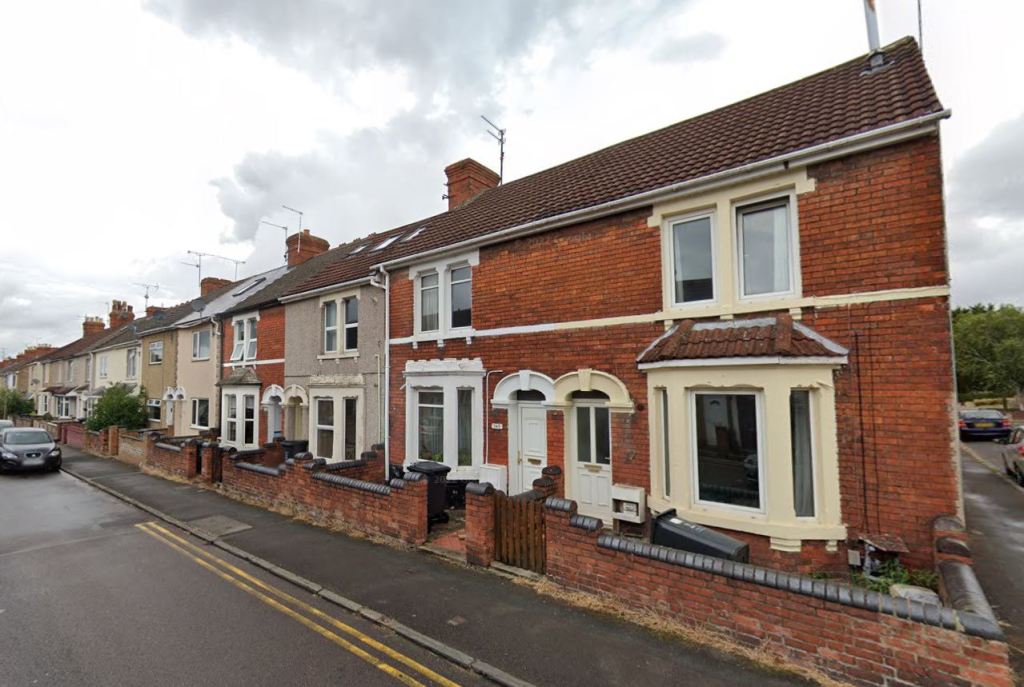
Built in 1883 by James Hinton, number 141 Clifton Street began life as 5 Graham Terrace.  The first owner was Alfred Reynolds, a coach builder obviously keen to invest in the Swindon property boom, who bought the property from James Hinton in 1884 and speedily sold it on.

On May 13, 1884 schoolmaster Samuel Snell paid £200 for No 5 Graham Terrace.  The deeds provide some fascinating details of the property and a glimpse of the Kingshill area in the middle of development.

The house at 5 Graham Terrace, Clifton Street is described as being ‘lately erected.’  The parcel of land on which the property was built had “a frontage to the said Street and being of the width throughout of fourteen feet eight inches.”  It was bounded “on the South Western end by a back road ten feet wide as the same is made or intended to be made parallel with Clifton Street.”

Samuel Snell didn’t live long in the house on Clifton Street before moving into the school building at The Willows, The Sands with his family, two assistant masters, three domestic servants and nine boarders.

John T. Mayell, a 24 year old boilermaker from Brierly Hill in Staffordshire was the next owner and moved into 141 Clifton Street with his wife and baby daughter.  In 1889 he took out a second mortgage on the property with Swindon solicitor Walter H. Kinneir, which he had repaid by 1901.  John lived in the house for more than ten years. 

By 1899 the street was built up along its entire length saving a few empty plots on the bend of the road opposite the Clifton Hotel.  The new road mentioned in the 1884 deeds is Exmouth Street.

In 1911 the property came on the market again.  Jabez Bull was the owner occupier and he sold the house to Charles Frederick Farr, an engine erector who lived just up the road at number 159.  Although now commonly known as Clifton Street, prospective buyers were reminded that the property had once been known as 5 Graham Terrace. 

James Hinton, New Swindon Local Board member, had land laid out between Dixon, Stafford and Clifton Streets by 1879.  In 1883 he built numbers 136-145 Clifton Street and the following year he built numbers 70-81 on the same street.

In 1880 James Hinton sold an 11½ acre plot in the middle of the Kingshill estate to Swindon’s two Local Boards for the building of the town’s much needed new cemetery.

He later served as Vice Chairman of New Swindon Local Board and became Mayor of Swindon in 1903-1904. Hinton Street in Gorse Hill was named after him. James Hinton died in 1907 and was buried in Radnor Street Cemetery.

Thomas Mullett – a Gas Work labourer

The last time we find Thomas Mullet on official documents is in the 1901 census. A Gas Work labourer Thomas lived at 146 Morrison Street with his wife Jane and three of their children – George 23, a furnaceman, Rose 19, a dressmaker and Mary 18, a shirt machinist.

Morrison Street – the Mullett family lived in the end house

Swindon

Thomas Mullett of 146 Morrison Street has succumbed to the effects of injuries sustained in an accident in the GWR Works a fortnight ago.

Deceased mounted a wall for the purpose of lighting a lamp, and fell on a quantity of rough stones his head being cut open. He received attention at the GWR Hospital and subsequently went home. After a while however erysipelas and internal complications supervened and death took place on Wednesday.

Western Daily Press Friday October 5, 1906.

Thomas Mullett aged 56 was buried on October 6, 1906 in grave plot D137 where he lies alone.

After her husband’s death Jane took stock of where her own life was going. Just two years later she had made up her mind and set sail for the USA. In 1920 she was living with her daughter Rose and son-in-law William H. Hobbs in Onondaga County, New York State.

Jane died in 1939 and is buried in Sherrill, NY, a long way away from Morrison Street and Thomas in Radnor Street Cemetery.

Thanks to Between the Bridges – The Early Days of Rodbourne – by David Lewis

Walter George Watts – killed instantaneously

Walter George Watts was known to family and friends as George. The son of Charles and Elizabeth Watts he was born in Horton, Wiltshire and began his working life at 14 years old as a farm labourer in Haydon Wick. Perhaps he was still employed on the land in 1910 – there is little information to be discovered about Walter’s life – only the report on his death.

In 1932 the Prevention of Accidents booklet was published with ‘posed’ photographs of potentially dangerous situations for those working on the railways. But it seems likely George wasn’t a railway employee. The railways were (and continue to be) dangerous places, even if you didn’t work on them.

A recent view of Montagu Street, Rodbourne

Fatality on the GWR near Swindon

A fatal accident occurred on the Great Western Railway between Swindon and Purton, about midnight on Wednesday. Two men were walking along the railway towards Swindon, and after they had passed two trains, which were meeting each other, one of them missed his companion, Walter George Watts, of 119 Montague Street Swindon. He made a search for him and eventually found his dead body by the side of the line. He had been struck by one of the trains and was killed instantaneously. The body was removed on a light engine to Swindon to await an inquest. The unfortunate man was 24 years of age and met his death on his birthday.

Western Daily Press, Friday August 12, 1910.

Walter George Watts was buried on August 15, 1910 in a public, unmarked grave, plot B2401. He was buried with two others; Jacob Fry who died in 1895 and was probably unrelated and Walter’s father Charles Watts who died in 1913.

With thanks to David Lewis – Between the Bridges – The Early Days of Rodbourne.

If you are researching your railway ancestor you may also like to visit the Railway Work, Life & Death website.

Elizabeth Jane Hardy – Exhumation of Swindon Woman

The sad story of Elizabeth Jane Hardy who died at the Wilts County Mental Hospital in Devizes in 1934 and was buried there in error.

Exhumation of Swindon Woman

Re-Burial in Radnor Street Cemetery

The Late Mrs Hardy

Early on Friday morning, in the presence of about half-a-dozen people, the body of Mrs Elizabeth Jane Hardy, aged 82 of Swindon, was removed from the grave in the hillside cemetery at the Wilts County Mental Hospital at Devizes, where it has been for just over a month.

The exhumation, by request of the Home Secretary, Sir John Gilmour, who granted the order, was carried out “As quietly as possible,” and only three members of the public were present at the re-burial at the Radnor Street Cemetery, Swindon, an hour later.

Secret Proceedings

And so at last satisfaction has been secured in connection with the unfortunate mistake that led to Mrs Hardy being buried in the Mental Hospital grounds against the expressed wish and without the knowledge of her 82 year-old husband, Mr Samuel Hardy, of 4, Euclid Street, Swindon.

Not a single relative was afforded an opportunity of attending the first burial, or of sending a few flowers down to the hospital, and immediately he heard of what had taken place, Mr Hardy and other members of the family, who naturally, were greatly distressed, vowed that they would not rest until an exhumation order had been secured.

In order to avoid any kind of public demonstration, the proceedings on Friday morning were carried out with the utmost secrecy.

The exhumation order was issued on Monday through Mr A.E. Withy, who has been acting for Mr Hardy, and the Mental Hospital authorities were immediately notified. Last Thursday afternoon the arrangements for lifting the body were completed, and Mr F.N.W. Baker, son-in-law, accompanied by Mr D.S. Smith (son of Mr A.E. Smith, the undertaker) motored down to the hospital cemetery on Friday morning.

The grave had been opened by the time they arrived, and when the coffin was disinterred Mr Baker expressed a wish that the lid should be raised in order that he might identify the body. This was done.

Those present at the exhumation included Dr. J.W. Leech, acting medical superintendent of the hospital, Mr J. S. Deavin, Clerk, and the Rev. Dudley, hospital chaplain.

The Mourners

The elm coffin was then enclosed in a magnificent oaken shell, and brought in a hearse to Swindon.

Just after nine o’clock, following a short service conducted by the Rev. Bertram E. Woods, of the Methodist Central Mission, Swindon, the re-burial took place in the Radnor Street Cemetery, in the grave which was originally opened for the public funeral that had been arranged to take place on Tuesday, 3 April.

The mourners present were Mr Samuel Hardy, husband; Mrs F.N.W. Baker and Mr Baker, daughter and son-in-law; Miss Joan Baker, granddaughter; Mr and Mrs Walter Timbrell, niece and nephew; Mrs Butt, Mrs Tylee and Mrs Selby, nieces; Mr and Mrs F. Baker, and Mrs Trowbridge, friends.

Mr Hardy, in conversation with a North Wilts Herald reporter, said the members of the family were greatly relieved to know that their efforts had been successful, and they owed a great debt of gratitude to the many friends who had sympathised with them in this sad affair.

“We are particularly grateful to Sir Reginald Mitchell Banks,” added Mr Hardy. “When the appeal was made to him, he instantly responded, and despite the great call upon his time personally sought the Home Secretary in order to hasten forward the granting of a licence.”

North Wilts Herald, Friday, 11 May, 1934.

Elizabeth Jane Hardy was buried in grave plot D919 where her husband joined her when he died in 1937.

James Fox – accidental death

Fox family

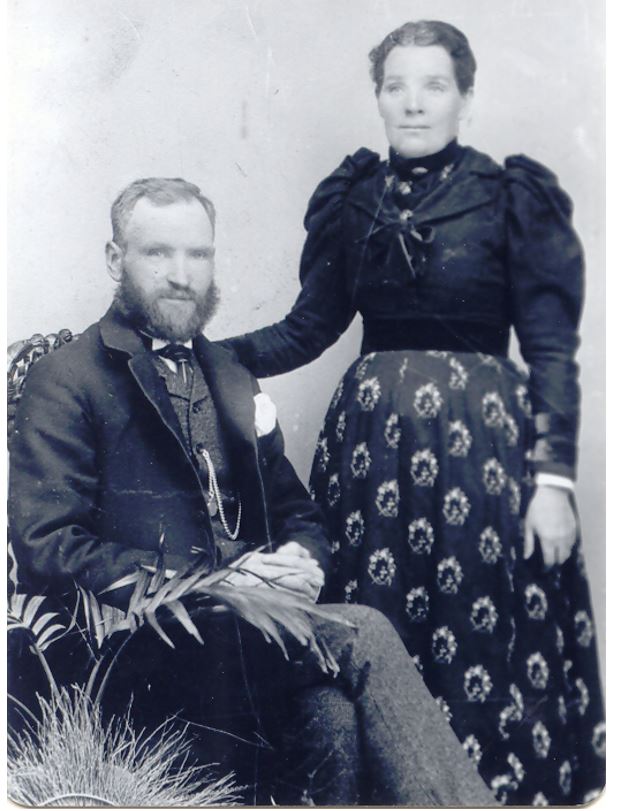
James and Annie Fox

James Fox was born on February 28, 1851. He grew up at Salthrop Cottages, Wroughton where his father Richard Fox worked as a shepherd. By 1871 he had moved into Swindon and was lodging with his brother and sister-in-law at Eastcott Hill. James married Annie Herridge on December 24, 1874.

The UK Railway Employment Records 1833-1956 state that James entered the service of the Great Western Railway in April 1876. Two accidents occurred during his working career. The first was on January 28, 1894 which caused damage to wagons. The second on December 10, 1901 caused the derailing of an engine at Swindon. There could be various reasons for these accidents; the railway industry was a dangerous working environment yet employees safety was still an issue of personal responsibility. But far worse was to follow …

Frederick George Higgins, engine driver in the employe of the GWR Co., said he was shunting on September 6th in the Swindon transfer yard. He and deceased were going ahead with one empty truck and a guard’s van. The van was at the back. They were not going more than three miles an hour. Deceased was attempting to get on the back van, and slipped. Deceased wanted to ride to go to the other end of the yard. He was not engaged upon the shunting operation. He (witness) saw the deceased slip. Deceased did not get a firm footing. He hung on with his hands, and his feet evidently caught in the crossings. The truck wheel went over the deceased’s foot, crushing it. The deceased was taken at once to the Hospital.

Dr Astley Cooper Swinhoe said he attended the deceased on Sept. 6th. He found the deceased was suffering from a compound fracture of the lower part of the left leg. The leg was amputated at once. Two days afterwards gangrene set in, and the man died from exhaustion consequent upon the gangrene.

The jury returned a verdict of “Accidental death.”

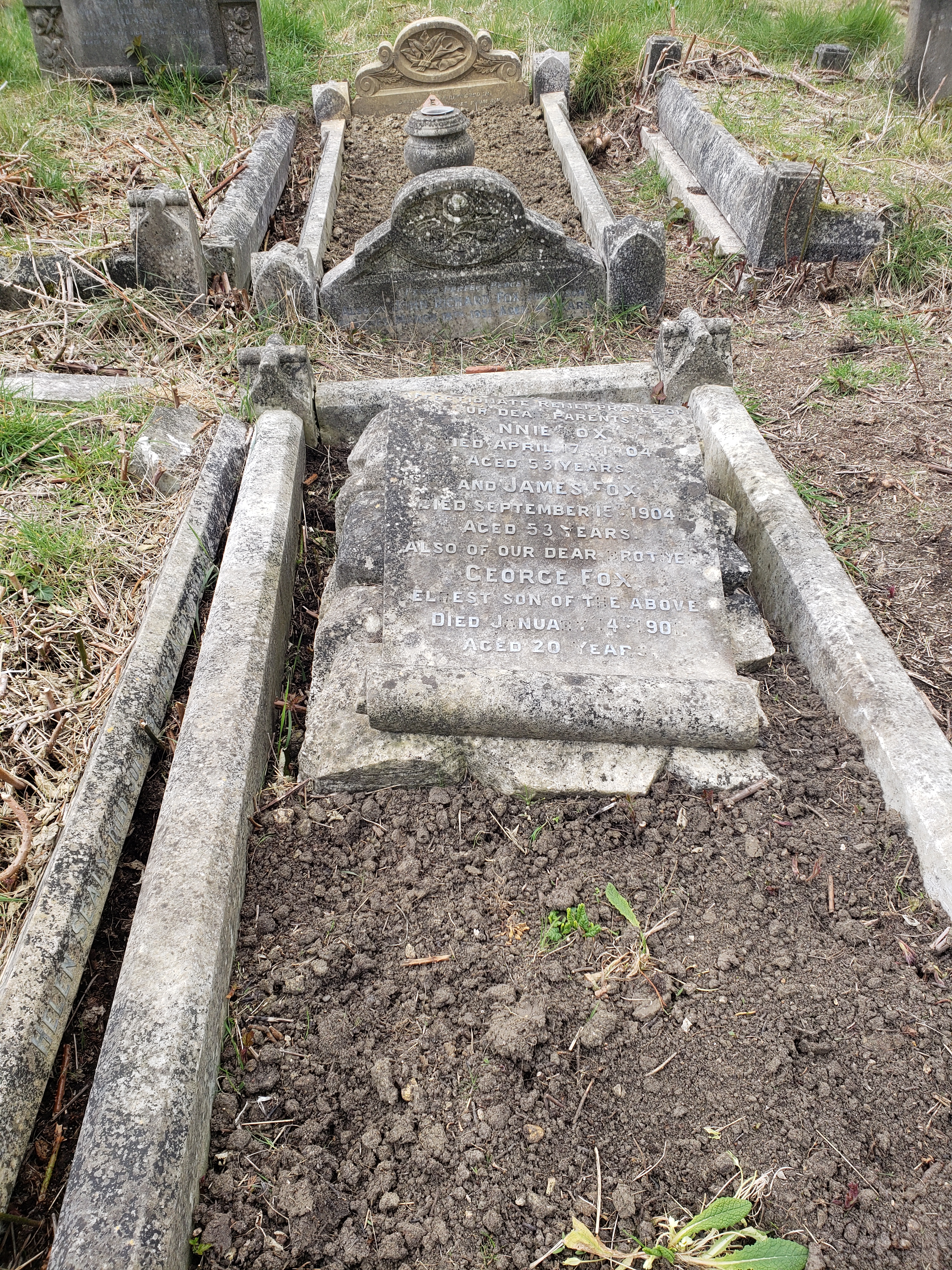
20220409_132809

Funeral of Mr Fox – Impressive Scene at Swindon Cemetery

The funeral of the late Mr James Fox, a GWR shunter, who died in the Medical Fund Hospital, last Thursday, took place in Swindon cemetery, last Sunday afternoon, in the presence of an immense concourse of people.

The funeral procession left deceased’s late residence, 163 Beatrice Street (whither the body had been removed from the Hospital), at three o’clock, arriving at the Cemetery almost half an hour later.

The coffin, which was covered with beautiful wreaths, was conveyed in a hearse, and the chief mourners, relatives of deceased, following in three mourning coaches.

Then there followed on foot about 100 uniform men from the GWR Station fellow workmen in various department with deceased, and these were headed by Inspectors Simpkins, Spurlock, Winter and Taylor. About 30 other members of the Amalgamated Society of Railway Servants (of which deceased was a member) followed, being headed by Mr G.E. Leonard (Chairman of the Swindon Branch) and Councillors J.H. Thomas and J.H. Mayell. Many members of the GWR Provident Society were also present, headed by Mr. W.H. Perry Court Pride of Wiltshire, A.O.F., of which Mr Fox had been a member for many years, were represented by Bros. T. Robinson (Secretary), N. Young, F. Williams, J. Lawrence, W. Timbrell and W. Comley.

It was a lovely fine afternoon, and by the time the procession reached the Cemetery, a crowd numbering some thousands had assembled. The greatest order was maintained throughout, and the service was impressively read at the graveside by the Rev. W.J. Scruby, Primitive Methodist Sup. Minister. Deceased was buried in the same grave as his wife, who died last April, and a son, who died some four years ago.

The coffin was of polished elm, with brass furniture, and bore the following inscription: James Fox, died September 13th, 1904, aged 53 years.

Extracts taken from Inquest and Verdict/Funeral of Mr Fox Swindon Advertiser Friday September 23, 1904.

James Fox 53 years 63 Beatrice Street burial September 18, 1904 grave plot E7385

Photograph of the Fox siblings believed to have been taken on the day of James Fox’s funeral – Back left to right – Florence, Henry James, Tom, Elizabeth. Middle row left to right Annie Amelia, Emily, Alice. Front row left to right Winifred Ellen, Rose.