The re-imagined story …
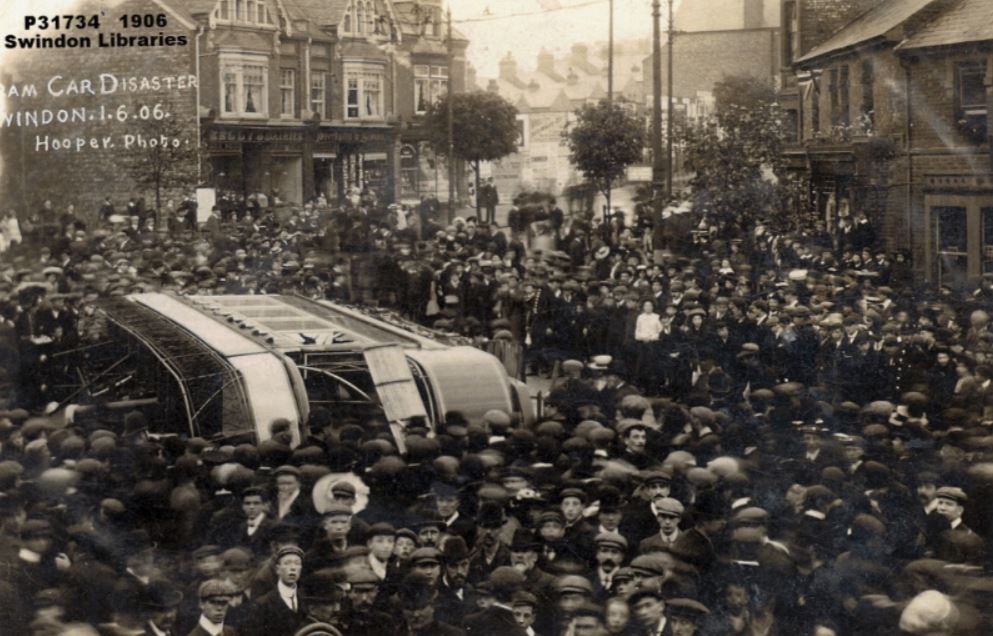
We could all see that the tram was travelling too fast and people on the street began to move, clearing a path. When the accident happened, it was as if in slow motion; until the screech of metal on metal and the screams of the passengers plunged the scene into sharp and noisy relief.
As the tram swerved and toppled over some of those travelling on the open top were thrown to the ground. Surely, they could not hope to survive.
The visitors to the Bath and West Show who thronged down Victoria Road stood in shocked disbelief. For a split second there was a silence, a nothingness and then onlookers surged forward to help.
I was just returning to the studio from an assignment and had my camera with me. I briefly considered taking photographs of the scene, but just as quickly decided against it. I left my equipment in the foyer at the Empire Theatre and joined those helping to rescue the trapped and injured passengers.
Local photographer William Hooper published a postcard photograph of the crash scene that same day. I knew then that I didn’t have what it took to be a commercial photographer and I resigned from my position before my employer had an opportunity to dismiss me.
I took up a clerical job in the Works soon after. When I retired forty years later my colleagues presented me with a camera!

The facts …
Runaway Tram Car
Dashes Down a Swindon Hill and Overturns
Four Passengers Killed and 30 injured
Somerset Farmer loses his life
Dorchester People Injured
A serious tram accident occurred at Swindon on Thursday evening. In consequence of the Bath and West of England Agricultural Show, the electric cars, which are Corporation property, were very heavily laden, and No 11 car, which is registered to carry 56 passengers, was descending Victoria road, a steep decline connecting the old and new parts of Swindon, with a load of between seventy and eighty people. Midway down the hill, the car got beyond control and at the foot of the hill ran on to the uprails at a crossing, and overturned.
The passengers on the top were precipitated into the road like stones out of a catapult, some being thrown a considerable distance. There were a great many people about at the time, and for some moments the greatest consternation prevailed. A few cool heads were soon on the spot to render assistance. The shrieks and groans of the injured filled the air, and one spectator says that blood ran into the gutter in streams. Scarcely a single passenger escaped without injury, although one or two who saw their danger had jumped off before it was too late.
Dr. Lavery, who lives close by, came on the scene, and was soon followed by Drs. Waiters. Dalea Gordon, Ducane, and the officials from the Great Western Surgery. Dazed and unconscious, the victims lay strewn about the roadway for many yards. The doctors and ambulance men rendered first aid to the more serious cases, and conveyances were summoned and the victims conveyed to the Victoria Hospital.
All the injured were transferred to the Victoria Hospital where they were given further treatment. Unhappily, the injuries in two cases proved fatal. Mr Edwin H. Croad, proprietor of the Railway Hotel, Swindon died on the way to the hospital while Mr Harry Dyke, brewer’s agent, of Swindon succumbed to his injuries shortly after admission. Two other victims died later. The roll of injured contains the names of about 30 persons, and others who were merely bruised or shaken went direct to their homes.
The Dead
Harry Dyke, brewer’s agent, Goddard-avenue, Swindon.
E.H. Croad, Railway Inn, Newport Street, Swindon.
Rowland J. Dunford, Nables’ Farm, Draycot Cerne, Chippenham.
Charles Phippen, farmer, Weston Bampfylde, Sparkford Bath.
The two first names died soon after admission. In all cases death is supposed to be due to fracture of the skull.
How the Accident happened
General comment is that the car was carrying far too many passengers; indeed, eye witnesses and many of the passengers declare that it was grossly overcrowded. In descending Victoria road, the brakes either did not act, or were overpowered, and the momentum acquired in descending this steep thoroughfare hurried it along at a pace which convinced passing pedestrians, and even the passengers themselves, that an accident was inevitable. Whatever the feelings of the passengers were, no panic was displayed.
There was an absence of screaming, one and all awaiting with a grim quietness the denouement which all felt was bound to come. The car kept to the rails going down the hill. At the bottom is a sharp curve into Regent circus. On reaching the bend, it ran on to the up line, rocked heavily, and then fell over on its side with great force. It was exceedingly fortunate that there was no car on the up line or the loss of life must have been much great.
Lyons, the driver, stuck to his car to the last. He is said to have been an experienced motor man. He received some slight injuries to his side, but soon recovered. The conductor, who was on top of the car, was picked up in a dazed condition, but he pulled himself together in a few minutes. Lyons declares that he put on his brakes on reaching the hill, and applied them as hard as he could. He never let go of these until the car toppled over, and did all that he could to avert the disaster.
The trams belong to the Corporation of Swindon, and there is no doubt that the matter of compensation will have to be faced by the town authorities. The overcrowding allegations give a further serious aspect to the matters. Passengers are booked on a way bill, similar to the system followed in Bristol, the deviation being that the bill, instead of being placed in a prominent position within the car, is kept in portfolio form, and checked by the inspector whenever he mounts the platform. This way bill doubtless will be produced when required at the official enquiries which will be held, and, if accurately entered up, should show the exact number of persons who were riding. This can be further checked by the number of punched tickets issued.
This is not the first mishap which has occurred at the foot of Victoria road, although, fortunately, the previous accident was not attended with serious consequences. Warnings have more than once been uttered emphasising the necessity for special care being exercised in the descent of the hill, and at the annual dinner of the Chamber of Commerce, Mr A.E. Withey, a prominent local solicitor, expressed strong views on the question.
Taunton Courier and Western Advertiser 6th June 1906 (extracts)
Edwin Herbert Croad, the 60-year-old proprietor at the Railway Hotel, Newport Street, Swindon was buried in plot E8374 in Radnor Street Cemetery on June 6. William Hooper got a photo of the funeral as well.
Swindon Corporation was found liable for more than £7,000 compensation and costs and was forced to increase the rates for three years to pay the bill.


 Radnor Street Cemetery
I will add information on Rowland Dunford of Nables Farm, Draycot Cerne, to my website. He is buried in the cemetery at Upper Draycot.
LikeLike
Thank you for getting in touch.
LikeLike