There is a world of difference between enjoying a drink and taking a bottle of whiskey to bed and I wonder what propelled Mary Bailey from the one to the other.
Drunkenness was the scourge of the 19th century working classes. Even in Swindon where the much lauded Great Western Railway Company provided wrap around care ‘from the cradle to the grave’ there was still want and destitution for those who fell through the cracks of society.
Temperance societies encouraged people to abstain from drink and to take the pledge of a lifetime of sobriety. By the end of the century Swindon numbered around 18 such organisations, including the GWR Temperance Union with around 3,000 members, however it is unlikely Mary joined their ranks.
A Fatal Taste for Alcohol
A sad case came from Coroner W.E.N. Browne, on Monday in an inquest concerning the death of Mary Baily, wife of a GWR fitter of 11 Hawkins Street, New Swindon.
The deceased who was 49 years of age, was stated by a neighbour to be of intemperate habits. Her husband on Friday night went to bed at 10 o’clock, and thinking his wife was asleep did not disturb her. He arose at five o’clock on Saturday morning and found his wife dead and quite cold. A whiskey bottle was found beneath the bed. Dr. Duffield stated that death was due to asphysxia, cause by the woman lying on her face in a helpless condition ensuing upon an over-dose of alcohol.
Gloucester Citizen Tuesday November 28, 1899.
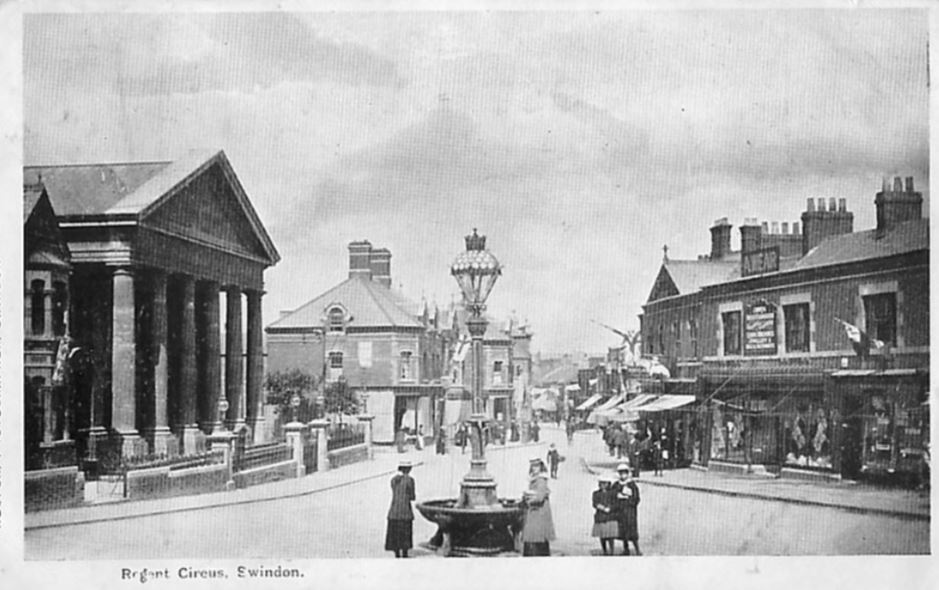
Drinking fountain erected by the Swindon United Temperance Board in Regent Circus 1893
Mary Christianna Dance was born in Stratton, Gloucestershire and baptised on February 4, 1849, the eldest of John and Jane Dance’s eight children. She married Thomas Bailey in 1871 and by 1881 they were living at 11 Henry Street (later renamed Hawkins Street) with their 8 year old son Thomas, and Mary’s brother Charles. Both men worked as carriage fitters in the Works.
So what happened to Mary between 1881 and 1899, or had her problem with alcohol begun long before? Did she try to control her drinking, or was she aided and abetted by her husband Thomas, whose comments at the inquest appear ingenuous when compared with the neighbours observations.
Mary was buried on November 28, 1899 in grave plot C109, a privately purchased grave, which might come as some surprise. In 1908 she was joined by Tryphena Bailey, Thomas’s second wife and then in 1937 by Thomas himself.
Many thanks to David Lewis and his book Between the Bridges – The Early Days of Rodbourne.

 Radnor Street Cemetery