Rodbourne Man Killed – Fatal Accident in the GWR Works

How we like to moan about good old ‘health and safety’ regulations. What a nuisance it all is – well this is how life was before we had such protection.

When John Parkinson went to work that Tuesday in October 1901 it was just another day in the railway factory. By eight o’clock that evening he lay dead in the Medical Fund Hospital, his wife Kate a widow and his four young sons Ernest 8, George 6, Percy 4 and 2 year old Wilfred without their father.

The Fatal Accident in the GWR Works

A Rodbourne Man Killed

A terrible accident occurred in the GWR Works, Swindon, on Tuesday, which, unhappily, terminated fatally. A man named J.E. Parkinson, of 46, Linslade-street, Rodbourne, and engaged in the boiler shop of the GWR Works, was the victim, a large boiler falling on his back, and inflicting such injuries that his life was despaired of from the first. The accident happened about four o’clock on Tuesday last, and the unfortunate fellow, who was 31 years of age, was conveyed to the GWR Medical Fund Hospital, where Drs. Rodway and Astley Swinhoe attended to his injuries. The injuries to the back and sides were so terrible that it was utterly impossible to do anything more for the unfortunate man than give him stimulants and keep him warm. He only lingered four hours, passing away soon after eight o’clock in the evening. He leaves a widow, who is prostrated with grief, and four children.
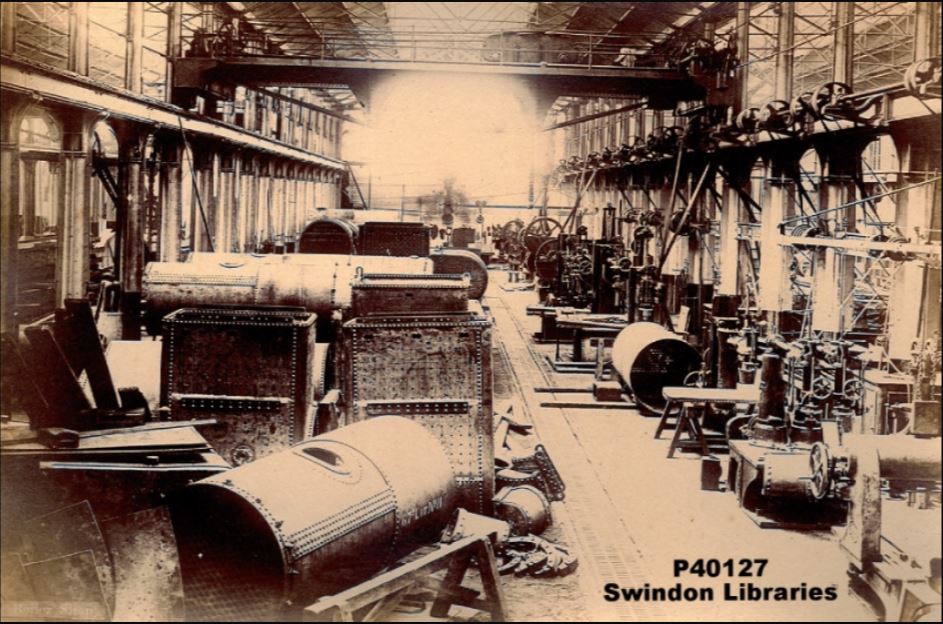
GWR Boiler Shop c1886 – image published courtesy of Local Studies, Swindon Central Library.

The Inquest

Was held yesterday (Thursday) afternoon in the Council Chamber of the Mechanics’ Institution, by Mr Coroner W.E.N. Browne, and a jury, of which Mr. Thos. Tranter was chosen foreman. There were also present J.S. Maitland, Esq., H.M. Inspector of Factories, and Mr. A.E. Withy, representing the widow of deceased.

The Jury having viewed the body, the first witness called was William Simpkins, employed in the GWR Works, who was working on the boiler at the time of the accident. His evidence went to show that the boiler was mounted on trestles outside the shop. It had been there about three weeks. It was an ordinary engine boiler, and the trestles were standing on the bare ground. He did not notice anything wrong until a minute before the accident happened, and then he saw the trestles were sinking at one end. He gave the alarm, and one man was got out from the smoke box end, but the deceased was too late, and the boiler caught him as it tilted over.

By the Coroner: Is it usual to do this kind of work with the boiler mounted on trestles? Sometimes they are mounted on bogies, but they are done as much one way as another. – Has there ever been any accident before? Not to my knowledge.

By the Inspector: since the accident iron plates have been put under the trestles. Is that any improvement? Yes, undoubtedly.

By Mr Withy: Was it impossible for the man to get away after the warning was given? Quite impossible.

At this point a desire was expressed on the part of the jury to see the spot where the accident happened, to which the Coroner agreed.

Upon returning, Charles Bray, who was also working on the same job, gave evidence. He said that when the boiler began to slip, he shouted, and the man in the smoke-box end was got out. He then shouted to the man in the fire-box end, who said “What’s up?” He (witness) said that the boiler would fall presently, as the trestles were giving way. Parkinson then tried to get out, when the boiler went, crushing him between it and the packing.

By the Coroner: How long had the packing been there? I couldn’t quite say. – Were the trestles good? They were when they were put up. – Was there anything under the trestles- plate or anything? No. – Is this usual? Yes. – Was the boiler empty at the time? No, full of water, and deceased was marking what tubes had to come out.

Mr Llewellyn Dyer, foreman of the B Shop, was the next witness. In answer to the Coroner, he said that the trestles were quite strong enough. – Is it usual to put boilers on trestles? Yes, it is done every day. When they had sufficient bogies they were used, and when not they were put on the ground. – Had deceased stopped in the boiler, would he had been safer? Yes, I think so.

By the Inspector: Whose duty was it to see the boiler put on the trestles? My own nominally, but necessarily I have to leave details to others. – Will precautions be taken to prevent similar accidents in the future? You my take it from me, sir, such an accident will never occur again. – Witness went on to state that the ground on which the boiler stood was new ground, and had not, previous to a month ago, been used for the purpose for the past 30 years.

Dr. G. Rodway Swinhoe gave evidence that he attended the deceased soon after the accident, and found him suffering from very severe shock. After examination he was put to bed, and stimulants were administered, but he was too bad to be moved about. Deceased never recovered from the shock, and this was undoubtedly the actual cause of death.

The Jury returned a verdict of “Accidental Death,” caused by severe shock to the system, through the accident.

At the conclusion of the enquiry, Mr. Dyer stated that a communication would be sent to Mr. Maitland by the Manager of the Works stating what steps had been taken to prevent a recurrence of the unfortunate affair, at which the Inspector and Coroner expressed their satisfaction.

Swindon Advertiser, Friday, October, 18, 1901

The Fatal Accident in the GWR Works

Funeral of the Deceased

The body of John Ernest Parkinson, of Linslade Street, Rodbourne, who succumbed to injuries received in the GWR Works, Swindon, on Tuesday week, as already reported in our columns, was interred in the Swindon cemetery last Saturday morning. Nearly a hundred persons followed the coffin to the grave, the chief mourners being the deceased’s widow, his mother, and children. Mr. C. Hall and Mr F. Green, assistant foremen in the same shop that deceased worked in, followed many shop mates and others being present. The Rev. F.J. Murrell (Wesleyan) conducted the service, and the coffin, which was of elm with black fittings, was covered with floral tributes….

Mr Charles Dunn carried out the funeral arrangements.

Extracts from the Swindon Advertiser Friday October 25, 1901.

Linslade Street, Rodbourne c1920s image published courtesy of Local Studies, Swindon Central Library.

When John Ernest Parkinson married Maud Mary Kate Clack at St. Mark’s Church, Swindon in 1892 he gave his occupation as Cheese Monger and an address in London. By the time of the census in 1901 he describes his occupation as a Locomotive Boiler Tuber in the GWR Works here in Swindon.

His funeral took place on October 19, 1901 and he was buried in grave plot C1979 where he lay alone for 74 years. In 1975 his son George Clement Parkinson was buried in the same plot and two years after that Kate Parkinson (most probably George’s wife) joined them.

The Ellis family memorial

Sadly, this is all that remains of a once magnificent memorial to the Ellis family in Radnor Street Cemetery.  Thieves armed with cutting equipment removed the ornate metalwork and with it all reference to the family buried there.

William Ellis was one of the first members of the New Swindon Local Board, a director of the Swindon Building Society, Chairman of the New Swindon Gas Company and a director of the Swindon Water Company. A devout Methodist, he was described as being ‘a most acceptable lay preacher widely known in Wiltshire and South Wales.’

Expansion at the GWR Works in 1861 saw the building of new Rolling Mills. Once established the rail mill produced an estimated 19,300 tons of rails a year with the workforce consisting mainly of Welsh iron workers.  

Thomas Ellis was the first manager at the Rolling Mills and was responsible for building the cottages along Cambria Place to house the Welsh workers. 

William came to Swindon with his two young children and took over as manager in 1863.  The family’s first home was at 4 Church Place, before moving to the Woodlands, a GWR manager’s house.

When William died on May 25 1896 the Advertiser published a lengthy obituary in which he was described as having the ‘esteem of the large number of men who were under his control.’

“The first portion of the funeral service was conducted at 8 am on the lawn in front of the Woodlands by Revs A.A. Southerns and G. Osborne.  Portions of Scripture were read, and hymns No. 680 and 940 from the Wesley hymn book were sung at the close of the beautiful and impressive early morning service,” the Advertiser reported.  “The cortege then proceeded to a saloon, which was placed near the house, and the family left by the 9-5 train for Abergavenny where a hearse and carriages were in waiting to convey the remains and family to Lanelly church, where a large number of friends from neighbouring places had assembled.”

William’s son Ernest followed his father into the Rolling Mills where he worked as Assistant Manager.  He and his wife Catherine lived at the old Ellis family home at 4 Church Place. Two of their children who died in infancy were buried in the Radnor Street plot, Olga Louise in 1897 aged 2 years and 2 months and Louis Robert in 1890 aged just six months.

Ernest died in 1915.  The Advertiser published an account of the Memorial Service held in the Wesley Chapel, Faringdon Street during which Ernest was described as a man who ‘hoped for the best, and believed of the best in people,’ ironic considering the vandalism of his family’s memorial.

Ernest’s wife Catherine who died in 1931 aged 78 and his sister Louisa who died in 1944 aged 89 were both buried in the family plot.  The names of William and his wife Emily were included on the family memorial.

Fortunately there are photographs of the distinctive monument preserved on Duncan and Mandy Ball’s website.  Without this record the memory of one family who made such a large contribution to 19th century Swindon would be lost.

A Swindon Time Capsule

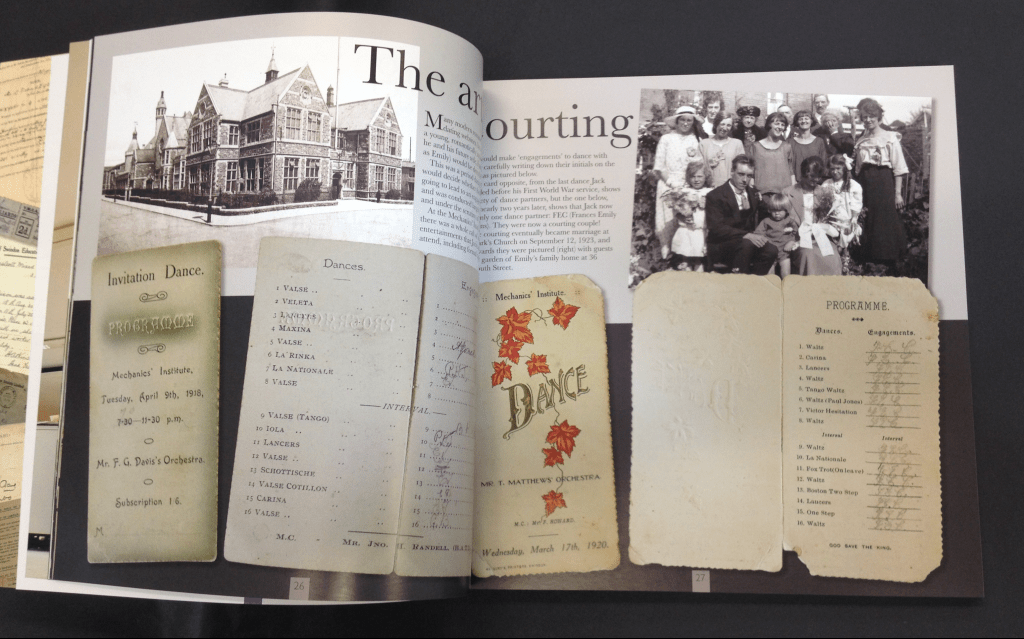
If you’re looking for a last minute Christmas gift for a history loving member of the family then I can recommend A Swindon Time Capsule.

In 2018 the Swindon Heritage team in partnership with Mike Attwell and Local Studies, Swindon Central Library (supported by funding from the HLF) produced an *award winning book entitled A Swindon Time Capsule: Working Class Life 1899-1984.

The book came about following a donation to the Swindon collection made by Mike Attwell when he cleared his family home following the death of his mother Audrey.

Audrey was the daughter of Jack Dixon, a second generation Swindonian whose grandparents George and Mary Hemsley and Francis and Martha Dixon migrated from the North East of England between the years 1840-1850.

George Hemsley worked as a fitter and turner and Francis Dixon as a boilermaker who with their wives were pioneer residents in the new railway town. Both men were active members of the New Swindon society, George was a member of the Liberal & Radical Association and co-founder of the New Swindon Industrial Co-operative Society. For more about George’s life see.

Francis Stephenson Dixon married Martha Charlton at the church of St. Andrew, Newcastle on May 21, 1843. By the time of the 1851 census they were living in Taunton Street with their two children, John 7 and 11 months old Ann.

And like so many of the early railway settlers in Swindon, members of the Hemsley and Dixon families found their final resting place in Radnor Street Cemetery. Francis died at his home, 10 Faringdon Street, on January 2, 1884 aged 63. The cause of death is recorded as cardiac disease. He was buried on January 3 in plot D8283 where his wife Martha followed him the following year.

The Dixon-Attwell family, apparently threw nothing away. As a result ordinary ephemera such as clothing catalogues and dance cards have survived along with apprenticeship indentures and military service records and provide a unique example of everyday life from 1899-1984. A selection from this vast collection can be viewed here.

*In 2019 a Swindon Time Capsule won the Alan Ball award, which rewards local organisations for their work to promote and share local history. Copies of the book are available from the Library Shop.

Harriett Annie Veness – political activist

Although the Liberal dominance nationally was on the wane in the last decades of the 19th century, Swindon remained a Liberal stronghold and a hive of political activity with women playing an active role. One such woman was Harriett Annie Veness.

We might consider the term feminist to be a modern one but the word first came into usage in 1852 and Annie Veness was an exemplary role model, demanding women’s rights throughout her lifetime.

Annie was born in Macclesfield, Cheshire in 1869, daughter of Thomas Veness, a bricklayer and mason, and his wife Harriett. The family moved to Swindon in the early 1870s and appear on the 1881 census living at 30 Sheppard Street. Annie cut her proselytizing teeth supporting her parents with their work in the Church of England Temperance Society, later becoming honorary secretary of the British Women’s Temperance Society.

Annie joined the Swindon and North Wilts Women’s Liberal Association upon its foundation in 1893, becoming the first Honorary Secretary, a role she fulfilled for more than ten years. Neither did she restrict her campaign work to the Swindon district but travelled across the country canvassing in elections in her role as organizing secretary for the Women’s National Liberal Federation. She was an enthusiastic public speaker, described as giving a “spirited address” in Ebbw Vale whilst speaking for “nearly an hour” in Chelmsford

Following her mother’s death in December 1897 Annie and Thomas continued to live at 30 Sheppard Street where they employed a 15 year old domestic servant, Janet Hinder. Her three brothers Thomas, Alfred and Reginald would all emigrate to the USA.

Annie’s political campaigning appears to have come to an end in around 1908 when she resigned from the Women’s National Liberal Federation. Annie and her widowed father moved to Worcester where Annie got a job as a clerk in the Women’s Department at the Employment Exchange. At the time of the 1911 census Thomas Veness was a patient in Birmingham’s General Hospital while Annie stayed at the Cobden Hotel to be close to her father. Following a lifetime of independence, eventually and inevitably Annie was forced to accept the traditional female role as carer for her elderly father.

Thomas died on May 21, 1920. His body was returned to Swindon where he was buried with his wife in Radnor Street cemetery. After her retirement, Annie also returned to Swindon and a home at 59 Drove Road where it was recorded that she did “quiet, good work in the town in the Liberal interest and the temperance cause.” It is sad to think of the passionate, bold speaker reduced to quiet, good work.

Annie died at the Victoria Hospital on October 31, 1936, her life and death recorded in an obituary published in the Swindon Advertiser where it was commented on that “link with the days when Swindon was a strong Liberal constituency is snapped.”

The funeral service took place on November 4 at the Baptist Tabernacle followed by interment in the cemetery. Annie was buried in plot E8097 with her parents where today a fine headstone lies flat on the family grave.

Drowning fatality at New Swindon

The re-imagined story …

At the inquest it was stated there were no adults in the vicinity of the pond where the three boys drowned, but I knew differently.

I heard them laughing and shouting as they edged across the frozen surface and then the screams as they foundered in the icy water.

I watched as the young Mapstone boy, still fully clothed and wearing his skates, jumped into the freezing water and momentarily disappeared. I watched him struggle up the bank, casting off his clothes and running this way and that, searching for something with which to pull the boys out.

The father of one of the lost boys asked the coroner about the adults who were observed at the scene of the tragedy, but young Mapstone said they arrived too late, the boys had already disappeared, but I knew differently. The police sergeant said no one was to blame. I knew I was to blame.

All the time I looked on, hiding in the hedgerow, praying that no one would see me, praying that no one would expect me to jump into that pond. Now, twenty years later I still pray that no one will discover my secret.

The young Mapstone boy was praised for his actions. I wonder if that was of any consolation to the eleven-year-old. I wonder if he still has nightmares. I know I do.

Today I enlisted with the Wiltshire Regiment. I’m hoping I’ll be sent out to France pretty soon. The casualty numbers are mounting and I hope I will soon be one of them. I don’t want to come home a hero. I don’t want to come home at all. I’m praying I’ll be killed pretty quickly. Then I’ll no longer see those boys drowning in that pond or young Edwin Mapstone frantically running along the bank, half dressed.

Drove Road 2

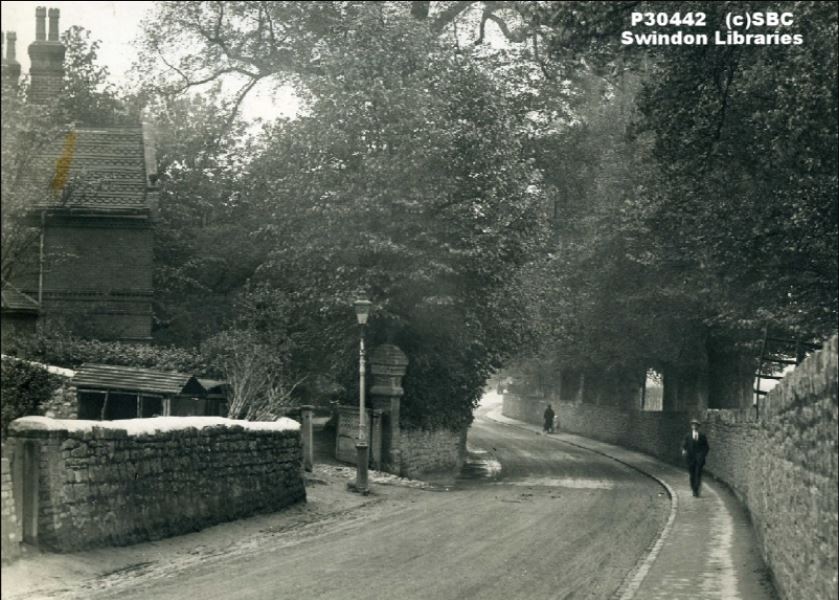
Drove Road c1910 published courtesy of P.A. Williams and Local Studies, Swindon Central Library.

The facts …

Drowning Fatality at New Swindon

Three Lives Lost

Inquest on the Bodies

On Saturday, about noon, a sad accident happened at New Swindon by which three lads lost their lives. It appears that the boys, being too venturesome, went sliding on a pond in a meadow known as Wharf Field, near the Drove road, New Swindon. Suddenly the ice gave way, and the three boys fell in. The water was about ten feet deep, and there being no one at hand to rescue them, all three were drowned. Some other boys who witnessed the sad occurrence ran off and gave information to the police, with the result that P.C. Keating and another constable hastened to the spot, but by the time they arrived the bodies were out of sight. They recovered the bodies, but life was extinct. Dr Lavery was also sent for, but he found all attempts at resuscitation useless, and the bodies were removed to the Queen’s Arms Hotel, and the Coroner communicated with. Two of the lads resided in Mill-street, their names being Charles Greaves, aged 8 years, and Thomas Tombs, aged 10 years. The third lad, who was about the same age, and whose name was Wm. Stagg, hails from Southampton, and was on a visit to some friends at 32 Princes Street. He was to have returned home the same Saturday evening.

The Inquest

On the bodies of the three unfortunate lads was held at the Queen’s Arms, on Monday afternoon by Mr Coroner Browne and a jury of whom Mr J. Jefford was foreman. – Chas. Fredk. Townsend aged 10 years, said he was sliding on the ice with the three deceased lads on Saturday about 12 o’clock. He slid across the pond first and the other three lads followed altogether. Greaves was first, and when they reached the middle of the pond the ice broke and all three fell in. He and the other lads watched them struggling in the water and whistled for assistance. – Edwin Mapstone, aged 11 years, said he was skating on a ditch about 100 yards from the pond and saw the lads sliding on the pond. On hearing the shouts of the other boys he went across to the pond and saw the three lads struggling in the water. He jumped in to try to rescue them, but could not swim under the weight of his clothes and skates on, and he went down once himself in trying to help the other boys. Two boys went for a prop, which witness put into the water, but the drowning lads had not strength enough to hold it. He saw the lads as he was passing the pond before they went on the ice and told them the ice was not safe. – In answer to Mr. Tombs, father of one of the deceased lads, witness said there were several grown up persons round the pond, but they did not arrive until the bodies had disappeared. – P.C. Scammel said he was informed of the accident whilst on duty in Regent-street, and he at once proceeded to the pond, but by the time he arrived the bodies had disappeared underneath the water. With the assistance of P.C. Keating he recovered the bodies but then all attempts at resuscitation were useless. – Edwin George Castle, of 40 Mill street, said he lived near the pond, the construction of which he knew perfectly well. It was nine feet deep in the centre and was cleaned out about two years ago. It was 25 ft. in width and was built in basin shape, with a division for the purpose of allowing cattle to drink. The ice covering the pond on the day in question was not safe. He was near the pond about 12.45 on Saturday last and saw the witness Mapstone running across the field, partially naked, crying for assistance. He obtained a pole and went to the pond, but when he arrived the lads had sunk. – E. Mapstone was re-called to answer a question as to whether there were any grown up persons near the pond at the time of the occurrence. He said the bodies had just disappeared when they arrived. – Sergt. Garrett said he had made full enquiries on this point, and did not think the grown-up persons needed any censure.- Mr Toombs: I do not wish to censure anyone. – Dr Lavery said he saw the bodies about ten minutes past two death was due to asphyxia from drowning. In answer to a question the doctor said if he had been present about five minutes after total submersion he might have succeeded in saving life. – This concluded the evidence, and the Coroner said there was only one verdict which the jury could return. No blame could be attached to anybody. The little boy Mapstone seemed to have done the best he could to try and save the lads and was deserving of the highest praise. – The jury then returned a verdict of “accidentally drowned,” and Mr Bradbury moved a vote of condolence with the bereaved families. The jury handed their fees to Mrs. Greaves, the widowed mother of the deceased lad Greaves.

Swindon Advertiser, Saturday February 2, 1895

The boys were buried in Radnor Street Cemetery on the same day, in graves just a few spaces apart.  Eight-year-old Thomas Greaves was buried in plot B2275, a privately purchased plot, which he shares with his father Francis who had died in 1894.

Ten-year-old Charles Tombs was buried in plot B2213 a public or pauper’s grave, which he shares with five others, including May Tombs, a 22 month old baby who died in 1893 and is most probably a relative.

There is no further information about William Stagg, the third boy who drowned.

Edwin Mapstone was born on May 29, 1883, the son of Welsh born Evan Mapstone, a striker in the Works, and his wife Margaret. The family lived at 41 Mill Street when Edwin was baptised at St John the Evangelist on December 29 of that year.

In 1897 the fourteen-year-old began a 6½ year apprenticeship in the Works as a blacksmith. In 1909 he married Emily Baker and by the time of the 1911 census he was living with his wife and baby son in Tredegar, Monmouthshire, where he worked as a labourer below ground in a colliery. The couple lived with Edwin’s elder brother John and his wife. He eventually returned to Swindon and a job as a painter in the Works.

Edwin died in January 1969 aged 85 years old and is buried in Radnor Street Cemetery in a privately purchased plot C1519, which he shares with three others, including his brother John who died in December 1964.

In 1891 Charles Tombs lived at 32 Mill Street, Thomas Greaves lived at number 25 and Edwin Mapstone at number 26. Drove Road

Drove Road c1920 published courtesy of Local Studies, Swindon Central Library

Thomas Messenger – Fatal Accident in the GWR Works

On Friday December 14, 1894 Thomas Messenger was involved in a fatal accident in the Timber Yard at the GWR Works. Back home in Linslade Street his wife Emma went into labour. Thomas died two days later. He was 31 years old and according to the report made to the Great Western Railway Board he had been employed in the Company for 5 years and 5 months, his daily rate of pay was 3s 2d.

Fatal Accident in the GWR Works – On Tuesday morning, Mr. Coroner Browne and a jury, of whom Mr W.J. Deavin was foreman, held an inquest at the Cricketers’ Arms, New Swindon, on the body of Thomas Messenger, aged 31 years, a labourer, employed in the Great Western Railway Works timber yard department. Mr T.O. Hogarth and Mr H. Hayward were present to watch the case on behalf of the GWR Company.

From the evidence adduced, it appeared that deceased was on Friday morning employed with other men in stacking timber. A “skid” – a piece of timber weighing some 7 cwt. – was used for sliding the timber on to a stock in order to save labour. Deceased placed the skid too far over the corner and it rebounded and stuck him in the head, causing a fracture of the skull.

A verdict of accidental death was returned. The jury gave their fees to, and also made a subscription on behalf of deceased’s widow, who is left with three children, and was confined on the morning of the accident. The sum handed to the widow was £1.

Wilts and Gloucestershire Standard, Saturday, December 22, 1894.

Thomas was buried on December 19 in a public grave plot B2264. His father, also named Thomas, was buried with him in 1902. They share the grave with a baby and an elderly widow, both unrelated.

Thomas and Emma had been married less than two years. Emma had already been widowed once before, left with two little daughters Martha and Amelia. Now she was on her own again with another child. The baby was baptised at the parish church in Latton on January 27, 1895. She was named Thomasina Polly Strong Messenger. Emma went on to marry for a third time in 1901. She died in 1943, aged 82.

Thomasina married, raised two children and died in High Wycombe in 1973, aged 79.

No 1 Shop, Timber Yard pictured in 1928. Image published courtesy of STEAM Museum.

Edith Gay Little and the wooden memorial

wooden grave

The re-imagined story …

He knew exactly what type of memorial he wanted for Edith, and he would make it himself.

He sketched it out on the table in the front room at 59 Station Road. A large cross, something that would stand proud and obvious.

In Memory of Edith Gay, the beloved wife of Edward Little. He practised the style of lettering he would use. He wanted something elegant. No, that was too ornate. He rejected his first attempt. The next was too difficult to read. Eventually he settled on a simple script, something Edith would have liked.

Would he leave a space for his own name to be added in the future? He decided not to. He couldn’t trust anyone else to choose the right script or to execute the work to a sufficiently high standard. This memorial was a symbol of his love. He didn’t want it spoilt by some ham fisted amateur.

He sat in the silent house; the late summer afternoon sunshine streamed through the window. He’d make a start now, he decided. He had a nice piece of seasoned timber in the shed.

Little

The facts …

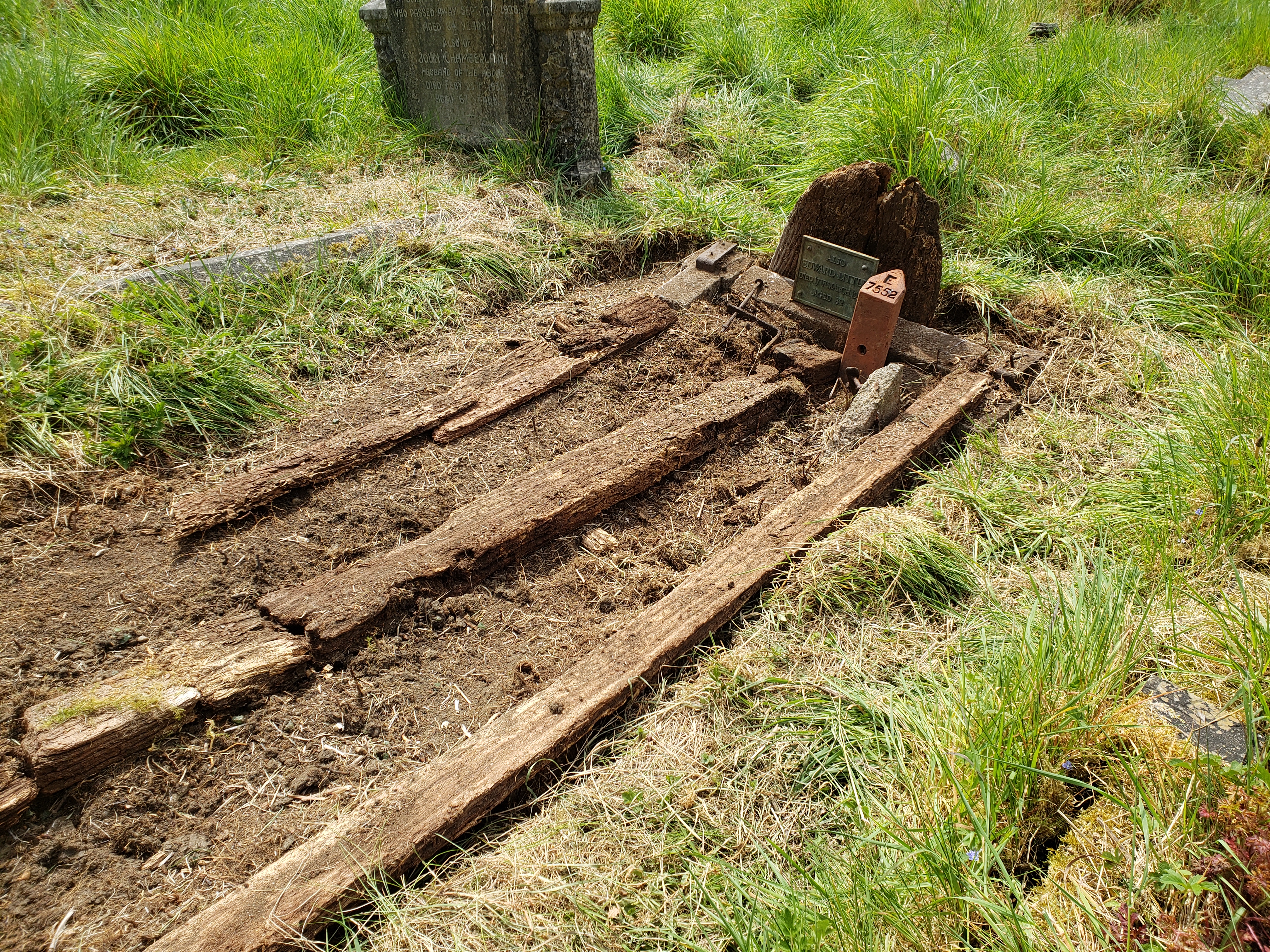
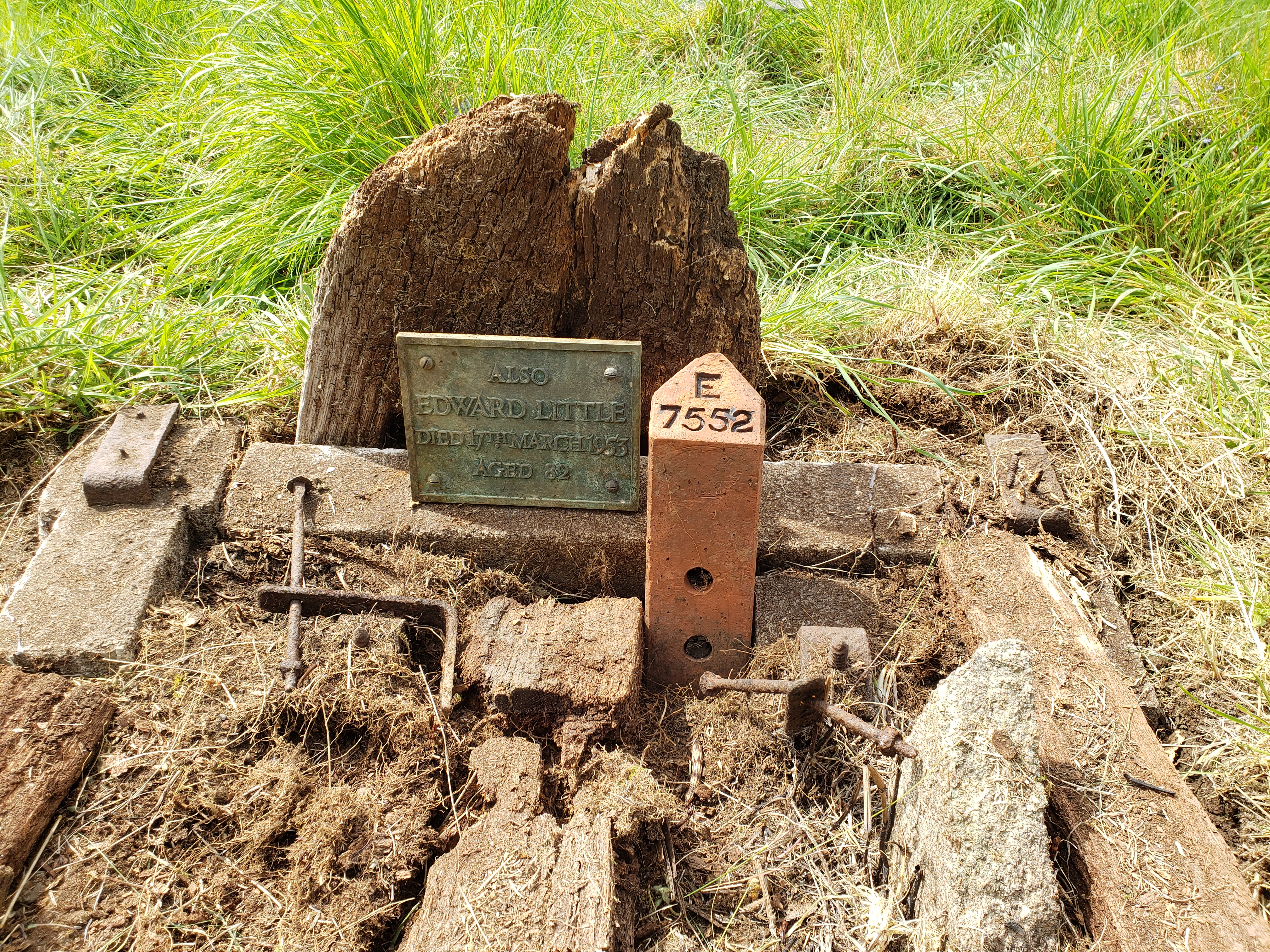
I first discovered this memorial more than ten years ago and each spring when the guided walks resume, I always have difficulty finding this grave again. And every year I wonder if it has managed to survive another winter, because this extremely unusual memorial is a wooden one.

It marks the grave of Edith Gay Little, a former nurse, who died on August 23, 1928 at the Great Western Railway Medical Fund Hospital.

Edith’s husband was Edward Little and I believe it was he who made this wooden memorial. Edward was employed as a bodymaker in the carriage and wagon works at the Midland & South Western Junction Railway at Cirencester. He was promoted to chargehand and eventually foreman and by 1923 was based in Swindon.

Edward was no stranger to Swindon as it was here that he married his first wife, Elizabeth Ann Bindon, at St Paul’s Church on August 21, 1897. Elizabeth died in 1909 aged 38 and was buried ‘under Coroner’s warrant’ in South Cerney where they were living at the time.

On September 22, 1911 Edward married for the second time. By now he was 41 and his bride Edith Gay Smith was 43. The couple married at Holy Trinity Church, Trowbridge.

Unfortunately, there are no known photographs of this memorial when it was new. How distinctive it must have looked, standing out against the surrounding white gravestones. I imagine Edward would have visited the grave regularly, polishing and treating the wood to preserve it.

It would appear that Edward had no children by either of his wives. He retired from the railway works in 1935 and continued to live at 59 Station Road, the home he had shared with Edith.

Sadly, he ended his days in Roundway, the psychiatric hospital in Devizes, where he died on March 17, 1953. Probate was proved at Oxford and his effects, valued at £2,369 16s 5d, were placed in the hands of Lloyds Bank.

He was buried with Edith. With no one left to come and polish the wooden memorial it now lies at the mercy of the elements.

This week Radnor Street Cemetery volunteers Kevin and Brian managed to locate and reveal the wooden grave. They even found a memorial plaque to Edward, the man who I believe was the maker of this unique and poignant memorial.

Little (2)

Edwin Gordon White – Military Cross

On our guided cemetery walks I frequently speak about the wartime work of Swindon’s women, in particular Elsie Wootten White, a Swindon school teacher who was a member of the Swindon Prisoners of War Committee during the First World War. However, this was only part of the White family’s war story.

Edwin Gordon White was born in Swindon in 1892 and baptised at St. Mark’s Church on March 12. He was the son of Frank James, a machineman in the Works, and Susan White and with his parents and sister Elsie lived at 29 Guppy Street, Rodbourne.

By the time of the 1911 census Susan was widowed and living with Elsie and Edwin at 61 Graham Street, the last home Edwin would know. Aged 19 Edwin worked as Laboratory Assistant and part time student in Swindon’s secondary school.

Unfortunately Edwin’s military records do not survive, but we do know that he was awarded the Military Cross, a medal granted in recognition of an act or acts of exemplary gallantry during active operations against the enemy on land.

The citation was published in the Wiltshire Times on Saturday October 5, 1918 – five months after his death.

Conspicuous Gallantry

Wiltshire Officers Decorated

The King has been pleased to approve the Military Cross to the undermentioned in recognition of their gallantry and devotion to duty in the field:-

T./Lt. (A./Capt.) Edwin Gordon White Wilts Regt.

For conspicuous gallantry and devotion to duty during a raid. Though badly wounded, he continued to direct operations as long as possible, thus greatly adding to the spirit and moral of his platoon. His personal reconnaissance work, carried out for five days before the raid with the greatest keenness and untiring energy, greatly added to the success of the operation.

The Wiltshire Times, Saturday, October 5, 1918.

Edwin died of wounds on May 7, 1918. He was 26 years old and is buried at Montecchio Precalcino Communal Cemetery Extension in Italy. The inscription on his headstone reads:

Only son of Mrs S. White

Ever in the thoughts of those who loved him RIP

He is also remembered on his mother and sister’s headstone in Radnor Street Cemetery.

Yesterday had been a good day

The re-imagined story …

‘A sound of breaking glass; she had been so close to sleep that at first she had thought she was dreaming.  But soon she heard the unmistakable sound of panic surge through the house.

She had done everything in her power for the man, three nights she sat with him until she felt that she could do so no longer and then it was decided to engage a nurse to take the night duty.

Yesterday had been a good day.  He had sat up in bed, even ate some toast and marmalade.  The doctor said the pneumonia wasn’t that bad, just on the right side.  Today had not been so good.

His condition had rapidly worsened.  She had tried to encourage him to sip a spoonful of broth, but he had taken no fluids all day; all she could do was keep his lips moistened.

She had sent word down to Morris Street, to let his wife know he had taken a turn for the worse.  Poor woman was worried out of her mind but what could she do with the little ones clinging to her skirts?

All day she had sat with him, her presence seemed to calm him, his ramblings were less wild when she held his hand.

“Sorry dad, I’m sorry dad,” he sobbed as he gripped the sweat soaked sheet.  He called for his mother and told Norah he loved her and the kids.

The facts …

At the time of the 1911 census James and Norah were living in Warmley, near Bristol where he worked as a pottery labourer in a brick and tile works. He was 24 and Norah was 21. They had a year old son Herbert and six month old twin daughters Norah and Kathleen. They had been married for five years.

By 1912 the family had returned to Swindon and were living at 16 Reading Street in the railway village where little Norah died aged 19 months old. She is buried in Radnor Street Cemetery in a large plot for infant burials B1317.

The inquest into the death of James Price took place at the Police Station at the top of Eastcott Hill. Norah told the court that her husband was 27 years of age, and a bombardier in the Reserve Battery of the Royal Field Artillery.  In private life he was a wagon painter.  She lived at 4, Morris Street, and her husband was billeted at 97 Lansdown Road.

The jury found that the deceased died from fracture of the base of the skull, due to leaping from the window while in a state of unsound mind.

Price JW

Gunner James William Price, aged 27 years, was buried on February 12, 1915 in plot B1777, a public grave where he lies with two others.

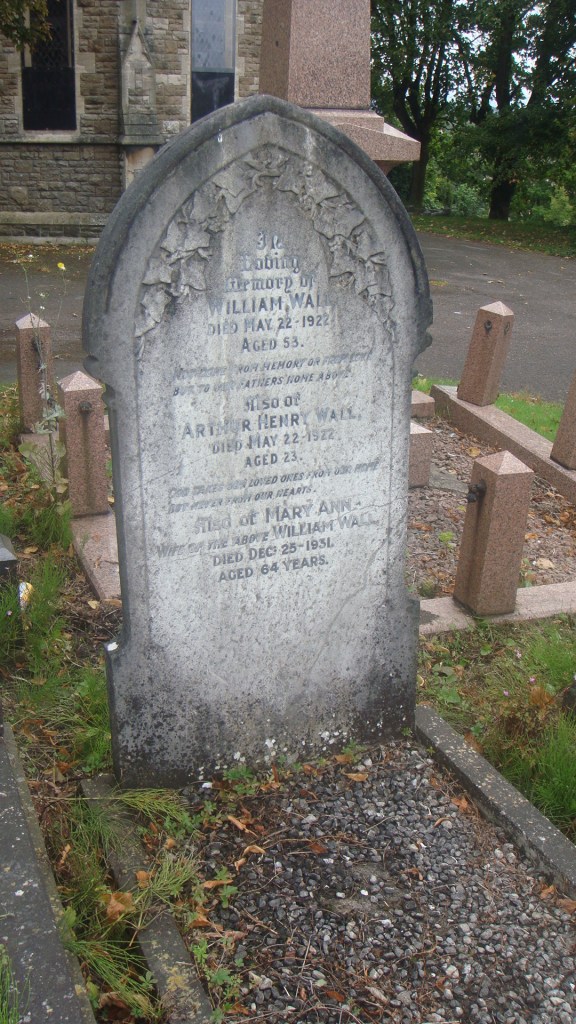
William and Arthur Henry Wall – died on the same day

The newspaper article provides a pretty comprehensive account of William’s service. His military records reveal that he enlisted in the 4th Wilts on September 14, 1914 aged 46 and served at home until January 2, 1916. On January 3, 1916, having transferred to the 22nd Wessex & Welsh Btn the Rifle Brigade, he was sent to the Western Front where he served for 325 days. On November 24, 1916, he was posted to Salonika where he served for 1 year and 215 days before being posted home on June 27, 1918, having previously transferred to the Royal Engineers.

William was discharged on August 10, 1918 as being no longer physically fit for War Service. He was 49 years and 11 months old and suffering from valvular disease of the heart (VDH).

He was awarded a weekly pension of 27 shillings for four weeks after which it dropped to just over 13 shillings, to be renewed after 48 weeks.

William had previously worked for more than twenty years as a Rivetter’s Holder Up in the GWR Works, a physically demanding job that he was now no longer strong enough to do.

William died on May 22, 1922 just hours before his son Arthur also died.

When Arthur Henry Wall enlisted at the Devizes recruitment office he stated that he was 19 years old and worked as a boilermaker. In fact he was only 16 years old and two years below the minimum age for enlistment.

He served a period of 140 days from January 12, 1915 to May 31, 1915 at home but on June 1, 1916 was posted to France, aged 17. However, on July 10 Arthur’s true age was detected and he was sent back to England as ‘underage and physically unfit for service.’

He spent the next year posted in England but on June 28, 1916 he returned to France and served more than 300 days. By now serving with the Bedfordshires, Arthur was gassed on May 12, 1918 and ten days later returned to England.

On November 23, 1918, he was discharged suffering from Defective Vision, Dyspnoea (a symptom of aortic insufficiency) and headache.

He was awarded a pension of 11 shillings a week from November 24, 1918 to be reviewed in 26 weeks’ time. In 1920, by now a married man, Arthur wrote to the Record Officer of the Bedfordshire Regiment asking if he could apply for further money under the Army Order 325/19 but was informed that only soldiers serving from the date of the pay increase on September 13, 1919 were entitled.

Like his father, Arthur also died of heart disease, a direct result of his military service.

United in Death

Father and Son Buried at the Same Time

The burial of a father and a son who died on the same day took place at Radnor Street Cemetery, Swindon. The deceased were Mr William Wall, 35 Linslade Street, Swindon, and his son, Mr Arthur Henry Wall, 36 Jennings Street. Both had served in the war, and their death was directly attributable to the hardships endured on active service. The father, who was 53 years of age, served in the Army for 12 years, and during the war he was in Egypt, Greece, Serbia and Italy – first with the Wilts Regiment then the Rifle Brigade and was later attached to the Royal Engineers. In August, 1918 he was discharged as unfit for further service. His death occurred on May 22nd, just a few hours before his son passed away.

The latter was 23 years of age. When only 16 he joined the Wilts Regiment, and was later transferred to the Bedfords, and then to the 1st Herts. He saw service in France and Belgium, and was badly gassed in May, 1918. In November of the same year he was discharged.

It is a pathetic fact that although he did not know his father was so ill he had a sort of premonition that they would die at the same time, and expressed a wish that they might be buried together.

Wiltshire Times and Trowbridge Advertiser June 17, 1922.

Father and son were buried in plot E8206 where Mary Ann, William’s wife and Arthur’s mother, joined them following her death in 1931.

If you are wondering why they do not have a Commonwealth War Graves Commission headstone it is because their deaths occurred after August 31, 1921 the date on which the First World War officially ended.

First published on October 9, 2021.