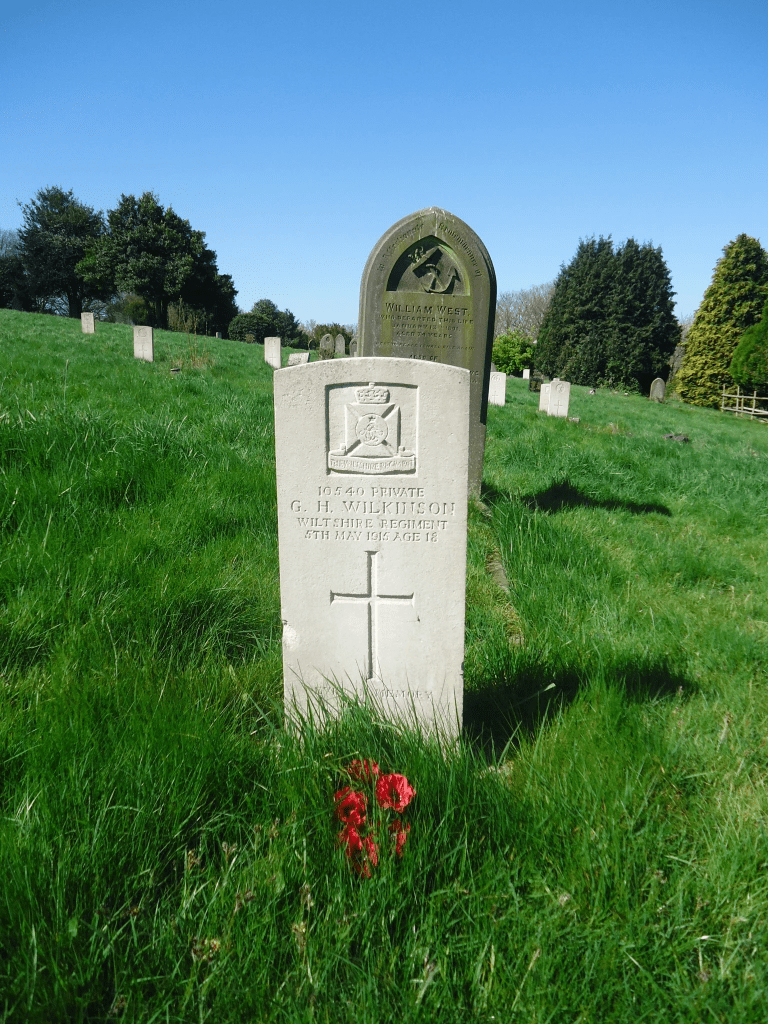
In the Spring of 1915, a new disease was observed on the battlefield. It would cause 35,000 British casualties and many hundreds of deaths. Symptoms included breathlessness (leading to bronchitis), a swelling of the face or legs, high blood pressure, headache and sore throat along with albuminuria (abnormal levels of the protein albumin in the urine). When the disease was first observed in 1915 doctors were at a loss as to know the cause. It was first thought it was caused by infection, exposure and diet (including poisons) although it was later suggested it may have been caused by hantavirus, a virus carried by rodents. This disease was named trench nephritis* and it killed 18-year-old George Henry Wilkinson on May 5, 1915.
George was born in Milton, Berkshire the second of John and Emma Wilkinson’s large family of ten children. He enlisted with the Duke of Edinburgh’s (Wiltshire) Regiment in Swindon where his mother had grown up and where his grandfather worked in the GWR Works.
George died on May 5, 1915 in the Weymouth Sydney Hall Hospital. He was buried in Radnor Street Cemetery on May 11 in grave plot B1599, a public grave. The burial registers record that his last address was 28 Butterworth Street. The Commonwealth War Graves Headstone includes an inscription chosen by his grieving father – Ever in Memory.
His mother Emma had died the previous year and was buried in another public grave, number B1559, close to where her son would eventually lie.
*nephritis – inflammation of the kidneys

Image of funeral account kindly supplied by A.E. Smith & Son, Funeral Directors.

 Radnor Street Cemetery