Chiseldon Camp disaster

The re-imagined story …

The houses in Medgbury Road looked exactly like ours in Derby. I don’t know why I was surprised. We were exchanging a home in a northern railway town for one in Wiltshire, of course there would be similarities. I just didn’t take account of how many there would be though.

The old canal ran alongside Medgbury Road, silted up and no longer in use, while row upon row of red brick terrace houses stretched back to the railway line.

We were moving to Swindon to make a new start. I don’t know how we thought that would be possible. To begin with we had a kind of excitement, but I soon realised we lacked imagination. Perhaps it was the grief. We were no different to anyone else; how could we have ever thought it would be otherwise?

Every household, every family had someone employed in the railway works and in 1920 everyone had been touched by four long years of war.

When my new neighbour told me about the Chiseldon Camp accident it felt as if it had happened just yesterday, so intense was her grief.

“We knew them all. You did in a street like this. Watched them grow up, start school, start work,” she said. “It was the Easter weekend, the year after the war ended. The boys were off to Liddington Castle for the day. They took a few sandwiches and some pop. It was all so innocent. Just a day out in the country. A few games with their friends.

“One of the boys suggested walking over to the practise trenches at the Chiseldon Camp. They split into two groups and just seven of the boys chose to go on to the Military Camp.

“Albert Townsend watched his mate Fred pick up something that looked like a rolling pin, and roll it down a bank,” she pulled a handkerchief from her apron pocket. “Three of the boys were killed outright, only one of the seven escaped injury.”

There was talk of setting up a memorial in the cemetery, she told me, raising a public subscription, but people just didn’t have the money in those first years after the war. There were already a growing number of memorials appearing across the town commemorating too many dead. But the boys’ story would long be remembered and the mothers of Medgbury Road would never forget.

We lived in Medgbury Road for a year and then we moved back to Derby. How did we ever think we could forget? Why would we want to?
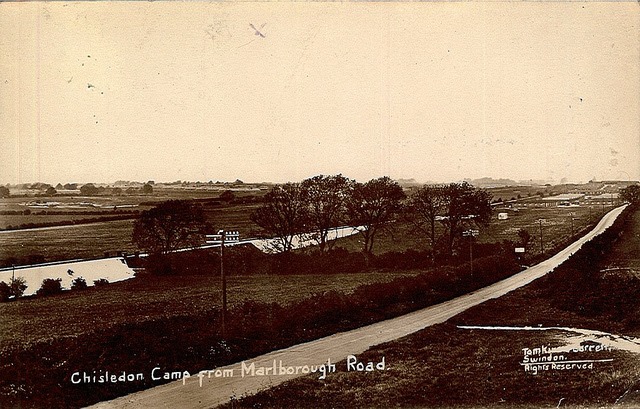
Chiseldon Camp

The facts …

The funeral of Frederick Cosway 14, Frederick Rawlinson also 14 and 13-year-old Stanley Palmer, the adopted son of Elizabeth and Henry Holt, took place on April 24 1919 and was attended by what was described as ‘an immense throng’ of people.

The funeral procession started from the boys’ homes along a route lined with spectators and proceeded to the Central Mission Hall in Clarence Street. The congregation numbered approximately 800 with many more standing outside the hall.

The report of the funeral continued:

“Two of the coffins were conveyed in shillibiers and the third on a handbier. There was a great profusion of flowers. The chief mourners followed in carriages. They included the parents and other relatives of the deceased lads. Between 30 and 40 lads, companions of the deceased, followed on foot.

As the procession wended its way to the Cemetery rain commenced falling heavily, but it proved to be a storm of short duration. The interment took place in the Cemetery in the presence of several thousand spectators, and the service, which was conducted by Pastor Spargo, will long be remembered by all who took part.”

The three boys were buried together in plot C728. Today there is no memorial to mark the spot.
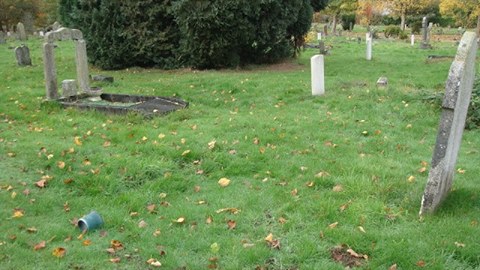
Chiseldon boys

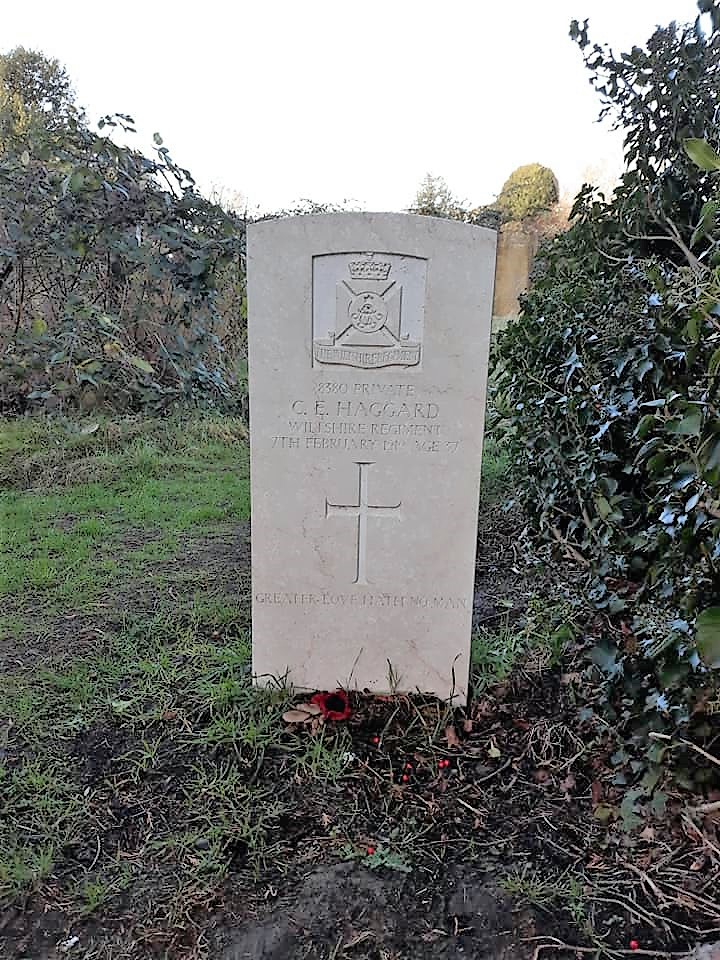
Charles Haggard – Prisoner of War

Charles Haggard - Copy

The re-imagined story…

‘He woke up gently, sliding smoothly into a new day.  It wasn’t usually like this.  Sometimes he woke up with a jolt, ready to jump out of bed, as if he could.  Sometimes he suddenly found himself awake, his heart beating rapidly, his breath coming in gasps.  Sometimes he just lay there, eyes open, awake, absent.  But today felt different.  Today he turned over in bed and snuggled down beneath the blankets.

The bedroom was cold.  He’d known colder.  He’d known bone aching cold when every joint was immobilised, every muscle mortified.  But he liked this cold.  It reminded him of childhood.  Ice on the inside of the window; a house full of noise, children getting ready for school, his father already at work.

“Charlie are you up yet?” he was always the last one, reluctant to leave his bed.

Today his mother tapped softly on the bedroom door; checking if he was awake, checking if he was alive.  He understood her dilemma.  Should she wake him or should she let him sleep on?

“Morning Ma,” he called.

The door opened.

“Cuppa tea boy.”

Nearly 37 years old but he would always be her boy.  When he was a child he had to share her, but now she was his alone; making up for lost time.

His father hadn’t recognised him when he opened the door of 60 Stafford Street.  Four years as a prisoner of war had altered him immeasurably.  But as the cold January air swept around him and into the house she knew it was her boy returned.  She had never given up hope.

Today he felt a little better, a little stronger.  Today he would take a slow walk into town.  He would call in at the Town Hall and sign the register of returning soldiers.  He hoped Miss Handley might be there.  He would so like to see her, say thank you for the food parcels that had kept the prisoners of war alive’.

The facts …

Charles Haggard was born April 30, 1882 at the Old Red Lion Inn in Minety where his father Samuel was the innkeeper.  His parents were in their early 20s and already had four children, George, Alice, Kate and Thomas.

By 1901 the family had moved to 60 Stafford Street, Swindon and on the census returns for that year 18-year-old Charles described himself as a Steam Engine Tender Maker, Fitter & Turner – of course he still had two years left to serve of his apprenticeship.

By 1911 he had left a life ‘inside’ (which is how everyone referred to working in the railway factory) and joined the army where he served as a Private in the 1st Wiltshire Regiment.  Charles was taken prisoner on October 24, 1914 at the Battle of Mons and was held prisoner at Krossen-on-Order for the duration of the war.

On February 7, 1919 Charles spent the day in Shrivenham visiting friends. He arrived back in Swindon sometime between 9 and 10 pm where he met his father in Manchester Road.

At the inquest Charles’s father said his son seemed very cheerful as they began the walk home to Stafford Street.

When they reached Deacon Street Charles called out “Wait a minute, dad,” and went to catch hold of the palisading, but fell backwards. His father knew he was dead.

Mr A.L.  Forrester, Coroner for North Wilts, held an inquest at St Saviour’s Schools, Ashford Road, Swindon where Dr Beatty testified that he had made a post mortem examination of the body and found athroma of the valves of the heart.  The cause of death was aortic disease of the heart, a condition worsened by starvation and exposure during his time as a prisoner of war.  Charles had been home less than three weeks.

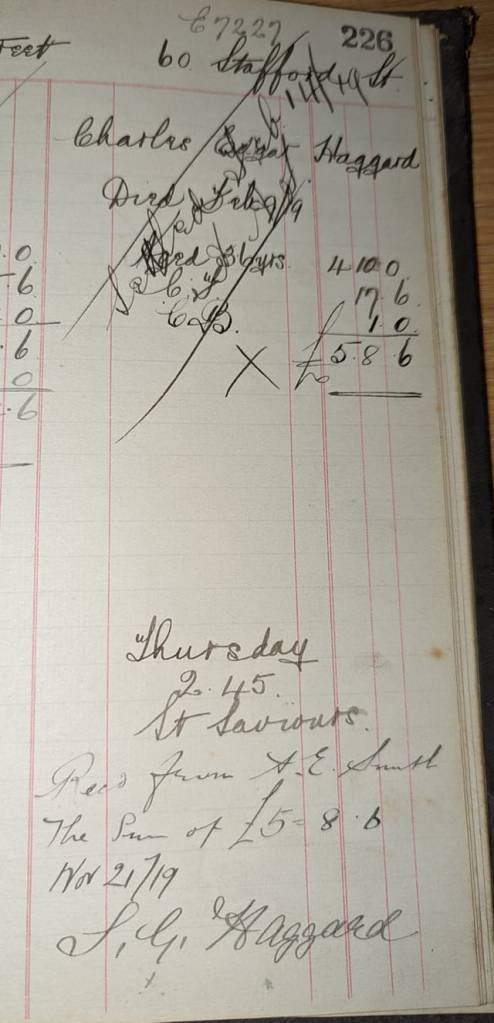
He is buried in plot E7227 with his brothers George and Thomas.

Image of funeral account provided by A.E. Smith & Son, Funeral Directors

Mary E. Slade MBE

I had long wanted to find the grave of Mary E. Slade who died in 1960. I eventually discovered she was buried in the churchyard at Christ Church, but where …

The Swindon Committee for the Provision of Comforts for the Wiltshire Regiment was formed in 1914.  More than thirty years later Mary Slade and Kate Handley would still be supporting the soldiers who had survived the horrors of the Great War and the families of those who hadn’t.

Mary Elizabeth Slade was born in Bradford upon Avon in 1872, the daughter of woollen weavers Frank and Susan Slade.  Mary and her brother George grew up in Trowbridge but by 1899 Mary had moved to Swindon and a teaching position at King William Street School.

At the outbreak of war Mary headed the team of mainly women volunteers who were based at the Town Hall.  Their work was much more than despatching a few cigarettes and a pair of socks to the Tommies on the Front Line and soon became a matter of life and death as the plight of the prisoners of war was revealed.

“When letters began to arrive from the men themselves begging for bread, it was soon realised that they were in dire need, and in imminent risk of dying from starvation, exposure and disease,” W. D. Bavin wrote in his seminal book Swindon’s War Record published in 1922.

The provisions the prisoners received daily was a slice of dry bread for breakfast and tea and a bowl of cabbage soup for dinner.

“Had it not been for the parcels received out there from Great Britain we should have starved,” said returning serviceman T. Saddler.

The team of volunteers co-ordinated supplies and materials with the support of local shopkeepers, schools and hard pressed Swindon families.

In the beginning the committee spent £2 a week on groceries to be sent to Gottingen and other camps where a large number of men from the Wiltshire Regiment had been interned following their capture in 1914. By October 1915 the committee was sending parcels to 660 men, including 332 at Gottingen and 152 at Munster.  And at the end of July 1916 they had despatched 1,365 parcels of groceries, 1,419 of bread comprising 4,741 loaves, 38 parcels of clothing and 15 of books.

As the men were moved from prison camps on labour details, the committee adopted a system of sending parcels individually addressed.  Each prisoner received a parcel once every seven weeks containing seven shillings worth of food.  More than 3,750 individual parcels were despatched in the five months to the end of November 1916.

But their work did not end with the armistice on November 11, 1918.  Sadly, the soldiers did not return to a land fit for heroes as promised, but to unemployment and poverty.  Mary Slade continued to fund raise for these Swindon families through to the end of the Second World War.

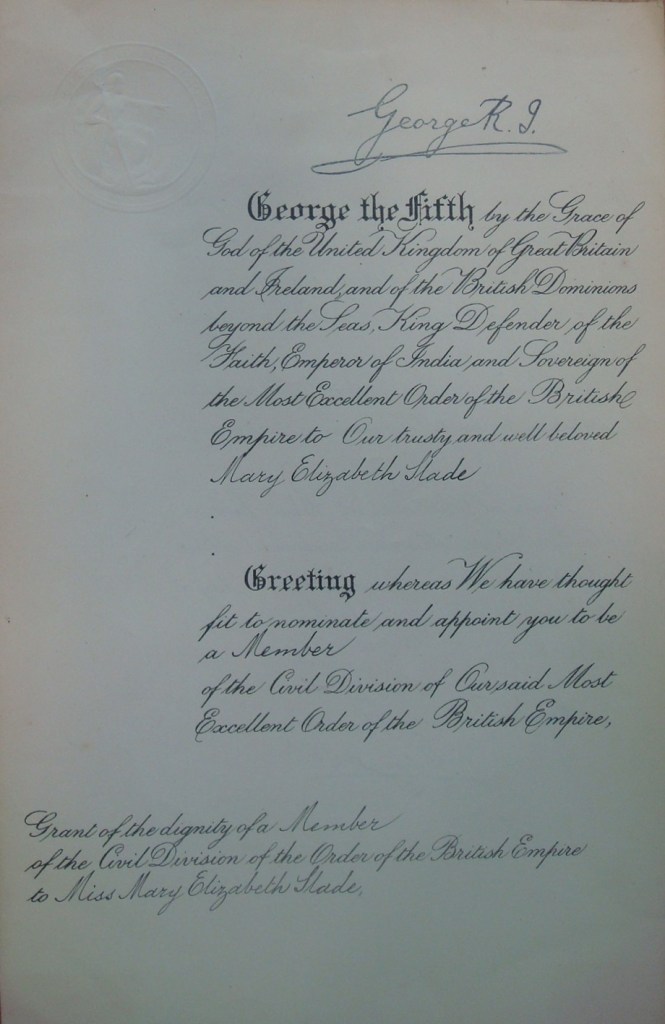
On July 25, 1919 Mary Slade and Kate Handley represented the Swindon Prisoners of War Committee at a Buckingham Palace Garden Party and in 1920 Mary was awarded the MBE.

Mary Slade died suddenly on January 31, 1960 at her home, 63 Avenue Road.  She was 87 years old.  The previous evening she had been a guest at the choir boy’s party at Christ Church.

Yesterday Noel and I visited the churchyard at Christ Church to pay our respects at the grave of our friend Mark Sutton. As we passed the Rose Garden on our way out I looked down and there was a plaque dedicated to Mary E. Slade. It was through Mark’s lifelong study of the Swindon men who served in the First World War that I first heard the story of Mary E. Slade.

Mary Elizabeth Slade

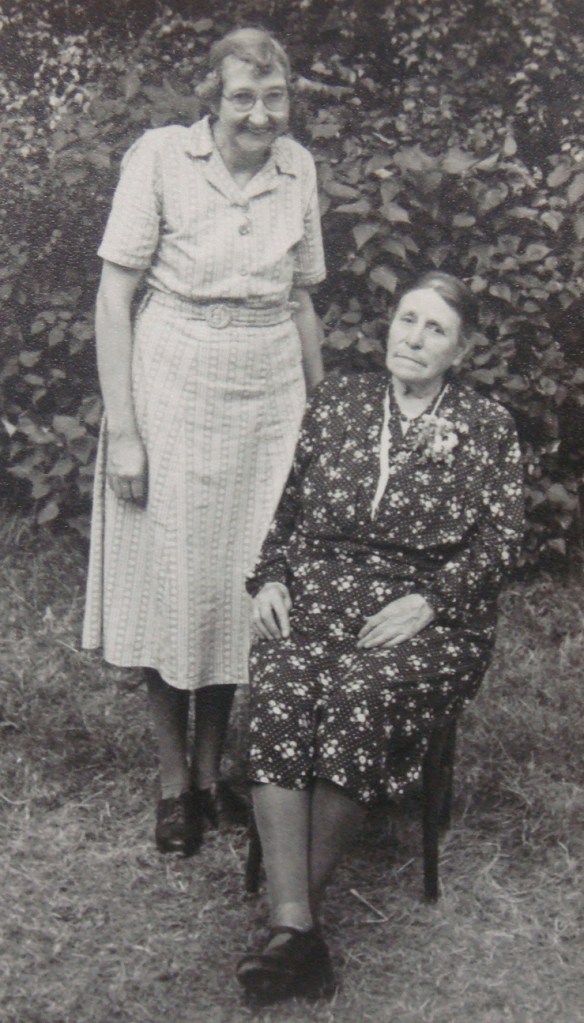
Mary Slade and Kate Handley

Cyril Gordon Webb – Tell Them of Us

How terrifying must it have been to be the parents of five adult sons on the eve of war in 1914?

James George Webb and his wife Bertha lived a comfortable life at 117 Bath Road where in 1911 they stated on the census returns that they had been married for 25 years. They answered the questions– how many children born alive 5; children still living 5; children who have died nil. Not every family in this period was so fortunate.

Four of James and Bertha’s sons still lived at home with them in 1911. Their eldest son Vere was employed as a draughtsman in the Loco, Carr & Wagon Dept at the Wolverhampton railway works.

Then in 1914 second son Algernon Ewart Webb enlisted in the Army Service Corps, eight months before the outbreak of war. However, his military service was brief as he was found to be medically unfit when mobilization took place on August 6, 1914.

How relieved his parents must have been to welcome him home. Algernon and three of his brothers went on to live long lives. It would be their youngest son Cyril Gordon Webb who went away to war. 

A former student at the North Wilts Technical College in Victoria Road, Cyril is remembered on the college’s stained-glass window war memorial. The window, restored and renovated by stained glass window craftsman Richard Thorne, was moved to Swindon College at the North Star campus in 2010.

Pte C.G. Webb of the 52nd Battalion Bedfordshire Regiment died on June 7, 1918 at his home 37 Okus Road. His cause of death was Pulmonary Tuberculosis contracted during his military service.

Cyril’s father James died in October that same year, a few months after his son. Bertha died in 1934. They are both buried with their boy in Plot D402.

#TellThemofUs

#MarkSutton

Tell Them of Us – Pte. R.A. Cook – promoted for gallantry

Continuing a series remembering Swindon’s sons who served in the First and Second World Wars.

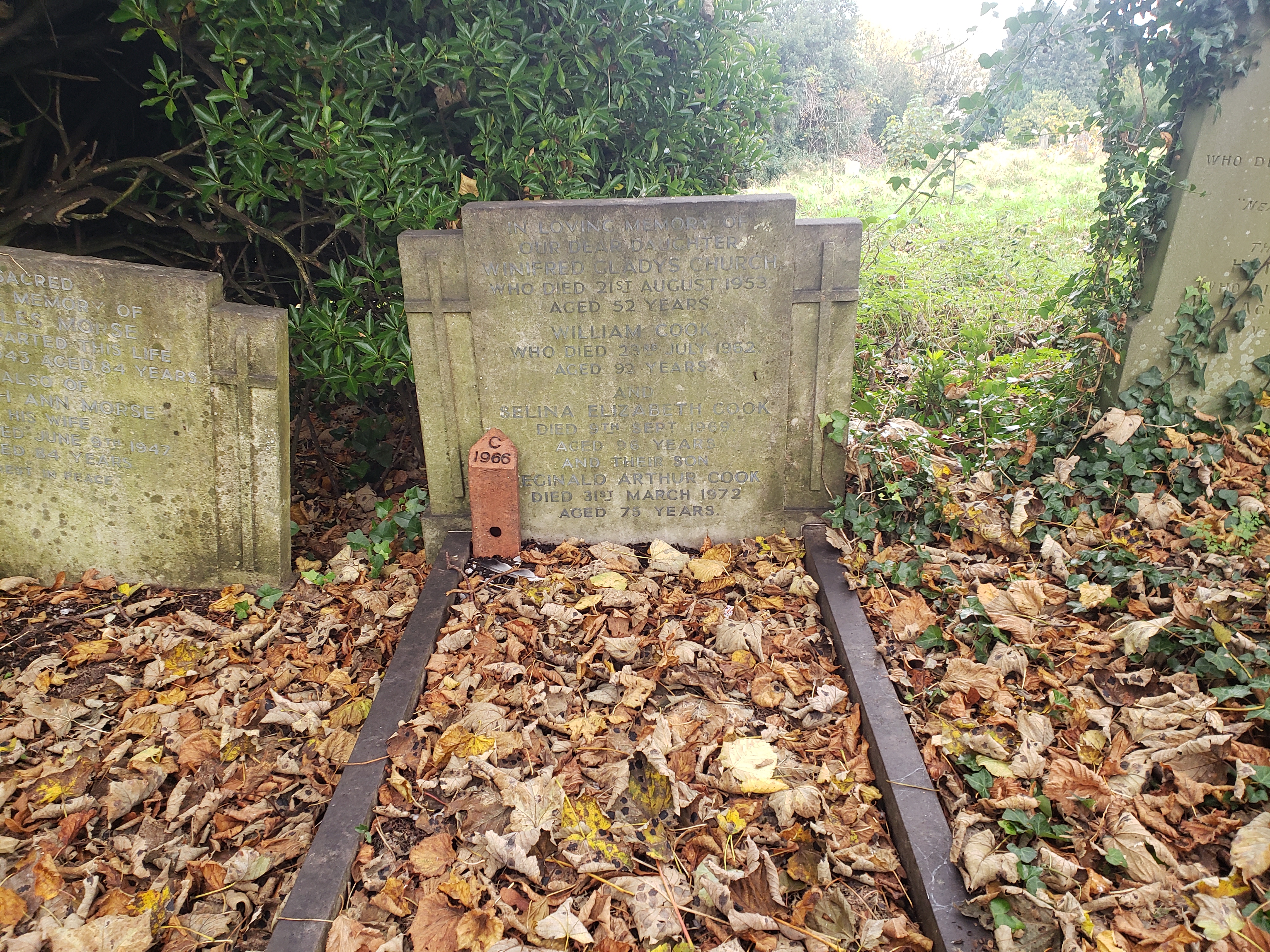
Reginald Arthur Cook was born in Swindon on September 8, 1896 the son of William and Selina Cook. Reginald entered the employment of the GWR shortly after his 14th birthday and stayed with the company until his retirement. His only absence was during the First World War when he served on the Western Front and was promoted for an act of gallantry.

Swindon Soldier Promoted for Gallantry

Pte. R.A. Cook, the only son of Mr. W. Cook, Cemetery Superintendent, Radnor Street, Swindon, has been promoted to the rank of lance-corporal for gallant conduct.

Major-General H.D.E. Parsons, Director of Ordnance Services, British Armies in France, has written to Pte. Cook, dated October 19th, as follows: “Your name has been brought to my notice by your Commanding Officer for ‘gallant conduct in snatching an enemy stick-grenade, that had become ignited, from another man, and throwing it into a shell hole some ten yards away, thus saving the man’s life at grave risk of your own. The report reflects credit on yourself and the Army Ordnance Corps.”

Lce. Copl. Cook is 21 years of age, and is a native of Swindon. On leaving school he entered the GWR Works as a clerk. He joined the Army on October 6th, 1915, and proceeded to Woolwich for training, but after being there three weeks he was transferred to France, where he has been ever since. He is now home on leave, and will return to France on December 21st.

North Wilts Herald, Friday, December 14, 1917.

Reginald returned home to Swindon at the end of the war and lived with his parents at 63 Kent Road where he died on March 31, 1972. Reginald never married and was buried with his parents and his only sister Winifred Gladys, in the cemetery where his father once worked as Cemetery Superintendent.

Pte Percy Walter Dyer and his brother Pte Frank Edward Dyer – Tell Them of Us

With a fresh complexion, brown hair and brown eyes, Percy Walter Dyer weighed 129 lbs (9st 3lbs) and stood 5ft 5ins tall when he enlisted in the army. This poignant description of 19 year old Percy was written more than 110 years ago when his ambition was to serve with the Wiltshire Regiment.

Percy was born on April 13, 1888 in Lea, a small village 1½ miles east of Malmesbury. He was the son of John and Sarah Dyer and one of 11 children.

By 1901 the family were living at 141 Beatrice Street, Gorse Hill. Still living at home were Percy’s elder brothers Charles, Frank and Lewis who all worked as general labourers. His sisters Alice and Edith both worked as laundry assistants while Kate was employed in one of the towns several clothing factories. Younger siblings George, Ernest and Florence were still of school age but at 13 Percy stood on the threshold of adulthood.

When he filled in his attestation papers in Devizes on August 13, 1907 he was already serving in the Militia. What was his driving force – patriotism, or did he see a career in the army as an opportunity to travel, to escape.

As a serving soldier with seven years’ experience Percy was sent to France with the British Expeditionary Force (BEF) when war broke out in 1914.

During action at Armentieres on December 14, 1915 Percy received a gun shot wound to his right elbow. Although he survived, the injury caused permanent damage and limited the movement of his arm. In 1917 Percy was declared physically unfit for military service and was transferred to Avonmouth to work in an ammunitions factory.

A medical examination made in May 1918 declared that the injury to his arm rendered him 30% disabled and limited his prospects of employment on the open labour market. But this was not the extent of his poor physical condition. Percy was also declared 100% disabled by tuberculosis with ‘Sanatorium treatment’ recommended. But it was too late. Percy died on September 22, 1918. He was 30 years old and had spent eleven years in the army, three of those fighting in France and Flanders.

Sarah buried her son in Radnor Street Cemetery on September 25. Was there any consolation for her in having her boy back home? This was not the first of her sons to die as a result of the war but her elder son Frank had no known grave.

The military service records of Frank Edward Dyer do not survive, destroyed when an incendiary bomb hit the War Office Record Store in September 1940 during the Second World War. We do not know if Frank had been a volunteer when war broke out or whether he had been ‘called up’ following the introduction of conscription in 1916. Frank’s name is recorded on the Tyne Cot Memorial in Belgium, which bears the names of almost 35,000 officers and men whose graves are not known. The memorial was unveiled in 1927 – it is unlikely Sarah was ever able to visit it.

Percy was buried on September 25, 1918 in grave plot B2756. He was buried with his younger brother Ernest who died in 1911 and the boys’ father John who died just weeks after Percy joined the army. In 1933 Sarah Ann Dyer, the boys’ mother, joined them.

Tell Them of Us – Arthur North

Mark Sutton had a life long interest in the Swindon men who served in the Great War, researching, writing and recording their service and sacrifice in his book – Tell Them of Us.

Mark made numerous visits to the battlefield cemeteries in France and Belgium, laying wreaths on the graves of Swindon men on behalf of their families back home. Mark also worked with Swindon’s schools, showing items from his vast military collection. He knew instinctively how to talk to children about a war that was beyond living memory but intrinsic to our town’s history. For many years he conducted guided walks at Radnor Street Cemetery, visiting the Commonwealth War Graves and remembering the men buried there. He was a popular speaker on the Swindon history circuit, his talks selling out immediately they were announced. He was also co-founder of Swindon Heritage, a quarterly history magazine published between 2013 and 2017. Sadly, Mark died in 2022 but his memory and his legacy will live on, in the same way he made the story of Swindon’s sons who served in the Great War endure.

I begin with the story of Arthur North who is mentioned in Mark’s book Tell Them of Us and is told here in the words of Kevin Leakey, local historian researching the history of Queenstown and Broadgreen.

Gorse Hill Memorial rescued by Mark Sutton and displayed in the Radnor Street Cemetery chapel.

Arthur was a younger brother of one of my Great Grandmothers – Kate Leakey.

He was 7 months old and living with his family at 62 Bright St. on the
1891 census, so I would guess he was probably born at that address.

By the 1901 census the North family were living at 69 Cricklade Rd and
by 1911, were at 139 Cricklade Rd, where Arthur’s parents lived until
they passed away.

The 1934 funeral of his Mother, Mary Ann, took place at Trinity
Methodist Church (139 Cricklade Rd being a few doors away from the
church), which I think was the church the WW1 memorial came from.

Arthur emigrated to Australia in 1909 and worked as a farmer, living
with his Uncle Samuel North and his family at a small place called
Batchica near Warracknabeal, Victoria.

He joined the Australian Army in January 1915, and after going to
Gallipoli in Sept. 1915, he seems to have been ill from the end of
October until June 1916, then spending the next 7 months in the UK,
before being sent to France in Feb. 1917.

He was killed on the 3rd May 1917 on first day of the second battle of
Bullecourt. As far as I can tell his body was never recovered.

The Red Cross files give info about his death from other soldiers that
saw him on the day it happened. I don’t suppose it was at all unusual, with the men being in the middle of a battle at the time of his death, but their reports as to his
whereabouts etc. seem to contradict each other.

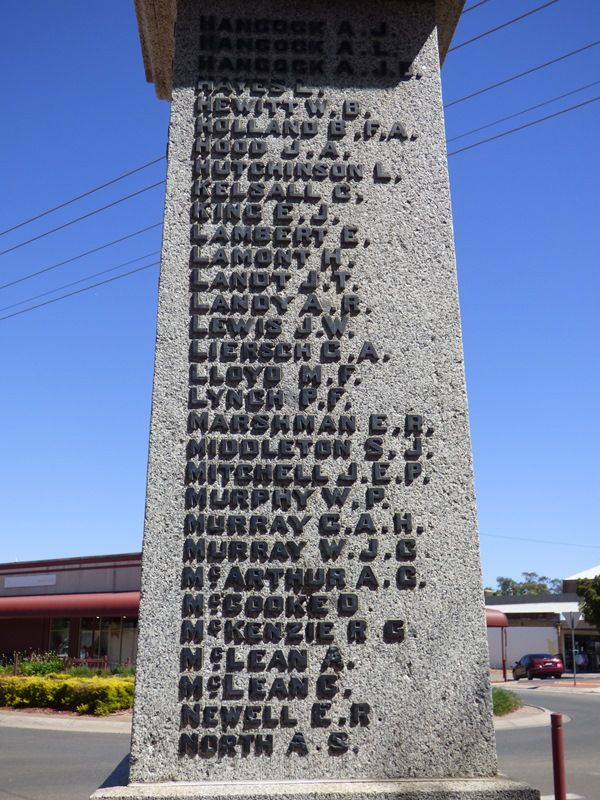
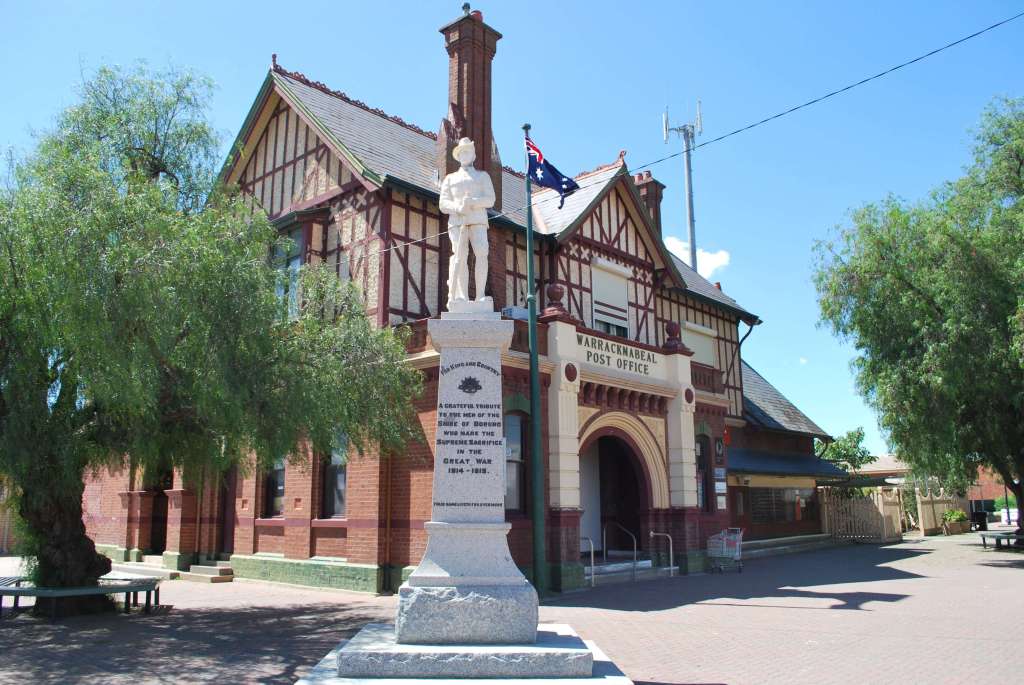
Apart from his name being on the Gorse Hill memorial, it is also on the
Warracknabeal war memorial in Australia.

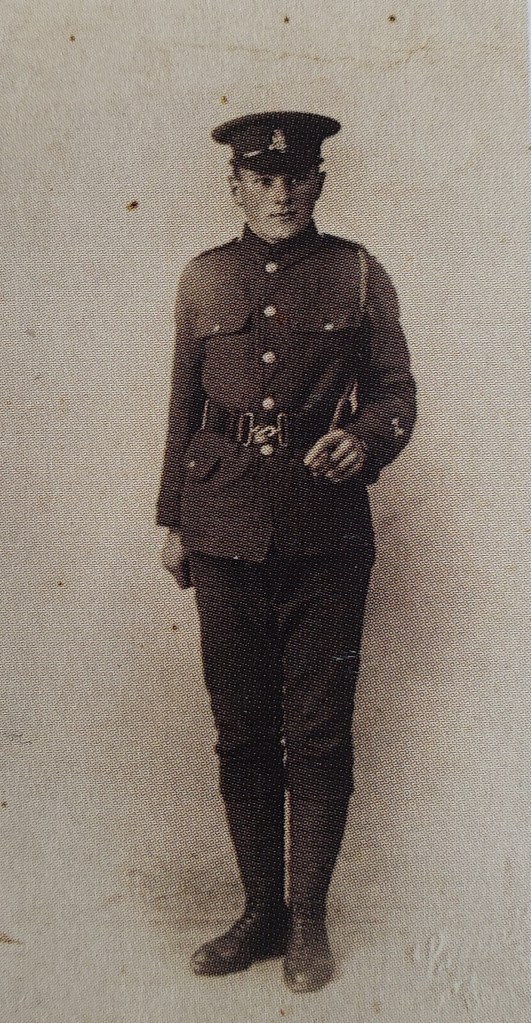
Sadly, we have no photos of Arthur and aren’t in contact with any of his
brothers and sisters families, but I always put a cross down at the
cenotaph every year in remembrance.

Cross of Sacrifice

The sheer number of bodies left lying on the battlefields of the Great War is today beyond belief and by 1915 the situation was already becoming reprehensible. Burials were frequently made without any planning or organisation with graves marked by a simple wooden cross, sometimes with the name scratched on in pencil.

Major General Fabian Ware, who commanded a mobile ambulance unit during the First World War, quickly recognised that this could not continue. Ware believed that the war dead should all be treated alike with no distinction between wealth and status. The headstones should all be uniform, displaying name, rank and regimental badge with an inscription chosen by the family.

It was Reginald Blomfield who designed the memorial, the Cross of Sacrifice, which is now familiar worldwide. The design was delegated to a team of architects and when disagreements occurred among the team Blomfield had the final say. Blomfield’s design became so popular it was adopted everywhere from battlefield cemeteries to churchyards where there were more than 40 war graves.

Messrs B. Turvey and Sons, of Bath, have been successful in securing contracts for headstones at the British Military Hospital, at Ovillers, France, and also at Swindon. They have also been commissioned to supply the War memorials at Swindon (Radnor Street Cemetery), and at Arnos Vale (RC) Cemetery Bristol. The former will take the form of a Cross of Sacrifice, with a bronze sword* on the face of it, and the latter will be a Screen Wall, with moulded panels bearing the names of the soldiers who were interred in the cemetery.

Bath Chronicle and Weekly Gazette Saturday 22 August 1925

*the sword is now a resin replacement

Join us tomorrow, Sunday November 10, 2024 for a Service of Remembrance. Meet at the Cross of Sacrifice for 2 pm.

Tell Them of Us – Jesse Bray

Military and local historian Mark Sutton spent a lifetime dedicated to the research of the Swindon men who served in the First World War. In 2006 he published Tell Them of Us – Remembering Swindon’s Sons of the Great War 1914-1918 – a go-to book for anyone researching their Swindon ancestors who served.

Among the many stories Mark tells in his book is that of Jesse Bray.

Born on November 13, 1897 in Aldbourne, Jesse was the son of Albert, a Windsor chair maker, and his wife Honor Bray. He was baptised on January 30, 1898 at the parish church of St. Michael’s and grew up in Castle Street and South Street, Aldbourne.

Taking up the story in Tell Them of Us, Mark writes how Jesse Bray enlisted at the age of just 17 and served with the 4th Battalion Wiltshire Regiment, attached to the Signal Service Royal Engineers. Jesse kept a diary recording his movements during the war, which Mark was allowed access to and which he reproduced in his book.

Jesse enlisted with the 4th Wilts on April 24, 1915. He returned to Aldbourne for a brief holiday before being sworn in at Princes Street, Swindon. On September 3 he joined the Signal Service and was moved to Winton, Bournemouth where he was billeted with “Mrs Best 33 Somerly.”

On March 14, 1916 Jesse embarked on HMS Saturnia at Devonport. “Set sail at noon. Destination unknown.” On April 3 he arrived at Alexandra Docks, Bombay. From 13-17 April he marched more than 60 miles from Jelicote to Chanbattia. On July 7 he visited Ranikhet, the Indian hill station, which made such an impression on another Wiltshire man, the Hammerman poet Alfred Williams.

Jesse spent 3 years serving in India recording his movements and memorable incidents in his diary. He recorded the marches, the outbreaks of fever and a minor wound. And then on November 11, 1918 Jesse Bray, signaller for 37th Brigade HQ, took the historic telegram that announced the armistice and an end to hostilities.

On August 29, 1919 Jess writes: “Transferred to departure camp.” On September 22 he enters “Warned for England.” The following day he left Deolali to begin his journey home. October 14 and he writes “Arrived Plymouth and entrained for Fovant.” Oct 16 – “Handed in rifle and left for Swindon.” On April 1, 1920 he is able to write “Final Discharge.”

Jesse returned to Swindon where he married Teodolinda Stefani in 1922. Despite the dangers and deprivations of his military service, Jesse lived to the grand age of 95. He died on March 24, 1992 at 26 Tiverton Road, Swindon and lies buried in St. Michael’s churchyard, Aldbourne.

Perhaps without Mark’s dedicated research we would never have known about Jesse Bray’s Great War Service.

Tell Them of Us – Remembering Swindon’s Sons of the Great War 1914-1918 by Mark Sutton.

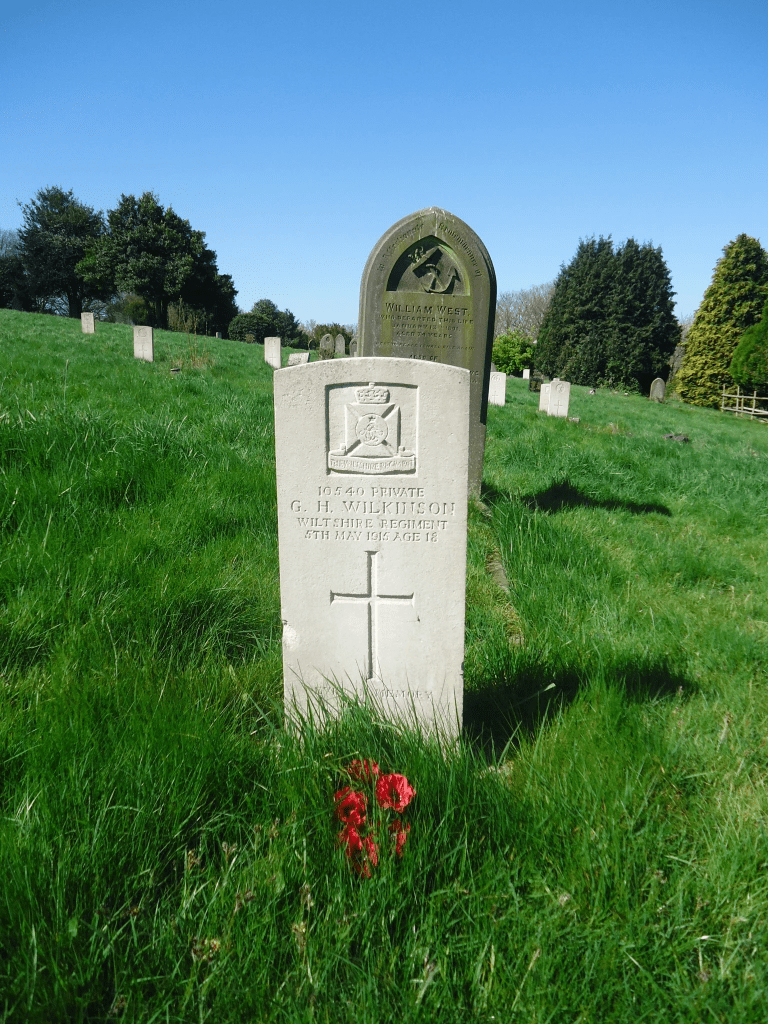
Private G.H. Wilkinson – Tell Them of Us

In the Spring of 1915, a new disease was observed on the battlefield. It would cause 35,000 British casualties and many hundreds of deaths. Symptoms included breathlessness (leading to bronchitis), a swelling of the face or legs, high blood pressure, headache and sore throat along with albuminuria (abnormal levels of the protein albumin in the urine). When the disease was first observed in 1915 doctors were at a loss as to know the cause. It was first thought it was caused by infection, exposure and diet (including poisons) although it was later suggested it may have been caused by hantavirus, a virus carried by rodents. This disease was named trench nephritis* and it killed 18-year-old George Henry Wilkinson on May 5, 1915.

George was born in Milton, Berkshire the second of John and Emma Wilkinson’s large family of ten children. He enlisted with the Duke of Edinburgh’s (Wiltshire) Regiment in Swindon where his mother had grown up and where his grandfather worked in the GWR Works.

George died on May 5, 1915 in the Weymouth Sydney Hall Hospital. He was buried in Radnor Street Cemetery on May 11 in grave plot B1599, a public grave. The burial registers record that his last address was 28 Butterworth Street. The Commonwealth War Graves Headstone includes an inscription chosen by his grieving father – Ever in Memory.

His mother Emma had died the previous year and was buried in another public grave, number B1559, close to where her son would eventually lie.

*nephritis – inflammation of the kidneys

Image of funeral account kindly supplied by A.E. Smith & Son, Funeral Directors.