People who attend our walks do so for a variety of reasons. Sometimes it is to visit the cemetery they remember from childhood when they accompanied a parent to visit a family grave. Some join us because they’ve only just discovered there is a cemetery in the centre of town. Then some years ago a visitor joined us to see if the pig on the chapel still survived. The pig (although I think it is probably a boar) is a gargoyle on the east facing wall and remains in good condition, as you can see here.
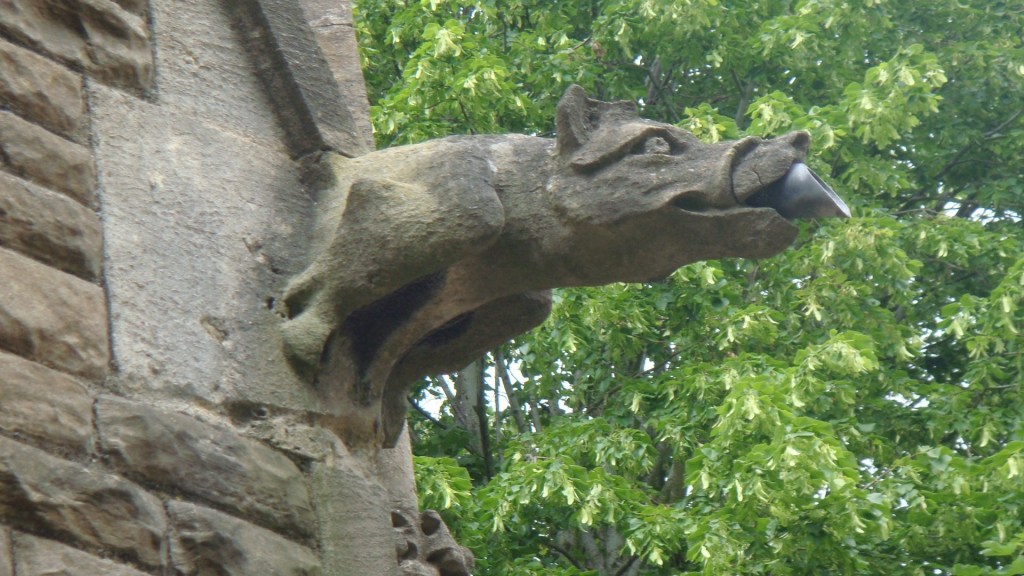
The same visitor then cast her eye around the lush, summer cemetery and mentioned that one of the grasses dated back to ‘the time of the dinosaurs.’
Now I’m no horticulturalist, but Andy and Noel were able to identify the grass as the horsetail. The RHS website describes the horsetail as ‘an invasive deep rooted weed with fast growing rhizomes (underground stems) that quickly send up dense stands of foliage.’

The fir tree like plants can grow up to 60 cm (2ft) tall with roots as deep as 2m (7ft) making them difficult to dig out. Fortunately there are no such triffid like examples in the cemetery and before too long the grass cutters will be out to cut them down and minimise the spread. But what about the claim that the horsetail dates back to the time of the dinosaurs.
Apparently ancient civilizations used the horsetail to stop bleeding and heal wounds. Although the plant is believed to have medicinal properties there is not sufficient research to confirm that it is safe and effective for human use.
And then, trawling through weed related pages on the internet I came across a ‘prehistoric’ reference on a Wikipedia page.
‘Equisetum is a ‘living fossil’ the only living genus of the entire subclass Equisetidae, which for over 100 million years was much more diverse and dominated the understorey of late Paleozoic forests.’
So our visitor was right. I learn something new every day spent in the cemetery.

 Radnor Street Cemetery