There are some obvious points raised in the following inquest; to establish that machinery and practises in the Works were not at fault and that proper medical attention was received by the victim.
But what I find astonishing is that a 55 year old man, already identified as having a weak heart, and who had previously suffered a rupture and was wearing a truss, was continuing to work as a smith in the Works.
The Fatal Accident in the GWR Works
Inquest This Morning
Mr W.E.N. Browne, County coroner, held and inquest this morning at the Clifton Hotel, New Swindon, on the body of Thomas Barter, a GWR employee, aged 55 years, and lately residing at 59, Radnor Street, Swindon. Deceased, who was a widower, was accidentally struck with a hammer by his mate, and two days after affair died through the injuries received.
Mr J. Gregory was chosen foreman of the jury. Mr. C.R. Pendock, Inspector of Factories, was in attendance.
Mr George Finch, son-in-law of deceased, was called, and said that the latter was a smith in the GWR Works. On Tuesday last he went home about mid-day, and the daughter told witness that he had complained of having had a blow. Later in the day, Dr. Maclean was sent for. Before going home deceased had called in at the Surgery, but a surgery doctor was not sent for afterwards. Witness saw deceased the evening of the next day, and he appeared to be gradually sinking.
By the Coroner: Witness had made no complaint about insufficient attention on the part of the surgery doctors.
By Inspector Pendock: Witness believed that deceased had suffered from a weak heart for some six months before the accident.
By a Juror: A Surgeon was at the Surgery when deceased called and attended to him.
William Berry, who was engaged with deceased in making crown bar ends, said he was striking side blows at the bar, and deceased was stood on his left. The bar happening to swerve witness missed the bar and struck the deceased in the lower part of the stomach. Deceased said he was hurt, but acknowledged to witness that it was a pure accident and not witness’s fault at all. Deceased worked for three-quarters of an hour after the accident, and then he put his coat on and said he was going out to see a doctor.
By the Inspector: Had you been long accustomed to the work?
Witness: Yes, sir. Six years. I have known the deceased for 15 years, and never known him to have a misword with anyone in the shop. He was the best man I ever worked with in my life.
The Inspector: The work you were engaged on was nothing unusual?
Witness: No, Sir. We have made thousands of these same things.
The Inspector: Was the bar hanging by a chain at one end?
Witness: Yes, sir, and in a crane and block at the other.
The Inspector: Did the chain give way at all?
Witness: No sir.
David Jeans, another workmate of deceased, gave similar evidence, and added that he (witness) had gone to the foreman after the occurrence, and made him acquainted with the facts of the same. The foreman promptly ordered witness to take deceased to see a doctor, but deceased said he would go by himself. Witness saw deceased at his home on Wednesday. He was then too ill to speak much, but made witness understand it was all an accident. He said he had gone to the Surgery on the Tuesday, but witness could not gather whether or not deceased had seen a doctor there.
The Inspector: You don’t make any complaint of the appliances you use for this work?
Witness: No, sir, not at all. We have made thousands.
The Inspector: They are properly fitted to the work, and no blame attaches to the Company?
Witness: That is so.
Dr. Carew Webb, assistant to Dr. Maclean, said he was called in on Wednesday evening, and examined the deceased. There was a certain amount of tenderness on the lower side of the abdomen, but no marks of bruising, nor was there any swelling or anything to suggest any serious internal injury. Deceased had been previously ruptured, and at the time of the accident was wearing a truss. The hammer must hit the truss, or the accident might have proved fatal sooner than it did. Witness saw deceased on Thursday morning, and he seemed a little brighter then but on the way to the station later, witness was stopped and asked to go to the house. When he arrived there the man was dead. They told him at the house that deceased had vomited a great deal before he died. Having heard from Dr. Maclean that deceased had suffered from heart disease, witness gave it his opinion that the immediate cause of death was heart failure, due to a weak heart, and accelerated by the accident.
The Coroner then asked Dr. Gardner, of the GWR Surgery, if he wished to say anything, as it had got about the town that the deceased was neglected at the Surgery. Dr. Gardner said that he himself had seen the deceased, and ordered him to go home and keep to his bed, and that the doctor would call in the morning. The doctor did call, but found Dr. Maclean had been called in.
A verdict in accordance with Dr. Webb’s testimony was returned.
Swindon Advertiser, Saturday, August 19, 1899.
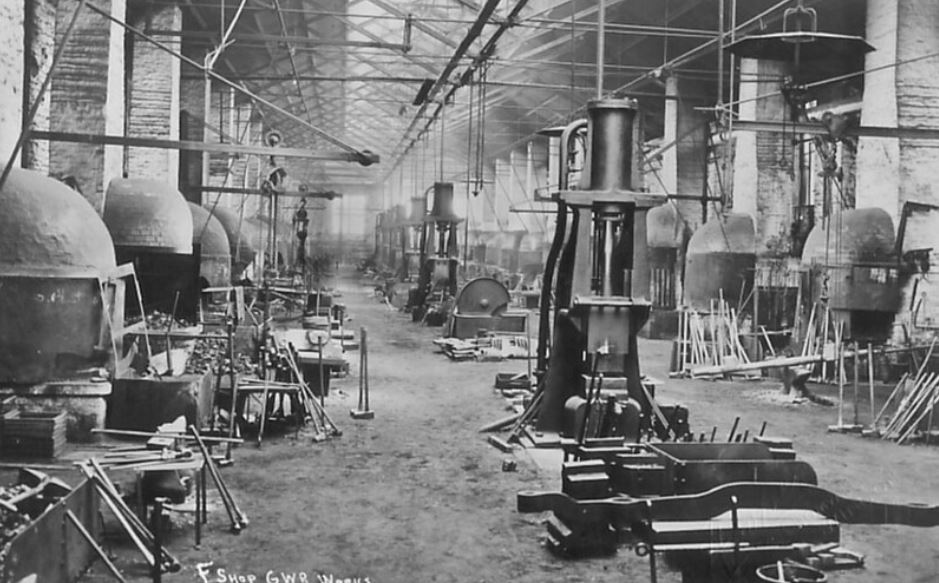
F Shop, GWR Works where Thomas Barter was employed published courtesy of Local Studies, Swindon Central Library.
The Fatal Accident in the GWR Works
Funeral of the Deceased
A Large Gathering
The funeral of the poor unfortunate victim of the accident which occurred in the GWR Works last Tuesday took place on Saturday afternoon. Owing to the popularity of Mr. T. Barter amongst his shopmates, the funeral was largely attended, over 100 mourners following. The procession was formed at deceased’s late residence in Radnor Street, and wended its way to the Cemetery where the interment took place, the officiating clergyman being the Rev. J.W. Fish, of Stratton.
Deceased had been in the habit of attending the Clifton Street Primitive Methodist Chapel for many years, and was only recently appointed as one of the trustees of the new building fund.
The coffin was conveyed on a handbier, the bearers being Messrs. D. Jeanes, D. Hunt, Wm. Harvey, Alf Reece, Jas Welch and Thos Brett, all shop mates of the deceased.
The Swindon branch of the A.S.E. was represented by the Secretary (Mr B. Johnson). Deceased was a prominent member of this Society and was Secretary of the Superannuation Fund for this district.
Deceased’s only sister (Miss Barter) was unable to be present as she crossed to Ostend on the morning of deceased’s death.
Last evening a memorial service was held at the Clifton Street Chapel, when an appropriate sermon was preached by the Rev. J.W. Fish, who took for his text the following words “There is but a step between me and death.” The rev. gentleman dwelt upon deceased’s life in connection with their church, and also of the good feeling which existed between him and his fellow workers. The congregation joined in singing the special hymn “Sleep on beloved,” and Mrs Westmacott sang as a solo “We shall meet at the beautiful gate.”
No flowers were sent by special request.
Extracts from Swindon Advertiser, Monday, August 21, 1899.

Clifton Street Primitive Methodist Chapel published courtesy of Paul Williams
The funeral took place on August 19, 1899 when Thomas Barter was buried in grave plot D23.

 Radnor Street Cemetery