Harry Day had been an acrobat since childhood. Probably one of those little boys forever performing flips and somersaults. By 1899 he was working for John Leopold’s “Frivolity” Company. In 1900 the troupe appeared at the Queen’s Theatre, Swindon* but on Tuesday, September 25, tragedy struck.
The inquest later heard how the acrobats were throwing somersaults on to a spring table. Two or three others had done their turns, and then the deceased went on. In attempting to complete a double somersault he missed, and came down upon his head in the middle of the table.
Harry was transferred to the Victoria Hospital and Dr. Rattray was summoned. At the inquest Dr. Rattray said he found the patient to be suffering from a broken neck and paralysis. Harry died a few days later.
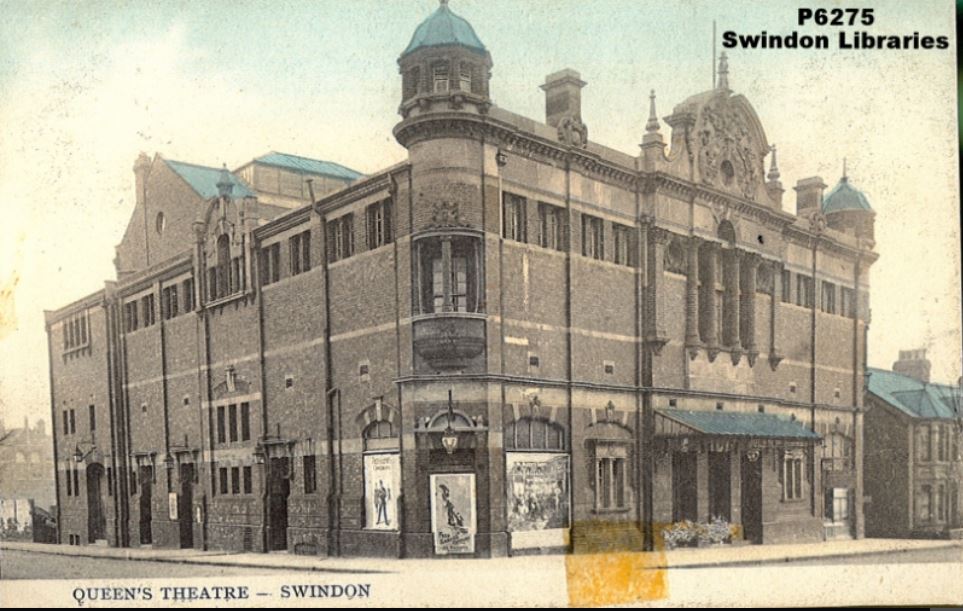
Image published courtesy of Local Studies, Swindon Central Library.
His wife, Christiana, was said to be greatly affected when she gave evidence at the inquest. She already had a small child and later gave birth to a daughter named Henrietta in memory of her father.
Christiana remarried in 1904 and by 1911 was living in Stirchley in the West Midlands, with her second husband Richard George Holbeche and her daughter Emily Day. Little Henrietta had died in infancy.
Henry Thomas Day was buried on October 3, 1900 in Radnor Street cemetery in grave C578, a plot later purchased by the Longman family
The Late Mr Harry Day – Last Saturday’s “Era” contained a letter from Mr John Leopold, of the “Frivolity” Company and a list of subscriptions secured on behalf of the widow and children of the late Harry Day, for some time a member of the Original Leopolds’ “Frivolity” Company, and who, on Sept. 25th last, while performing at the Queen’s Theatre, Swindon met with an accident which resulted in his death a few days later at the Victoria Hospital. From the list we gather that the total sum subscribed is £91 5s, including £31 14s subscribed by the “Frivolity” Company £25 of this being given by Mr John Leopold), and also £20 collected by Mr. Ernest Carpenter, of the Queen’s Theatre, Swindon. Mr Leopold desires to thank all who have given their help in this very deserving case.
Evening Swindon Advertiser, Thursday, January 17, 1901.
*The Queen’s Theatre stood at the junction of Clarence Street and Groundwell Road and was later renamed The Empire.
All for the Empire: the History of Swindon’s Historic Theatre, by Roger Trayhurn and Mark Child

 Radnor Street Cemetery