The re-imagined story …
I started in the Works in the polishing department in 1937 and stayed for two years. I hated every day I was there.
French polishing sounds as if it might be a delicate, artistic occupation. I suppose there was an element of artistry about, it but it certainly wasn’t delicate. French polishing involved stripping back to the basic wood, making good any damage and then building up the polish again, brushing and sanding, brushing and sanding. A door could take you five days, on and off. We worked on anything made of wood, everything from panels and partitions to toilet seats.
12A Shop was in the Carriage Works along London Street and it was cold and filthy. We were quite separate from the men in the railway factory and had our own facilities. That’s a laugh, one toilet with two washbasins and some disinfectant soap useless at getting all the muck off our hands. Methylated spirits worked much better but it was hard on your hands and left them red and raw.
The mess room was under the workshop but no one wanted to spend their lunchtime there. When the weather was good me and Ivy used to walk to the GWR Park and eat our sandwiches on a bench. It got you out of the dirt and fumes for a bit.
In those days, just before the Second World War, jobs in the Works were few and far between for women. In fact, the polishing department was the first to employ women back in the 1870s. A big deal had been made about ‘the comfort of the women.’ Ha, well by 1937 that had all gone by the board.
My dad used to keep on about getting a trade and being set up for life, as if I were a man, but I couldn’t wait to get out of that place. All I wanted was a nice, clean little job before Ted and me got married. I looked forward to polishing my own furniture and it would be a sight easier than French polishing railway carriage doors, I can tell you.

The Carriage and Wagon Works, London Street published courtesy of Local Studies, Swindon Central Library.
The facts …
By the 1870s the railway factory had been in operation for some 30 years but the GWR were finding it difficult to recruit skilled men. The problem was a shortage of jobs in Swindon for young women, the railwaymen’s daughters. The men wouldn’t move their families to Swindon if there was no work for their daughters.
Joseph Armstrong, the Locomotive, Carriage and Wagon Superintendent, the top man, addressed the problem by extending the Carriage Works on London Street and creating a separate upholstery department for the employment of girls only. By the end of 1874 five women were employed in the new trimming department.
Celia Folland was born in Tredegar, Monmouthshire in 1857, the daughter of Richard Folland, a rail sawer, and his wife Margaret. By 1871 the family had moved to Swindon and were living at 1 Reading Street in the railway village.
Celia Folland was the first woman to be employed in a GWR workshop where she worked as a French polisher, checking in for the first time on July 18, 1874.
Celia married George Morkot at St Mark’s Church, Swindon on July 19, 1883 and by 1891 they were living at 31 Chester Street with their three children, Charles 6, Nellie 4 and George 2. Celia would go on to have another four children.
Celia died aged 65 years old in February 1922 at 31 Chester Street where the family had lived for more than 30 years. Her funeral took place at Radnor Street Cemetery on February 15 and she is buried in plot D1613.
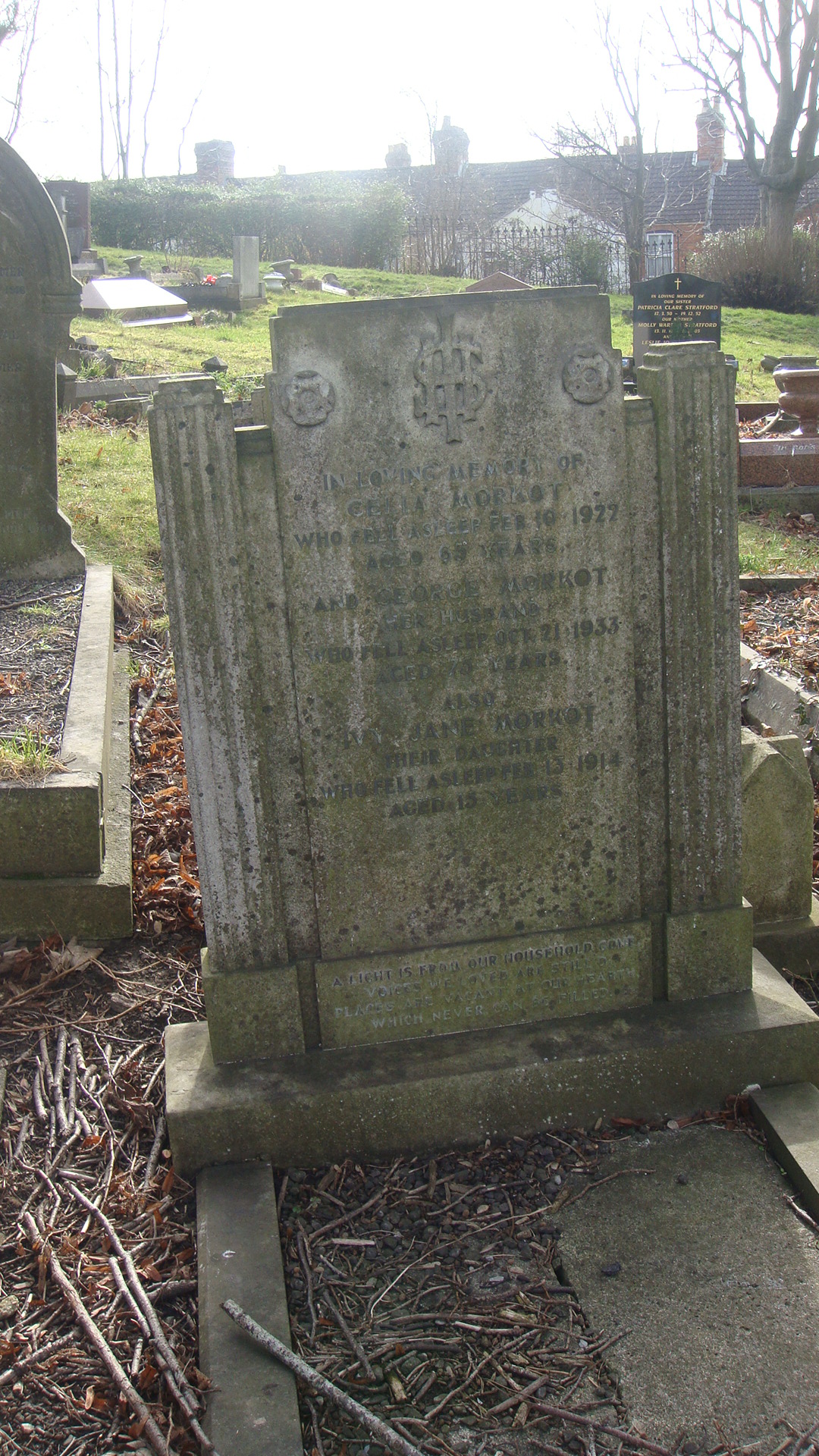

 Radnor Street Cemetery
The surname Morkot reminds me of a poignant memorial. in the Advertiser every year , from a Nanny (Morkot) to her Grandson.
LikeLike