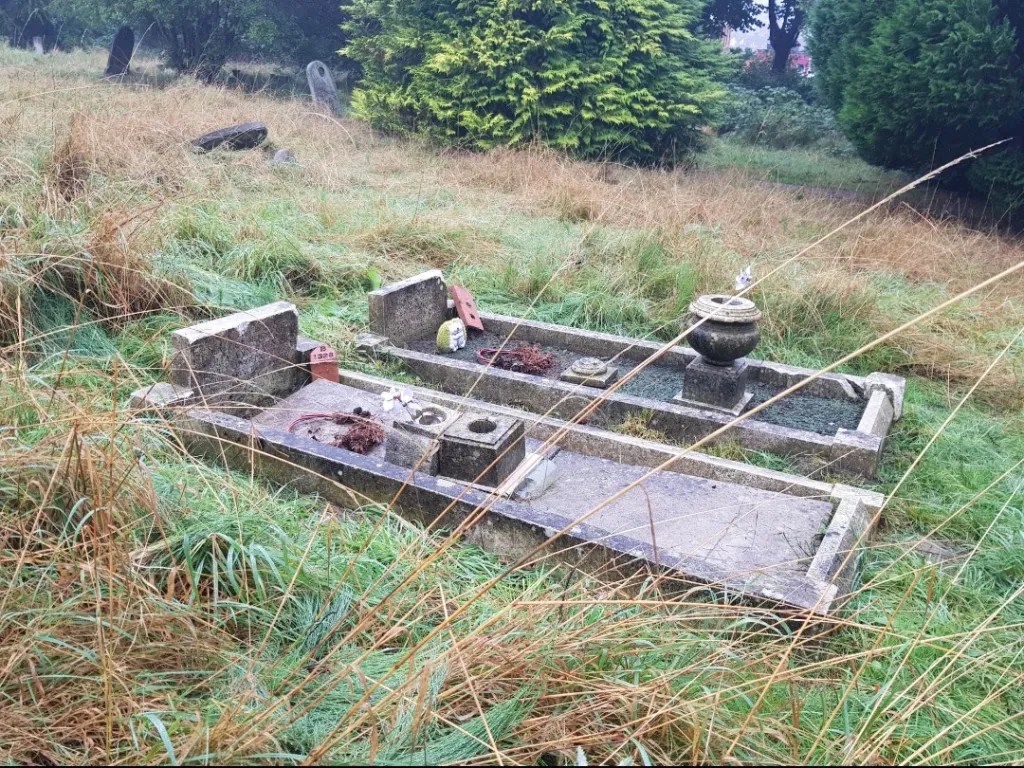
Graveplot B1328

This is the story of Harry Woolford, born in Swindon the son of Robert and Matilda Woolford. When I first saw the name I wondered if he might be a member of the Lydiard Tregoze/Purton family in whom I have an interest.


In 1901 Harry aged 26 lived at 13 Jennings Street with his mother, her second husband Thomas Bailey, his three Woolford brothers and a 9 year old half brother, Alfred Bailey.


On that day in January 1903 Harry left his home in Rodbourne to begin work in the railway factory as usual. But that day he met with a fatal accident.

Fatal Accident in Swindon

Man killed in the GWR Works

This morning a sad accident occurred in the GWR Works, by which a young man named Harry Woolford, residing in Jennings Street, Rodbourne Road, Swindon, lost his life.

The deceased, who is a single man, was employed as a labourer in the Mason’s Yard, under Mr Dougall Clark. Whilst attending some machinery, we believe, oiling it, his right arm became caught, and had it not been for the ready assistance of some of his mates who were standing near, he would probably have been drawn in and crushed badly. As it was, his arm was sadly injured, and the loss of blood was so great that he died almost immediately.

A message was sent to London Street, and Dr. G. Rodway Swinhoe and Dr. Pattison were soon on the spot, but their medical knowledge was of no avail. His body was removed to the GWR Medical Fund Mortuary shortly after to await an inquest, which will probably [be] held tomorrow.

Swindon Advertiser, Tuesday, January 6, 1903.

Harry was buried in graveplot B1328, a public grave, once called a pauper’s grave, reserved for those families who could not afford to buy their own, private plot. He was buried with his father, Robert Woolford, who had died 15 years previously and Georgina Hatton, an 86 year old widow who died in 1913.


As was the custom in this cemetery, the grave lay unmarked and undisturbed for 50 years.


Then in 1963 there was a terrible accident in Park South where two little girls were struck by a school bus and killed.


Friends and neighbours, the two families wanted their daughters to be buried side by side. Julia Ann Barnes parents bought plot B1329 and Dawn Maria Rose’s bought plot B1328.


No longer a neglected, pauper’s grave, the two families erected a fine, identical memorial on each of their daughters’s graves. The Radnor Street Cemetery volunteers keep these graves tidy and Cheryl, Gina and Angie Phillips lay flowers in the little girls’ memory.


This is the story of Harry Woolford who died in an industrial accident in the railway works and Julie Ann and Dawn, two little friends who died returning home from school.
Dr Charles Reid – Scottish rugby international

Scotland met Italy in the opening weekend of the 2026 Mens Rugby Six Nations. In atrocious weather conditions Scotland lost by the narrowest of margins. But let us remember a Scottish rugby hero buried in Radnor Street Cemetery.

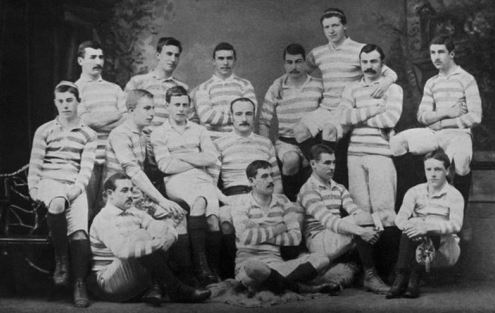
Edinburgh Academicals – Charles Reid pictured seated middle row 4th from left

Charles Reid was born January 4, 1864 at Lochwinnoch, Renfrewshire, the youngest son of John and Margaret Reid. By the age of 17 he stood 6ft 3ins tall and weighed in at around 15-16 stone.

He played for Edinburgh Academical Football Club, the oldest rugby club in Scotland and the second oldest in the World, which he captained from 1883-1888, beginning his international career in 1881.

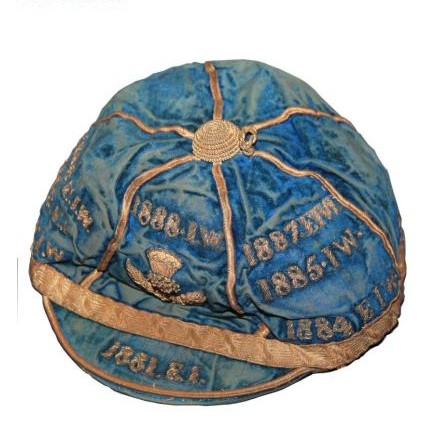
Charles Reid’s first cap published courtesy of Edinburgh Academicals

He was 17 years and 36 days old when he was first capped in 1881, the first schoolboy to play in a forward position in an international match. He went on to captain Scotland to 17 wins in 21 games. He was known for his skilful play and his ferocious tackling and today many rugby pundits place him in their ‘fantasy rugby team.’

Dr Charles Reid’s medical qualifications were registered at the University of Edinburgh in 1888. He worked for sometime in Selkirk where he met and married Catherine Louise Steedman. His medical practice was at 32 Wood Street where he was based for some four years. Sadly, Catherine died just 18 months later after their arrival in Swindon.

Death of Dr. Reid

Well known Medical Practitioner

A Great Rugby Football Player

Famous International

The news of the death of Dr. Charles Reid, partner with Dr. J. Campbell Maclean, of Swindon, was received with unfeigned regret on Tuesday last. Deceased, who was only 45 years of age, passed away at a Surgical Home in London on Monday night, whither he had undergone several operations of a painful malady. He had been in failing health for some time, but the end came somewhat suddenly. Dr. Reid lost his wife by death about four years ago after being married only 18 months.

Deceased was born in Scotland, and was educated at the Royal Academy, Edinburgh, and subsequently studied at Edinburgh University. He secured the degree of M.B., and of C.M. (Edinburgh) in 1883, and practised for some time at Selkirk, where he fell into bad health. He then lived at Craigie with Mr. Campbell for several years, and in 1903 came to Swindon to join Dr. Maclean. He then married, but his wife died 18 months later.

Dr. Reid was an able practitioner, and his opinion was held in high estimation by members of the profession. With patients he was most popular.

Dr. Reid was in his early days a great athlete, and he captained the Scottish Rugby team for many years and possessed no less than a score of International caps. He was the great Edinburgh Academical and Scottish International forward of the early eighties. A new football generation has grown up, but the twenty times capped giant forward is far from being forgotten across the border, he being spoken of as perhaps the greatest forward Scotland ever produced.

The fact that his death took place at the comparatively early age of 45, brings the reminder (says an Edinburgh correspondent) that he was barely 17 when he played against England in 1881 for the first time, and he was only 24 when he retired from football. From 1883 to 1888 he captained the Edinburgh Academical team, and in his last two International matches no fewer than five of the Scottish forwards were Edinburgh Academicals.

The funeral

The mortal remains of the deceased were brought to Swindon on Wednesday night, and the interment took place in Swindon Cemetery this afternoon, where lie the remains of his late wife.

The Swindon Advertiser, Friday, October, 29, 1909.

Dr Charles Reid died following a surgical procedure in London. His body was returned to Swindon to lie next to his wife and was buried here on October 29, 1909 in grave plot E8478.