George Hemsley – co-founder of the New Swindon Industrial Co-operative Society.

The re-imagined story …

My mum had a fantastic memory. She never forgot a birthday or anniversary and she could remember her Co-operative Dividend Number until the day she died.

She used to shop in the Co-op in East Street and knew Mr Hemsley, the secretary, well. George Hemsley was a railwayman from Gateshead and an influential character in the early days of New Swindon.

I began my fitter’s apprenticeship on the same day as Mr Hemsley’s son William, but while I spent 50 years in the Works, William Thompson Hemsley went on to enjoy a very different career.

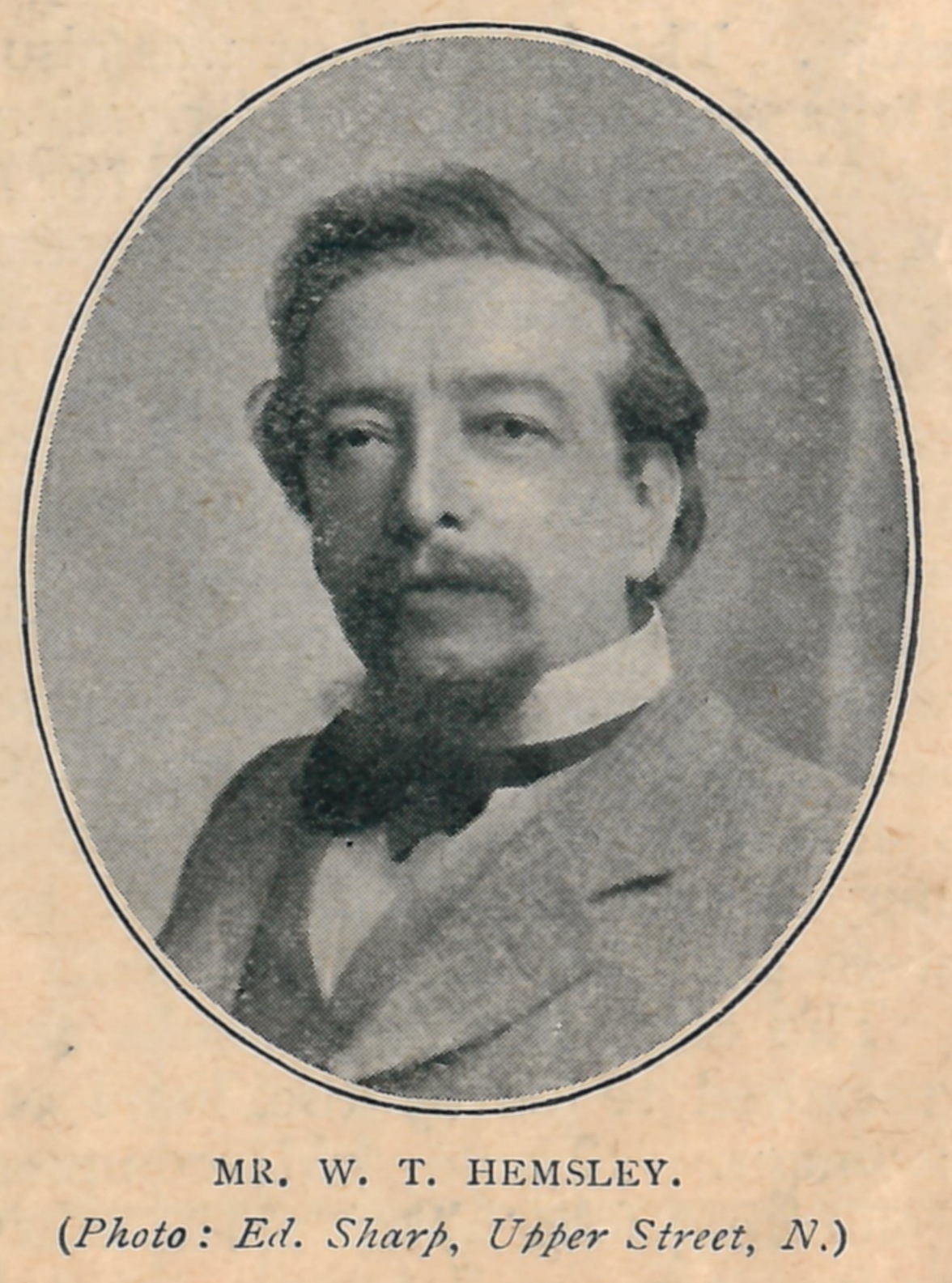
W T Hemsley

I was pretty good at sketching (I’d even considered a draughtsmen’s apprenticeship at one point) so when William told me he was starting drawing classes at the Mechanics’ Institute I decided to join him. I had no idea just how good he was though, and before too long he was actually teaching the drawing classes.

He began his scenic art career at the Mechanics’ and it was my proud boast that I helped him paint the theatre scenery on one occasion. I had little to do with the design, just followed instructions, but it was an interesting project to be involved in and something to tell the grandchildren.

William kept in touch with Swindon, even after he became famous. We used to meet up for a pint in the Cricketer’s when he came back to visit family.

George Hemsley died on November 12, 1888. My mum always mentioned him on the anniversary of his death. My mum had a fantastic memory.

ND: Looks as if taken in 1890s

George Hemsley with his daughter and an unidentified man

The facts …

George Hemsley, a fitter and turner was an early arrival at the GWR Works, Swindon.

George was born on January 17, 1822 in Gateshead the son of William and Anne Hemsley. At the time of the 1851 census George was living at Quarry Field, Gateshead with his wife Mary and their 10-month-old son William. George most probably worked at The Quarry Field Works, a marine, locomotive and general engineering firm established by John Coulthard & Son in 1840.

By 1861 George and Mary were living at 6 Westcott Place with their six children, four of whom had been born in Gateshead. John Robert Hemsley, was the first to be born in Swindon in around 1858 which places the Hemsley family’s move to Swindon sometime between 1854 and 1858.

Tracking the family through the census returns we find them at 22 Reading Street in 1871. William Thompson Hemsley has followed his father into the Works where he is a fitter and younger brother John Robert’s job description is boy in foundry.

George was also co-founder of the New Swindon Industrial Co-operative Society.

George died at his home 22 Reading Street on November 12, 1888 aged 66. He was buried in Radnor Street Cemetery and his funeral arrangements were performed by Richard Skerten, a carpenter and undertaker.

Mary remained in the family home following George’s death, living with her widowed daughter Mary J. Rollins and her two granddaughters, plus Frederick Birch, a Grocer’s Assistant who boarded with the family. Mary died on December 19, 1899 and is buried with George.

‘Mr Hemsley was a staunch supporter of the local Liberal and Radical Association, frequently appearing on the platform at public assemblies and often putting his signature to the Nomination Papers of Liberal candidates at Parliamentary elections. He played a prominent part in the election campaign of Mr B.F.C. Costello in 1886, when the latter gentleman was opposed from the right by a Liberal Unionist and from the radical wing of the party by the Independent Liberal Sir John Bennett.’

A Drift of Steam by Trevor Cockbill

George Hemsley’s name appears on a list of more than 130 who formed a local committee at New Swindon to secure the election of Daniel Gooch in May 1865.

Swindon Advertiser May 22, 1865

 Hemsley George

 9 March 1889 Personal Estate £558 18s 11d

 The Will of George Hemsley late of 22 Reading-street New Swindon in the County of Wilts Engine Fitter and Turner who died 12 November 1888 at 22 Reading-street was proved at the Principal Registry by William Thompson Hemsley of 57 Belvedere-road Lambeth in the County of Surrey Scenic Artist the Son and William Simpson of 7 Bangor terrace Jennings street New Swindon Engine Fitter two of the Executors

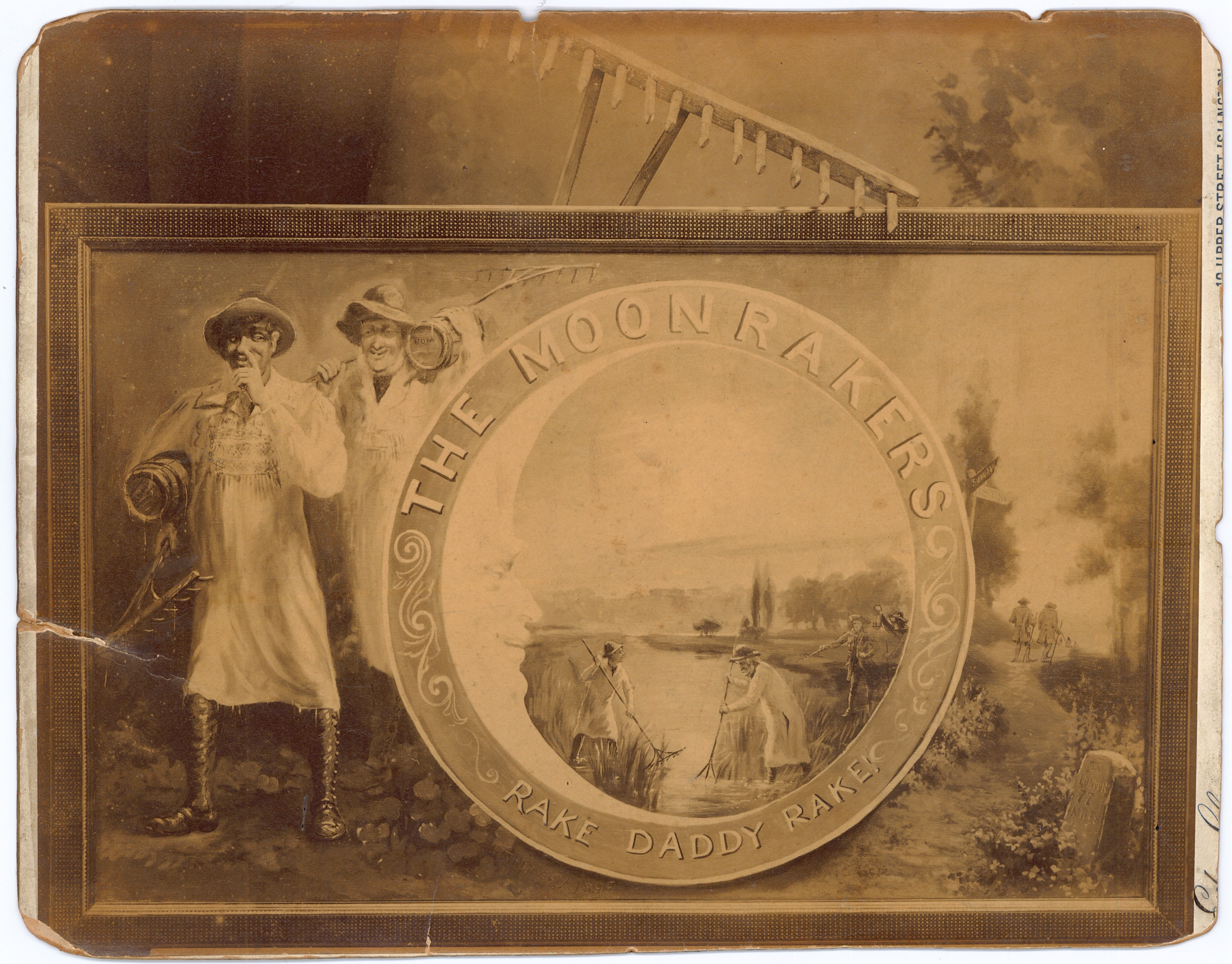
Rake Daddy Rake

Probably W.T. Hemsley’s most celebrated local work was a painting of the Wiltshire Moonrakers that hung  in the reading room at the Mechanics’ Institute for at least 35 years. This painting of Wiltshire yokels raking the pond to recover the contraband hidden there accompanied the Moonies Association when they met for their annual gathering in London.

Photographs published courtesy of Mike Attwell and Local Studies, Swindon Central Library.

John Hudson Read – Driver of the Royal Train

The re-imagined story …

Father spread the newspaper across the kitchen table. It took him some time to find the report he sought as Mr Morris had seen fit to hide it on the fifth page of his periodical. The attempt on the Queen’s life had happened two days previously and was old news by then.

Father cleared his throat before speaking. In his melodious Welsh voice he announced – ‘An attempt to shoot the Queen was made on Thursday evening at Windsor station.’

Father had a magnificent voice. I loved to hear him sing in the Baptist Chapel in Cambria Place where we attended every Sunday. Mind he had some keen competition, lot of good Welsh voices there were there.

Mother was less enthusiastic. ‘Likes to hear the sound of his own voice,” she said, which I thought was a compliment – until I grew older.

That evening he read to us the report of the attempt on the Queen’s life. In his rich tenor voice he presented the scene – the poorly clad, starving clerk and the brave Eton schoolboy who belted him round the head, the crowds, the police – it was like something out of a Penny Dreadful!

We later learnt that the Royal Train on which the royal party travelled that day was driven by a Mr. John Hudson Read. And then would you believe it, two years later he moved into the house next door to us. There’s famous he was. I used to tell the story to my children but they were less impressed. I suppose it was old news by then.

The facts …

Attempt to shoot the Queen

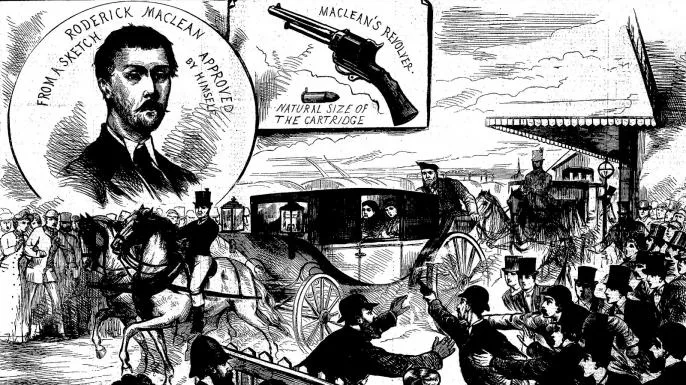
An attempt to shoot the Queen was made on Thursday evening at Windsor station. The name of the miscreant is said to be Robert Maclean, who was poorly clad, and who states that he is a clerk out of employment.

The particulars of the foolhardy act are as follow :- The Queen, who had been spending a couple of days at Buckingham Palace, left London in the afternoon for Windsor Castle. The Royal train arrived at Windsor about half past five o’clock, a large crowd having assembled to witness the arrival of the Sovereign. On alighting from the train her Majesty at once entered a carriage which was in waiting to convey her to the Castle, when just as she was about to drive oft a man who had been standing with others at the entrance to the station yard suddenly fired a revolver at the Royal carriage, but happily the shot did not take effect.

The fellow was about to fire a second time, when the pistol was wrenched from his grasp by a bystander, and he was at once seized by the police, who, however, had some difficulty in preventing him being lynched by the crowd. It is stated that at the moment the pistol was fired the crowd was cheering the Queen, who, it is thought, did not hear the report; but of course her Majesty was quickly apprised of the attempt which had been made upon her life, and, with her usual solicitude for others, she at once caused inquiries to be made as to whether any one had been struck by the pistol-charge.

Some doubt exists as to whether a bullet was really fired or not, as no trace of one has been found. The pistol, which was a six chambered one, was found to be loaded with two blank cartridges and two containing bullets. Several other cartridges were found on the person of the would be assassin. Maclean is thought to be of unsound mind.

This is the sixth outrage which has been perpetrated on the person of the Sovereign. The first occurred in June, 1840, when the Queen was fired at by Oxford. The next was in May, 1842, the would be assassin being John Francis. Two months later a man named Beau presented a pistol at her, but without firing it. In June, 1850, her Majesty was struck in the face by a fellow named Pate as she was walking out; and in 1872 a lad named Arthur O’Connor presented an unloaded pistol at her as she was entering Buckingham Palace.

The Prisoner Before the Magistrates,

Windsor, Friday afternoon.

The prisoner was driven to the Town-hall in an open fly at half-past one to-day, in charge of Supt. Hayes and a plain clothes official. He has a very wretched look, and is a man very much of the Lefroy type. He looks unclean and unshaven, and has a slight black moustache. He was immediately taken before the bench of magistrates, the Mayor of Windsor presiding Mr Stevens, solicitor to the Treasury prosecuted on behalf of the Public Prosecutor. Amongst the magistrates present were Alderman Chamberlain, and Mr G. Poole.

In reply to the Mayor, the prisoner said in a most off-handed manner and in a firm voice that his name was “Maclean-Roderic Maclean.” Supt. Hayes was then sworn. – Mr Stevenson said he was instructed to prosecute by the Secretary of State.- Supt. Hayes that her Majesty arrived at the station at 5-25 yesterday. She was accompanied by the Princess Beatrice, and Mr Brown was sitting behind the carriage. As the carriage started and had got half way to the gate he heard a report, and looked to the left, when he saw the prisoner. Prisoner here asked whether he was allowed to ask any questions. The Mayor said certainly he would, presently.

Examination continued: He looked to the left and saw the prisoner in the act of presenting a pistol at her Majesty. He did not hear more than one shot fired. The prisoner was about 150 yards from the carriage where the shot was fired when he first saw the prisoner. He was holding the pistol straight out in the direction of the carriage. He immediately sprung on him, and collared him by the collar and neck. He stopped to take the pistol from him when a young man named James Burnside subsequently got possession of the pistol, and handed it over to him. He produced the pistol, which had been in his possession ever since; he put it in his pocked immediately he put prisoner against the wall, assisted by Inspector Fraser and others. Prisoner said, “Don’t hurt me, I will go quietly.”

A little Eton boy came up and gave him a blow on his head, and he then took prisoner to the police station, and when there he asked him his name and address. He gave his name and address, and said he had been in Windsor about a week. On the way to the Police-station in the cab prisoner said, “I was starving, or I should not have done this.” At the station when charged he said, “Oh, the Queen!”

He examined the pistol. It was a German pin-fire revolver; it had two empty cartridge cases in it, that was to say exploded cartridges. Three were full whole cartridges, and two chambers empty. He drew the cartridges, and produced them. He searched the prisoner, and on him found 14 other cartridges of the same make. They were in a piece of rag. He found other articles of no value, including a pocket book, a knife, etc. Amongst other things a letter was found. It was taken from him by Inspector Fraser. The letter was then read, in which prisoner stated that he would not have dared the crime had the sum of 10s been given to him instead of 5s being offered the insultingly small sum of 6s. He was compelled to commit this crime against the bloated aristocrat, headed by that old lady “Mrs Vic.”

Witness further said that at 10.30 this morning prisoner said he wished to make a further statement, “I have a complete answer to the charge.” He then wrote a letter which was now put in and read, in which prisoner said he was not guilty of shooting at the Queen with intent to do grievous bodily harm, his object was only to cause the public alarm, with the result of having his grievances redressed. Such was the pecuniary strait in which he was.

All the circumstances tended to prove this statement. Had he cared to have injured the Queen he would have fired at her when she was getting out of the carriage. As it was he shot at the wheels but the pistol kicked and the bullet might have hit the carriage door. The only consolation he could offer the Queen was this statement, and he offered it if the charge of intent to do the Queen grievous bodily harm was withdrawn, and a charge of attempting to intimidate others substituted he would do all in his power to elucidate the mystery, and to bring the matter to a speed issue. At the end of the letter prisoner said that was the whole truth. The prisoner was remanded.

The Swindon Advertiser, Saturday March 4, 1882.

James Haydon Wardall

The re-imagined story …

I was working as night porter and resting the day Mr Wardall checked in at the Albion. Polly told me he wasn’t looking well and that she expected I may be required during the night.

Polly was my sweetheart and we were saving hard to get married. We had met when we were both in service. We were ambitious and knew that we wanted more than a life of bowing and scrapping. We dreamt of opening our own little boarding house and being our own bosses, answerable only to one another.

We decided to get some experience in the hotel business before embarking upon our big adventure. It seemed to me though that there was little difference to being in service. The work was as arduous, the hours as long and there was still a lot of bowing and scrapping to be done.

It was early on in the season and only a few of the rooms were occupied. Throughout the night I kept busy with my usual tasks, alert to the bells and a possible summons to Mr Wardall’s room, but all was quiet.

The morning dawned bright and blustery with rain threatening but I followed my usual routine and took a brisk walk down by the harbour before returning to my room. I disliked working the night shift and could seldom sleep during the day, every noise in the hotel disrupted my slumber.

That day I was disturbed more than usual and eventually I rose and dressed and went down to the kitchen for a cup of tea. It was then I learned that Mr Wardall had died during the night and it was my poor Polly who discovered his body.

We left the Albion soon after that; I wasn’t sorry to go. We abandoned our boarding house dream.

Albion

Albion Hotel, Plymouth

The facts …

Military Funeral. – The Swindon Advertiser of the 28th ult. records as follows the funeral, with military honours, of one who was known to many in this district, to which he is also related: – The funeral of Mr James Haydon Wardall, nephew of Mr J. Haydon, took place on Tuesday evening.

The deceased gentleman commenced his education at the old GWR Schools at New Swindon, under Mr Braid, and completed it at Edinburgh, whether he removed in 1866. On leaving school he was apprenticed to learn the trade of an engineer under his uncle, Mr John Laverick, at Edinburgh. After his apprenticeship he entered the service of Messrs. Douglas & Grant, at Kirkcaldy, Fifeshire, where he remained for some time; afterwards coming to Swindon, where he was employed in several shops in the GWR Works. Finally he obtained the position of draughtsman under Mr S. Carlton (manager of the Locomotive Department of the GWR Works). In June, 1885, he was offered the post of principal foreman in the Fitting and Turning Shop of the Bombay, Barolda, and Central Indian Railway at Parel, which office he accepted.

During his residence at Swindon, Mr Wardall was associated with several athletic clubs, including the Swindon Drill Hall Gymnastic Society, of which he was secretary on its formation. He was a full corporal in the F (New Swindon) Company of Volunteers for several years, and after leaving Swindon joined the Volunteers in connection with the company for whom he worked in India.

Latterly, Mr Wardall was prevented by ill-health from actively following his employment, and he decided to seek the benefit of a sea voyage, and came to England. He arrived recently at Plymouth, where his illness proved fatal on April 20th.

The remains were conveyed to Swindon for interment, where his old volunteer friends resolved to accord him military honours. Long before the hour fixed for the funeral, the streets in the vicinity of the Works were lined with spectators, whose numbers were greatly increased, as the cortege passed the principal entrance, by the employees who were leaving work for the day.

A large number of volunteers assembled on parade, including the band of the battalion, numbering 32 men, one corporal, one drummer, and one fifer, from the F&G Co’s (New Swindon), under the command of Sergt. McCulloch, a total of 40; Bugle-Major J. Phillips, Armoury-Sergeant J. Westcott, 12 sergeants, five corporals, and 52 rank and file, the whole being under the command of the Sergt. Instructor of the Corps.

On leaving the residence of Mr T. Rice, 25 Gloucester Street, where the body had been removed on arrival from Plymouth, the band played Beethoven’s “Funeral March,” and the mournful procession proceeded to St Mark’s Church, via Sheppard Street, London Street, and Bristol Street.

The principal mourners, who rode in coaches, were Mr Lancelot Thomas Haydon (chief draughtsman in the Works, cousin to the deceased), Mr Thomas Butterfield Watson (uncle), Mr William Williams (Pontypridd, brother of the widow), Mr John Jones (uncle of the widow), Mr E. Jones (cousin of the widow), Mr T. Rice, and Mr F. Buckland, Mr James Haydon (uncle) was prevented from attending through illness.

Among others present were Mr J.B. Cartwright (captain of Swindon Drill Hall Gymnastic Society), Mr E. Head (sec.), Mr S. Warner, Mr H. Thomas, Mr B.J. Robinson, Mr J. Patton, Mr A.E. Murgatroyd, Mr Arthur Bowker, etc., private friends of deceased during his residence in Swindon.

The coffin, which was of polished oak, was covered with the Union Jack, and bore the deceased’s helmet and sword, which were surrounded by wreath of choice flowers, sent by Miss Wardall (sister), Mrs Thomas, old friends, styling themselves “The Boys,” the members of the Gymnasium, and others. The breast-plate was inscribed as follows:- “James Haydon Wardall, died April 20th, 1888, aged 32 years” The pall-bearers were Armoury-Sergt. Westcott, Col. Sergts Horsington and Harrod, and Sergt. W.H. Lawson.

On arrival at the church gates the firing party lined up, and the procession was met by the Vicar (the Rev. Hon. M. Ponsonby), who read the first portion of the service in the church. The band played the “Dead March” in Saul as the cortege subsequently proceeded to the Cemetery, where there was a large attendance of the public. The volunteers formed a cordon around the grave, with the firing party drawn up, and, when the body arrived, it was wheeled to the graveside and lowered into its last resting place. The service was impressively conducted by the Rev. Hon. M. Ponsonby, and at its conclusion the firing party (a full lieutenant’s escort) discharged the customary three volleys over the grave. The Volunteers were then re-formed, and marched to the Mechanics’ Institution, where they were dismissed.

The Fife Free Press Saturday May 5, 1888
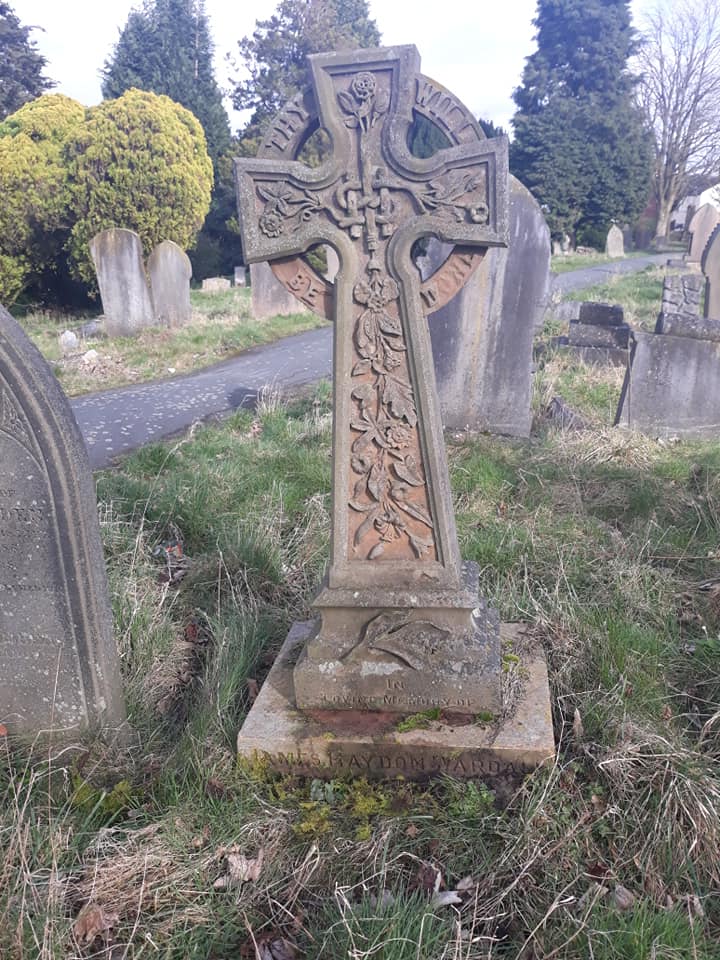
James Haydon Wardall

Wardall James H. 32 years Albion Hotel, Plymouth burial 24th April 1888 plot E7997.

Radnor Street Cemetery burial registers.

Wardall James Haydon of Parel Bombay India died 20 April 1888 at the “Albion” hotel Plymouth Administration (with Will) London 4 February to Margaret Wardall widow Effects £140 14s

Emma Lavinia Watson – formerly of Eynsham

Now my Radnor Street Cemetery colleague Noel and I thought it was quite a coincidence when we realised we both had connections with the village of Eynsham in Oxfordshire, but imagine my surprise when I discovered the story of Mrs Watson, born and married (twice) in Eynsham but buried in Radnor Street Cemetery.

Emma Lavinia Goodwin was born on July 30, 1844, the daughter of Charles Goodwin landlord at the Royal Albert and brewer at the Crown Brewery, Eynsham and his wife Harriett. Emma was the couple’s fifth child and at the time of the 1851 census the family lived in Newland Street, a long street lined with stone built properties large and small, that ran from Mill Street and out of Eynsham to Cassington.

Emma married Harry Gibbons (farmer and butcher) by licence on June 4, 1861, shortly before her 17th birthday. Marriage by licence usually indicates a desire to marry quickly and unobtrusively and it looks likely that young Emma was already pregnant. Harry was the son of James Gibbons, farmer, grocer and another brewer with premises in the High Street. Was this a union of two brewing dynasties?

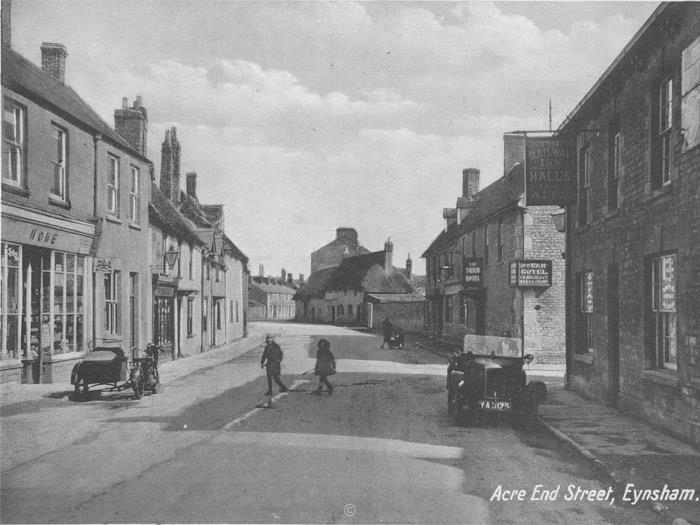
At the time of the 1871 census Emma was living at Acre End Street, Eynsham where today stone cottages rub shoulders with brick built ones crowding close to the narrow road leading to St. Leonard’s Church. By 1871 Emma was just 27 years old with five children, Harriet 9, Maria 8 (staying with her aunt and uncle on census night) Frederick 6, Sarah 4 and 3 year old Jane. She was already widowed, her husband Harry having died in 1867 aged 30. But Emma didn’t rush into a second marriage, which is quite unusual for the time. A young woman with five children to support often remarried within 12 months but perhaps Emma’s extended family helped to support her financially.

Maria Gomm nee Gibbons (Emma’s daughter) and her husband Thomas

Emma eventually married in the December quarter of 1873. Her second husband was carpenter and joiner George Watson. They continued to lived in Acre End Street where the Watson children soon began arriving! At the time of the 1881 census living with Emma and George were Jane Gibbons 13, Emma’s youngest child from her first marriage, and Augustus Watson 7, Lavinia Watson 4 and three year old Mary Watson.

Then, towards the end of the 1880s the family moved to Swindon where George most likely took up a job in the GWR Works. When the census was taken in 1891 they were living at 50 Clifton Street with their five Watson children, two of whom, William and Charles, had been born in Swindon.

When George completed the census returns in 1911 he made a bit of a mess of the form with numerous crossings out and alterations. The family were now living at 29 Tennyson Street and he records that he and Emma have been married 38 years and had 7 children all living. He lists Jane R. Gibbons, his stepdaughter, as being present on census night but then crosses out her name and adds ‘Croydon, Surrey’ so presumably this is where she was living in 1911. Staying with the couple on census night were their married daughter Lavinia Deans and her five year old daughter Ruth.

William Watson, Emma’s son – founder of Watson’s Typewriters Ltd., Glasgow.

Emma made Swindon her home for about 30 years and the funeral report indicates she contributed to community life at St. Mark’s Church.

Emma died aged 70 at her home in Tennyson Street on June 26, 1915 and was buried in plot E8626F on July 2. She shares the plot with her youngest son Charles Watson who died the following year aged 27. George Watson, Emma’s second husband, died in 1916 and was burried on December 6 in the neighbouring plot E8626E.

Death of Mrs G. Watson

The remains of the late Mrs G. Watson, of 29 Tennyson street, whose death occurred on the 26th ult., were laid to rest in Swindon Cemetery on Friday, July 2. Deceased, who was 70 years of age, was a daughter of the late Mr C.A. Goodwin, a brewer, of Eynsham. During her residence in Swindon she took a great interest in the life of St. Mark’s Church, and she will be greatly missed by a large circle of friends. The first portion of the service was held in St. Mark’s Church, Canon A.G.G. Ross officiating. The rites at the cemetery were performed by the Rev E.A.W. Topley (All Saints’’) and the choir were augmented by that of All Saints’ Church, deceased’s eldest son bearing the cross. The inscription on the breast-plate was: “Emma Lavinia Watson, died June 26th, 1915, aged 70 years.” The chief mourners were Mr. G. Watson (husband), Messrs A., E., W. and C. Watson (sons), Mrs. T. Gomm, Miss J. Gibbons, Mrs W. Robinson and Mrs E. Davies (daughters) Mrs and Mrs L. Deanes (son in law and daughter), and Mr E. Watson (grandson). A large number of friends were also present. There were numerous floral tributes.

The Oxfordshire Weekly News, Wednesday, July 28, 1915.

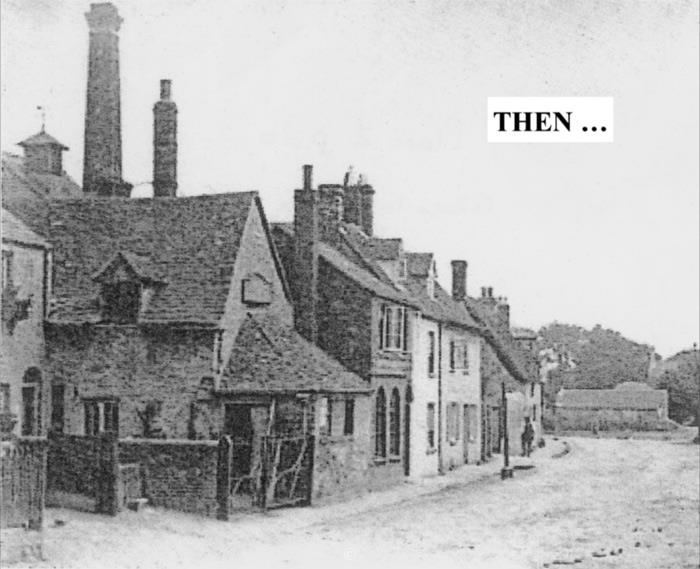
The tall chimneys to the left (High Street 25 Jan 1886) belong to Gibbons brewery –

I recommend a visit Eynsham online.

Albert Sykes – the father and founder of music in Swindon

The re-imagined story …

Mr Sykes asked me to sing All Things Bright and Beautiful. He listened very carefully; his head tilted on one side. There was a brief pause after I stopped.

“Well Ada,” he said, “I’m sure we can find a place for you in the chorus.”

I was so excited I could have given him a big hug, but that would have been entirely inappropriate. You didn’t hug a gentleman like Mr. Sykes.

My ma said I was born to sing. She said that I sang even as a baby in my crib. “You never wailed or screamed like the other babies,” she said, “you sang.”

I’ve been singing ever since. I especially love to sing in church. My favourite hymn is Rock of Ages, I love the rise and swell of the music. And I sing at my work, but I try not to be too enthusiastic as Mrs Morse has delicate hearing and she usually asks me to close the green baize door while I’m in the kitchen.

But I had never sung in public before and I never dreamed I would one day stand on the stage at the Mechanics’ and sing before an audience. I could scarce believe Mr. Sykes might even consider me.

It was my best friend Polly who suggested I audition for the chorus in the Mechanics’ Institution pantomime that year – Babes in the Wood, or Harlequin and the Cruel Uncle.

Opening night was just days away and this was to be our dress rehearsal. “Let’s put you next to Letitia, just follow her lead,” Mr Sykes had said at our last rehearsal. Letitia Jones was one of the principal singers in the chorus. She had a beautiful voice, a bit on the quiet side, I always thought, but melodious none the less.

Polly was waiting in the wings when I arrived. She was in conversation with Letitia and had her back towards me, but I could hear them talking as I approached.

“I hope Ada Firebrace doesn’t stand next to me again. She quite puts me off,” said Letitia.

“I never expected Mr. Sykes would engage her,” I heard Polly say. “I hoped he might tell her … you know … tell her what an awful voice she has. Then perhaps she would stop singing morning, noon and night.”

I stood stock still. Letitia had seen me walk across the stage and was grimacing and nodding at Polly with the intention of warning her that I approached. It was too late.

I never spoke to Polly again and I didn’t take part in the Mechanics’ Institution pantomime that year either. But I did save up my pennies and took some singing lessons with Mrs Sykes.

Ma says my voice is more beautiful than ever now. I have no desire to sing before an audience anymore, but I will always have kind memories of Mr Sykes.

The facts …

The Late Mr Albert Sykes

In accordance with the recommendation in the report, Mr Spencer proposed that a large portrait be obtained of the late Mr Albert Sykes, and placed in the Reading Room. Mr Sykes, he remarked, was a man who in his day and generation did a great work for New Swindon, and many men had been indebted to him for his musical tuition. Mr. Sykes was a useful man on the Council of the Institute, a capital librarian during the time he held that position, and he was also the father and founder of music in Swindon.

Mr A.W. James seconded the proposition, which was carried unanimously.

Mr Morris said he was pleased to know that the Council were thus going to recognise Mr Sykes’ services, and he hoped the same course would be adopted with regard to the late Mr J.H. Preece and the late Mr F.G. O’Connor.

The Swindon Advertiser, Saturday, May 5, 1894.

The two Sykes brothers were born in Leeds – Albert in 1823 and Joah in 1824. On the 1841 census they are living in Hunslet where their father John worked as a surveyor of roads. Albert was working as a mechanics’ apprentice while Joah was a potter’s apprentice.

Albert began work as a fitter and turner in the GWR factory in September 1847 later working as a shop clerk.

The 1851 census shows Joah still living in Hunslet with his wife and baby daughter. He is working as a whitesmith (someone who works with tin). Joah joined his brother in New Swindon around 1853 where he worked as a blacksmith in the railway factory.  At the time of the 1861 census he is living with his wife and their five children at 1 East Place in a property they share with Peter Vizard, his wife and two daughters; Thomas Toombs, his wife and their three children and a lodger by the name of Jeremiah Walker!

By 1871 Joah and his family are living at 25 Reading Street, which remained his home until his death in 1910.

On first coming to New Swindon Albert lived in Westcott Place. Then he spent 20 years living in Fleet Street before moving to Victoria Road where he and his wife opened a music school.

Both Joah and Albert were talented musicians. Joah played the oboe and both brothers were involved with musical events at the Mechanics’ Institute where Albert conducted the Mechanics’ Institutes’ Choral and Orchestral Union.

The two Sykes brothers are typical of those early settlers who left their home, their family and friends to move to New Swindon and once here immersed themselves in the life of the community.

Albert died on February 27, 1894. His funeral took place on March 3, 1894 and he is buried in plot E8362 with his wife Mary Hannah, son Albert and nephew Herbert Francis Sykes – Joah’s son.

Joah was elected to the Council of the Mechanics’ Institution in 1870. He was a member of the Liberal Association with a reputation for being a radical and he was a member of the Methodist Chapel in Faringdon Road.

Joah died on February 17, 1910. He is buried in plot E8364 close to his brother Albert, with his wife Ellen and two of their daughters. Emily is described on the 1901 census returns as being an ‘imbecile from birth’.

George Augustus Crocker – with Mother’s fond love

The re-imagined story …

‘Some say it was a futile war, a pointless war, an unjustifiable war. Tell that to Kate Crocker, that’s what I say.

When the old Queen married off her children into European Royal households she did it to create one big family. Well, we all know what families are like – there are favourite children and jealous cousins and an interferring aunt and uncle – but it’s something quite different when family members fall out on the world wide stage. Some people don’t know when they’re well off.

The First World War began when Gavrilo Princip assassinated Archduke Franz Ferdinand of Austria, but of course there was more to it then that. The causes of that Great War were many. Tell that to Kate Crocker.

By the time Kate took possession of her son’s war medals she was alone in this world, her immediate family gone, her husband and both her children dead. Europe was a different place as well. The old Queen’s plans for her family had come to nothing. Just like Kate’s.’

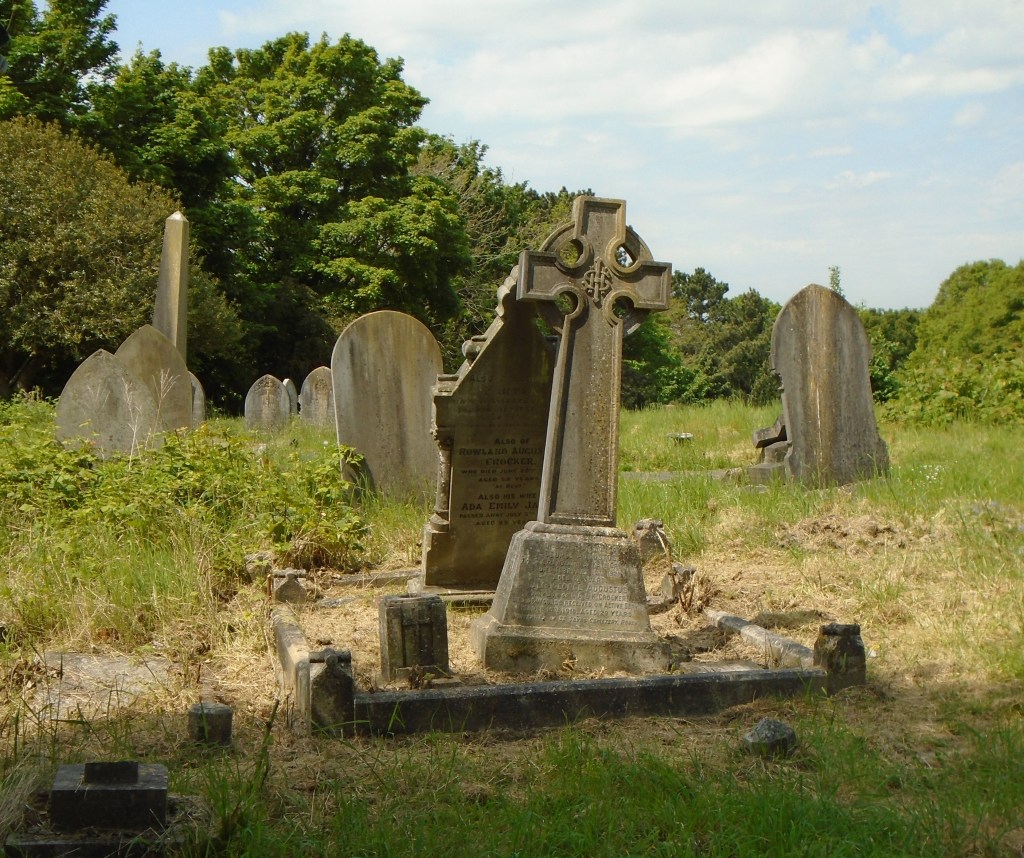
The inscription on the headstone reads:

Also George Augustus

only son of G.A. & K. Crocker

Died of wounds received on Active Service

March 15th 1918 Aged 29 years

Interred in St Seves Cemetery Rouen

The facts …

George Augustus Crocker and his sister Edith were baptised together at St. Mark’s on December 3, 1888. The family home at that time was at 28 Reading Street. In 1901 the family are recorded as living at 63 Exmouth Street.

George followed his father into the Works and a job as a railway clerk in the Operating, Traffic, Coaching Depts. He began his employment as a 16 year old on an annual salary of £25 on May 16, 1904.

George Augustus Crocker enlisted in the Royal Army Medical Corps at Swindon on May 10, 1915. He later transferred to 6th Cyclists Bttn Field Ambulance. He died on March 15, 1918 from wounds received in action (Gas) in No 9 General Hospital Rouen. He was 29 years of age. He had served a total of two years and 310 days – a year and 280 days at Home and 1 year and 30 days in France. He is buried in St. Sever Cemetery extension, France. The inscription on his headstone reads – They died that we might live with Mother’s fond love.

He left effects valued at £125 to his mother. Property returned to Kate included letters, photographs and a diary.

Kate Crocker died on June 8, 1938, She is buried in plot E8506 with her daughter Edith who died in 1908 aged 21 years and her husband George Augustus senior who died in 1921. Their son George Augustus is mentioned on their memorial. Ada Emily Jane Crocker, the widow of Rowland Augustus Crocker, George Augustus senior’s brother, was buried in the same plot in 1967.

In the neighbouring grave plot E8507 lies William Crocker, George Augustus senior’s brother, his wife Martha and the aforementioned brother, Rowland Augustus Crocker.

St Sever Cemetery and St. Sever Cemetery Extension are located within a large communal cemetery situated on the eastern edge of the southern Rouen suburbs of Le Grand Quevilly and Le Petit Quevilly. – see www.cwgc.org.

A busy day in the Coroner’s Court

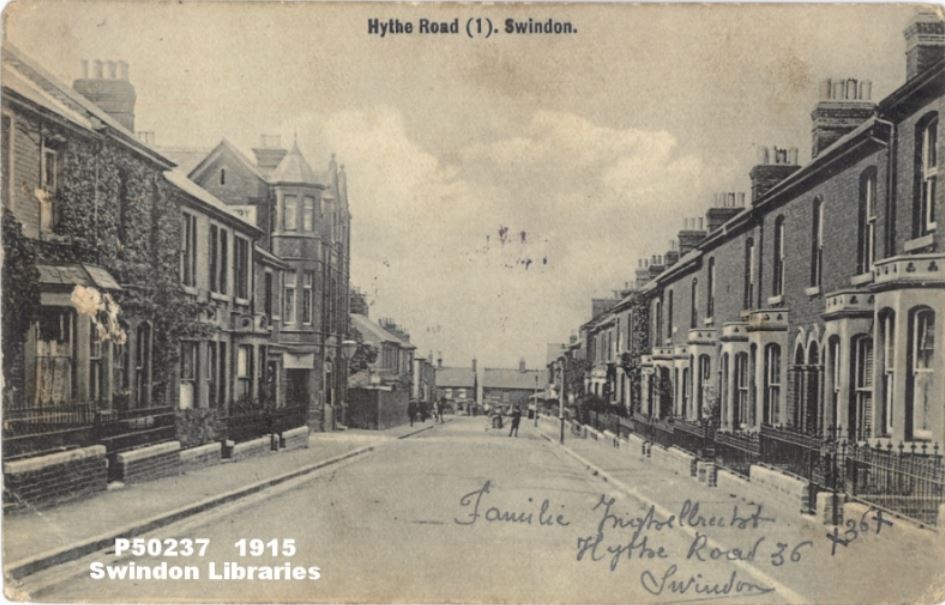
Hythe Road 1915 published courtesy of Swindon Local Studies

Friday January 3, 1908 proved to be a busy day for North Wilts Coroner Mr A. L. Forrester – Inquests in Swindon – Five on one day – A Record for the Borough. Three of the inquests took place at the Frome Hotel, Hythe Road. The first was described as ‘an extraordinary case’ and involved the sudden death of Mrs Ann Smith, aged 72 and some ‘remarkable evidence’ given by Eliza Adams during which she traded insults with the attending doctor, Dr Hirsch.

The second inquest was that of Charles Joseph Birchell, aged 25, a groom. Evidence was given by Frederick Goddard, 17, of Newport Street Swindon, who said ‘last Friday he was leaving his house, when he heard a pony gallop by. He looked along the house, and saw Burchell fall from the pony’s back. He ran to the spot and found Burchell unconscious. He picked him up and carried him into his (witness’s) house. Dr. Reid was sent for, and he on arrival ordered his removal to the Victoria Hospital. The pony did not stop, but galloped on up the street. Deceased lived at Prospect Villa, Wroughton Road.’

Dr J.C. Reid said on Friday last he was called to see deceased, who was suffering from concussion and laceration of the brain due to an accident. Burchell died at the Victoria Hospital on Wednesday evening as the result of secondary hemorrhage of the brain, owing to the shock caused by the accident.

The jury returned a verdict of accidental death.

Charles Joseph Birchell was buried in grave plot B2095, a public grave, on January 6, 1908, with three other unrelated persons.

The third inquest was into the sudden death of Charles Hillier, employed as a coachman by Captain T. Hooper Deacon, JP, of Kingshill House.

Hillier was waiting to convey his employer home after a New Year’s Eve party in Overton when it transpired that Hillier had fallen from the Brougham and died instantly.

A post mortem examination revealed that Hillier’s heart was “twice its ordinary size” and that he had died due to “valvular disease.”

Image published courtesy of Swindon Local Studies

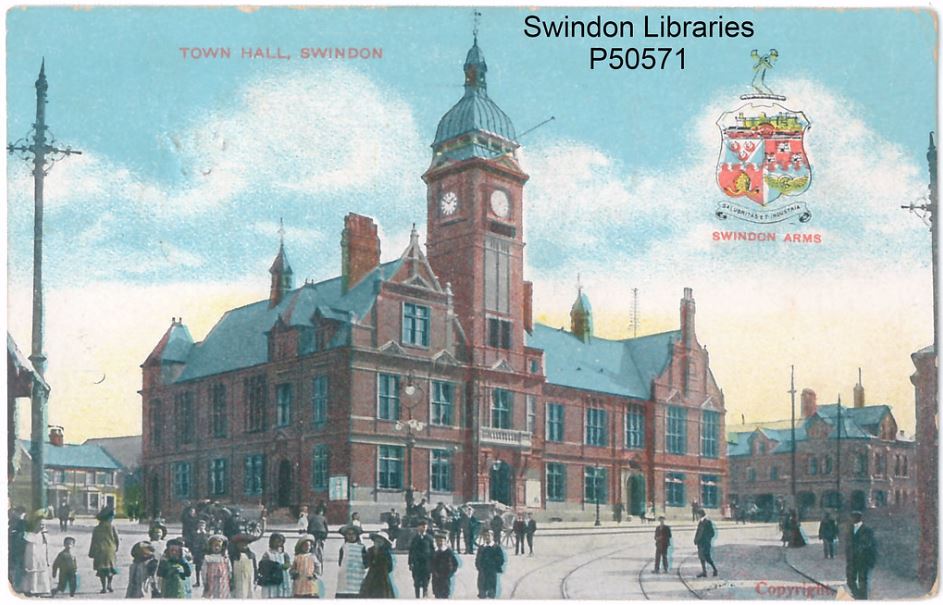
Coroner A.L. Forrester now headed off to the Committee Room at the Town Hall and the inquest of John Mason, aged 72.

A former railway labourer, John had suffered “a stroke of paralysis” some seven years prior to his death. Dr. Waters was called to John’s home in Byron Street. He pronounced “the cause of death was in his opinion, heart failure brought on by paralysis.”

John was buried on January 7, 1908 in grave A2470, a privately purchased family grave.

The final inquest on this busy day was that of Sarah Birch aged 83 who died peacefully in her sleep at her daughter’s home 46 Eastcott Hill. A verdict of “heart failure” was given.

No doubt Mr Forrester was pleased to have concluded the day’s business and returned to his home!

Joseph and Charles Williams – busy building Swindon

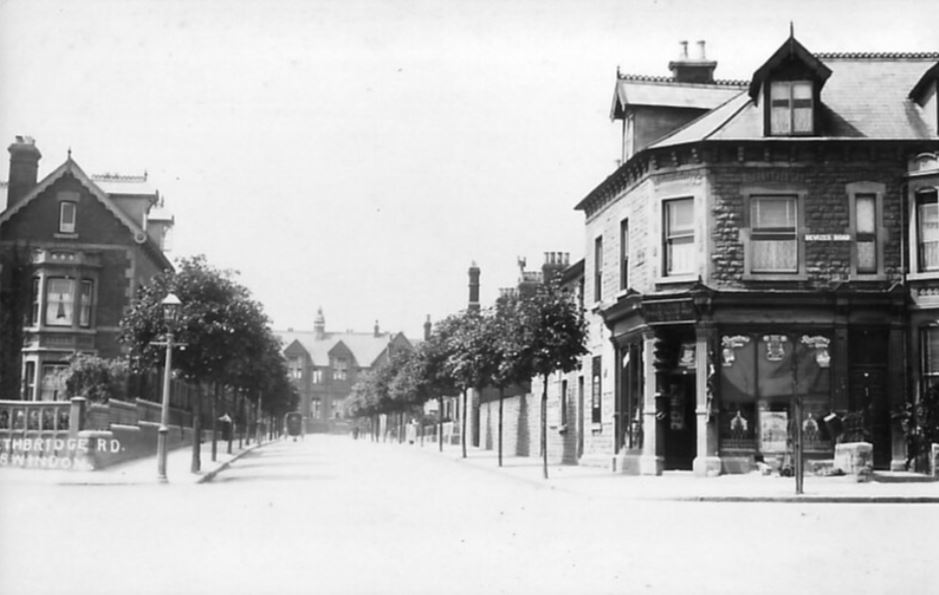
Lethbridge Road published courtesy of P.A. Williams and Local Studies, Swindon Central Library.

After a lifetime of hard graft, Joseph Williams had to face the humiliation of bankruptcy and the end of his business. Ultimately it proved too much to bear.

Joseph Williams was born in Shrivenham in 1841, the second son of Charles Williams, a carpenter and joiner, and his wife Lucy. He married Sarah Jane Painter at Christ Church on December 26, 1866 and the couple had two children, Frederick born in 1870 and Florence born five years later.

Joseph’s brother Charles combined two jobs, recorded as the licensee at the Dolphin, Rodbourne in 1881 but also working as a builder.

Both brothers worked hard, building their business, and building Swindon. By the 1880s both were well established. Elder brother Joseph was working in Stafford Street, Lethbridge Road, and Springfield Road. At the beginning of the 1890s he built more houses in Lethbridge Road, 17 in Albion Street and 22 in Morrison Street.

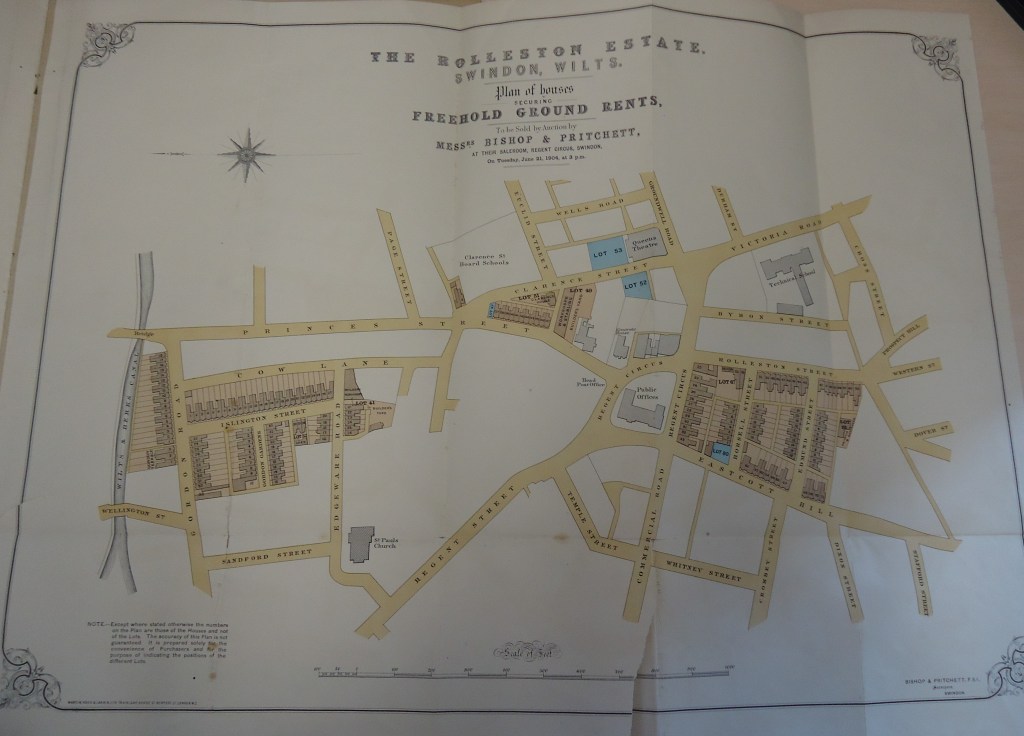
Charles was equally busy where he built 24 cottages in 1888 on the newly available Rolleston Estate. During 1897 he built a school in Euclid Street, 7 houses in St. Paul’s Street and 40 Houses in Redcliffe Street.

Perhaps the brothers were over ambitious. Perhaps they were not fully acquainted with their financial situation; too busy working.

In 1902 Charles built 28 houses in Morrison Street and in 1905 Joseph built 12 houses in Lansdown Road and that seems to be the end of the Williams’ building empire.

In 1906 Joseph sadly took his own life.

1904 map of the Rolleston Estate held in Local Studies, Swindon Central Library

Suicide of Mr Joseph Williams

Found Hanging in a Loft

Inquest and Verdict

Shortly before 11 o’clock on Friday morning a shocking discovery was made in a loft adjoining Clifton House, Devizes Road, [Lethbridge Road] Swindon, the body of Mr Joseph Williams being found hanging from a beam. Immediately the tragedy was revealed, Mr S.W. Filtness, who was engaged at his oil stores opposite, was summoned by Mr Williams’ daughter, and he at once proceeded to the loft and cut the body down, life being found to be extinct.

Mr Williams was missed for about half an hour. He had partaken of breakfast, and appeared as usual, and in cheerful spirits. After the meal he read his newspaper and shortly afterwards went out to fetch some wood. As he did not return, his daughter – Mrs Dismore – went to search for him. When the dreadful discovery was made, Dr. Lavery, who happened to be attending a case in Winifred Street, was called in and subsequently Dr. Reid, but they were only able to pronounce life extinct.

Needless to say, the news caused a good deal of sensation and spread with remarkable rapidity through the town. The deceased’s recent misfortunes have for some time been occupying general interest, and the incidents associated therewith had gained him the greatest sympathy. There is not the slightest doubt but that his mind had become seriously affected as the result of his troubles in this direction, and it will be remembered that prior to his examination in the Bankruptcy Court the state of his health was so distressing that he was compelled to leave the town to recuperate. He never completely regained his physical and mental strength, however, and, although his relatives had never heard him threaten to take his life, the news of his untimely end did not occasion absolute surprise amongst those who were painfully aware of his state of mind.

Mr Williams had resided in Swindon nearly the whole of his life, and, as a builder and contractor, was widely known and respected. He had, until latterly, led a very active life – in fact, his career had been one of hard work, with no indulgences, which makes his tragic end the more painful. Mr Williams has been responsible for many extensive contracts in Swindon and district, and was of course, a large employer of labour. Until within the last twelve months his upright, active and almost youthful bearing hardly betokened a man who had left three score years behind him. For the relatives of the deceased the deepest regret is felt.

Deceased, who is 63 years of age, was prominently connected with the Victoria Road Congregational Church, and was for many years a superintendent of the Sunday School.

The enquiry into the sad circumstances was held at the Fountain Inn, Devizes Road, on Friday afternoon. Mr Alfred Bowker was chosen foreman of the jury. Mr G.M. Butterworth watched the case on behalf of the relatives, of whom Mr C. Williams, deceased’s brother, was present. Supt. Robinson was also in attendance.

The formalities were of the briefest possible description, and the Coroner dispensed with his usual preliminary address to the jury.

Mrs Sarah Jane Williams was the first witness, and said: I live at Clifton House, No. 1 Lethbridge Road, Swindon, and I am the wife of the deceased, whose name is Joseph Williams, and his age was 63 last birthday. He was a builder and contractor. He has been ill for more than twelve months. At times he has been very quiet, and very depressed. He has never expressed the intention of doing harm to himself. He was perfectly well last night, and at breakfast time this morning, only depressed. He had been attended by a doctor, who saw him either on the previous Monday or Saturday.

Stephen William Filtness said: I was in a yard opposite to where Mr Williams lives, on Friday morning, when the deceased’s daughter, Mrs Dismore, came and fetched me about 11 o’clock. She asked me to see what was the matter with her father. I went into deceased’s workshop and up the ladder into the loft. I saw Mr Williams with the rope round his neck. He was suspended, and his feet were touching the ground. I cut him down, and went and found a policeman. Deceased was just warm, but I am quite certain he was dead.

P.C. Walter Shergold said: From information I received I proceeded to Joseph Williams’ loft I found the deceased lying on his back with a rope tightly round his neck. I slackened the rope round his neck and examined him to the best of my ability, and I found he was dead.

P.S. Buchanan said: From information I received I proceeded to the house where Mr Joseph Williams had lived. I found these papers written for his wife. I have read the papers.

Dr Charles Lavery said his partner (Dr. Rattray) had been in medical attendance upon the deceased for some time, chiefly for nervous breakdown. He never expressed any intention of taking his life.

The jury returned a verdict of “Suicide whilst temporarily insane.”

Extracts from the Faringdon Advertiser, Saturday, April 14, 1906.

Joseph was buried on April 11, 1906 in grave plot D1578. His wife Sarah Jane died in April 1929 aged 85 years and is buried with him. Their daughter Florence Mary Dismore joined them when she died in 1956 aged 80 years.

When probate was granted to his widow in 1919 Joseph’s effects were valued at £15.

At the time of the 1911 Charles Williams, Joseph’s brother, appeared living at the County Ground Hotel with his son, another Charles, who was the Hotel Proprietor. Charles was 62 and still describes himself as a builder. He lives with Mary, his wife of 43 years and the couple declare that of their five children, Charles (the hotel proprietor) is the only one still living.

Diana Dors and the Fluck family

Witty, outrageous Diana Dors provided the media with a whole raft of risqué quotes. Born in Swindon in 1931 she went on to become our very own blonde bombshell, Britain’s answer to Marilyn Monroe. She was bold and brassy and lacked the vulnerability of Marilyn Monroe and sadly, today her sleazy lifestyle is better remembered than her considerable acting ability. But it could be said that Diana like Marilyn was a product of her success and the men who used and exploited her during a lucrative career in the 50s and 60s.

24th October 1953: Film star Diana Dors (1931 – 1984)

She seldom returned to Swindon having left the town behind and following the death of her parents there remains little trace of Diana. Or does there?

Diana’s mother, Winifred Maud Mary was born in Chewton Mendip, Somerset in 1890, the daughter of Mercy Georgina and Elijah Payne. Her first husband, William George Padget, was killed in action in 1916 during the First World War. In 1918 she married for a second time. Albert Edward Sidney Fluck was a railway clerk in the GWR Works. Their only child, Diana Mary Fluck, was born in a nursing home in Kent Road and grew up in a house in Marlborough Road. Her ambition to act, sing and dance became apparent at a very early age and was encouraged by her mother. Her precocious beauty and ambition saw her enrolled at the Academy of Music and Dramatic Art at just 14 years old. Diana would later say:

“They asked me to change my name. I suppose they were afraid that if ‘Diana Fluck’ was in lights and one of the lights blew …” A classic Diana quip. The surname Diana chose was her maternal grandmother’s maiden name, Dors.

Diana’s father Albert Edward Stanley Fluck was born on October 10, 1893 in Swindon and baptised on November 12 at St. Mark’s Church, Kingsholm, Gloucester, the church in which his parents had married in 1892. His father Albert Edward Fluck was a railway clerk and had moved to Swindon in around 1889 and can be found lodging with the Jones family at 40 Oriel Street at the time of the 1891 census.

November 1968: Diana Dors (1931-1984) with her husband Alan Lake in a car after their wedding. (Photo by Keystone/Getty Images)

By 1901 the Fluck family were living at 11 Poulton Street, Gorse Hill – Albert E. Fluck 35 a clerk at the GWR Works, Ada 34 and Albert E.S. aged 7. Lodging with the family was George J. Sarwell 37, a Church of England clergyman.

Albert Edward Fluck died on January 24, 1907 aged 40 years. His funeral took place on January 30 and he is buried in Radnor Street Cemetery in plot C1800.

The area in which grave plot C1800 is located

Ada went on to marry widower Albert Ausden a scaffolder employed in the GWR Works. At the time of the 1911 census the family were living at 19 Cambria Place with Albert’s three children Rupert, Florrence and George and her two children Albert, then aged 17, and Gweneva Fluck 7.

Ada died in 1948 aged 81 years and is buried with Albert Fluck in plot C1800. Their daughter Gweneva died in 1966 and is also buried with them.

There does not appear to be a headstone on the Fluck family grave. Probably back in 1907 there was not the money to pay for one. I suspected their granddaughter Diana Dors probably had something big and showy, but surprisingly she hasn’t. Diana died in 1984 aged 52. She was buried in Sunningdale Catholic Cemetery. Her third husband Alan Lake took his own life just five months later. He is buried alongside her and the two have identical headstones.

Image published courtesy of Dizi Daisy

The rebellious John Riley

The re-imagined story …

Some said John Riley was an intimidating character, but I never found him so. Yes, after a drink or two he could get a bit lairy, but I knew how to handle him. I suppose I had a bit of insight into what he had been through.

I don’t think anyone came back from the war the same person they had been before it. I’d argue with anyone who said they hadn’t known fear, hadn’t seen sights that made their stomach churn, done things that haunted them.

John Riley had known a fear and a horror the like of which few experienced and the only way to blot it out was to drink.

Aged just twenty, John had left the safety of a job as a storeman in the Works to join the army and have an adventure. Mostly all John saw were the bowels of the earth, like a rat in a sewer.

John liked to drink and he liked to gamble. His life was one big gamble. Would he be blown to pieces or buried alive? Would it happen today or tomorrow? The odds weren’t good.

DSC07150 - Copy

The facts …

John had little time for military protocol, he was outspoken and insubordinate and for this he was awarded Field Punishment No. 1. Sounds pretty innocuous, doesn’t it, but it was a torture metred out to rebels, those who wouldn’t abide by regulations. It was used to set an example to others who baulked at military discipline.

In September 1917 John went missing. He was absent while on active service for 34 hours and 55 minutes, and was charged with breaking out of camp at 9.30 pm on September 14 and breaking back in at 8.55 am on September 16. His punishment was to forfeit three days pay and 14 days Field Punishment No. 1.

So, what was Field Punishment No 1? The soldier found guilty was placed in fetters and handcuffs (sometimes spread eagled in a form called ‘crucifixion’) and tied to a fixed object such as a gun wheel or fence post, for one hour in the morning and one hour in the afternoon. Although this punishment was supposed to take place behind the front line in a field punishment camp, it was sometimes applied within range of enemy fire. When a unit was on the move, the unit itself would administer the punishment.

It wasn’t the first time John had been so punished. In September 1915 he had been ‘awarded’ as if it was an honour, 96 hours Field Punishment No 2 for “when on active service missing 8 am parade.” Field Punishment No 2 was a lesser punishment and involved the prisoner being placed in fetters and handcuffs, but not attached to a fixed object. Both sentences included hard labour.

In the summer of 1918, he was sentenced to 7 days Field Punishment No 1 for ‘misconduct’ on 24 August and on 31 August he received a further 7 days Field Punishment No 1 for leaving the lines without leave and missing a Medical Board as a consequence.

And a final insult, 12 days after the guns were silenced, John was demoted to Private by his Commanding Officer for “Neglect of duty.”

John’s audacious and fearless attitude, the qualities that made him a good tunneller, were the very characteristics that frustrated his Commanding Officers.

No one was more surprised than John when he survived the war and returned to the same job in the Works that he had left behind in 1914.

Did he enjoy the security, the safety, the daily routine? Surely, he didn’t miss the claustrophobia of the tunnels.

When John enlisted it was for three years or the duration of the war. It turned out to be a life sentence.

This image has an empty alt attribute; its file name is cemetery-view-3.jpg

View across Section C where Edwin John Riley is buried.

(Edwin) John Riley was born c1895 in Rodborough, Gloucestershire, the only one of John and Sarah Jane’s three children to survive to adulthood. By 1901 the family had moved to 11 Folkestone Road, where John’s father worked as a builders’ plumber.

As a sixteen-year-old John worked as a fishmonger but by 1913 he had secured a job as Storeman in the Works

John enlisted in the 1st Battn Grenadier Guards at Caterham on December 19, 1914, aged 20 years and 34 days. His military records reveal that following eight months service at home John joined the Expeditionary Force in France from August 11, 1915 until January 10, 1918. By May 1916 John was attached to the 177th Tunnelling Coy RE (Permanent) Authy. For more information about the work of the tunnelling companies and the 177th see https://en.wikipedia.org/wiki/177th_Tunnelling_Company.

He married Daisy Sweeper in 1919. John was discharged on demobilization on March 31, 1920 and their daughter Stella was born in 1922. A second daughter Jose was born in 1927.

In 1939 John was working as a Stores’ Issuer in the Railway Works and living in Harcourt Road, Gorse Hill with Daisy and their two daughters Stella and Jose.

Edwin John Riley died in October 1945 and was buried in plot C1678 on October 16.

cemetery view