Serious Accident at Racing Stable

The re-imagined story …

It was usually the wind that caused the horses to be skittish but that early morning in June there was not so much as a breath of air. Brayhead, a handsome chestnut stallion, was looking agitated as Tom led him out of the stable into the yard. Most of the horses were already on their way to the gallops on Russley Downs, but I held back.

Tom was an experienced stable lad and perfectly capable of handling the horse, but I was just a little concerned. Brayhead was edgy, stepping backwards in circles each time Tom tried to get into the saddle. Eventually he was up and slipping his feet into the stirrups.

“A bit frisky today,” he laughed as he pulled on the reins to guide the animal’s head in the right direction. I followed behind as we joined the string of racehorses heading out across the Wiltshire countryside. Once on the open downs Brayhead took off in an explosion of speed. I wondered if Mr Robinson had noticed.

On our way back to the yard I noticed the horse was sweating profusely, yet the exertion had failed to exhaust him. In fact, quite the opposite and Tom continued to have difficulty keeping him under control.

Again, I was at the rear of the string of horses returning to Foxhill House. It was normal practice to take them to their stable and rub them down after their exercise, but when I arrived back at the yard the other horses and riders were being led into the paddock.

I could hear Brayhead snorting and stamping in his stable, but otherwise it was eerily quiet in the yard, despite the number of people gathered around the figure on the ground.

Tom died from his injuries three days later. Afterwards, I wished I had voiced my concerns that morning, approached Mr Robinson, done something.

liddington-castle

views across Liddington Castle, Wiltshire.

The facts …

 Serious Accident at a Racing Stable – On Monday morning an accident which proved to be of a serious nature occurred at the well known Foxhill Stables at Lydington, near Swindon. It appears that while the horses were out for their morning exercise Mrs Langtry’s Brayhead started rearing, and fell back on a lad named Tom Whiteman. Assistance was soon at hand, but it was easily visible that a serious accident had happened. Dr J. Campbell Maclean, from Swindon, was sent for, and his assistant (Dr. C. Carew Webb) was soon at the stables, and made an examination, which proved that the lad was suffering from a fractured pelvis, and was badly injured in the abdomen. He ordered his removal to the Swindon Victoria Hospital. The patient lies in a very dangerous condition, and his recovery is not expected.

The Warminster and Westbury Journal Saturday June 17, 1899

Brayhead was a chestnut stallion owned by the actress Lillie Langtry. Mrs Langtry is remembered for her numerous affairs, most famously with Albert, Prince of Wales (later Edward VII) and Prince Louis of Battenberg.

Mrs Langtry owned a number of racehorses, purchased under the name of Mr Jersey. In 1899 the five-year-old Brayhead was one of several horses in training with William ‘Jack’ Robinson at Foxhill. Wiltshire.

Tom Whiteman 39, died in the Victoria Hospital on June 15. He was buried two days later in Radnor Street Cemetery in plot C1237, a public or pauper’s grave, with five other unrelated people.


Foxhill 3


Mr W.J. Robinson and the Foxhill stables – published courtesy of the Illustrated Sporting and Dramatic News, March 11, 1899.

Joseph Robert Pinchon 14, fatally injured

When James Pinchon completed the 1911 census form he was required to state next to his wife’s name the number of years they had been married, how many live births she had had, how many children were living and how many had died. At the time of the 1911 census James and Ann lived at 1 Cyrus Cottages, Rodbourne Cheney. James was 69 years old, a retired Herald Painter (i.e. a coach painter). Ann was 70 years old, an old age pensioner. James and Ann had been married for 46 years. They had had 8 children of whom 2 were still living and 6 had died. One of those children was Joseph Robert who aged 14 had sustained fatal injuries in an accident in the Works.

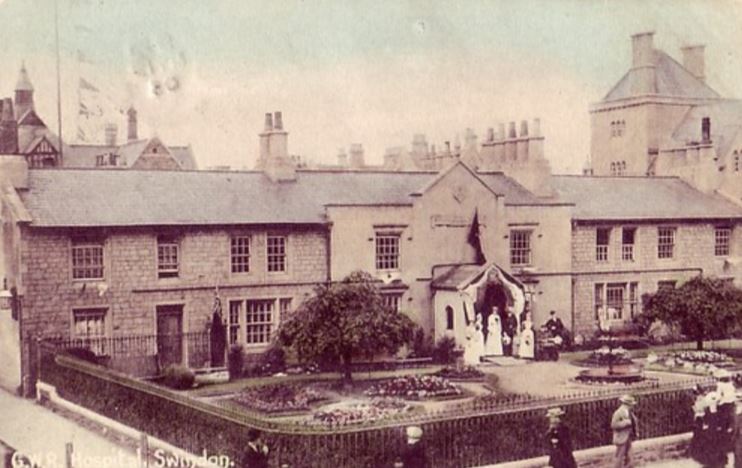
Much has been written about the GWR Medical Fund, a health care system established in 1847 and credited with informing the foundation of the NHS a hundred years later. The Accident Hospital was opened in 1872 in a building which had previously been the drill hall and armoury for the XI Wiltshire Volunteer Rifle Corps. The new hospital had four beds, an operating room, a bathroom, a surgery, a mortuary and accommodation for a nurse in an adjoining cottage.

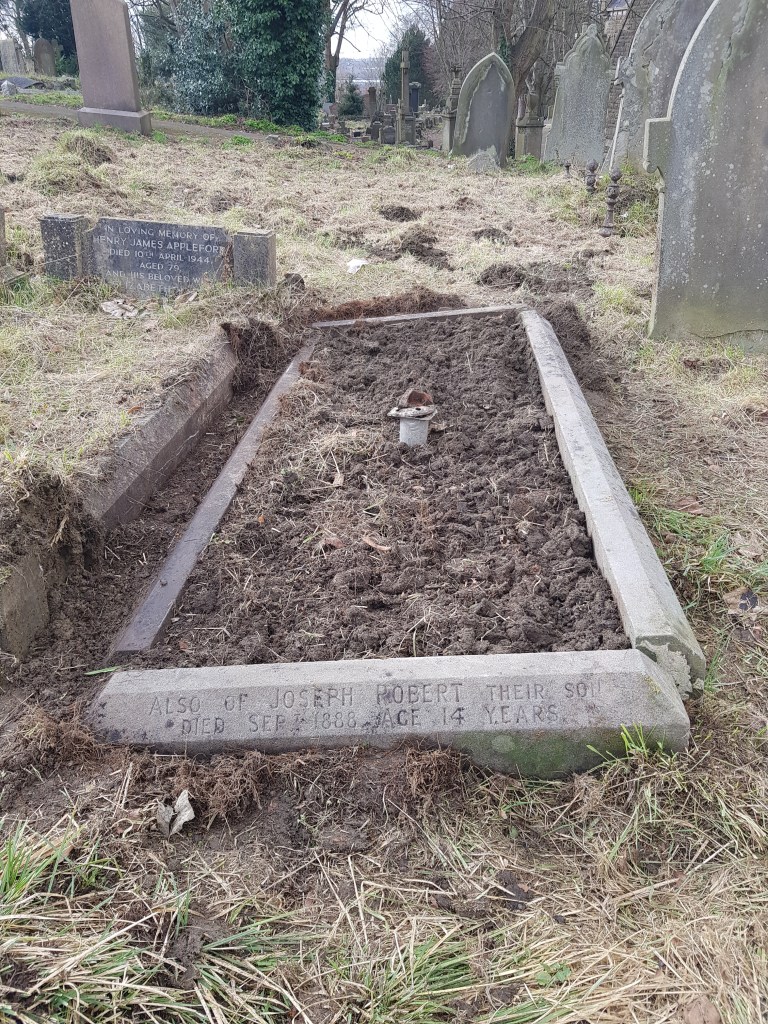
Following the accident, Joseph Pinchon’s workmates carried the boy to the nearby Accident Hospital where he died ten hours later. Joseph Robert Pinchon of 16 Reading Street was buried in grave plot E8072 on September 25, 1888.

Medical Fund Accident Hospital – image published courtesy of Local Studies, Swindon Central Library.

Fatal Accident in the GWR Works – On Thursday morning in last week a sad accident happened to a youth named Joseph Pinchon, residing in Reading Street, New Swindon. He was working in the brass finishing shop in the GWR Works, and had occasion to go to the carriage department. In attempting to pass between two tracks of a train which was engaged in shunting operations, the buffers caught him in the chest and back and severely crushed him. He was immediately picked up and conveyed on a stretcher to the GWR Medical Fund Society’s Hospital, where he lingered till midnight and then expired.

On Saturday morning Mr Coroner Browne held an enquiry into the cause of the death of deceased, at the Cricketer’s Arms, New Swindon. Mr J. Bradbury was chosen foreman of the jury. Mr W. Mole represented the GWR Company.

James Pinchon, father of deceased, said his son was 14 years of age, and had only been employed in the Works two or three months. Dr. Cleveland (Messrs Swinhoe, Howse and Bromley), stated that death was due to internal injuries accompanying collapse.

Walter Martin, shunter in the Works, stated he was engaged in shunting operations when the accident happened. When the coaches were about two yards apart he saw deceased attempt to pass between them. It was impossible to stop the coaches when he saw deceased. – The jury returned a verdict of “Accidental Death.”

Swindon Advertiser, Saturday. September 29, 1888.

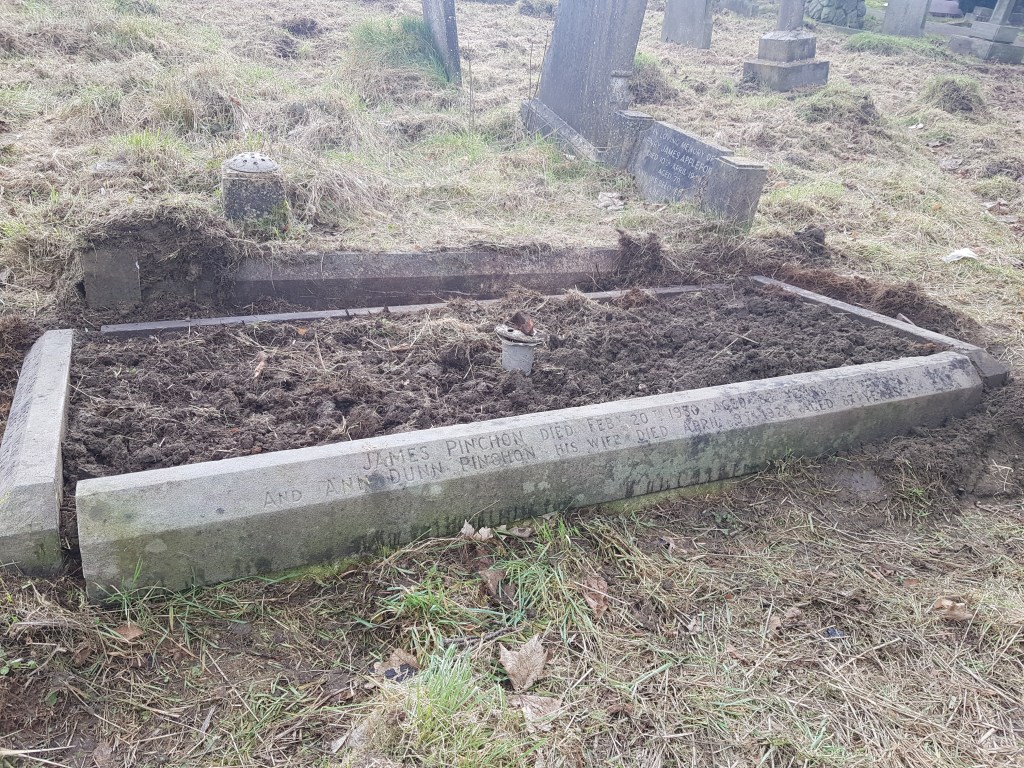
Our volunteers have revealed the Pinchon family grave. Young Joseph Robert was the first to be buried in this plot and it is likely there was no permanent memorial at the time of his death. The kerbstone would appear to have been erected after the death of his parents with an inscription which included his details. Ann died at her home in Rodbourne Cheney in 1928 aged 87 years. James died in 1930 aged 88 years. They were both buried with their young son who had died some 40 years earlier.

The enterprising Westall and Lafford families

Shirley and her friend have been joining our cemetery walks for several years but it wasn’t until we all met at a recent Swindon Society Open Day that Shirley elaborated on her family history, telling us about her hard working parents Maud and Stanley and their Westall and Lafford families. And at our subsequent cemetery walk Shirley brought along some precious family photos.

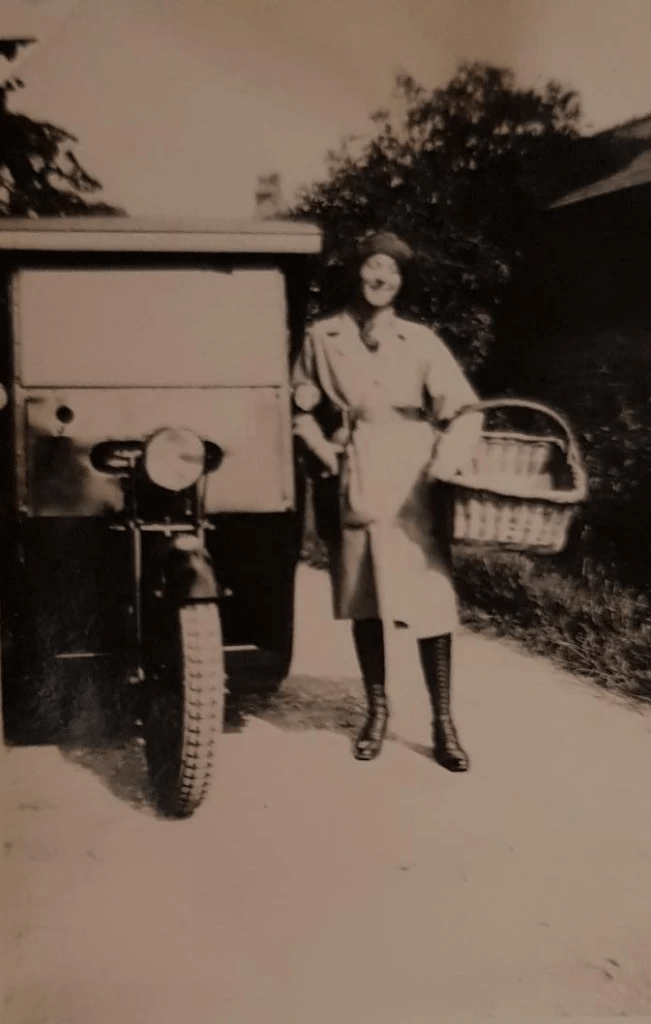
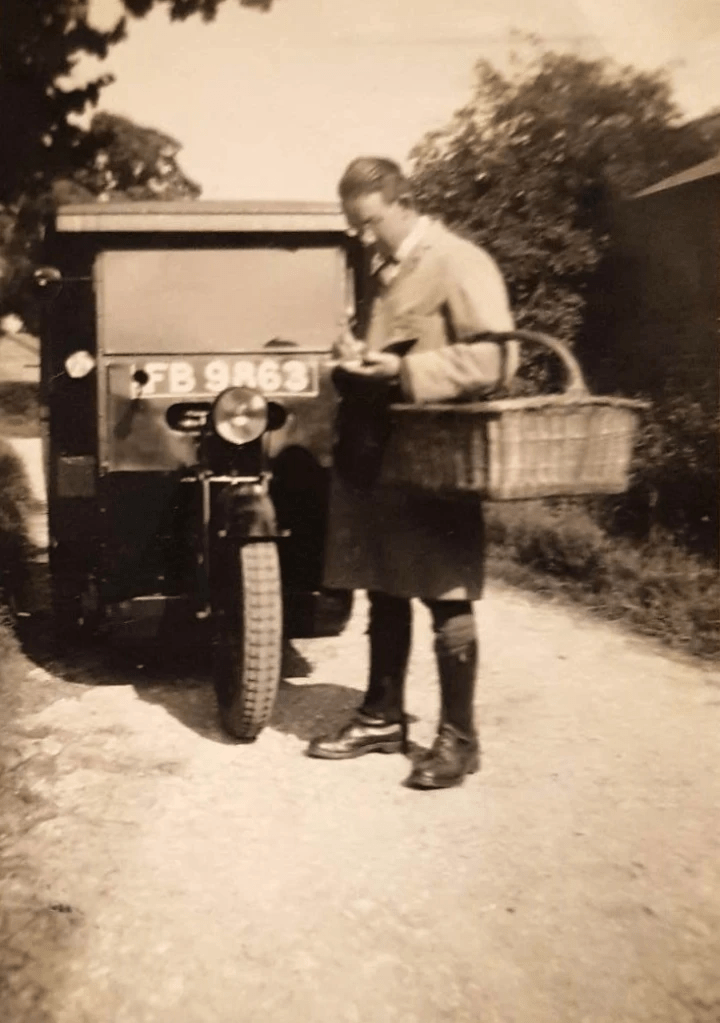
Maud and Stanley Lafford ran a shop in County Road on the corner of Gambia Street, with their front room at 142 Clifton Street doubling as a storeroom. Here is a photo of Maud standing outside the shop. The couple are both pictured with their delivery van, which was actually a chassis built over a motor bike. Stanley used this vehicle to deliver to the surrounding villages. He also collected slabs of ice in this vehicle which Maud used to make ice cream. Stanley then had deliver it pretty smartish to the ice cream parlour in Old Town.

Shirley’s grandparents David Lafford and Susan Clara Page were married in Barnsley, Gloucestershire in 1902. Sadly, their first child Clara born in Durrington, Glos on February 6, 1905 died just 2 days later. By 1907 the couple had arrived in Swindon where David worked as a carpenter and the family lived at 126 Clifton Street where their children Stanley, Alfred and Ivy grew up.

Among the family photos is a tiny image of Shirley’s other grandparents, James Westall and Annie Day.* In about 1911 they moved from Hereford to Swindon with their daughter Maud. In 1912 they were living at 22 Omdurman Street when they had their 2nd daughter Edna Muriel baptised at St. Barnabas Church, Gorse Hill.

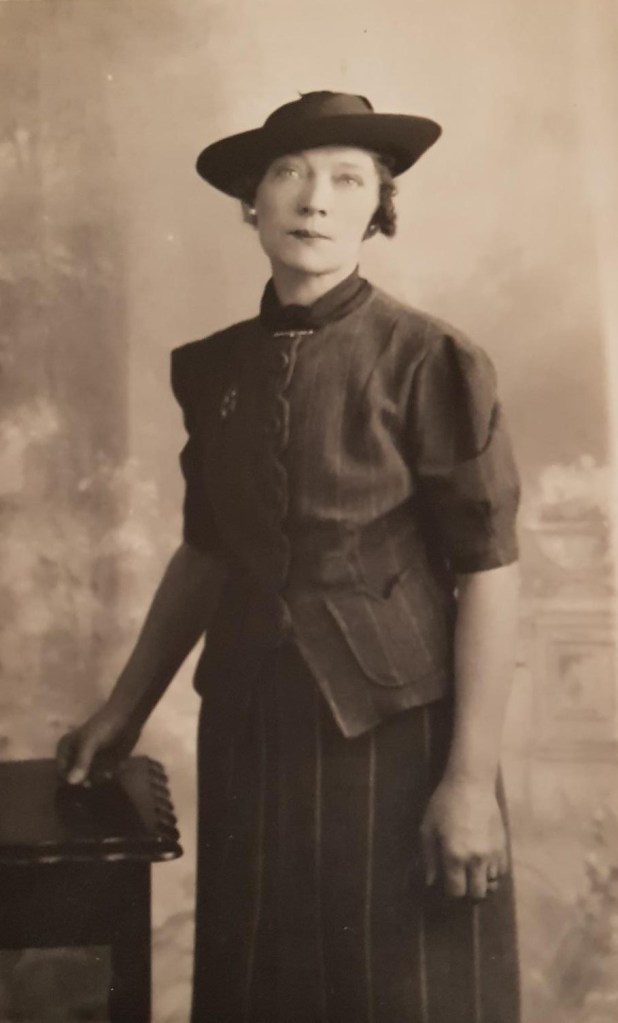
There is another precious photo of James and Annie Westall with their three young daughters -Maud standing, baby Mavis on her mother’s lap and Edna Muriel seated on the left of the photograph. Edna died aged 6 not long after this family photograph was taken. Shirley remembered her grandmother had an enlargement made of the section with the pretty little girl with bows in her hair. In amongst the family photographs there is also one of the elegant Annie Westall.

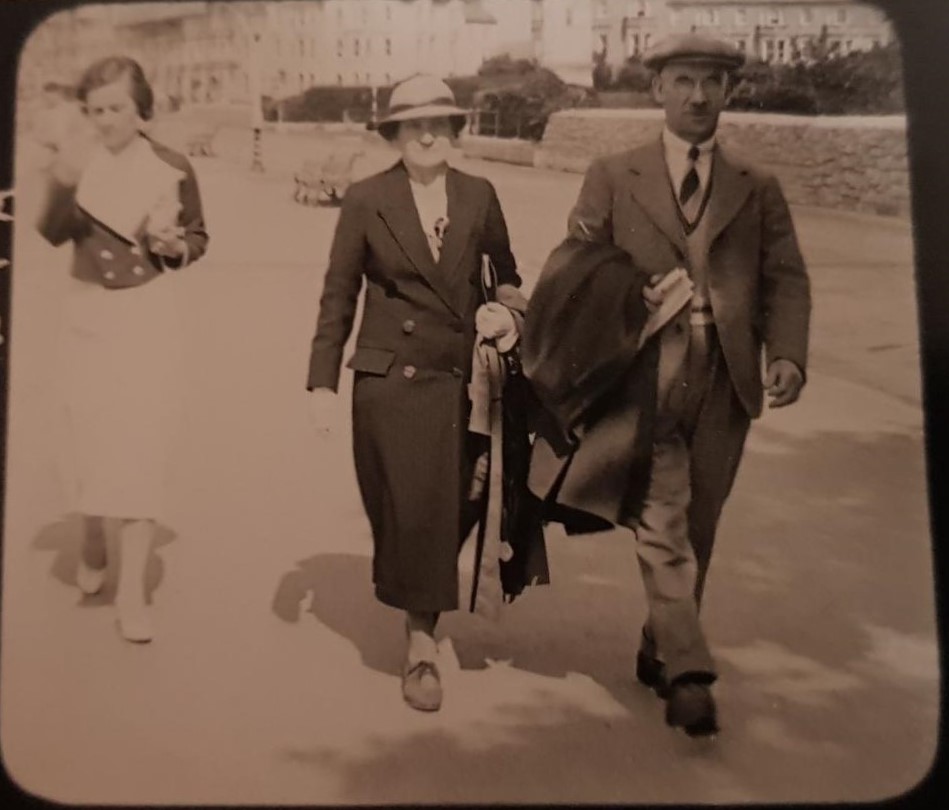
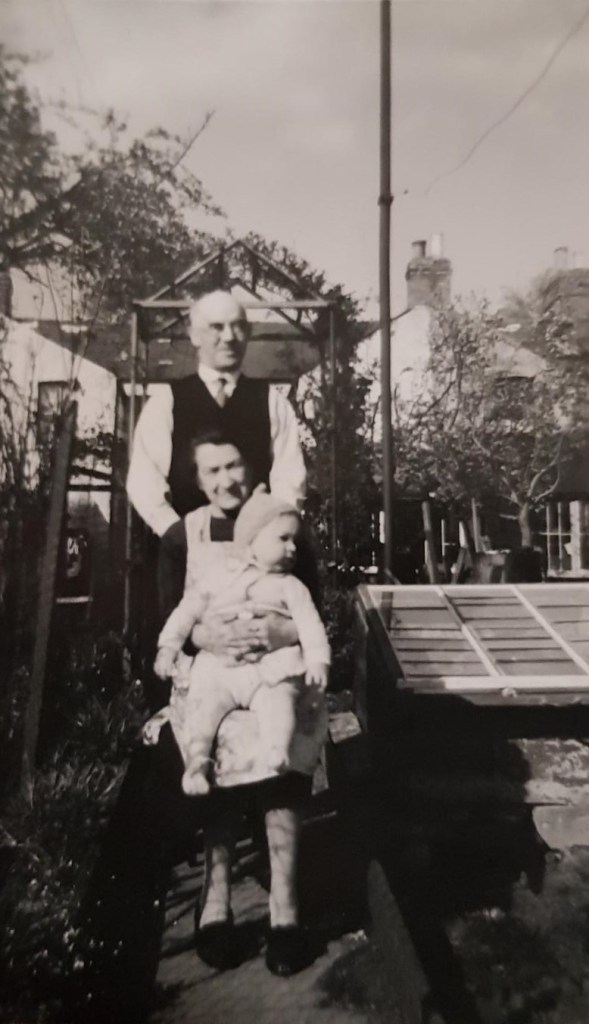
Young mother Susan Lafford is pictured with her baby son Stanley on her lap while a much later photograph shows David and Susan Lafford, possibly on a seaside promenade. There are even photographs where Shirley herself makes an appearance in the back garden at 126 Clifton Street.

Shop corner of Gambia Street

Maud Lafford nee Westall pictured in 1932

Stanley Lafford

Stanley Lafford

James and Annie Westall nee Day*

James and Annie with their three daughters, Maud standing, baby Mavis and Edna seated

Annie Westall

Susan Lafford with baby Stanley – 126 Clifton Street

Susan and David Lafford

Susan and David Lafford with Shirley

Susan and David Lafford with Shirley

Both sets of Shirley’s grandparents are buried in Radnor Street Cemetery. Shirley remembers as a child visiting the cemetery with her aunt and seeing the grave of James Westall where a wooden cross once stood.

James Westall died aged 49 years in the Isolation Hospital. He was buried on May 26, 1934 in graveplot C3553 with his little daughter Edna Muriel who died in 1918. The glamorous Annie died in 2002 aged 91 and is buried in the same plot.

Susan Clara Lafford died aged 73 in 1951 and was buried in grave plot E7850 where David joined her in 1955.

*This small format portrait looks to be an example of a so-called “stickyback” photograph produced c1915 at a studio at 15 Regent Street. These photographs had a gummed back and were cheaper than others available at the time. Swindon Photographers & Postcard Publishers by Darryl Moody and Paul A. Williams.

James Prater – bootmaker

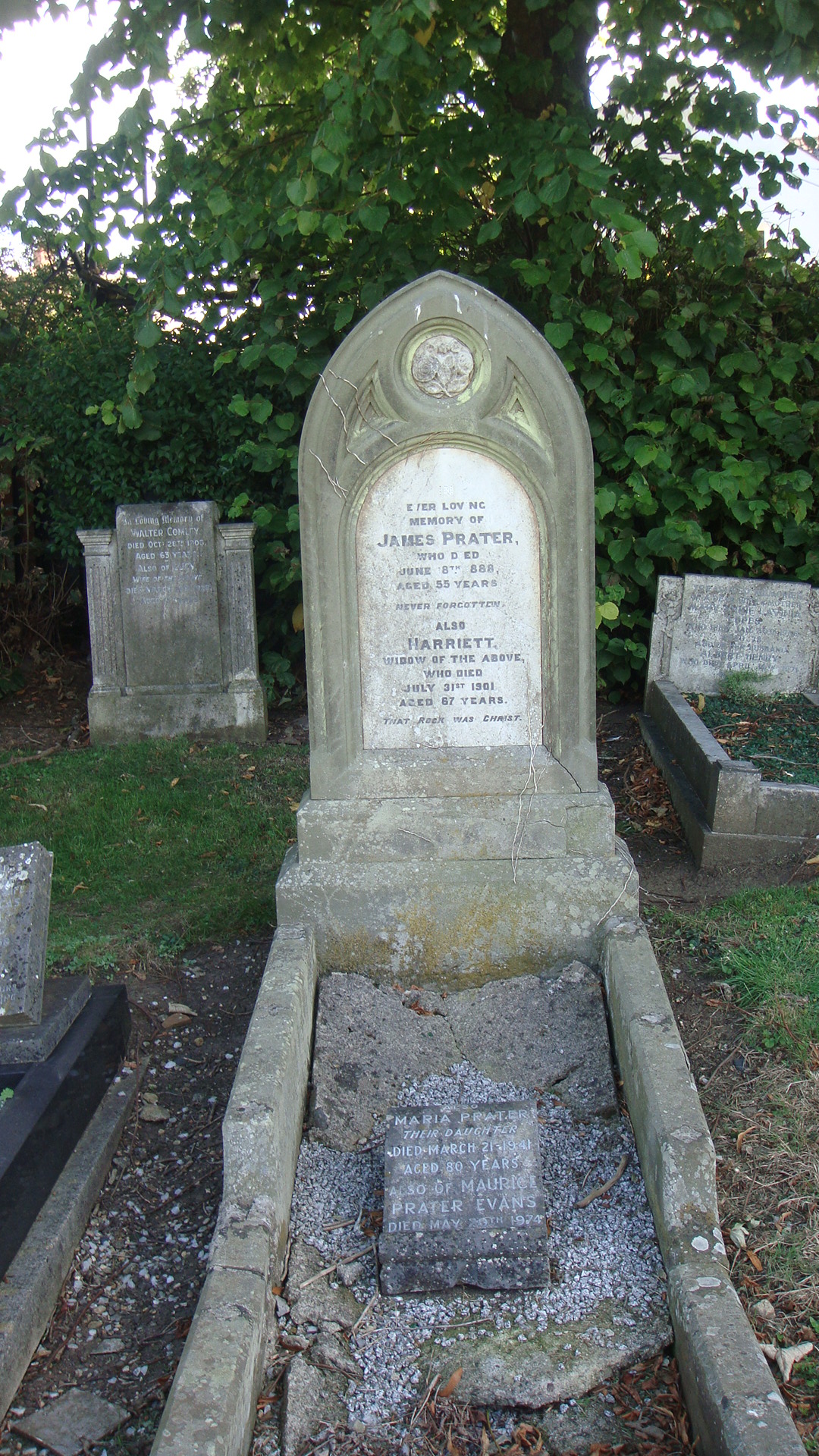
DSC07142

Supposed Suicide – An inquest was held on Wednesday evening on the body of Mr James Prater, found that morning in the Coate reservoir. Mr Prater for many years carried on a good business in Old and New Swindon as a bootmaker, and for some time past has lived retired. During the past three weeks he has been somewhat strange in his manner. On Saturday he accompanied his wife shopping and whilst she was in a shop he suddenly disappeared. His dog, which was with him, returned home on Monday. On Tuesday deceased’s hat was found on a bush by the side of the reservoir, and the next day his body was found in the water near. – The jury returned a verdict of found drowned.

Wilts and Gloucestershire Standard, Saturday, June 23, 1888.

James Prater Personal Estate £745 2s 10th August 1888

The Will of James Prater late of 47 Cheltenham Street New Swindon in the County of Wilts who died 18 June 1888 at Coate in the Parish of Liddington in the said County was proved at Salisbury by Maria Prater Spinster the daughter and Harry King Noble Railway Clerk both of New Swindon two of the Executors.

James was buried on June 13, 1888 in Radnor Street Cemetery plot E8587. He shares the grave with his wife Harriett who died in July 1901, his daughter Maria who died aged 80 years in March 1941 and Maurice Prater Evans. Maurice was the son of Caroline A. Gunnell, the Prater’s granddaughter, who lived with her grandmother at 47 Cheltenham Street. Maurice’s funeral took place on May 29, 1974.

James Prater

The story of school friends Julia Ann and Dawn

Julia Ann Barnes and Dawn Rose were best friends and next door neighbours. That day in March 1963 the two girls were excited – they had a birthday party to go to. The school bus stopped at the junction of Wolsesly Avenue and Thornbridge Avenue where the girls jumped off and ran behind the bus to cross the road. They were struck by a school bus travelling in the opposite direction.

The news of their deaths reverberated through the Park South community and 60 years later is still remembered by one of the families who lived on that road.

In 1962 a series of articles in the Evening Advertiser featured families who had made their homes here in Swindon during the town’s expansion programme. George and Violet Phillips, who had moved from Bermondsey, South London, were interviewed. They spoke about how much they enjoyed living in Swindon, however, Violet said: “My only grievance is the schooling.”

Park South was built during the 1950s but by 1962 the area was still without a designated school and children were bussed to schools outside the area. The Phillips’ young daughter Cheryl aged 7 was one of those children ‘bussed’ to King William Street School in Old Town and George was concerned for her safety. As a member of the Park South Tenants Association George campaigned for building work to begin on a school in the area – and he took his concerns higher – first to the Mayor of Swindon and the Education Committee and then to Francis Noel-Baker, Swindon MP and eventually to the Minister of Education when members of the Park South Residents Association delivered a petition to the House of Commons.

It was anticipated that Park South Infants School would be ready for use by August 1963 and the Junior School a year later – but tragedy struck before then.

In June 1963, following the deaths of Julia Ann and Dawn, George made an official request that his daughter be transferred from King William Street School to Lawn Junior. He then withdrew his daughter from school in protest. George faced a hearing held by the Child Care Sub-Committee with the threat of a possible prison sentence if he did not return his daughter to school. But the campaign waged by George Phillips and the Park South Tenants Association did see changes implemented on the schools transport service. Children were accompanied and supervised on the buses; bus stops were relocated and a warning notice ‘Caution Children Alighting’ was displayed on the back of the vehicles.

Angie Phillips writes: “Ironically, even when the Park South Infant and Junior Schools were completed, our house, being in Thornbridge Avenue was not in the catchment area and all the children in our house subsequently attended Lawn Junior School … but not by bus!”

Julia Ann aged 6 and Dawn 5 and 1/2 were buried on March 20, 1963 in a joint funeral service; their graves side by side with identical memorials.

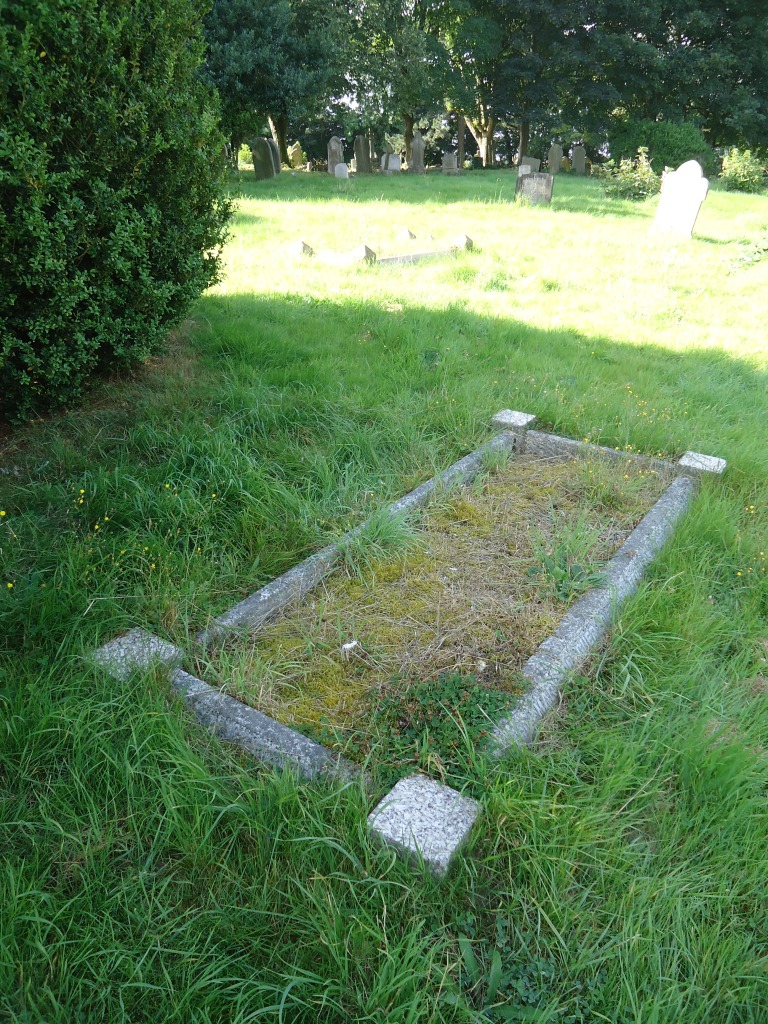
Unfortunately, the graves had become overgrown in recent years but in the autumn of 2023 cemetery volunteers Kevin and Jonathan cleared and tidied them up. It is the wish of the Phillips’ sisters Cheryl, Gina and Angie that the story of the two young friends is remembered and today they regularly attend the graves.

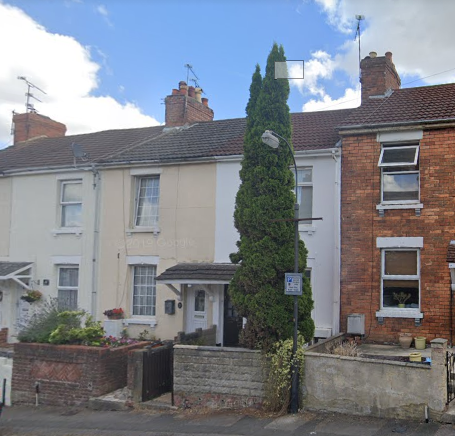
Florence Villa

Florence Villa

The re-imagined story…

My granddaughter is calling her new baby daughter Florence. I love it that all the old names are coming back into fashion.

Did you know that Florence Nightingale was named after the Italian city? I always wanted to travel to Florence; to walk the medieval roads and cross the Ponte Vecchio; to offer up a prayer inside the Cathedral of Santa Maria del Fiore; to stand before Botticelli’s Birth of Venus in the Uffizi Gallery. Oh my! Such a romantic city. I was lucky to have a week in Weston every summer as my parents reminded me when my imagination got the better of me.

There wasn’t a lot of romance to be found growing up in post war Swindon. The closest I ever got to Florence was a house up the road from ours called Florence Villa. This was not an example of Renaissance architecture but a modest little red brick terrace property like all the others in Swindon Road. I used to wonder if the house was named in honour of a pilgrimage to that beautiful city, or maybe one that never came to fruition, like mine.

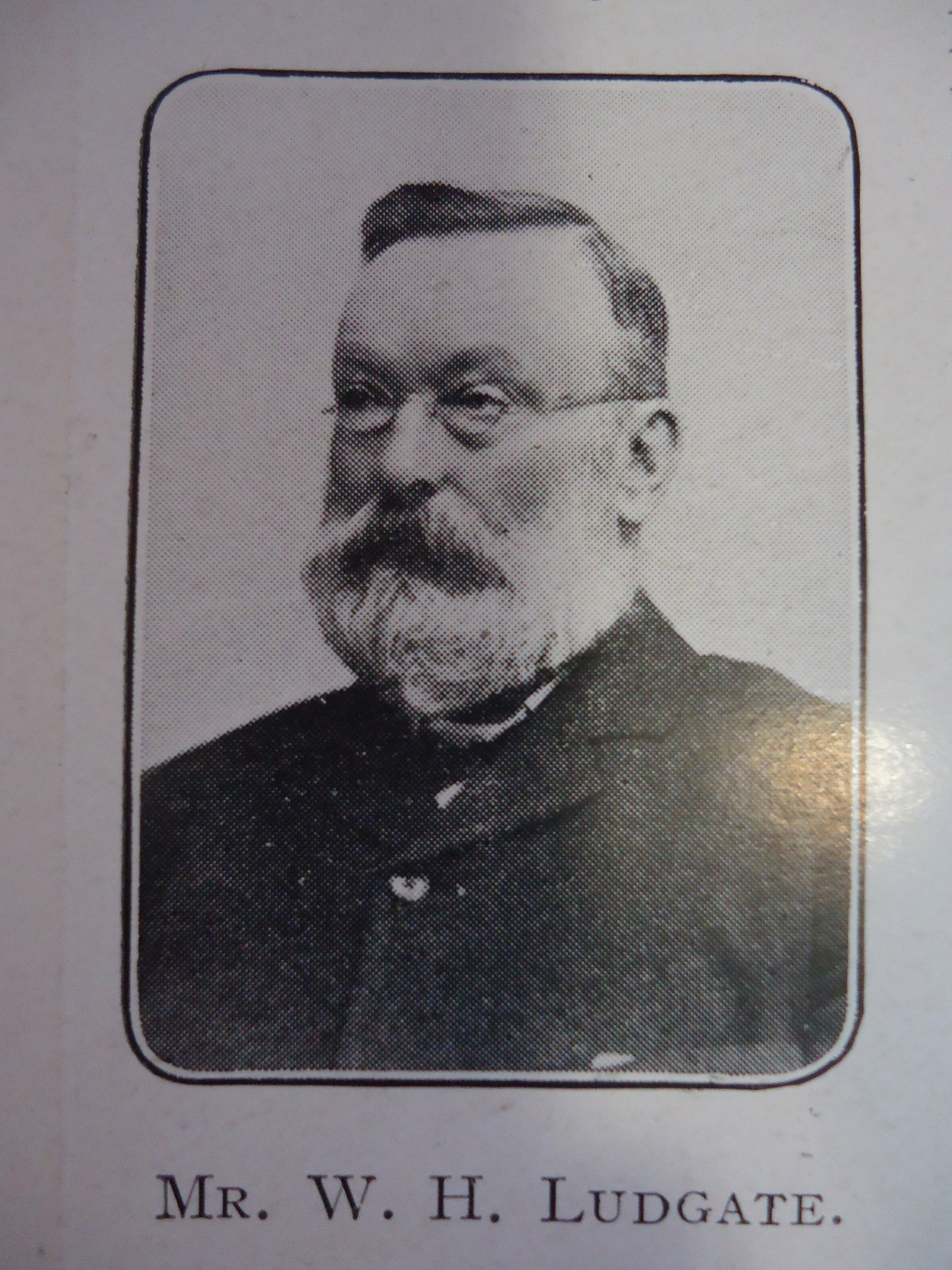
I later discovered it was the home of a senior official in the GWR Works, Mr William H. Ludgate, who had named his home in honour of his daughter Florence. Florence Ludgate lived in Florence Villa with her parents until her father died in 1921. By the time I grew interested in the house she was long gone but no one seemed to remember what had become of her.

I’ll suggest my granddaughter names her home after her new baby. Perhaps in years to come someone will speculate on the naming of a 21st century urban property. I wonder what our little Florence will achieve in her lifetime? What places will she visit? Perhaps she’ll fulfil my dream and visit her namesake city. More than anything I hope her story will live on, and that she will not be forgotten like Florence Ludgate.

DSC07555

The facts …

William Homan Ludgate was born in Fermoy, Ireland in 1833, the son of Robert Hooper Ludgate. He married Caroline Hill, the daughter of inn keeper George Hill, at St John the Baptist Church, Gloucester on December 2, 1857.

By the time of the 1861 census William and Caroline were living at 7, Bellwood Place, Swindon where Caroline’s sister Jane was staying with them.

The couple had two surviving children, William George born in 1864 and Florence born in 1873. According to the 1911 census Caroline states that a third child had been born and died by that date.

By 1891 the family were living at Florence Villa, Swindon Road, their home for more than thirty years.

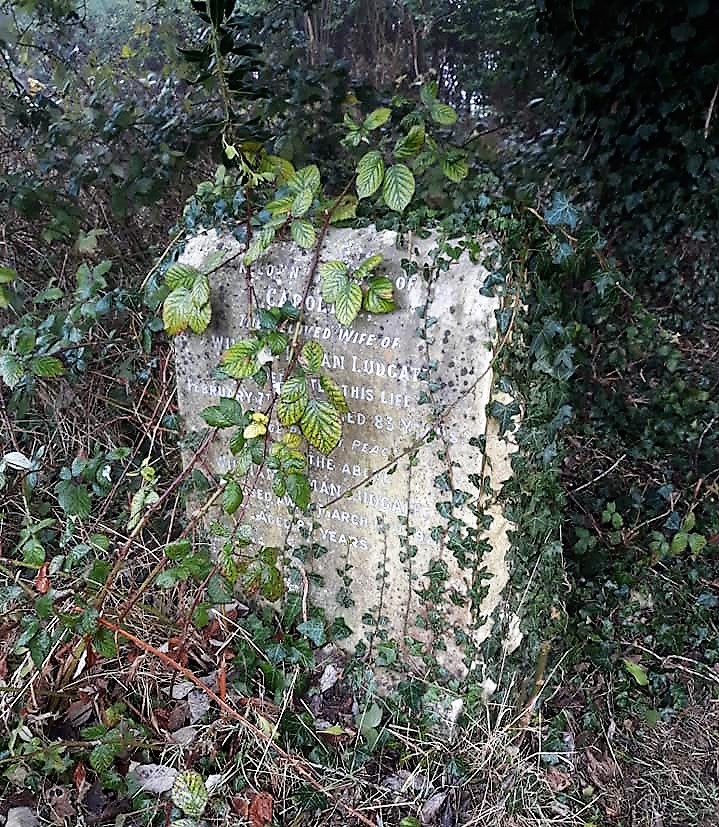
Caroline died in 1918 and William in 1921. They are buried together in plot D401.

Swindon – The close of 1907 saw the retirement, after more than fifty-four years’ service, of one of the oldest Carriage and Wagon Department servants, in the person of Mr W.H. Ludgate , Chief Travelling Inspector. He started under the late Mr John Gibson, Paddington, at a time when there were no carriage or wagon shops at Swindon, the whole of the stock being purchased from private firms. Mr Ludgate was shortly after transferred to Gloucester, to inspect the stock purchased by the company, which came from the North loaded in wagons and had to be put on broad gauge frames at Gloucester.

Probably during the past forty years there has been no better-known man in wagon-building and private freighters’ circles than Mr Ludgate. Possessed of ability considerably above the average and of that invaluable personal asset, an equable temperament, he was eminently fitted for dealing with the many difficult questions arising in regard to the construction and maintenance of privateowners’ wagons, and it is owing in no small degree to his diplomatic methods that the various regulations of the Board of Trade and Railway Clearing House in regard to private owned stock have been successfully interpreted on the Great Western Railway.

Opportunity was taken of Mr Ludgate’s retirement to present him with a drawing room clock and cheque. In making the presentation Mr Churchward said it afforded him great satisfaction to be present at such a gathering to wish an old comrade goody-bye. He congratulated Mr Ludgate on his splendid record and announced that there were upwards of 600 subscribers to the testimonial.

Mr Ludgate has the best wishes of our readers for a happy retirement.

Great Western Railway Magazine 1908.

Ludgate, Caroline of Florence Villa Swindon Road Swindon Wiltshire (wife of William Homan Ludgate) died 7 February 1918 Probate London 20 March to Florence Ludgate Spinster Effects £2014 15s 2d.

Ludgate, William Homan of Florence Villa Swindon Road Swindon Wiltshire died 13 March 1921 Probate London 30 April to William George Ludgate engineer captain R.N. (retired) and Florence Ludgate Spinster Effects £8149 17s 10d.

Mr Ludgate had more than one string to his bow –

Gas Company Founder – The funeral of the late Mr William Henry [Homan] Ludgate of Florence Villa, Swindon Road, Swindon, one of the founders and for 43 years chairman of the Swindon United Gas Company, who died on Sunday, 13 March, at the ripe age of 87 years, took place on Friday in last week. The cortege left deceased’s late residence and proceeded to St Paul’s church where the first portion of the service was conducted by the Rev C.W. Jacob (Vicar) and Rev C. Averary Jones (Curate). The Vicar also officiated at the graveside in the cemetery, where deceased’s remains were laid to rest beside those of his late wife, who died three years ago. The chief mourners were Capt. W.G. Ludgate of Southsea (only son) Miss Florence Ludgate (only daughter) and Misses B. & E. Arkell, of Cheltenham (cousins). The Gas Company was represented by Mr A.G. White, Mr W. Harvie, Mr F.W. Adams, and Mrs J.S. Protheroe (directors). Mr E.G. Vince (Secretary) and Mr H.C. Shepherd. Mr Ernest Bishop represented the New Swindon Building Society, of which deceased was for many years Chairman, and there were also present Mr H.K. Noble, Mr Birks, Mr Jennings, and other old friends. There were numerous lovely wreaths and other floral tributes.

Faringdon Advertiser and Vale of the White Horse Gazette Saturday 26 March 1921.

Caroline and William H. Ludgate

Jesse Eagles – boilersmith

Jesse Eagles woke early and asked his wife if it was time to get up. On being told not yet, he turned over and went back to sleep – “a sleep from which he never awoke” as the Swindon Advertiser reported on July 17, 1909.

When the time comes this is how I would like to go. Peacefully, in my sleep with no prior warning, no lengthy, debilitating illness. But not yet, of course.

Sudden Death in Swindon

Mr J. Eagles of Clifton Street

Inquest and Verdict

The death occurred yesterday with painful suddenness, of Mr. Jesse Eagles, of 118 Clifton Street, Swindon. Deceased, who was a well known resident of the town, was a boilersmith by trade, and had been employed in the GWR Works for the past forty years. He was at work as usual on Wednesday until 5.30 p.m., and returned home and had his tea. In the evening he went out in his garden till nine o’clock, and later he retired to rest at the usual time. He awoke yesterday at four o’clock, and was then quite well, apparently. He remarked to his wife, “It is not time to get up yet, is it?” She replied in the affirmative, and deceased then went to sleep again – a sleep from which he never awoke. When his wife called him at five o’clock, there was no response, and she was alarmed. Medical aid was summoned, and Dr. Mason, from the GWR Surgery, attended, but he could only pronounce life extinct, death being attributed to heart failure.

Deceased, who was 60 years of age, leaves a widow and grown up family, for whom the deepest sympathy will be felt.

By the Foreman:- Deceased had no supper on Wednesday night. He was lying on his right side when witness found him.

By the Doctor:- He had not complained of shortness of breath when going up hill.

Dr. Woodgate Mason said he was called to the deceased about 5.15 that morning, and on arrival found him dead. In his opinion death was due to heart failure. He made an examination of the body, and found no marks of violence.

Extracts from the Swindon Advertiser, Friday, July 16, 1909

Jesse Eagles aged 60 years of 118 Clifton Street was buried on July 17, 1909 in grave plot E7453. His wife remained living at 118 Clifton Street where she died in 1921 and was buried with her husband.

The Boucher family paperwork

43731787_2357590734282064_2810830051103211520_n

The last serious act of vandalism to take place in Radnor Street Cemetery happened across one weekend several years ago.

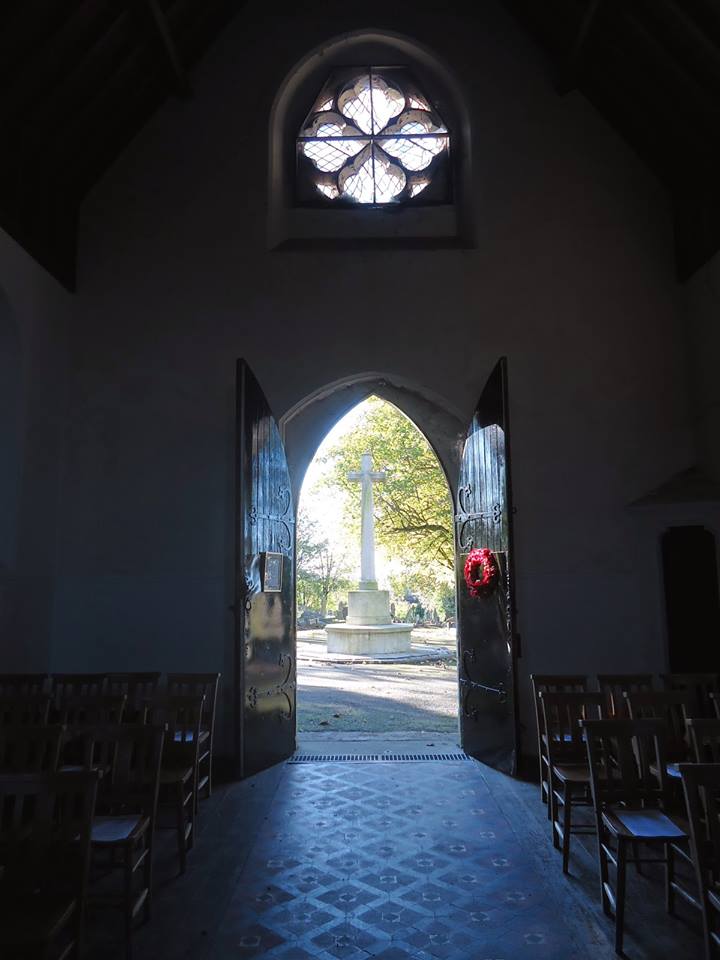
A break-in at the chapel saw windows smashed, including the rose window above the door. The intruders lit a fire in the vestry, the small room off the chapel, using a box of documents stored there.

The documents were ‘Form of application for permission to erect or restore a memorial’ and included the name and address of the owner of the grave and how much the memorial cost, invaluable information lost in the fire. One rare, surviving document includes the details of the Boucher family grave, naming the stonemason, the dimensions of the memorial and the inscription.

Boucher family

‘In loving memory of George Boucher died 8th July 1915 aged 61 years also Mary Boucher died 25th February 1943 aged 88 also Alice and Ethel their beloved daughters.

The owner of the grave was Annie Elizabeth Boucher who lived at 30 Swindon Road. The grave plot is C484 and the memorial cost in total £3 10s. Alice died in 1897 aged 16. Ethel died in 1956 aged 70.

George and Mary Anne were originally from Herefordshire where they married in 1877. They both came from farming families and were neighbours living in Cublington.

By 1881 they had moved to Swindon and lived in 19 Thomas Street, Rodbourne. George worked as a Machine Man in E & M Shop in the Works.

Ten years later and George was working as a machine manager in the Iron Works. The couple had seven children and were still living in Rodbourne at 54 Linslade Street.

By 1901 the family were living at 111 Linslade Street and the elder children had left home. Emily, aged 22 was working as a parlour maid while Ethel, 15 was a machinist in the shirt factory round the corner from Linslade Street.

At the time of the 1911 census the couple had just two children living at home in Linslade Street. William had followed his father into the Works as an engine fitter while Ethel remained employed at the Cellular Clothing Company in Rodbourne.

George died on July 8, 1915 and Mary Anne in 1943. Ethel was still living at 111 Linslade Street when she died in 1956, more than 50 years after the family originally moved there.

A 1917 Trade Directory lists Annie as a shopkeeper living at 30 Swindon Road, which was her last home in the 1960s. She died at the Cheriton Nursing Home on December 31, 1962. She is not buried in this family plot and does not appear to be buried elsewhere in Radnor Street Cemetery. She never married and left effects valued at more than £5,000 to the administration of two solicitors.

Esther Swinford – victim of a shooting tragedy

The re-imagined story …

6989714486_4aafd0b80d_h

Esther Swinford published courtesy of James Turner and Local Studies, Swindon Central Library

‘I watched him enter the pub from my seat beside the fireplace.  What did she see in him?  My sister said he was handsome in a dark and brooding fashion and that I was jealous.

She read too many romantic novels.  Where she saw dark and brooding I saw surly and ill tempered, but she was right about one thing; I was jealous.

I was in love with Hetty and had been for several years, since she first began working at The Ship. She was pretty and vivacious with a kind word for everyone.  Mr Matthews said she was one of the best barmaids he had ever employed.  She was like one of the family, he used to say.

I watched Palmer walk over to the bar.  He looked furtively around the near empty pub.  I inclined my head in acknowledgement.  I didn’t want to encourage him over to the vacant seat beside me.

I hadn’t seen him in many months.  Rumour had it that he had left for Canada nursing a broken heart after Hetty broke off their engagement.

My sister said she’d heard he’d spent Hetty’s savings, all the money she had put away for their future home together, on other pastimes.

But he was obviously back now.

I watched as Hetty appeared behind the bar.  She seemed unsurprised to see him and welcomed him with a polite smile, the smile she showed all her customers, the smile she always gave me.  Nothing special.

He ordered a bottle of Bass and a cigar.   She placed his drink in front of him and went out the back to get the cigar.

I watched as they exchanged a few words.  I couldn’t hear what was said, but suddenly I noticed her expression change.  The sound of the gunshot reverberated around the pub.  He placed the gun on the bar.

I watched as he took a long, slow draught of beer.  He lit his cigar and enjoyed a leisurely smoke while all hell broke out around him.

After his arrest they found a photograph of Hetty in his pocket.  He had written across the bottom ‘the curse of my life.’

ship inn

The Ship Inn, Westcott Place published courtesy of Local Studies, Swindon Central Library

The facts …

Esther, also known as Hester or Hetty, was born in Fairford, Gloustershire in 1883, the daughter of farm labourer Edwin Swinford and his wife Alice. By 1901 she had moved to Swindon where she worked as a barmaid at the Ship Inn for Mrs Isabella Groves. The following year the widowed Mrs Groves married Walter Ernest Matthews and together they continued to run the large establishment in Westcott Place.

It was Mr Matthews who paid for the funeral expenses while local people donated towards a memorial. A large cross stands on Hetty’s grave.  The inscription reads:

In Memory of Esther Swinford who was the victim of the shooting tragedy in Swindon on Sep 18th 1903.  Aged 19 years

“In the midst of life we are in death.”

Cut into the stone is a cascade of passion flowers.  Is this how Hetty’s death should be remembered, as a crime of passion, like something out of a romantic novel?

Hetty’s funeral took place on September 22.  She was buried in plot A760 which she shares with one other who died in 1889; a railwayman by the name of George Frederick Palmer, could this just be a macabre coincidence?

Edward Richard Palmer hanged for the crime on November 17, 1903 in Devizes gaol.

The memorial was repaired and restored in 2009 by Highworth Memorials after a project by James Turner.

The Cemetery – Why Were the Gates Locked?

Following the verdict of the jury of ‘Suicide from drowning, while temporarily insane’ upon Sarah Richens, the Coroner’s attention turned to the pressing matter of the discourteously way in which he and the jury had been treated at the cemetery.

At the close of the inquest the coroner made some comments on how the jury and himself had been treated. When they arrived at the cemetery gates to go and view the body, about 4.45, they found the gates locked at the Ashford Road entrance. The police constable who was with them displayed some agility by climbing over the high iron gates and going down to the caretaker’s house and obtaining the keys.

Sergt. Everett informed the Coroner and jury that the caretaker of the cemetery was warned to have the gates open, as the inquest would be held at 4.30 p.m.

The Coroner asked the representatives of the Press to take notice of the facts, as the District Council ought to know that the Coroner and jury had been treated discourteously by having the gates locked against them.

A Juryman: I think they might also provide a light in the mortuary.

The Coroner: Yes, I think so too. We had no light whatever beyond a lighted match which one of the jurymen held.

The enquiry then closed.

The Swindon Advertiser, Friday, November 17, 1899.

The mortuary building, Chapel and Radnor Street Cemetery caretakers lodge were designed by popular local architect W.H. Read.