This is the story of Harry Woolford, born in Swindon the son of Robert and Matilda Woolford. When I first saw the name I wondered if he might be a member of the Lydiard Tregoze/Purton family in whom I have an interest.
In 1901 Harry aged 26 lived at 13 Jennings Street with his mother, her second husband Thomas Bailey, his three Woolford brothers and a 9 year old half brother, Alfred Bailey.
On that day in January 1903 Harry left his home in Rodbourne to begin work in the railway factory as usual. But that day he met with a fatal accident.
Fatal Accident in Swindon
Man killed in the GWR Works
This morning a sad accident occurred in the GWR Works, by which a young man named Harry Woolford, residing in Jennings Street, Rodbourne Road, Swindon, lost his life.
The deceased, who is a single man, was employed as a labourer in the Mason’s Yard, under Mr Dougall Clark. Whilst attending some machinery, we believe, oiling it, his right arm became caught, and had it not been for the ready assistance of some of his mates who were standing near, he would probably have been drawn in and crushed badly. As it was, his arm was sadly injured, and the loss of blood was so great that he died almost immediately.
A message was sent to London Street, and Dr. G. Rodway Swinhoe and Dr. Pattison were soon on the spot, but their medical knowledge was of no avail. His body was removed to the GWR Medical Fund Mortuary shortly after to await an inquest, which will probably [be] held tomorrow.
Swindon Advertiser, Tuesday, January 6, 1903.
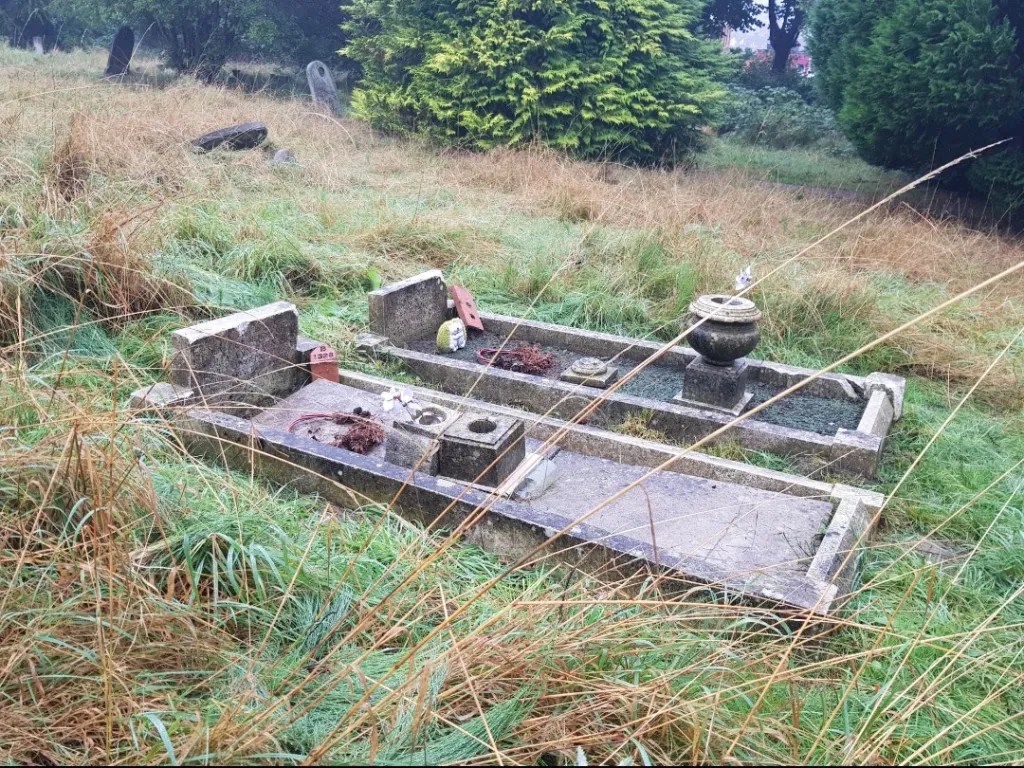
Harry was buried in graveplot B1328, a public grave, once called a pauper’s grave, reserved for those families who could not afford to buy their own, private plot. He was buried with his father, Robert Woolford, who had died 15 years previously and Georgina Hatton, an 86 year old widow who died in 1913.
As was the custom in this cemetery, the grave lay unmarked and undisturbed for 50 years.
Then in 1963 there was a terrible accident in Park South where two little girls were struck by a school bus and killed.
Friends and neighbours, the two families wanted their daughters to be buried side by side. Julia Ann Barnes parents bought plot B1329 and Dawn Maria Rose’s bought plot B1328.
No longer a neglected, pauper’s grave, the two families erected a fine, identical memorial on each of their daughters’s graves. The Radnor Street Cemetery volunteers keep these graves tidy and Cheryl, Gina and Angie Phillips lay flowers in the little girls’ memory.
This is the story of Harry Woolford who died in an industrial accident in the railway works and Julie Ann and Dawn, two little friends who died returning home from school.
In July 1939, as war became imminent, the Lord Privy Seal’s Office issued a number of Public Information Leaflets. Leaflet No. 2 contained information on ‘Your Gas Mask – How to keep it and How to Use It’ as well as instructions concerning ‘Masking Your Windows’ with the following advice:
In war, one of our great protections against the dangers of air attack after nightfall would be the “black out.” On the outbreak of hostilities all external lights and street lighting would be totally extinguished so as to give hostile aircraft no indication as to their whereabouts. But this will not be fully effective unless you do your part, and see to it that no lighting in the house where you live is visible from the outside. The motto for safety will be “Keep it dark!”
The ‘black out’ was yet another feature of wartime that impacted on everyday life. In the winter of 1940 these difficult conditions and icy winter roads resulted in a road traffic accident and the death of Charles Smart.
Image published courtesy of Local Studies, Swindon Central Library.
Killed in Black-Out
Inquest on Swindon Man
Against the wishes of his niece who thought the roads too treacherous for him, Mr Charles Smart, aged 68, a retired GWR employee, of 44, Curtis Street, Swindon, went out on Tuesday of last week to the Central Club. On his way home he was in the act of crossing the road when he was knocked down by a Corporation ‘bus receiving injuries from which he died in the GWR Medical Fund Hospital on Saturday night.
A verdict of “Accidental death” was returned by the jury at Tuesday’s inquest, conducted by the Wilts Coroner (Mr Harold Dale), and the driver of the ‘bus William John Snell was exonerated.
Mr Smart’s niece, Mrs Dorothy Kate Critchley, with whom he lived, said her uncle enjoyed good health, hearing and eyesight.
Dr Alister McLean said the cause of death was shock following injury to the brain due to a blow on the head.
Reasonable Speed
Walter Fred J. Ockwell, 10, Milton Road, Swindon said that last Tuesday night about 10 o’clock, he was in Curtis Street and just before reaching Whitehead Street he saw a form in the middle of the road. The form was not moving. When about 30 feet away he shouted to the object. A ‘bus came along but the object did not appear to move until the ‘bus was almost on top of it. As the ‘bus swerved to the right the object moved to the left. The ‘bus was almost in the middle of the road, and was being driven at quite a reasonable speed.
When he reached the spot, the driver and passengers were getting out of the ‘bus. The object proved to be a man lying a little to the centre of the road. It appeared as if the ‘bus had pushed the man forward. Witness said that as the man stood in the road he faced the direction from which the bus came.
Private James Lewis Warburton said he saw Smart leave the pavement and walk towards the centre of the road, where he stood still. He thought Smart was going to stop the bus, and he did not see him slip.
Driver’s Swerve
The bus driver, William John Snell, described it as a very dark night, with bad road conditions. When he first saw the figure in the road it was very close to the bus and well into the road. He immediately applied his brakes and swerved to the offside, but, owing to the condition of the road, the bus slipped along a little further, and the nearside headlamp struck the man, who was wearing dark clothing.
Questioned by his solicitor (Mr S.G.G. Humphreys), Snell said that had Smart remained where he was when he first saw him, the swerve would have avoided him.
The Coroner suggested that it might be that Smart found the road so slippery that he was afraid to move.
Sympathy was extended to the relatives by the Coroner, and by Mr Humphreys on behalf of the Corporation and the driver of the bus.
North Wilts Herald, Friday, 9 February, 1940.
Image published courtesy of the Dixon Attwell Collection, Local Studies, Swindon Central Library
Charles Smart 69 years of 44 Curtis Street died at the GW Hospital and was buried in a public grave, plot C149 on February 8, 1940.
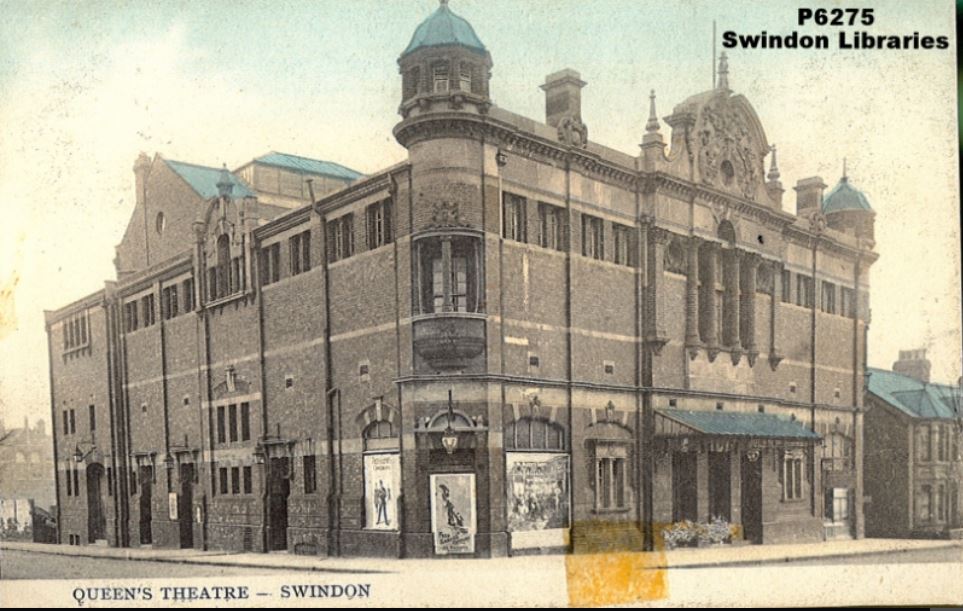
Harry Day had been an acrobat since childhood. Probably one of those little boys forever performing flips and somersaults. By 1899 he was working for John Leopold’s “Frivolity” Company. In 1900 the troupe appeared at the Queen’s Theatre, Swindon* but on Tuesday, September 25, tragedy struck.
The inquest later heard how the acrobats were throwing somersaults on to a spring table. Two or three others had done their turns, and then the deceased went on. In attempting to complete a double somersault he missed, and came down upon his head in the middle of the table.
Harry was transferred to the Victoria Hospital and Dr. Rattray was summoned. At the inquest Dr. Rattray said he found the patient to be suffering from a broken neck and paralysis. Harry died a few days later.
Image published courtesy of Local Studies, Swindon Central Library.
His wife, Christiana, was said to be greatly affected when she gave evidence at the inquest. She already had a small child and later gave birth to a daughter named Henrietta in memory of her father.
Christiana remarried in 1904 and by 1911 was living in Stirchley in the West Midlands, with her second husband Richard George Holbeche and her daughter Emily Day. Little Henrietta had died in infancy.
Henry Thomas Day was buried on October 3, 1900 in Radnor Street cemetery in grave C578, a plot later purchased by the Longman family
The Late Mr Harry Day – Last Saturday’s “Era” contained a letter from Mr John Leopold, of the “Frivolity” Company and a list of subscriptions secured on behalf of the widow and children of the late Harry Day, for some time a member of the Original Leopolds’ “Frivolity” Company, and who, on Sept. 25th last, while performing at the Queen’s Theatre, Swindon met with an accident which resulted in his death a few days later at the Victoria Hospital. From the list we gather that the total sum subscribed is £91 5s, including £31 14s subscribed by the “Frivolity” Company £25 of this being given by Mr John Leopold), and also £20 collected by Mr. Ernest Carpenter, of the Queen’s Theatre, Swindon. Mr Leopold desires to thank all who have given their help in this very deserving case.
Evening Swindon Advertiser, Thursday, January 17, 1901.
*The Queen’s Theatre stood at the junction of Clarence Street and Groundwell Road and was later renamed The Empire.
All for the Empire: the History of Swindon’s Historic Theatre, by Roger Trayhurn and Mark Child
There are some obvious points raised in the following inquest; to establish that machinery and practises in the Works were not at fault and that proper medical attention was received by the victim.
But what I find astonishing is that a 55 year old man, already identified as having a weak heart, and who had previously suffered a rupture and was wearing a truss, was continuing to work as a smith in the Works.
The Fatal Accident in the GWR Works
Inquest This Morning
Mr W.E.N. Browne, County coroner, held and inquest this morning at the Clifton Hotel, New Swindon, on the body of Thomas Barter, a GWR employee, aged 55 years, and lately residing at 59, Radnor Street, Swindon. Deceased, who was a widower, was accidentally struck with a hammer by his mate, and two days after affair died through the injuries received.
Mr J. Gregory was chosen foreman of the jury. Mr. C.R. Pendock, Inspector of Factories, was in attendance.
Mr George Finch, son-in-law of deceased, was called, and said that the latter was a smith in the GWR Works. On Tuesday last he went home about mid-day, and the daughter told witness that he had complained of having had a blow. Later in the day, Dr. Maclean was sent for. Before going home deceased had called in at the Surgery, but a surgery doctor was not sent for afterwards. Witness saw deceased the evening of the next day, and he appeared to be gradually sinking.
By the Coroner: Witness had made no complaint about insufficient attention on the part of the surgery doctors.
By Inspector Pendock: Witness believed that deceased had suffered from a weak heart for some six months before the accident.
By a Juror: A Surgeon was at the Surgery when deceased called and attended to him.
William Berry, who was engaged with deceased in making crown bar ends, said he was striking side blows at the bar, and deceased was stood on his left. The bar happening to swerve witness missed the bar and struck the deceased in the lower part of the stomach. Deceased said he was hurt, but acknowledged to witness that it was a pure accident and not witness’s fault at all. Deceased worked for three-quarters of an hour after the accident, and then he put his coat on and said he was going out to see a doctor.
By the Inspector: Had you been long accustomed to the work?
Witness: Yes, sir. Six years. I have known the deceased for 15 years, and never known him to have a misword with anyone in the shop. He was the best man I ever worked with in my life.
The Inspector: The work you were engaged on was nothing unusual?
Witness: No, Sir. We have made thousands of these same things.
The Inspector: Was the bar hanging by a chain at one end?
Witness: Yes, sir, and in a crane and block at the other.
The Inspector: Did the chain give way at all?
Witness: No sir.
David Jeans, another workmate of deceased, gave similar evidence, and added that he (witness) had gone to the foreman after the occurrence, and made him acquainted with the facts of the same. The foreman promptly ordered witness to take deceased to see a doctor, but deceased said he would go by himself. Witness saw deceased at his home on Wednesday. He was then too ill to speak much, but made witness understand it was all an accident. He said he had gone to the Surgery on the Tuesday, but witness could not gather whether or not deceased had seen a doctor there.
The Inspector: You don’t make any complaint of the appliances you use for this work?
Witness: No, sir, not at all. We have made thousands.
The Inspector: They are properly fitted to the work, and no blame attaches to the Company?
Witness: That is so.
Dr. Carew Webb, assistant to Dr. Maclean, said he was called in on Wednesday evening, and examined the deceased. There was a certain amount of tenderness on the lower side of the abdomen, but no marks of bruising, nor was there any swelling or anything to suggest any serious internal injury. Deceased had been previously ruptured, and at the time of the accident was wearing a truss. The hammer must hit the truss, or the accident might have proved fatal sooner than it did. Witness saw deceased on Thursday morning, and he seemed a little brighter then but on the way to the station later, witness was stopped and asked to go to the house. When he arrived there the man was dead. They told him at the house that deceased had vomited a great deal before he died. Having heard from Dr. Maclean that deceased had suffered from heart disease, witness gave it his opinion that the immediate cause of death was heart failure, due to a weak heart, and accelerated by the accident.
The Coroner then asked Dr. Gardner, of the GWR Surgery, if he wished to say anything, as it had got about the town that the deceased was neglected at the Surgery. Dr. Gardner said that he himself had seen the deceased, and ordered him to go home and keep to his bed, and that the doctor would call in the morning. The doctor did call, but found Dr. Maclean had been called in.
A verdict in accordance with Dr. Webb’s testimony was returned.
Swindon Advertiser, Saturday, August 19, 1899.
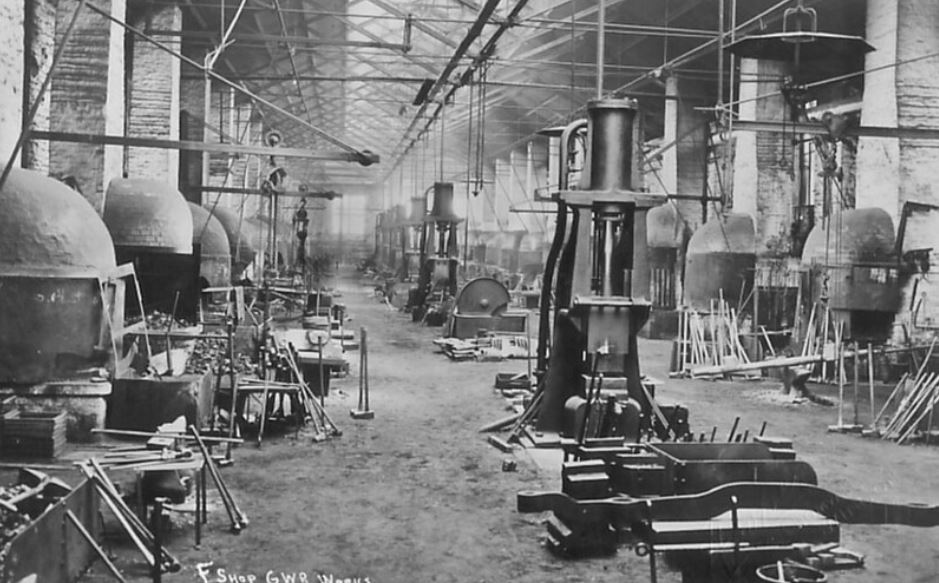
F Shop, GWR Works where Thomas Barter was employedpublished courtesy of Local Studies, Swindon Central Library.
The Fatal Accident in the GWR Works
Funeral of the Deceased
A Large Gathering
The funeral of the poor unfortunate victim of the accident which occurred in the GWR Works last Tuesday took place on Saturday afternoon. Owing to the popularity of Mr. T. Barter amongst his shopmates, the funeral was largely attended, over 100 mourners following. The procession was formed at deceased’s late residence in Radnor Street, and wended its way to the Cemetery where the interment took place, the officiating clergyman being the Rev. J.W. Fish, of Stratton.
Deceased had been in the habit of attending the Clifton Street Primitive Methodist Chapel for many years, and was only recently appointed as one of the trustees of the new building fund.
The coffin was conveyed on a handbier, the bearers being Messrs. D. Jeanes, D. Hunt, Wm. Harvey, Alf Reece, Jas Welch and Thos Brett, all shop mates of the deceased.
The Swindon branch of the A.S.E. was represented by the Secretary (Mr B. Johnson). Deceased was a prominent member of this Society and was Secretary of the Superannuation Fund for this district.
Deceased’s only sister (Miss Barter) was unable to be present as she crossed to Ostend on the morning of deceased’s death.
Last evening a memorial service was held at the Clifton Street Chapel, when an appropriate sermon was preached by the Rev. J.W. Fish, who took for his text the following words “There is but a step between me and death.” The rev. gentleman dwelt upon deceased’s life in connection with their church, and also of the good feeling which existed between him and his fellow workers. The congregation joined in singing the special hymn “Sleep on beloved,” and Mrs Westmacott sang as a solo “We shall meet at the beautiful gate.”
No flowers were sent by special request.
Extracts from Swindon Advertiser, Monday, August 21, 1899.
Clifton Street Primitive Methodist Chapel published courtesy of Paul Williams
The funeral took place on August 19, 1899 when Thomas Barter was buried in grave plot D23.
So, where did responsibility lie for the death of Herbert Hole? Described as ‘a fully qualified man and a good man’ it seems unlikely it was due to his incompetence. Investigations later that day revealed a previously unseen flaw in the hydraulic press, which had been working constantly for 19½ years. Today we bemoan the curse of ‘health and safety regulations.’ I dare say Mrs Hole and her family would tell us how fortunate we are to have such laws in place.
Fatality in the GWR Works
The circumstances attending the sad death of Herbert Henry Hole, aged 53 years, of 20, Curtis Street, Swindon, a fitter in the GWR Works, who was killed by an accident, were inquired into before M A.L. Forrester, Coroner for North Wilts, on Friday afternoon in last week at the Mechanics Institution, Swindon.
Mr O.A. Shinner, H.M. Inspector of Factories, of Bristol, was in attendance.
Arthur Herbert Hole, a fitter, who said he left home only two days ago and went to Grimsby to work, identified deceased as his father, 53 years of age, who had been in the employ of the GWR Co. a number of years, and was engaged in the stamping shop.
Dr W. Boxer Mayne said he was called to the Hospital about 4.30 p.m. on Wednesday. He found deceased suffering from a deep and extensive wound in the neighbourhood of the rectum. There was also the evidence of the fracture of the pelvis. He died in a few minutes from shock following the injuries.
Alfred Edward Mayor, of 28, Oriel Street, Swindon, hydraulic forgeman in the factory, said he and deceased were working on two hydraulic presses in the Stamping Shop. On Wednesday afternoon one of the presses was out of work, and deceased came there to put a guage on the dies of the press which was out of work. Whilst he was doing this witness was working the other press. About 3.50 p.m. witness heard a banging noise, and on looking round he saw deceased lying on the floor. Witness went to pick deceased up, but found his left foot was pinned down by a piece of iron (the crosshead of the machine). With assistance, witness raised the iron, and got deceased up and found he was seriously injured. Witness had left the machine ready for Hole to do the work. He was down on the block, and witness told him it was all right. He told deceased not to touch the lever, or the press would go up. Deceased could work the guage without touching the lever.
By Mr Skinner: The machine was not doing any work at the time of the accident. Deceased was doing some work to the guage.
Thomas Axford, of 161, Victoria Road, Swindon, GWR foreman, said he was in charge of the shop where deceased was working. Witness was 15 yards away from the scene of the accident at the time, and heard the noise. On turning round he saw deceased on the ground. Witness fetched an ambulance and also telephoned for a doctor, who quickly arrived. The same day, about 6 p.m. witness examined the machine and found an unseen flaw in the tie-rod coupling the top piston of the cylinder to the bottom one. The effect or result of the accident was that the tie-rod broke. Deceased was evidently knocked down. Someone must have touched the lever for the tie-rod to break. Deceased was standing near the lever, and in witness’s opinion the lever must have been touched or the tie-rod would not have broken. After the accident the lever showed that the machine was on the down stroke ready to press. This showed that the machine had moved on the up-stroke about an inch and then come down. The water was not shut off on the main during meal hours or for repairs. Every machine had a separate valve. Deceased was a fully qualified man and a good man.
By Mr Shinner: There was no particular pressure put on to cause the accident. There must have been pressure, and an improper pressure put on accidentally. The machine had been working constantly for 19½ years.
The jury, of whom Mr Waldon was foreman returned a verdict of “Accidental death,” and passed a vote of condolence with the widow and family of deceased in their great bereavement.
The Faringdon Advertiser, Saturday July 14, 1917.
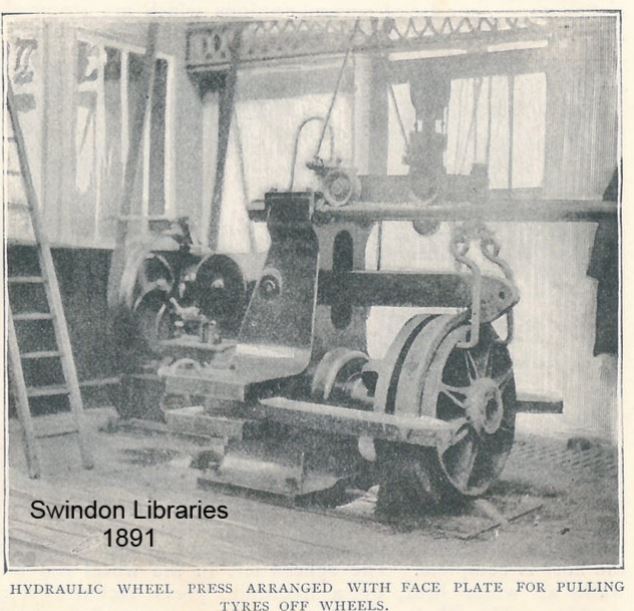
Photograph published courtesy of Local Studies, Swindon Central Library.
Was this the type of machine at which Herbert Hole was fatally injured?
Herbert’s funeral took place on July 9, 1917. He is buried in Radnor Street Cemetery in plot D1624 with his wife Priscilla and son A.P. Hole.
I’ve seen some accidents in the saw mill in my time, but I’ve never seen so much blood before.
No one could fathom out how the saw had fallen from the frame. At the inquest we were asked the very same question, which no one could satisfactorily answer. Putting the saws in the frame had been Charlie’s job.
Charlie had already replaced the first saw, which had fallen from the frame when a second one fell, the blade skimming across his wrist. He was a big old boy, but we managed to lift him out of the way of the machinery until we could get him to the Medical Fund Hospital.
It wasn’t until Charlie had been transported to the hospital that I remembered Harry, the young apprentice who had started work with us that same week. I eventually found him hiding in the cloakroom curled up in a ball on the floor. I thought we were going to have to call the doctor back out again, I’ve never seen anyone look so queer. I suppose it must have been the shock of seeing all that blood.
I told him Charlie was going to be alright, but he didn’t seem to understand me and in the end we had to find his father to come and take him home. He came back to work the following day, but he soon transferred to the Stores. People said he was never the same again.
Like I said, I’ve never seen so much blood before. We spent the rest of the day scrubbing the place down.
Death at the GWR Medical Hospital
Inquest and Verdict
On Tuesday last at the Lecture Hall of the Mechanics’ Institute, Swindon, Mr A.L. Forrester, Coroner for North Wilts held the inquest on the body of W. Cook, who died at the Medical Fund Hospital, under circumstances detailed in the evidence given below.
Mr Greenaway was chosen foreman of the jury.
Mrs Annie Cook, of 15 Carr street, Swindon said that she identified the body as that of her husband, William Cook, aged 64, a sawyer, employed in the GWR Works. He died on Saturday at the Medical Fund Hospital, and witness was there at the time of his death.
George Ockwell, of Purton, sawyer, in the GWR Works, said that on last Thursday week between 11 and 12, witness was in the saw pit putting the blocks in to cut the timber to a certain size. The saws were hung in the frame but not set, and as Cook put a block in the saw fell down. As Cook went to put the saw back in its place the other saw next to it fell down and cut his wrist. Witness who was in the pit saw the blood coming down. It was Cook’s duty to fix the saw.
The machinery was not in motion of course.
Oh no sir. You had nothing to do with these blocks below? Cook had to hand me the blocks to put in, and the first saw fell down as he was handing me the first block.
You had not put this block in position? No sir.
What do you think caused the saw to fall? I don’t know.
Did the saw fall right down into the pit? Oh yes, sir, close to me.
How deep is the pit? About 14 inches.
Witness explained that he sat on a board to adjust the saw, his legs only being in the pit. The back of the saw was towards witness, and the saw fell down between his legs. The saws were not circular, but were straight “up and down” saws.
Ernest Samuel Richards, shop foreman in the saw mills, said that the mill at which Cook was working was a vertical long frame. The saws were 5ft 10in long, and the average width would be about 5½ inches. The saw had a buckle on, with a hook, and it was attached to the tiller with the hook the reverse way. They were fastened in the frame by a steel cotter. The blocks were simply packing, and did not affect the hook at all. He had never heard of saws falling down during adjustment. If these saws are hooked up and keyed how could it drop down? They cannot drop down when they are adjusted unless they come off the hooks, and that could only happen by a blow or by their being lifted in some way or other.
Dr G.R. Swinhoe said that on May 6th the deceased was received at the GWR Hospital suffering from a cut to the left side of the wrist, severing the radial artery. The bleeding was stopped and the wound was dressed, and he asked the man to stay in the Hospital, but the deceased took his discharge and went home. He come up every day to have the wound dressed until the day before he was re-admitted (May 12th). He was admitted on the 13th suffering from blood poisoning to the left arm. Hypostatic pneumonia had set in and Cook died from hypostatic pneumonia on May 15th. Witness then explained how the temperature from the blood poisoning would affect the heart, and render the heart unable to pump the blood through the lungs. The primary cause of all the trouble was the suppuration set up in the cut wrist, and the other things followed in an elderly and very stout man with a weak heart.
The jury returned a verdict that Cook died from hypostatic pneumonia following a cut on the wrist, accidentally caused by a saw in the GWR Works.
Mr H.B. Dawe was present as being in charge of the GWR Timber Department. Mr W. Ireland, Factory Inspector was also in attendance.
Funeral of Deceased
Yesterday afternoon the remains of the late Mr William Cook were laid to rest in the Swindon Cemetery. The funeral cortege left Carr Street shortly after three o’clock, and proceeded to the Cemetery where the funeral service, both in the Chapel and at the graveside, was conducted by the Rev. J.T. Evans, in the presence of a large number of relatives and sympathising friends. The remains were enclosed in a polished elm coffin with brass furnishings, and bearing a breastplate with the inscription “William Cook died May 13th, 1909, aged 64 years.”
Swindon Advertiser Friday May 21st, 1909
William Charles Cook was born in Bath in 1845, the son of John Cook. He married Eva Annie Perrin on October 22, 1874 in Aylesbury, Buckinghamshire and by 1876 they were living in Swindon where their son Lewis Ernest Samuel Cook was born. At the time of the 1891 census William and Eva, were living at 15 Carr Street with 15-year-old Lewis and 2-year-old daughter Frances.
William was buried on May 20, 1909 in plot E7378 in Radnor Street Cemetery. He lies with his son Lewis who died in 1900 aged just 24 and his wife Eva Annie who died in 1913.
There may or may not be a headstone to William Charles Cook beneath all those brambles. We fully appreciate the financial constraints upon Swindon Borough Council – that the coffers are depleted and there is only enough money for essential services. But it is such a shame that an important heritage site such as Radnor Street Cemetery receives so little maintenance. Here lies, quite literally, the history of our town – remembering the ordinary people of Swindon.
At the inquest it was stated there were no adults in the vicinity of the pond where the three boys drowned, but I knew differently.
I heard them laughing and shouting as they edged across the frozen surface and then the screams as they foundered in the icy water.
I watched as the young Mapstone boy, still fully clothed and wearing his skates, jumped into the freezing water and momentarily disappeared. I watched him struggle up the bank, casting off his clothes and running this way and that, searching for something with which to pull the boys out.
The father of one of the lost boys asked the coroner about the adults who were observed at the scene of the tragedy, but young Mapstone said they arrived too late, the boys had already disappeared, but I knew differently. The police sergeant said no one was to blame. I knew I was to blame.
All the time I looked on, hiding in the hedgerow, praying that no one would see me, praying that no one would expect me to jump into that pond. Now, twenty years later I still pray that no one will discover my secret.
The young Mapstone boy was praised for his actions. I wonder if that was of any consolation to the eleven-year-old. I wonder if he still has nightmares. I know I do.
Today I enlisted with the Wiltshire Regiment. I’m hoping I’ll be sent out to France pretty soon. The casualty numbers are mounting and I hope I will soon be one of them. I don’t want to come home a hero. I don’t want to come home at all. I’m praying I’ll be killed pretty quickly. Then I’ll no longer see those boys drowning in that pond or young Edwin Mapstone frantically running along the bank, half dressed.
Drove Road c1910 published courtesy of P.A. Williams and Local Studies, Swindon Central Library.
The facts …
Drowning Fatality at New Swindon
Three Lives Lost
Inquest on the Bodies
On Saturday, about noon, a sad accident happened at New Swindon by which three lads lost their lives. It appears that the boys, being too venturesome, went sliding on a pond in a meadow known as Wharf Field, near the Drove road, New Swindon. Suddenly the ice gave way, and the three boys fell in. The water was about ten feet deep, and there being no one at hand to rescue them, all three were drowned. Some other boys who witnessed the sad occurrence ran off and gave information to the police, with the result that P.C. Keating and another constable hastened to the spot, but by the time they arrived the bodies were out of sight. They recovered the bodies, but life was extinct. Dr Lavery was also sent for, but he found all attempts at resuscitation useless, and the bodies were removed to the Queen’s Arms Hotel, and the Coroner communicated with. Two of the lads resided in Mill-street, their names being Charles Greaves, aged 8 years, and Thomas Tombs, aged 10 years. The third lad, who was about the same age, and whose name was Wm. Stagg, hails from Southampton, and was on a visit to some friends at 32 Princes Street. He was to have returned home the same Saturday evening.
The Inquest
On the bodies of the three unfortunate lads was held at the Queen’s Arms, on Monday afternoon by Mr Coroner Browne and a jury of whom Mr J. Jefford was foreman. – Chas. Fredk. Townsend aged 10 years, said he was sliding on the ice with the three deceased lads on Saturday about 12 o’clock. He slid across the pond first and the other three lads followed altogether. Greaves was first, and when they reached the middle of the pond the ice broke and all three fell in. He and the other lads watched them struggling in the water and whistled for assistance. – Edwin Mapstone, aged 11 years, said he was skating on a ditch about 100 yards from the pond and saw the lads sliding on the pond. On hearing the shouts of the other boys he went across to the pond and saw the three lads struggling in the water. He jumped in to try to rescue them, but could not swim under the weight of his clothes and skates on, and he went down once himself in trying to help the other boys. Two boys went for a prop, which witness put into the water, but the drowning lads had not strength enough to hold it. He saw the lads as he was passing the pond before they went on the ice and told them the ice was not safe. – In answer to Mr. Tombs, father of one of the deceased lads, witness said there were several grown up persons round the pond, but they did not arrive until the bodies had disappeared. – P.C. Scammel said he was informed of the accident whilst on duty in Regent-street, and he at once proceeded to the pond, but by the time he arrived the bodies had disappeared underneath the water. With the assistance of P.C. Keating he recovered the bodies but then all attempts at resuscitation were useless. – Edwin George Castle, of 40 Mill street, said he lived near the pond, the construction of which he knew perfectly well. It was nine feet deep in the centre and was cleaned out about two years ago. It was 25 ft. in width and was built in basin shape, with a division for the purpose of allowing cattle to drink. The ice covering the pond on the day in question was not safe. He was near the pond about 12.45 on Saturday last and saw the witness Mapstone running across the field, partially naked, crying for assistance. He obtained a pole and went to the pond, but when he arrived the lads had sunk. – E. Mapstone was re-called to answer a question as to whether there were any grown up persons near the pond at the time of the occurrence. He said the bodies had just disappeared when they arrived. – Sergt. Garrett said he had made full enquiries on this point, and did not think the grown-up persons needed any censure.- Mr Toombs: I do not wish to censure anyone. – Dr Lavery said he saw the bodies about ten minutes past two death was due to asphyxia from drowning. In answer to a question the doctor said if he had been present about five minutes after total submersion he might have succeeded in saving life. – This concluded the evidence, and the Coroner said there was only one verdict which the jury could return. No blame could be attached to anybody. The little boy Mapstone seemed to have done the best he could to try and save the lads and was deserving of the highest praise. – The jury then returned a verdict of “accidentally drowned,” and Mr Bradbury moved a vote of condolence with the bereaved families. The jury handed their fees to Mrs. Greaves, the widowed mother of the deceased lad Greaves.
Swindon Advertiser, Saturday February 2, 1895
The boys were buried in Radnor Street Cemetery on the same day, in graves just a few spaces apart. Eight-year-old Thomas Greaves was buried in plot B2275, a privately purchased plot, which he shares with his father Francis who had died in 1894.
Ten-year-old Charles Tombs was buried in plot B2213 a public or pauper’s grave, which he shares with five others, including May Tombs, a 22 month old baby who died in 1893 and is most probably a relative.
There is no further information about William Stagg, the third boy who drowned.
Edwin Mapstone was born on May 29, 1883, the son of Welsh born Evan Mapstone, a striker in the Works, and his wife Margaret. The family lived at 41 Mill Street when Edwin was baptised at St John the Evangelist on December 29 of that year.
In 1897 the fourteen-year-old began a 6½ year apprenticeship in the Works as a blacksmith. In 1909 he married Emily Baker and by the time of the 1911 census he was living with his wife and baby son in Tredegar, Monmouthshire, where he worked as a labourer below ground in a colliery. The couple lived with Edwin’s elder brother John and his wife. He eventually returned to Swindon and a job as a painter in the Works.
Edwin died in January 1969 aged 85 years old and is buried in Radnor Street Cemetery in a privately purchased plot C1519, which he shares with three others, including his brother John who died in December 1964.
In 1891 Charles Tombs lived at 32 Mill Street, Thomas Greaves lived at number 25 and Edwin Mapstone at number 26.
Drove Road c1920 published courtesy of Local Studies, Swindon Central Library
On Friday December 14, 1894 Thomas Messenger was involved in a fatal accident in the Timber Yard at the GWR Works. Back home in Linslade Street his wife Emma went into labour. Thomas died two days later. He was 31 years old and according to the report made to the Great Western Railway Board he had been employed in the Company for 5 years and 5 months, his daily rate of pay was 3s 2d.
Fatal Accident in the GWR Works – On Tuesday morning, Mr. Coroner Browne and a jury, of whom Mr W.J. Deavin was foreman, held an inquest at the Cricketers’ Arms, New Swindon, on the body of Thomas Messenger, aged 31 years, a labourer, employed in the Great Western Railway Works timber yard department. Mr T.O. Hogarth and Mr H. Hayward were present to watch the case on behalf of the GWR Company.
From the evidence adduced, it appeared that deceased was on Friday morning employed with other men in stacking timber. A “skid” – a piece of timber weighing some 7 cwt. – was used for sliding the timber on to a stock in order to save labour. Deceased placed the skid too far over the corner and it rebounded and stuck him in the head, causing a fracture of the skull.
A verdict of accidental death was returned. The jury gave their fees to, and also made a subscription on behalf of deceased’s widow, who is left with three children, and was confined on the morning of the accident. The sum handed to the widow was £1.
Wilts and Gloucestershire Standard, Saturday, December 22, 1894.
Thomas was buried on December 19 in a public grave plot B2264. His father, also named Thomas, was buried with him in 1902. They share the grave with a baby and an elderly widow, both unrelated.
Thomas and Emma had been married less than two years. Emma had already been widowed once before, left with two little daughters Martha and Amelia. Now she was on her own again with another child. The baby was baptised at the parish church in Latton on January 27, 1895. She was named Thomasina Polly Strong Messenger. Emma went on to marry for a third time in 1901. She died in 1943, aged 82.
Thomasina married, raised two children and died in High Wycombe in 1973, aged 79.
No 1 Shop, Timber Yard pictured in 1928. Image published courtesy of STEAM Museum.
I decided I’d join the guided walk around the cemetery on Sunday. I’d seen people on the walks before and to be honest I was surprised just how many turned out each time.
I lived in Clifton Street and had grown up on the cemetery doorstep, so to speak. As a kid I’d learned to ride my bike there and made snowmen on the rare occasions we had a fall of snow. It was my route to school and a short cut to town and as a teenager I’d walk through it most days to meet my mate Josh. It was as familiar to me as my own back garden. The cemetery held little fear for me, now, after all these years.
It had closed in the 1970s, long before I was born. Years ago, the council used to keep it nice and tidy. The wardens held various events here and I remember coming to a nature day and helping to put up bat boxes. These days it is very overgrown and neglected.
People began arriving at the chapel just before 2pm and as usual there was quite a crowd. The walk was led by a couple of older people. The woman gave us a short, potted history of the cemetery and the man told us a few do’s and don’ts. They were both quite funny actually, and made a good double act.
Then they led us around the cemetery, taking it in turns to talk about half a dozen graves and the people who were buried there. I was surprised at just how interesting it all was. I don’t know what I expected; something ghoulish and creepy, maybe a bit weird.
One of the old ladies started talking to me and took my arm as we were led away from the footpath and across the graves to where the two guides had stopped. I didn’t notice where we were heading.
“Do you think we could take the arm off?” asked Josh as he looked around for something to wield. “Wait up.”
He lived just a few doors from the cemetery gates and was gone just minutes, returning with a hammer.
“Go on. Have a go.”
I swung the heavy hammer but lost my grip and let it fall to the ground.
“Not like that, you idiot.” He began to swivel on the balls of his feet, like the athletes do when they throw the hammer. On the third revolution he let the hammer go. He was surprisingly accurate and the arm of the stone girl flew off.
“What the … Josh!”
We’d hung about in the cemetery loads of times, but we’d never done any damage before.
“Go on – have another go.”
“No.”
“Scared? Chicken?”
“It don’t seem right.”
“Well no one’s gonna complain. They’re all dead.”
I picked up the hammer. Perhaps if I just swung it around a bit maybe Josh would be satisfied. I raised it to elbow height and just as I swung it, a woman shouted out. I lost my balance and lurched at the memorial. The hammer flew out of my hands and knocked the head off the stone girl.
The woman continued to shout. As we turned round I could see she was keying a number into her mobile phone. No prizes for guessing who she was calling.
We legged it all the way down to the Radnor Street cemetery gate. I could hardly breath and my heart was beating furiously in my chest. We ran down the steep steps by the school and on to William Street, cutting through to Albion Street and the old canal walk, but Josh was laughing; laughing and laughing and laughing.
I’d have never done it – if I’d known the story of the girl and her dog – I’d never have done it.
The facts …
Doreen was tragically killed when the wheel of a timber wagon trailer ran over her body after she fell from her bicycle. The fourteen-year-old sustained multiple injuries and died at the scene of the accident in Stone Lane, Lydiard Millicent on August 23, 1938.
Doreen was the younger of George and Catherine Ind’s two daughters and with her sister Iris was cycling to their Aunt’s house in Upper Stratton when the accident occurred.
Iris gave evidence at the inquest held the day after her sister’s death. She told how the two girls were cycling round a bend in the road on Stone Lane, keeping as near as possible to the near side. Doreen was in the front and Iris behind her.
Iris described how a lorry with a timber wagon trailer approached them on the road. The wheel of the trailer knocked her sister’s wheel causing her to wobble on her bicycle. She tried to pedal, but there was no room. Doreen fell into the road and the back, nearside wheel of the trailer went over her.
“Before the wheel went over her I called twice to the man to stop.”
The funeral took place at St Paul’s Church on August 27 followed by the burial at Radnor Street Cemetery.
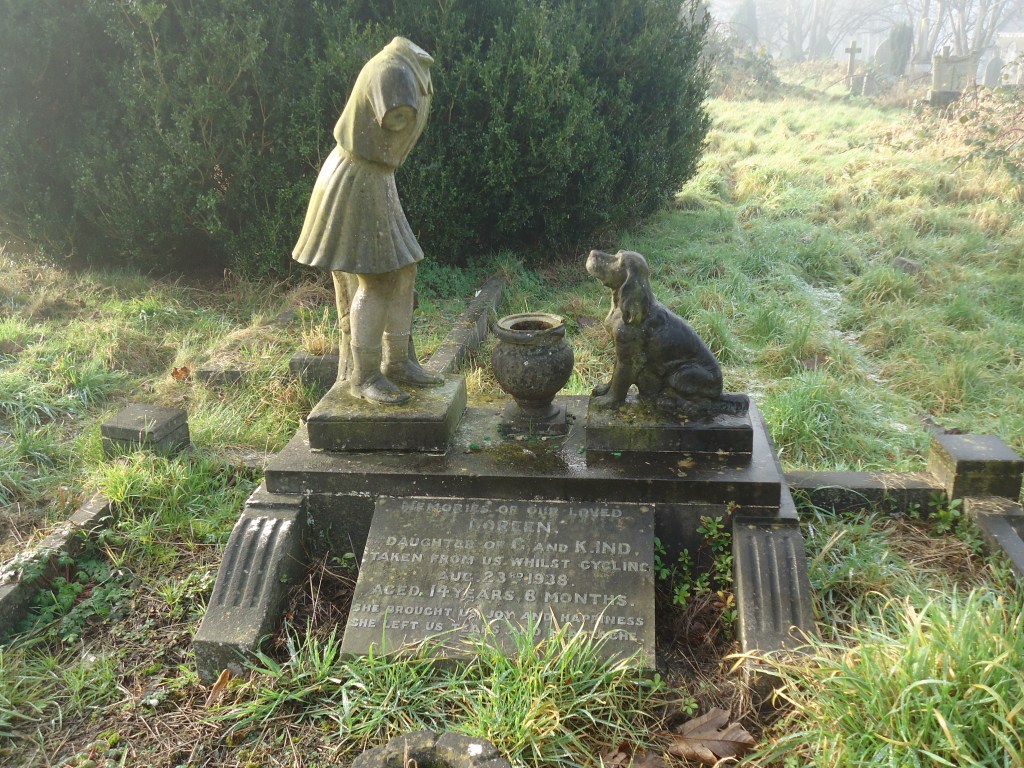
Doreen’s parents erected an unusual and poignant memorial to their daughter, depicting a girl holding out a ball to her pet dog. George died in 1947 and his wife Catherine in 1964 and they are buried with Doreen in a large double plot.
In 2009 a local resident walking through the cemetery disturbed a couple of boys attacking with a sledgehammer this unusual memorial of a girl holding out a ball to her dog. As you can see Doreen’s memorial is badly damaged, one of the last serious acts of vandalism to have occurred in the cemetery in recent years.
Photograph of Doreen’s intact memorial was taken in 2000 and is published courtesy of D & M Ball.
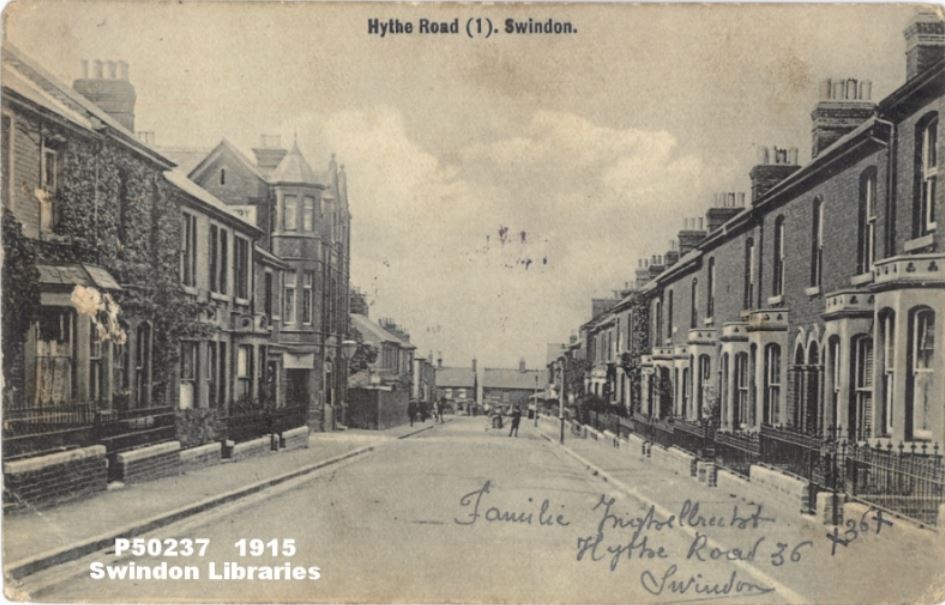
Friday January 3, 1908 proved to be a busy day for North Wilts Coroner Mr A. L. Forrester – Inquests in Swindon – Five on one day – A Record for the Borough. Three of the inquests took place at the Frome Hotel, Hythe Road. The first was described as ‘an extraordinary case’ and involved the sudden death of Mrs Ann Smith, aged 72 and some ‘remarkable evidence’ given by Eliza Adams during which she traded insults with the attending doctor, Dr Hirsch.
The second inquest was that of Charles Joseph Birchell, aged 25, a groom. Evidence was given by Frederick Goddard, 17, of Newport Street Swindon, who said ‘last Friday he was leaving his house, when he heard a pony gallop by. He looked along the house, and saw Burchell fall from the pony’s back. He ran to the spot and found Burchell unconscious. He picked him up and carried him into his (witness’s) house. Dr. Reid was sent for, and he on arrival ordered his removal to the Victoria Hospital. The pony did not stop, but galloped on up the street. Deceased lived at Prospect Villa, Wroughton Road.’
Dr J.C. Reid said on Friday last he was called to see deceased, who was suffering from concussion and laceration of the brain due to an accident. Burchell died at the Victoria Hospital on Wednesday evening as the result of secondary hemorrhage of the brain, owing to the shock caused by the accident.
The jury returned a verdict of accidental death.
Charles Joseph Birchell was buried in grave plot B2095, a public grave, on January 6, 1908, with three other unrelated persons.
The third inquest was into the sudden death of Charles Hillier, employed as a coachman by Captain T. Hooper Deacon, JP, of Kingshill House.
Hillier was waiting to convey his employer home after a New Year’s Eve party in Overton when it transpired that Hillier had fallen from the Brougham and died instantly.
A post mortem examination revealed that Hillier’s heart was “twice its ordinary size” and that he had died due to “valvular disease.”
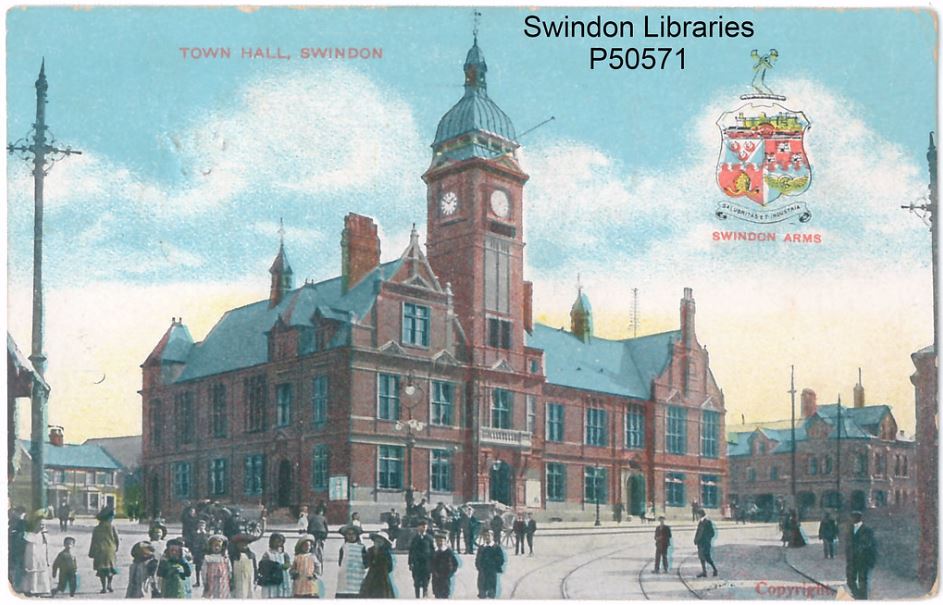
Coroner A.L. Forrester now headed off to the Committee Room at the Town Hall and the inquest of John Mason, aged 72.
A former railway labourer, John had suffered “a stroke of paralysis” some seven years prior to his death. Dr. Waters was called to John’s home in Byron Street. He pronounced “the cause of death was in his opinion, heart failure brought on by paralysis.”
John was buried on January 7, 1908 in grave A2470, a privately purchased family grave.
The final inquest on this busy day was that of Sarah Birch aged 83 who died peacefully in her sleep at her daughter’s home 46 Eastcott Hill. A verdict of “heart failure” was given.
No doubt Mr Forrester was pleased to have concluded the day’s business and returned to his home!








 Radnor Street Cemetery