34 Faringdon Road

The re-imagined story …

I quite like what they’ve done to the place, especially the wallpaper in the front parlour. I could never have afforded that when we lived there.

The thing I notice most is how clean everywhere is. In my day it was a constant battle against the filth pumped out of the Works and the coal smuts from the trains. If the wind changed direction the washing would be covered in grime when I took it off the line.

I preferred our home in Box, but it was only a small village in those days. There were more opportunities for the boys in Swindon, so we moved here. It was a dirty, noisy place back in the 60s but the people were good and kind. When John died more than two hundred people lined the roads from Faringdon Street to St Mark’s.

I like to pop back to the house occasionally. It’s open to the public now, you know. Who would have thought it?

DSC01085

The facts …

Jane Bennet married John Hall at New Monkland, Lanarkshire in June 1840 when John was working as an engine driver with the Wishaw and Coltness Railway in Scotland.

At the time of the 1851 census the family were living in Box, Wiltshire but by the next census ten years later they were at 1 Faringdon Street.

John died on Tuesday, February 29, 1876 as the result of a grisly accident on the railways. At the inquest his son James gave the following evidence:

‘James Hall, son of deceased, said:- My father was 65 years  of age last August. On Tuesday morning, about 25 minutes after two, I was at the station with him as his stoker to pilot the up rails out. We were there in case of the other engine breaking down. There were four coaches in front of our engine, which we were going to push on to the rails. Whilst waiting, the gauge lamp went out, and my father went to the front of the engine to light it by the other lamp. As he was returning along the side of the engine the signalman signalled us to come on, and I blew the whistle and started just as my father had another step to take to get back, and, in fact, had his hand on the weather board. He was walking along the side of the engine. As he was about to step on the foot plate his foot slipped and he fell, his right leg going between the outside connecting rod and the wheel. I had only moved about a yard. The rod brought him up again against the splasher, causing his leg to be jammed and the flesh torn off. The first I knew of his position was my father calling out, ”Stop Jim,” and I stopped immediately. I got down and found he was fixed inside the rod, and he was terribly torn about. It took a considerable time to get him out. He was taken to the hospital at once.’

John died from the shock about four o’clock the same day.  As the report said: ‘The injuries were sufficient to kill anyone, the flesh being taken off to the bone.’

The funeral at St Mark’s took place on the following Sunday, a wet and windy dayattended by  ‘a large number of the inhabitants, many engine drivers and stokers from various parts of the Great Western Railway. We understand that free passes were issued to all such drivers and stokers as desired to attend the funeral, and in this way over ninety of deceased’s fellow workmen were enabled to attend his funeral to pay their last respects to his memory, according to the Swindon Advertiser.

DSC01082

Jane outlived her husband by ten years. She died on January 22, 1886 at the home in Faringdon Street where she had lived for more than twenty five years. She was buried in Radnor Street Cemetery in plot A1047, a public grave, with Jane Humphreys, the wife of Alfred Augustus Humphreys of 9 Bangor Terrace, Jennings Street, who had died the previous year.

Faringdon Street was later renumbered and renamed Faringdon Road. Today the Hall’s former home is 34 Faringdon Road, the Railway Village Museum.

Henry Alfred Money – lost on a lads’ day out

A broken column like this memorial (see below) is symbolic of a life cut short, someone who died young and the story that goes with this grave in St. Mark’s churchyard has a very modern feel to it. 

Henry Alfred Money was the son of Thomas, an engine painter, and his wife Mary and in the 1860s the family lived at 8 Oxford Street in the railway village. 

Henry was a talented musician and played the violin. He was a member of the New Swindon Musical Classes and for many years had taken part in most of the New Swindon Musical entertainments. 

On the morning of Monday March 5, 1877 a body was found by the side of the railway track between Chippenham and Corsham. The young man had not been hit by a train but was lying in the ditch, his face covered by 3 or 4 inches of water.  The body was identified as 19-year-old Henry and at the inquest the following day the story unravelled.   

Henry and his friend Sutherland Polson set off for a lads’ day out on Sunday, March 4. They went first to Shrivenham, then to Wootton Bassett and then onto Bath. Arriving in Bath the two young men pretended they had come to the station to see some friends off. They were clearly larking about.  

They caught the 1 am mail train to Swindon and both fell asleep immediately they got on the train. When Sutherland awoke as the train pulled into Swindon he found his friend missing, his hat and stick left behind.   

At this point Sutherland must have panicked. He had no train ticket and no money on him. He gave his friends hat and stick to a porter and when asked for his details he gave a false name and address.   

Those called as witnesses at the inquest made no mention of the lads being drunk and in fact William Morrison, station inspector at Bath who was on duty that morning, made a point of saying that all the passengers who came out of the waiting room to board the mail train ‘seemed apparently sober.’  

The jury returned a verdict: Found dead by the side of the railway, apparently killed by a fall from the mail train.  

The funeral of the unfortunate young man took place on Saturday afternoon at St Mark’s burial ground, New Swindon, and was made the subject of a great demonstration, the route from the residence of the deceased’s mother in Oxford Street to the church being crowded by several thousand spectators.

The funeral cortege was made up as follows: – Firing party of 12 members of the 11th WRV Corps – Members of the Corps – The coffin, with deceased’s belt and hat, and several beautiful wreaths of flowers on the top, carried by rifle volunteers – The band of the 11th Wilts Rifles, 25 strong, wearing crape, with muffled drums, and playing the Dead March – About 60 friends, fellow clerks, and workmen of the rail mills – Upwards of 100 of the 11th and 16th WRV Lieut. Armstrong – and between 50 and 60 members of the Ancient Order of Foresters. The service was conducted by the Rev. George Campbell. The blinds at most of the houses on the route were drawn, and the utmost order prevailed.   

The inscription on the memorial reads:

Erected from the proceeds of a concert given by the New Swindon Amateur Minstrels (of which he was a prominent member) as a memento of their esteem.   

A young man with so much promise, lost on a lads’ day out.

Thomas Mullett – a Gas Work labourer

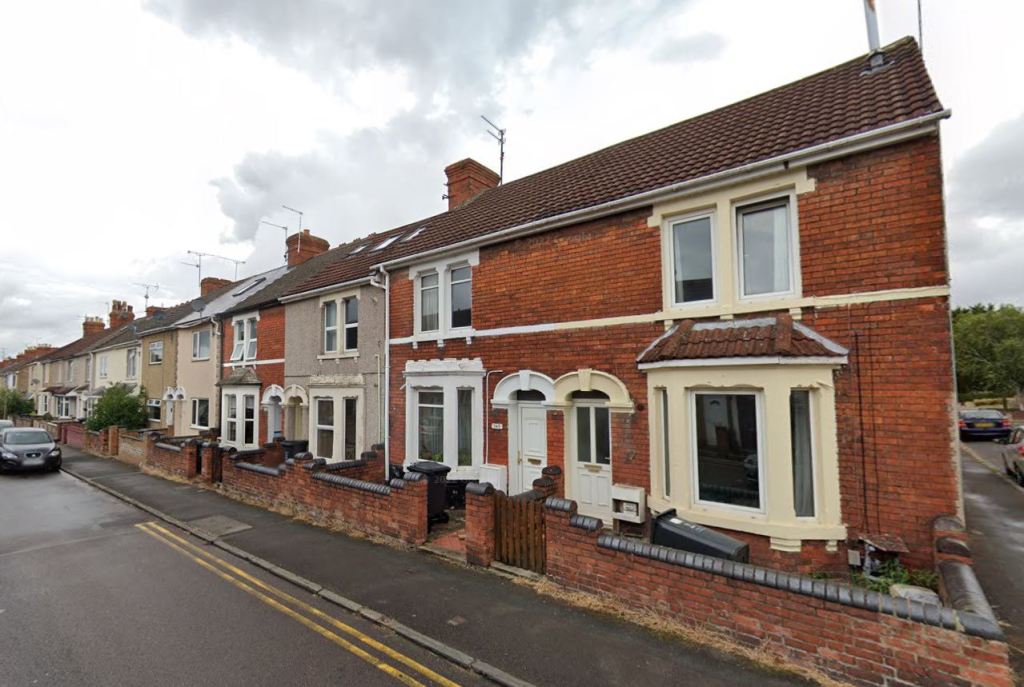
The last time we find Thomas Mullet on official documents is in the 1901 census. A Gas Work labourer Thomas lived at 146 Morrison Street with his wife Jane and three of their children – George 23, a furnaceman, Rose 19, a dressmaker and Mary 18, a shirt machinist.

Morrison Street – the Mullett family lived in the end house

Swindon

Thomas Mullett of 146 Morrison Street has succumbed to the effects of injuries sustained in an accident in the GWR Works a fortnight ago.

Deceased mounted a wall for the purpose of lighting a lamp, and fell on a quantity of rough stones his head being cut open. He received attention at the GWR Hospital and subsequently went home. After a while however erysipelas and internal complications supervened and death took place on Wednesday.

Western Daily Press Friday October 5, 1906.

Thomas Mullett aged 56 was buried on October 6, 1906 in grave plot D137 where he lies alone.

After her husband’s death Jane took stock of where her own life was going. Just two years later she had made up her mind and set sail for the USA. In 1920 she was living with her daughter Rose and son-in-law William H. Hobbs in Onondaga County, New York State.

Jane died in 1939 and is buried in Sherrill, NY, a long way away from Morrison Street and Thomas in Radnor Street Cemetery.

Thanks to Between the Bridges – The Early Days of Rodbourne – by David Lewis

Walter George Watts – killed instantaneously

Walter George Watts was known to family and friends as George. The son of Charles and Elizabeth Watts he was born in Horton, Wiltshire and began his working life at 14 years old as a farm labourer in Haydon Wick. Perhaps he was still employed on the land in 1910 – there is little information to be discovered about Walter’s life – only the report on his death.

In 1932 the Prevention of Accidents booklet was published with ‘posed’ photographs of potentially dangerous situations for those working on the railways. But it seems likely George wasn’t a railway employee. The railways were (and continue to be) dangerous places, even if you didn’t work on them.

A recent view of Montagu Street, Rodbourne

Fatality on the GWR near Swindon

A fatal accident occurred on the Great Western Railway between Swindon and Purton, about midnight on Wednesday. Two men were walking along the railway towards Swindon, and after they had passed two trains, which were meeting each other, one of them missed his companion, Walter George Watts, of 119 Montague Street Swindon. He made a search for him and eventually found his dead body by the side of the line. He had been struck by one of the trains and was killed instantaneously. The body was removed on a light engine to Swindon to await an inquest. The unfortunate man was 24 years of age and met his death on his birthday.

Western Daily Press, Friday August 12, 1910.

Walter George Watts was buried on August 15, 1910 in a public, unmarked grave, plot B2401. He was buried with two others; Jacob Fry who died in 1895 and was probably unrelated and Walter’s father Charles Watts who died in 1913.

With thanks to David Lewis – Between the Bridges – The Early Days of Rodbourne.

If you are researching your railway ancestor you may also like to visit the Railway Work, Life & Death website.

James Fox – accidental death

Fox family

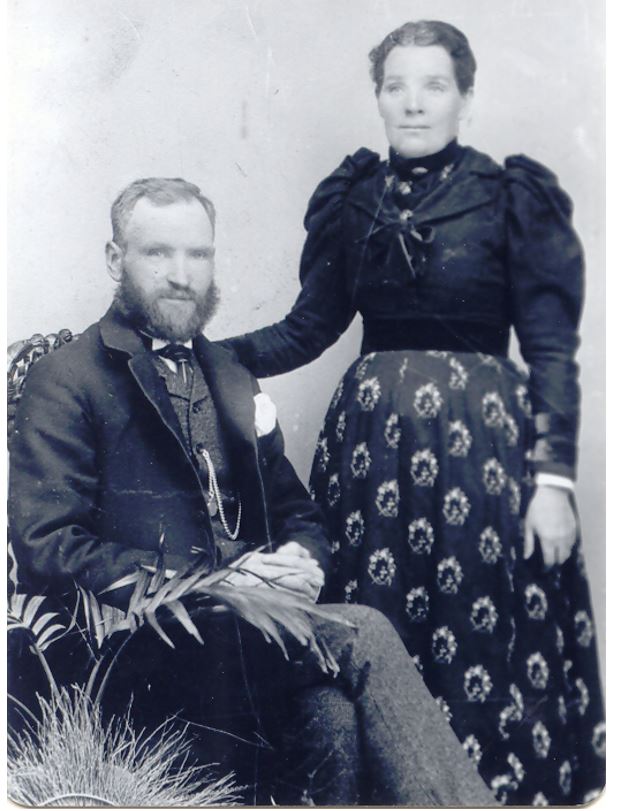
James and Annie Fox

James Fox was born on February 28, 1851. He grew up at Salthrop Cottages, Wroughton where his father Richard Fox worked as a shepherd. By 1871 he had moved into Swindon and was lodging with his brother and sister-in-law at Eastcott Hill. James married Annie Herridge on December 24, 1874.

The UK Railway Employment Records 1833-1956 state that James entered the service of the Great Western Railway in April 1876. Two accidents occurred during his working career. The first was on January 28, 1894 which caused damage to wagons. The second on December 10, 1901 caused the derailing of an engine at Swindon. There could be various reasons for these accidents; the railway industry was a dangerous working environment yet employees safety was still an issue of personal responsibility. But far worse was to follow …

Frederick George Higgins, engine driver in the employe of the GWR Co., said he was shunting on September 6th in the Swindon transfer yard. He and deceased were going ahead with one empty truck and a guard’s van. The van was at the back. They were not going more than three miles an hour. Deceased was attempting to get on the back van, and slipped. Deceased wanted to ride to go to the other end of the yard. He was not engaged upon the shunting operation. He (witness) saw the deceased slip. Deceased did not get a firm footing. He hung on with his hands, and his feet evidently caught in the crossings. The truck wheel went over the deceased’s foot, crushing it. The deceased was taken at once to the Hospital.

Dr Astley Cooper Swinhoe said he attended the deceased on Sept. 6th. He found the deceased was suffering from a compound fracture of the lower part of the left leg. The leg was amputated at once. Two days afterwards gangrene set in, and the man died from exhaustion consequent upon the gangrene.

The jury returned a verdict of “Accidental death.”

20220409_132809

Funeral of Mr Fox – Impressive Scene at Swindon Cemetery

The funeral of the late Mr James Fox, a GWR shunter, who died in the Medical Fund Hospital, last Thursday, took place in Swindon cemetery, last Sunday afternoon, in the presence of an immense concourse of people.

The funeral procession left deceased’s late residence, 163 Beatrice Street (whither the body had been removed from the Hospital), at three o’clock, arriving at the Cemetery almost half an hour later.

The coffin, which was covered with beautiful wreaths, was conveyed in a hearse, and the chief mourners, relatives of deceased, following in three mourning coaches.

Then there followed on foot about 100 uniform men from the GWR Station fellow workmen in various department with deceased, and these were headed by Inspectors Simpkins, Spurlock, Winter and Taylor. About 30 other members of the Amalgamated Society of Railway Servants (of which deceased was a member) followed, being headed by Mr G.E. Leonard (Chairman of the Swindon Branch) and Councillors J.H. Thomas and J.H. Mayell. Many members of the GWR Provident Society were also present, headed by Mr. W.H. Perry Court Pride of Wiltshire, A.O.F., of which Mr Fox had been a member for many years, were represented by Bros. T. Robinson (Secretary), N. Young, F. Williams, J. Lawrence, W. Timbrell and W. Comley.

It was a lovely fine afternoon, and by the time the procession reached the Cemetery, a crowd numbering some thousands had assembled. The greatest order was maintained throughout, and the service was impressively read at the graveside by the Rev. W.J. Scruby, Primitive Methodist Sup. Minister. Deceased was buried in the same grave as his wife, who died last April, and a son, who died some four years ago.

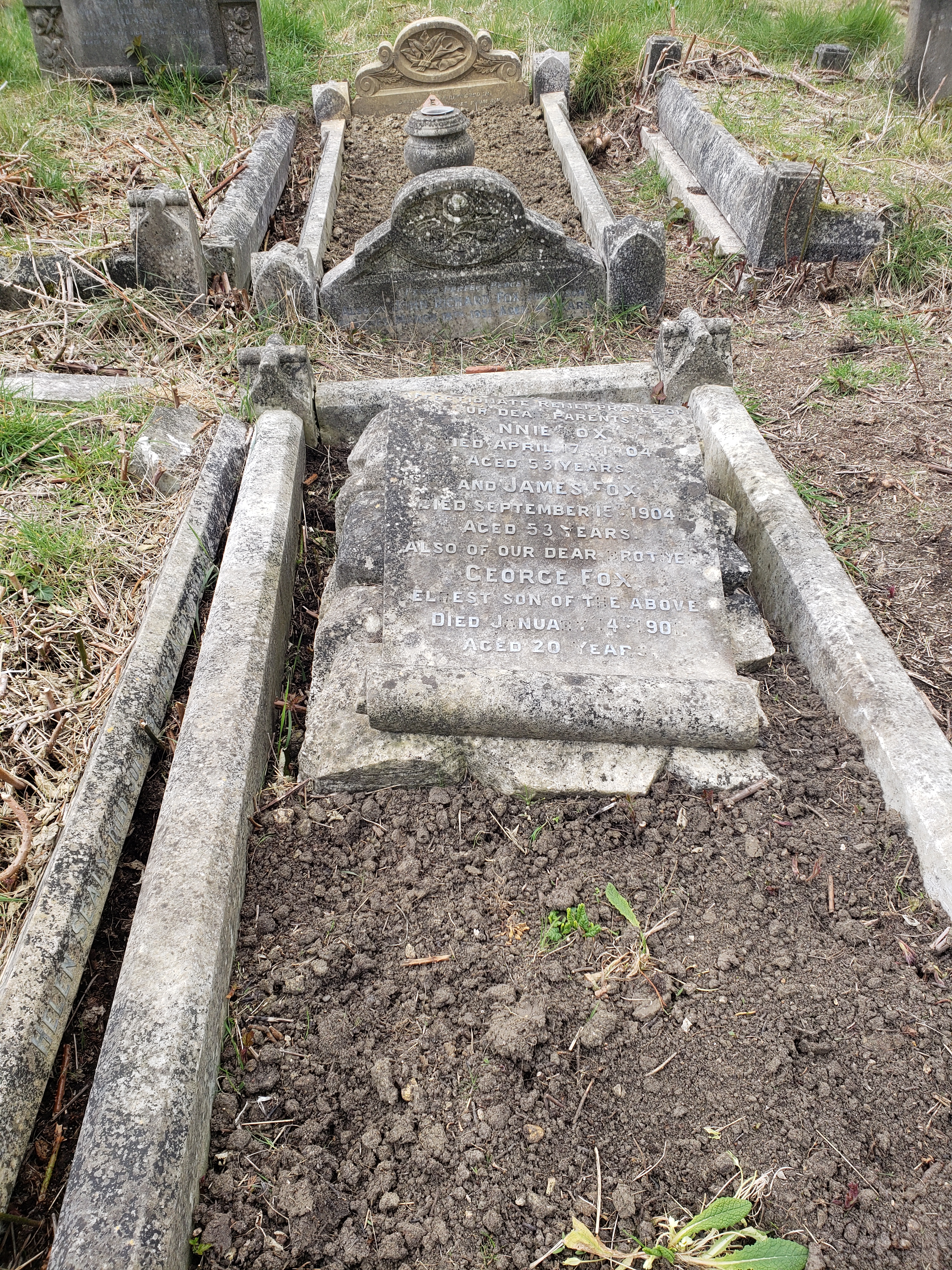
The coffin was of polished elm, with brass furniture, and bore the following inscription: James Fox, died September 13th, 1904, aged 53 years.

Extracts taken from Inquest and Verdict/Funeral of Mr Fox Swindon Advertiser Friday September 23, 1904.

James Fox 53 years 63 Beatrice Street burial September 18, 1904 grave plot E7385

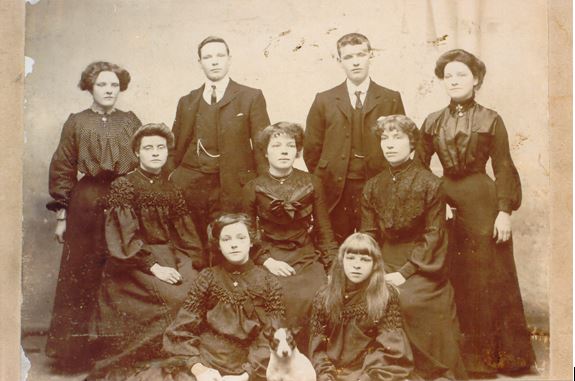
Photograph of the Fox siblings believed to have been taken on the day of James Fox’s funeral – Back left to right – Florence, Henry James, Tom, Elizabeth. Middle row left to right Annie Amelia, Emily, Alice. Front row left to right Winifred Ellen, Rose.

Railway Work, Life and Death project

There are copies of the Medical Fund Society Yearly Reports in Local Studies, Swindon Central Library and I recently published a blogpost about the Accident Hospital.

During 1885 there were 30 patients treated in the Medical Fund Hospital who had sustained injuries during an ordinary working day. Men like Henry Kent 44, a goods guard from Salisbury, who suffered fractured ribs and shoulder and died after 2 days in hospital. Thomas Tuck 38, a labourer from Wootton Bassett, who suffered a scalp wound but was discharged after 10 days in hospital. There are more details available about William Ball 56, a driver from Swindon, who fell off an engine while in motion and fractured two ribs and injured his head. He spent 29 days in hospital and was ‘discharged convalescent.’

Yesterday evening the Friends of Swindon Railway Museum’s monthly lecture, entitled ‘Into the Jaws of Death – working and dying on Britain’s railways 1900-1939,’ was delivered by Mike Esbester from the University of Portsmouth. The subject was the danger railwaymen faced on a daily basis whether working on the trackside or in railway factories such as Swindon Works.

In 1913 30,000 railway workers across the UK were killed or injured and yet responsibility was largely put on the men themselves – that they were careless!

In Mike’s presentation he talked about not just unsafe working practices and conditions but the pressure on workers to complete tasks at sometimes unrealistic speed; when wages were docked if targets were missed. Despite a railway inspectorate that highlighted dangers and trade unions that demanded change, railway companies were reluctant to act, and as Mike emphasised the onus was firmly placed upon the railwaymen themselves. Their personal safety was their responsibility.

In 2016 a joint initiative by the University of Portsmouth and the National Railway Museum saw the beginning of the ‘Railway Work, Life & Death’ project to try to make railway worker accident records more accessible and to see what could be learnt from them. These records are of interest not only to museums and archives professionals but to railway enthusiasts, family historians and the current railway industry. To date volunteers have transcribed around 50,000 surviving records, which are available to view on the project’s website.

Mike’s lecture was both compelling and revelatory. To discover more visit www.railwayaccidents.port.ac.uk.

And if you would like to join the Friends of Swindon Railway Museum visit their website. http://www.fosrm.org.uk/

Images of the Medical Fund Hospital published courtesy of https://swindonstory.uk/stories/gwr-hospital/

Accident Hospital

The Accident Hospital was opened in December 1871 and as the name suggests, that was its sole purpose in those early years. This postcard image published on the Local Studies flickr page has the annotation – ‘For use in case of accidents which are of daily occurance in the GWR Factory.’

On January 12, 1886 doctors Swinhoe, Howse and Bromley made their Accident Hospital Doctors’ Report to the Medical Fund Committee as follows:

Gentlemen,

The New Year of 1885, found us with three Patients in our Accident Hospital. Since then, twenty-seven new cases have been admitted, making a total of thirty for the twelve months. Of these, twenty have been discharged convalescent, six have died, and one is still under treatment and doing well.

We enclose tabulated list for your better information.

We are, Gentlemen,

Your obedient Servants,

Swinhoe, Howse, & Bromley.

Among the injuries treated during 1885 were leg fractures, a crushed foot and fractured ribs.

Of the six deaths that occurred in the hospital four of the deceased were buried in Radnor Street Cemetery.

Fireman Charles W. Nicholls aged 23 of 13 Medgbury Road died from having his ‘chest crushed in’. Charles Nicholls was buried on September 6, 1885 in grave plot A309.

George Turnbull aged 33, Charge Man in B2 Shop died from a compound fracture of the skull having spent 3 days in hospital. George Turnbull was buried on April 2, 1885 in grave plot A727.

Thomas Edwards who worked in the Saw Mill was admitted with a rupture and spent 40 days in hospital where he died of consumption. He was 33 years old. Thomas Edwards was buried on March 28, 1885 in grave plot A204.

William Collett of 40 Princes Street was admitted to the hospital suffering from extensive burns. He died 2 days later. He was 49 years old. William Collet was buried on March 26, 1885 in grave plot A628.

Locked out!

So, what do you do when you go up to the cemetery with a long list of graves to find and photograph to discover the cemetery gates are locked. Well you go to another churchyard instead!

There are few remaining headstones in the churchyard at St. Mark’s. It is unlikely there were ever many more as this was the burial place of the early residents of the railway village, most of whom were young with large families and little money.

By the end of the 1870s burial space at St Mark’s was running out and a new burial ground was urgently needed. This and the increasing demands of the large non-conformist congregations for an independent burial ground saw the establishment of Radnor Street Cemetery in 1881.

Robert Hanks was born in Bristol, the son of Thomas and Elisabeth Hanks, and baptised at St. Phillip and St Jacobs, Bristol on October 16, 1796. He married Elizabeth Phillips at St Paul’s, Portland Square, Bristol on September 10, 1820 and the couple had six surviving children.

The 1841 census finds the family living at an address at the Viaduct Foundry, Newton in Mackerfield, (Newton le Willow) Lancashire, where both Robert and his eldest son, also named Robert, are working as mechanics.

By 1851 the family had arrived in New Swindon where they lived at 13 High Street (later renamed Emlyn Square).

In 1866 Robert was killed in an accident in the Works when an iron truck on which he was working toppled over, crushing him. He was 71 years old.

It is said that after this fatal accident, Joseph Armstrong, Locomotive, Carriage and Wagon Superintendent, began a series of measures designed to improve safety in the railway factory.

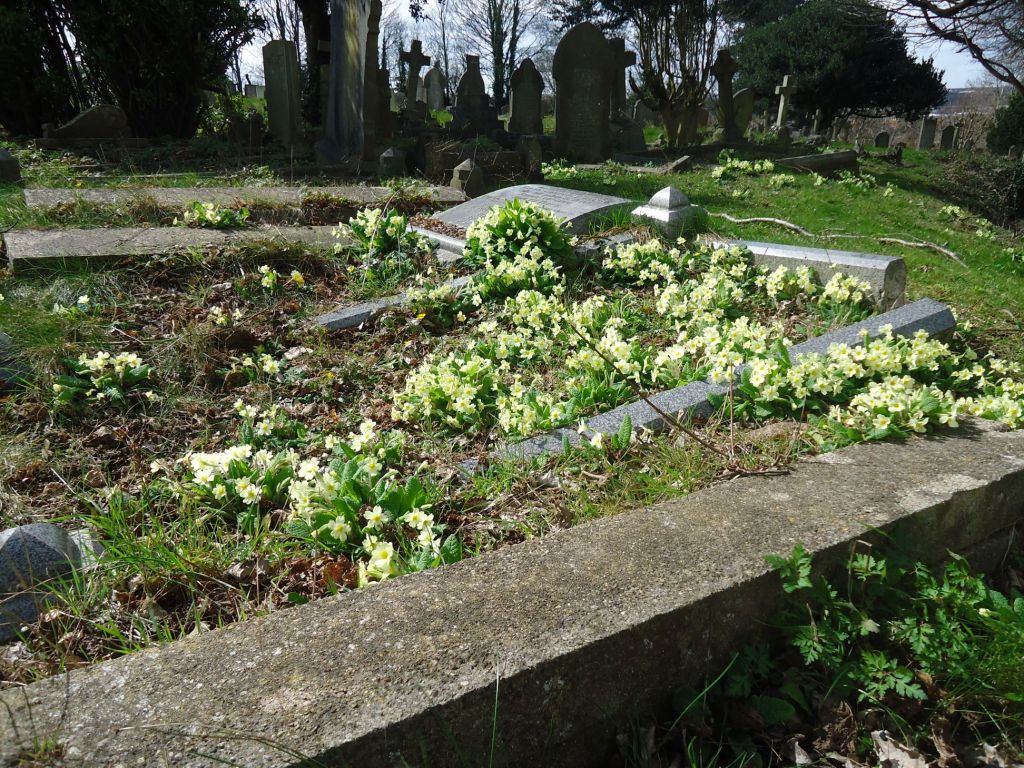
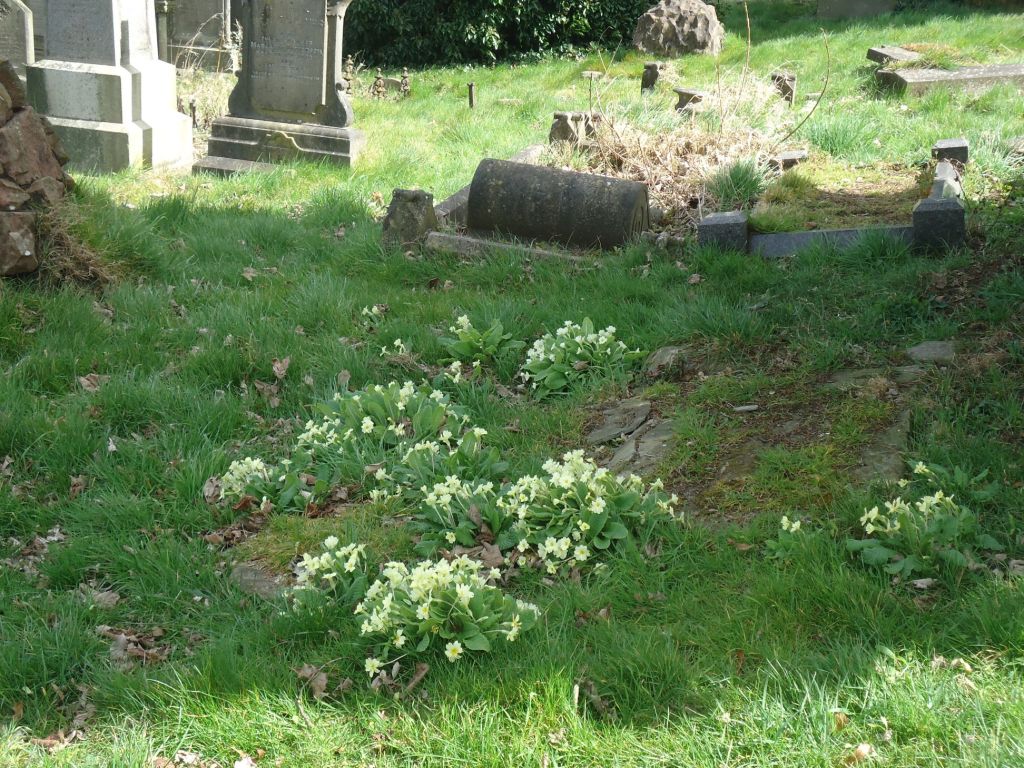
A profusion of primroses

Despite the persistent rain of recent weeks the cemetery is boasting a profusion of primroses. You may like to read again the story of James Shopland whose grave is wreathed in the cheery little spring flower, whatever the weather.

James Shopland, a civil engineer, was born in Purton in 1873, the son of James Rew Shopland, also an engineer.

By 1900 James had moved to the Southampton area and on July 6, 1900 he was at the Southampton Sewage Works, although it was pointed out at the inquest that he had nothing to do with the works, but was assisting in the rescue.

Three labourers working in the press house at the Sewage Works had attempted to free a blockage in a lime vat, firstly by ramming a rod down from the top, which was the usual way of clearing it. However, when this didn’t work, one of them went down into the ejector chamber and tried to free the pipe by undoing it. They tried to remove the cap but this wouldn’t move either, so they proceeded to remove a flange from the bottom and then the upright pipe. This immediately set off a fast flow of sludge and released a smell that rendered the men semi-conscious.

Passing workmen attempted to rescue the three men who were all lying unconscious in the sludge. As a call went out for volunteers, James Shopland arrived on the scene. A witness at the inquest described how as Mr Shopland descended the ladder he saw him put his hand to his head.

At one point someone tried to stop any more men going into the chamber, declaring that at this rate there would soon be fifty dead at the bottom.

James was brought to the surface where artificial respiration was attempted, but he was already dead. At the subsequent post mortem the cause of death was found to be due to congestion of the lungs brought about by carbolic acid gas poising.

The jury at the inquest recorded a verdict of accidental death and commended the noble endeavour made by James Shopland and four others who had attempted to rescue the men.

James was 26 years old and had been married for just a year. He is buried in plot D100 with his wife Helena (Nellie) Elizabeth Shopland. Helena moved to Bournemouth where she lived with her widowed mother-in-law, but she eventually came back to Swindon. At the time of the 1911 census she was living at 159 Goddard Avenue with her sister Violet Blanche Brown. She died just a few weeks later, on June 16, 1911. Her funeral took place on June 20 and she is buried with her husband.

William Dicks and the tunnel

The GWR Works was a dangerous place in which to work and until the construction of the main entrance tunnel it was even a dangerous place to get inside.

The original Workmen’s East Gate Works entrance was a route that involved crossing the mainline track and was the scene of numerous fatal accidents. There were 3 deaths in a single month in 1869, the year before the tunnel opened.

Joseph Armstrong, the first Locomotive, Carriage and Wagon Superintendent ushered in a period of rapid expansion during the 1870s which included the construction of the Carriage Works and a new, safer route into the railway factory. The main entrance into the Works was built on Bristol Street, opposite the Mechanics’ Institution and consisted of a tunnel measuring approximately 100 yards [91.4m] that ran northwards beneath the mainline track.

Contemporary photographs record the hundreds of men streaming out of the tunnel at the end of the working day, however, even after the tunnel opened on February 5, 1870 accidents continued to occur as men still cut across the railway line to work.

In 1905 William Dicks was struck down and killed going back to work on Saturday January 14. The report of the inquest published in the Wiltshire Times makes for gruesome reading.

Fatal Accident

Man Killed at the Works

A shocking fatality occurred on the Great Western Railway at Swindon on Saturday. William Dicks, an employe in the locomotive works had just returned from breakfast and crossed the rails in order to reach the check office. He failed to notice the approach of an engine which was out on its trial trip, and though his workmates tried to warn him of his danger, it was without avail, and he was knocked down by the locomotive and injured so terribly that he died on his removal to the hospital. Both his legs were severed, and his head was frightfully battered. Deceased, who was 52 years of age, was well known as a clarionist. [clarinetist].

At the inquest on Monday it was stated that deceased had no business to cross the line, a tunnel being provided for the men. – Dr Swinhoe said the man was practically cut in half.

The Coroner said he thought they could only return a verdict of “Accidental death” but they might add a rider to the effect that notice boards should be fixed in prominent places to warn the men not to cross the line. The Company certainly took every precaution in protecting employes, and the men should use the tunnels which had been provided for their express use.

The jury concurred, and returned a verdict accordingly.

The Wiltshire Times, Saturday January 21, 1905.

William Dicks was buried on January 18, 1905 in grave plot C1445, a public grave, which he shares with his wife Jane who died in 1909, and one other person

Today the Grade II listed former Carriage Works is the subject of a Heritage Action Zone project. Work has included improvements to the Sheppard Street underpass, London Street and the Bristol Street tunnel has also received a makeover. New interpretation boards at the entrance tell the story of the railway factory and the railway families who made New Swindon.

Image dated c1905 published courtesy of Kevin Leakey

Image dated c1950 published courtesy of Local Studies, Swindon Central Library.

Ghostly railway workers superimposed on a photo of the tunnel – see new interpretation boards at the tunnel entrance