During this month of remembrance I will be telling the stories of those buried in Radnor Street Cemetery who died as a result of their military service.
The Commonwealth War Graves headstone on grave plot C3653 commemorates two military heroes who served in not only the Great War but in the South African campaign as well.
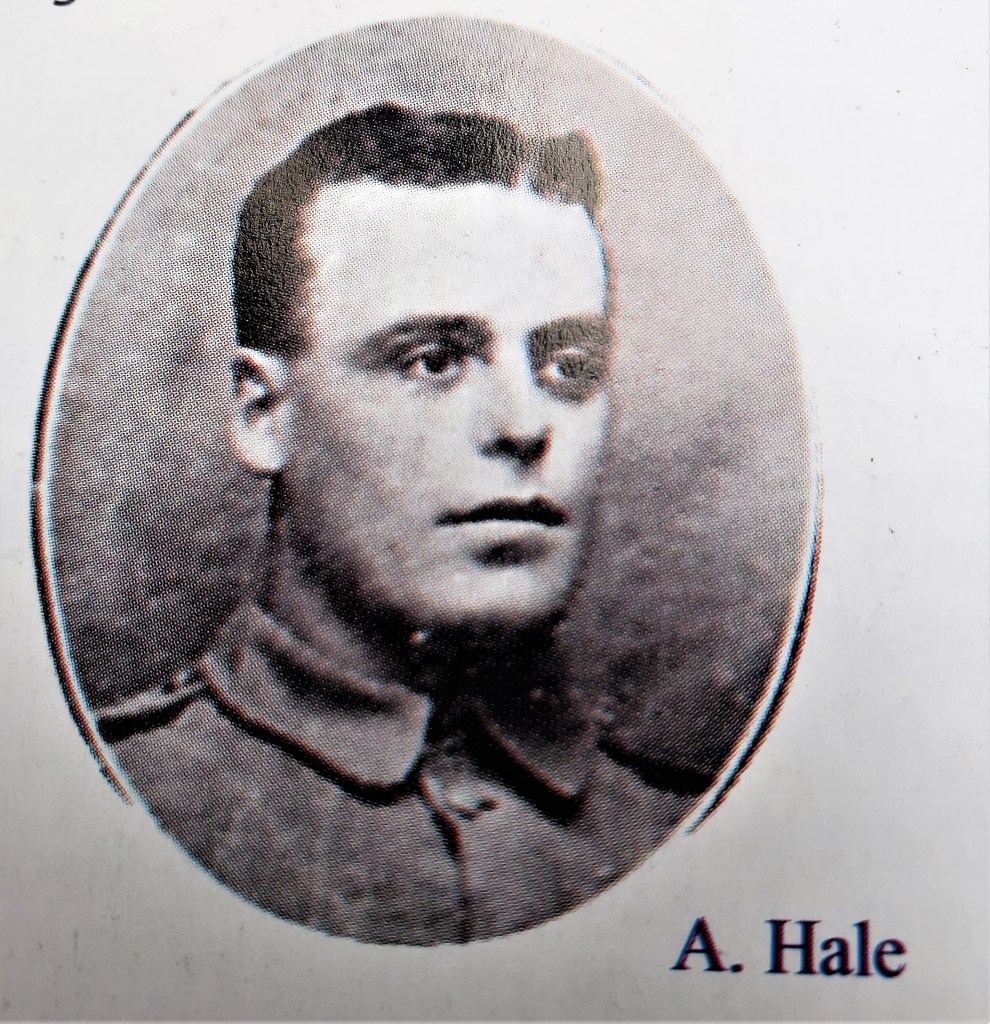
Alfred Hale born in c1869 in Enford, Wiltshire was about 17 years old when he enlisted with the Wiltshire Regiment in 1886. Having served for 7 years he was transferred to the Reservist List. In 1894 he married Mary Jane Paradise at the church of St. Mary the Virgin, Devizes. He was recalled to serve in 1898 and again in 1900. (A son born that same year was named Frederick William Mafeking). He was discharged and added to the Reservist List in 1902. Having received the Queen’s South African Medal with clasps he might have expected that this was the end of his military career. However, in September 1914 he was recalled to serve yet again, by then he was 44 years old.
Perhaps Mary Jane was used to being a soldier’s wife. Perhaps she never expected her husband would return from that terrible war in South Africa. But the outbreak of the Great War in 1914 must have brought a whole new level of worry when her eldest son Alfred enlisted and her husband was recalled.
3655 Pte Alfred Hale was discharged unfit to serve on September 25, 1916. He had cataracts in both eyes. His medical records state that his condition was not the result of and not aggravated by his military service and that an operation was advised. Alfred returned to his home at 163 Beatrice Street, Gorse Hill. He died at the London Hospital on November 7, 1919 aged 49. He was buried in grave plot C3653 on November 13, 1919.
200214 Pte Alfred Hale, aged 24 was serving in Israel and Palestine when he died from pneumonia on February 21, 1919. He was buried in Ramleh War Cemetery. He left £30 11s 11d to his mother, which included a War Gratuity of £26 10s.
Father and son are both remembered on a CWG headstone. The inscription reads:
3655 Private A. Hale
Wiltshire Regiment
7th November 1919 Aged 49
Also in memory of his son
200214 Pte A. Hale
Wiltshire Regiment
21.2.1919
Sharing the grave with Alfred is Mary Jane, his wife, who died in 1958 aged 85 years old. The inscription reads ‘Rest After Weariness.’ Buried with them is their son Frederick William Mafeking who died in 1953 and George Saloway, their daughter’s husband, who died in 1954.
Lewin Tom Clark was one of five children born to Tom and Sarah Jane Clark. His father died in 1891 after which his mother married Joseph Peart, an Printer Compositor, in 1900 and the couple went on to have two children. Lewin trained as a Bootmaker Clicker and served a five year apprenticeship with Swindon boot and shoe manufacturer W. Reynolds.
He served in the 2nd Vol Bat Wilts Regt and on January 10, 1902 he enlisted with the Imperial Yeomanry. His attestation papers reveal that he was 20 years and 1 month old, 5ft 5ins tall and weighed 129 lbs (just over 9 stones). He had a chest measurement of 34″ with a maximum extension of 36″. He had a fresh complexion, brown eyes and brown hair.
He served 118 days at home before being sent to South Africa where he served from May 8, 1902 to October 17, 1902 – a total of 163 days.
On October 26, 1902 he was discharged ‘at his own request.’ His conduct and character were recorded as very good and he was awarded the South Africa 1902 medal.
He returned to his mother and step-father’s house at 19 Lansdown Road in Swindon and a job in the GWR Works, but who was to know his state of mind or what he had witnessed during his time in South Africa.
Swindon Man Killed at Aldershot
Found Dead on the Railway
A Mysterious Affair
A man named Lewin Tom Clark, of Swindon – his parents reside at 19 Lansdown Road – was found killed on the railway at Aldershot on Friday.
Deceased, who was 22 years of age, had been employed in the GWR Works at Swindon.
It still remains a mystery why the young man journeyed from Swindon toAldershot, and why his life should have come to such a tragic end. When the body was searched, no money was found upon him, nor any articles of value. His head was terribly smashed, and he had sustained other injuries, which caused immediate death.
The body was at once removed to the mortuary, and deceased was quickly identified by means of papers found upon him. These included a discharge paper, which showed that he had served a year in the Imperial Yeomanry in South Africa. He had a medal for war service, and was discharged with a good character. The Aldershot Police communicated with Sup. Robinson and Inspector Everett at once saw the relatives of the deceased, whose step-father, Mr Joseph Peart, proceeded to Aldershot on Friday night, and identified the body.
The Inquest
Was held at Aldershot on Saturday. The first witness called was Joseph Peart, compositor, of 19 Lansdown Road, Swindon, who identified the body as being that of his stepson. He was a single man, 22 years of age. He served in the Imperial Yeomanry in South Africa, and was discharged in October, 1902. Witness did not know why deceased left Swindon, where he had been employed in the GWR Works. Witness did not think deceased was in any trouble. He had seen him a day or two previous with his young lady. Witness had never heard him express a wish to go to Aldershot.
Josiah Marshall, guard on the South Western Railway and living in London, said he was guard in charge of a passenger train which left London at 3.5 a.m. on Friday for Aldershot, where they arrived an hour later. He returned with the empty coaches to Woking, which he left again at 4.12 a.m. When passing the tunnel at Aldershot he was looking out – it was a bright morning – and when about 250 yards from the tunnel, towards London, he saw the body of a man lying by the side of the line. Witness did not stop the train, but afterwards reported the matter to the police.
A Military Funeral
The funeral of the deceased took place in Swindon Cemetery on Tuesday evening last, when the remains of deceased were laid to rest with full military honours.
Despite a great downpour of rain, there was a very large number of people who followed the solemn cortege to the graveside. The members of the local Companies of the Volunteers, F and G and K and M Companies, under Lieut. D.C.A. Morrison, mustered in strong force to pay a last tribute to their deceased comrade. The coffin was enshrouded in a Union Jack, and on it were placed deceased’s busby and belt. Members of the Volunteers acted as bearers. The firing party, under Sergeant A.C. Woolford, marched with rifles reversed, and the Bank, under Bandmaster Sergeant Jago, with muffled drums. On the way to the Cemetery, the Bank played the “Death March.” Large crowds of people lined the route to the Cemetery, and the spectacle was a most impressive one, the sombre aspect of the black uniforms and muffled drums, being added to by the continuous drizzle of rain.
In consequence of the very inclement state of the weather, the last solemn service was taken in the Cemetery Chapel, only a brief committal prayer being offered at the graveside.
During the firing of a volley over the grave one of the sisters of the deceased was seized with hysterics, and had to be assisted from the graveside.
The service was conducted by the Rev H.M. Hull, and the local arrangements for the funeral were in the hands of Mr F.J. Williams, of Bath Road. The coffin was of polished elm, with brass furniture, and the inscription on the plate was: “Lewin Tom Clark, died June 10th, 1904 aged 22 years.”
Extracts from The Swindon Advertiser Friday June 17, 1904
Lewin Tom Clark was buried in plot B1173, a public grave, with two other unrelated persons. As is the case with public graves, there is no headstone to mark the spot.



 Radnor Street Cemetery