When my much loved Auntie Ruth died more than thirty years ago I was surprised at the number of ladies who attended her funeral and sang with great gusto. It was unexpected as I was her only living relative and she had few friends, so I was anticipating a small and sad funeral. I later discovered that these ladies were members of the church, and although my auntie had not attended for many years, they accompanied every funeral, adding their voices to the hymns and responses.
Andy Binks, my cemetery walk colleague, likes to read out a letter published in the Swindon Advertiser in 1902 where uninvited mourners were definitely not appreciated. Our next guided walk is on Sunday June 1, meet at the chapel at 1.45 pm for a 2 pm start. I’m sure Andy will ready out this letter; it’s the reference to womanly instincts that amuses him.
Correspondence
Disgraceful Scenes
To the Editor of the Swindon Advertiser
Sir, – It has been my sad duty to visit the Swindon Cemetery rather frequently of late, and I have been struck with what I can only call the disgraceful scenes which are allowed almost daily to take place in what should be a sacred ground. Whenever there is a funeral, one notices the same crowd of women trampling over the graves to obtain a sight of the mourners and to discuss the qualities of the deceased. One day last week I happened to be there whilst three funerals took place, and the crowd appeared quite to forget the sadness of the occasion, their only object being to get a glimpse of all three gatherings.
Surely the officials must know these heartless gossips by now, and they should be given the power to prevent their admittance to the Cemetery grounds.
To any person who has a dear one resting there, it is painful to think that his or her last resting place is being trampled upon by women whose curiosity tide what should be their best womanly instincts.
Thanking you in anticipation. – I remain, yours truly,
Stories still circulate that in the 19th and early 20th century babies who died within days of their birth were buried with unrelated adults awaiting a funeral, usually an elderly woman – a comfort to the bereaved mother. So far I have not found any examples in Radnor Street Cemetery, but then how would such an incident be discovered?
Mostly the babies were buried in large, communal plots. In section Lower B there are a number of these plots reserved for the burial of infants under a year old. Several babies lived for just five minutes. Some entries contain the barest details while others include the parents’ names; one sad entry records ‘male child found in Wilts & Berks Canal.’ Burials often took place daily, sometimes with more than one burial a day.
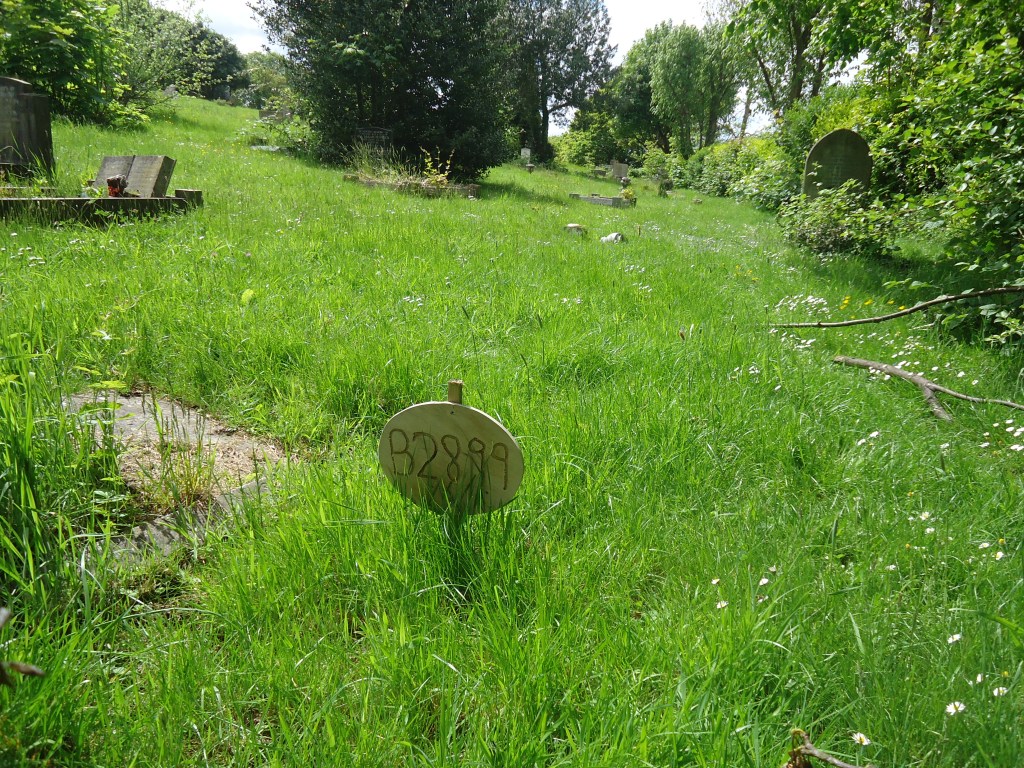
Here is a list of the names of those babies buried in grave plot B2899 between 1903-1905.
1903
7771 Margaretta Hobbs 10 days 23 Poulton Street 3rd March
7796 Ethel Blake 24 hours 39 Summers Street 25th March
7804 Edward John Gibbs 16 days 107 Salisbury Street 28th March
7811 Florence May Alder 13 days 6 Avening Street 1st April 1903
7812 George Jackson 5 min 14 Ripley Road 1st April
7814 Alfred George Gibbs 3 weeks 107 Salisbury Street 4th April (twin of Edward John Gibbs)
7830 child of John and Lily Selwood 13 days 50 Suffolk Street 16th April
7846 George Edmund Jackson 6 hours 28 Whiteman Street 24th April
7851 Turner (male) 1 hour 25 Vilett Street 28th April
7853 Edith Thesbe Ashton 1 month 22 Regent Place 29th April
7882 Albert Edward King 1 day 24 Byron Street 28th May
7855 David William Williams 14 days 14 Regent Place 6th June
7893 Ernest Speake 8 days 162 Westcott Place 11th June
7947 Frederick Hudd 1 hour 28 Avening Street 27th July
7961 Charles Blake 7 hours 64 Bridge Street 7th August
7971 Stanley (female) 10 minutes 65 Ponting Street 12th August
7975 Alice Irene Beard 17 hours 59 Eastcott Hill 18th August
7982 Gladys Eliza Smith 25 days 3 Gloucester Street 23th August
7986 Percival James Lawrence 12 days 2 Dowling Street 28th August
7991 Edward Ockwell 4 hours 10 Hythe Road 1st September
7996 Annie & Jessie Smith (twins) 1 day 41 Avening Street 10th September
8015 George Ricks 1 day 224 Ferndale Road 24th September
8016 John Baker 25 days 14 Whitehead Street 25th September
8017 Lily Barington 4 days 22 Rosebery Street 28th September
8022 Minnie Broadbear 22 hours 76 Crombey Street 2nd October
8048 Herbert George Mitchell 1 day 19 Dowling Street 25th October
8062 William Alfred Farrer 2 days 1 Holbrook Street 5th November
8068 William Thomas Payne 1 day 5 Carr Street 10th November
8070 Violet Harding 1 day 7 Morley Street 11th November
8074 Violet Law 21 days 122 Morrison Street 14th November
8081 Ethel May Payne 12 days 5 Carr Street 20th November (twin of William Thomas)
8089 Elizabeth May Peters 11 days 89 Medgbury Road 27th November
8095 George Morris 7 hours 95 Ponting Street 30th November
8097 James Rawlinson 25 days 3 Medgbury Place 1st December
8110 Dolly Rendell Illegitimate child of Charlotte Rendell 1 month 22 Swindon Road 9th December
8114 Albert Edward Ponting 16 days 26 Hinton Street 10th December
8135 Hall (male child) 13 hours 146 Beatrice Street 19th December
8138 John Chandler 2 days 9 Whitney Street 23rd December 1903
1904
8156 Elizabeth Chappell 12 days 6 Morris Cottages 1st January
8162 Charles Frederick Lander 15 days 6 Kitchener Street 5th January
8170 Stephen John Warren 3 weeks 12 Bradford Road 7th January
8181 Grace Wright 7 days 12 Granville Terrace 11th January
8189 William Arthur Franklin 1 month 155 Redcliffe Street 15th January
8196 Frederick James Webb 1 month 11 Bright Street 18th January
8197 Pope Francis Pope 21 hours 71 Curtis Street 19th January
8210 Fred Jefferies 1 day View Point House, North Street 28th January 1904
8216 Gladys Carter 13 days 4 Salisbury Street 30th January
8217 Alfred Edward Lord 27 days 46 Prospect Hill 30th January
8230 James Woolford 36 hours 134 Morrison Street 5th February 1904
8235 Speck (male) 10 months 13 Chester Street 8th February
8238 Mabel Boucher 1 month 25 Oriel Street 10th February
8247 Edith Beer 2 days 26 Prospect Place 19th February
8253 Bertie Green 3 days 101 Westcott Place 20th February
8262 (a) Albert Edward Button 1 month 14 Commercial Road 27th February
8263 Harold Edwards 5 days 69 Caulfield Road 29th February 1904
8264 Percival (male) 5 minutes 4 Bruce Street 29th February 1904
8271 Henry William Turner 5 days 7 Cambria Bridge Road 3rd March
8301 Elizabeth Ann Mayell 1 month 17 Florence Street 26th March 1904
8317 Lily Griffiths 2 days 18 Avening Street 11th April
8323 Sidney Alfred Leach 13 hours 25 Avening Street 19th April
8326 Stanley (male) 3 days 85 Dixon Street 19th April
8328 Gladys Kent 14 days 36 Cricklade Street 20th April
8330 Sarah Osborne minor 20 mins 20 Belgrave Street 22nd April
8353 Florence May Wright 1 month 23 Dean Street 7th May
8356 Charles Brown 6 hours 151 Morrison Street 13th May
8363 Emma Lecomte 12 hours 87 Eastcott Hill 18th May
8372 Elizabeth Ellen Adams 13 days 12 Exeter Street 24th May
8382 Harry Loxton 12 hours 1 Sonning Villa 30th May
8405 Hector Cecil Ashfield 2 days 34 Prospect Place 21st June
8409 Cox (Male) minor ¾ hour 151 Manchester Road 25th June
8415 Viscount Heath 2 weeks 2 Western Street 1st July
8423 Amelia Ann Hewer 14 days 118 Chapel Street 8th July
8436 Godfrey Smart 3 days 48 Albion Street 18th July
8467 Dobson (Female) 2 days 3 Stanier Street 11th August
8476 Ivy Price ½ hour 4 Argyle Street 17th August
8487 Leslie Gordon Ralph 7 days 58 Manchester Road 29th August
8511 Sandling (Female) 7 hours 201 Rodbourne Road 15th September
8536 (female) Leach 1½ 19 Cricklade Road 11th October
8545 Emily Florence Morris 3 days 49 Kingshill Road 18th October
8549 George John Spencer 1 month 50 Newport Street 19th October
8551 Edith Ellen Wait 1 day 128 Ferndale Road 19th October
8552 Leslie Slatter 18 hours 42 Goddard Avenue 19th October
8564 Nellie Fagan 7 hours 121 Beatrice Street 26th October
8572 Leonard Pitman 2 days 16 Kitchener Street 29th October
8591 Nellie Tarrant 4 hours 23 Jennings Street 5th November
8597 John Romans 3 days 18 Edmund Street 11th November
8602 (male) Dowse 5 min 70 Edinburgh Street 14th November
8632 Philip Arthur Nash 19 days 3 Sanford Street 28th November
8657 Albert Scutts 3 weeks 10 Albion Terrace 7th December
8660 Gladys Marcia Dowers 19 days 28 Hughes Street 7th December
The sad story of Elizabeth Jane Hardy who died at the Wilts County Mental Hospital in Devizes in 1934 and was buried there in error.
Exhumation of Swindon Woman
Re-Burial in Radnor Street Cemetery
The Late Mrs Hardy
Early on Friday morning, in the presence of about half-a-dozen people, the body of Mrs Elizabeth Jane Hardy, aged 82 of Swindon, was removed from the grave in the hillside cemetery at the Wilts County Mental Hospital at Devizes, where it has been for just over a month.
The exhumation, by request of the Home Secretary, Sir John Gilmour, who granted the order, was carried out “As quietly as possible,” and only three members of the public were present at the re-burial at the Radnor Street Cemetery, Swindon, an hour later.
Secret Proceedings
And so at last satisfaction has been secured in connection with the unfortunate mistake that led to Mrs Hardy being buried in the Mental Hospital grounds against the expressed wish and without the knowledge of her 82 year-old husband, Mr Samuel Hardy, of 4, Euclid Street, Swindon.
Not a single relative was afforded an opportunity of attending the first burial, or of sending a few flowers down to the hospital, and immediately he heard of what had taken place, Mr Hardy and other members of the family, who naturally, were greatly distressed, vowed that they would not rest until an exhumation order had been secured.
In order to avoid any kind of public demonstration, the proceedings on Friday morning were carried out with the utmost secrecy.
The exhumation order was issued on Monday through Mr A.E. Withy, who has been acting for Mr Hardy, and the Mental Hospital authorities were immediately notified. Last Thursday afternoon the arrangements for lifting the body were completed, and Mr F.N.W. Baker, son-in-law, accompanied by Mr D.S. Smith (son of Mr A.E. Smith, the undertaker) motored down to the hospital cemetery on Friday morning.
The grave had been opened by the time they arrived, and when the coffin was disinterred Mr Baker expressed a wish that the lid should be raised in order that he might identify the body. This was done.
Those present at the exhumation included Dr. J.W. Leech, acting medical superintendent of the hospital, Mr J. S. Deavin, Clerk, and the Rev. Dudley, hospital chaplain.
The Mourners
The elm coffin was then enclosed in a magnificent oaken shell, and brought in a hearse to Swindon.
Just after nine o’clock, following a short service conducted by the Rev. Bertram E. Woods, of the Methodist Central Mission, Swindon, the re-burial took place in the Radnor Street Cemetery, in the grave which was originally opened for the public funeral that had been arranged to take place on Tuesday, 3 April.
The mourners present were Mr Samuel Hardy, husband; Mrs F.N.W. Baker and Mr Baker, daughter and son-in-law; Miss Joan Baker, granddaughter; Mr and Mrs Walter Timbrell, niece and nephew; Mrs Butt, Mrs Tylee and Mrs Selby, nieces; Mr and Mrs F. Baker, and Mrs Trowbridge, friends.
Mr Hardy, in conversation with a North Wilts Herald reporter, said the members of the family were greatly relieved to know that their efforts had been successful, and they owed a great debt of gratitude to the many friends who had sympathised with them in this sad affair.
“We are particularly grateful to Sir Reginald Mitchell Banks,” added Mr Hardy. “When the appeal was made to him, he instantly responded, and despite the great call upon his time personally sought the Home Secretary in order to hasten forward the granting of a licence.”
North Wilts Herald, Friday, 11 May, 1934.
Elizabeth Jane Hardy was buried in grave plot D919 where her husband joined her when he died in 1937.
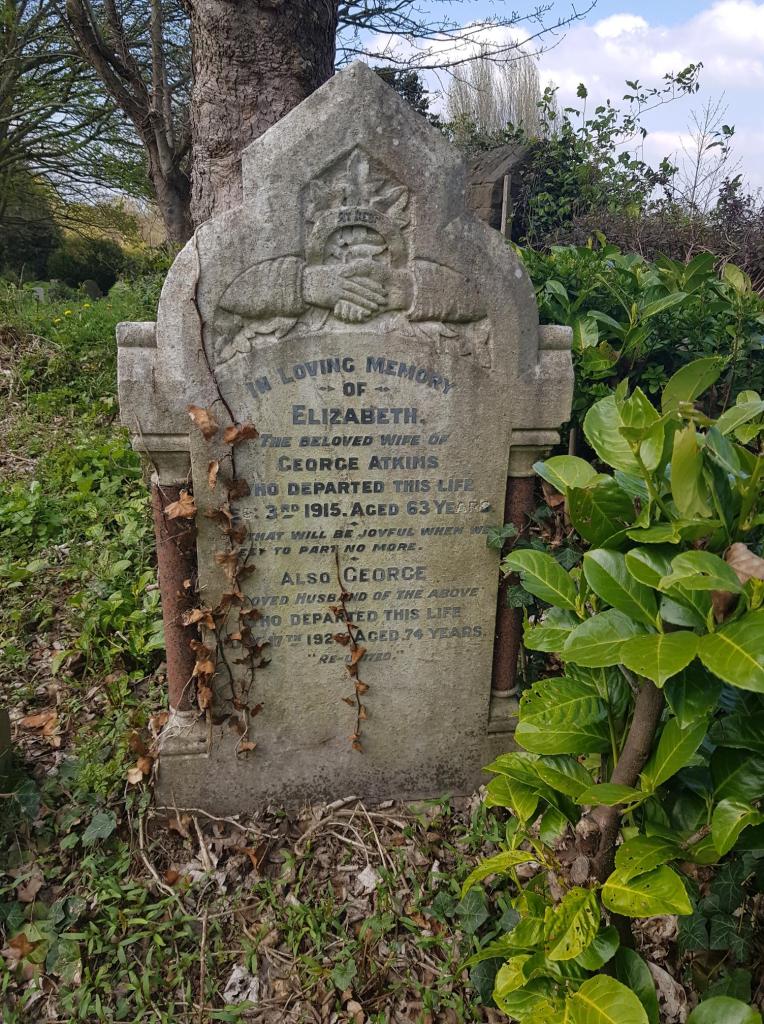
In recent years the hedge on the periphery of the cemetery has engulfed this headstone, so it was fortuitous that I was passing just after it had been trimmed and was able to take a photograph. A very elegant memorial, this headstone is full of funerary iconography and symbolism and tells us much about the couple’s relationship and religious faith.
The clasped hands is a symbol dating back to Greek and Roman funeral art. Interpretations of this symbol include the parting of a couple by death but also their reunion in the afterlife. In this example the hands are surrounded by ivy leaves which in turn represent friendship and immortality. The columns at either side of the inscription represent the entrance to heaven and the afterlife. So there is quite a lot going on here!
It would be fair to assume that the couple had a strong faith.
Their marriage banns were read at Christ Church but the marriage does not appear to have taken place there. Their first two children were baptised at the Faringdon Road Wesleyan Chapel where the couple worshipped and where they could possibly have been married.
By 1881 they were living at 7 Mount Pleasant, a short terrace of houses situated between Havelock Street and Brunel Street, lost beneath the 1970s development of the town centre. Originally from Birmingham, George worked as a brass finisher in the railway factory.
By 1891 George Elizabeth and their four children, Grace, John, Joseph and George were living at 92 Westcott Place. They would later live at 166 Westcott Place where Elizabeth died in 1915.
Elizabeth, aged 60 years, was buried in grave plot B3329 on December 8, 1915. George died aged 74 years at 49 Shelley Crescent (most likely Shelley Street) and was buried with Elizabeth on July 21, 1926. Elizabeth and George Atkins, reunited.
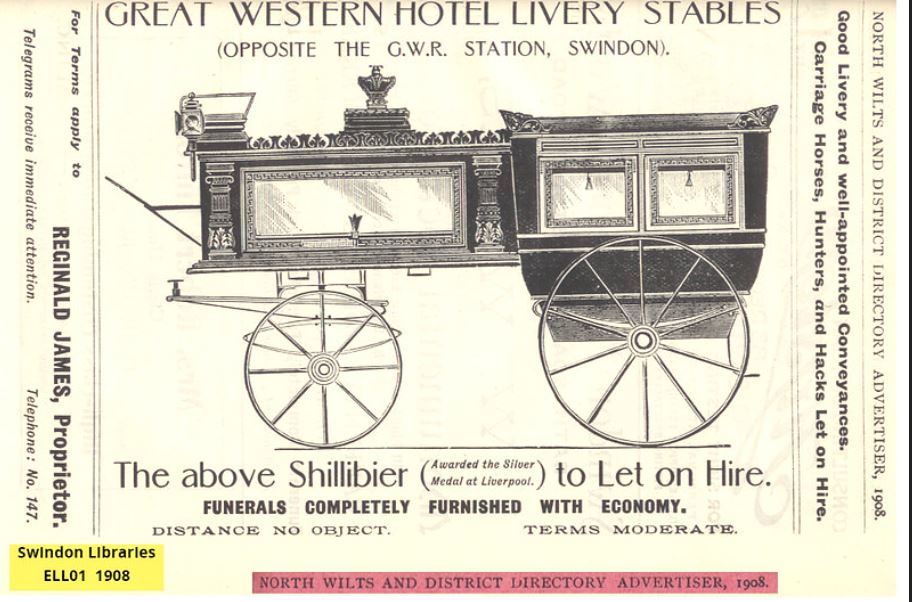
The Skerten family of undertakers had a presence in Swindon for more than 75 years. For most of that time they were busy in Radnor Street cemetery and the early burial registers reveal the many funerals they performed there.
Carpenter and joiner Richard Skerten married Ann Brown at St Paul’s Church, Bristol in 1844 and by 1851 they had moved to Swindon and a home at 32 Reading Street with their three young daughters.
By 1871 Richard was established as both a joiner and an undertaker but his business very nearly came to an end when a disastrous fire totally destroyed his Regent Street workshops. It happened on Friday June 15, 1877 when it was believed the heat of the sun ignited oils in the workshop. Neither the buildings, the stock-in-trade nor the workmen’s tools were insured.
However, Richard re-established his business at 1 Queen Street where his wife Ann and younger son Richard continued to run the family firm after his death in 1886.
Meanwhile, by 1881 elder son Arthur had established his own business at 5 King Street. On April 29, 1887 Arthur had the sad task of burying his twin baby sons Richard and Joseph just 3 and 4 days old respectively. Perhaps surprisingly the babies were buried in a public plot with three others – burial conventions were different then.
Probably the most extraordinary funeral Richard Skerten junior arranged was that of gipsy patriarch Timothy Buckland. For about a month the terminally ill Timothy camped in a field near the Wharf, Drove Road with some nine other vans and tents and 50 members of his family.
According to the Swindon Advertiser the funeral attracted several thousand spectators to the churchyard at Christ Church.
For the funeral the arrangements were placed in the hands of Mr Richard Skerten, undertaker, of New Swindon, and a hearse and eleven mourning coaches were engaged, the adult members of the family occupying the latter. The coffin was of French polished oak, with brass fittings, and bore the simple inscription on a brass plate “Timothy Buckland, died 8th Nov. 1890, aged 70 years.
Extract from theSwindon Advertiser, Saturday Nov 15, 1890.
When their time came all three Skerten undertakers were buried in Radnor Street Cemetery, which seems very fitting.
Richard Skerten senior was buried on May 20, 1886 in grave plot E8434 where he was joined by his wife Ann who died in 1902.
His son Richard was buried on December 11, 1911 in grave plot D1319 where his wife Ann joined him in 1936. Buried with them is their son-in-law Leslie Ernest Adams, their daughter Annie Amelia’s husband, who died at 1 Queen Street in October 1959.
Arthur Skerten was buried on February 9, 1934 in grave plot C1785 joining his 12 year old daughter Isabella May who died in 1907 and his wife Betsy who died in 1930.
The new Swindon Cemetery opened in August 1881 and by the end of that year 94 funerals had taken place.
The first burial was that of Frederick Gore whose funeral was furnished by Richard Skerten. With premises at 1 Queen Street, New Swindon, Richard Skerten was a Joiner and Undertaker employing three men and one boy in 1881. His son Arthur, based at nearby 5 King Street, was also a carpenter, joiner and undertaker (these occupations frequently went hand in hand.)
Edward Hemmings at 22a Fleet Street looked set to be busy with the opening of the new cemetery until his own unfortunate demise when he became the 5th person to be buried there in August 1881. His brother Frederick took over the business in 1882 and makes a regular appearance in the registers thereafter.
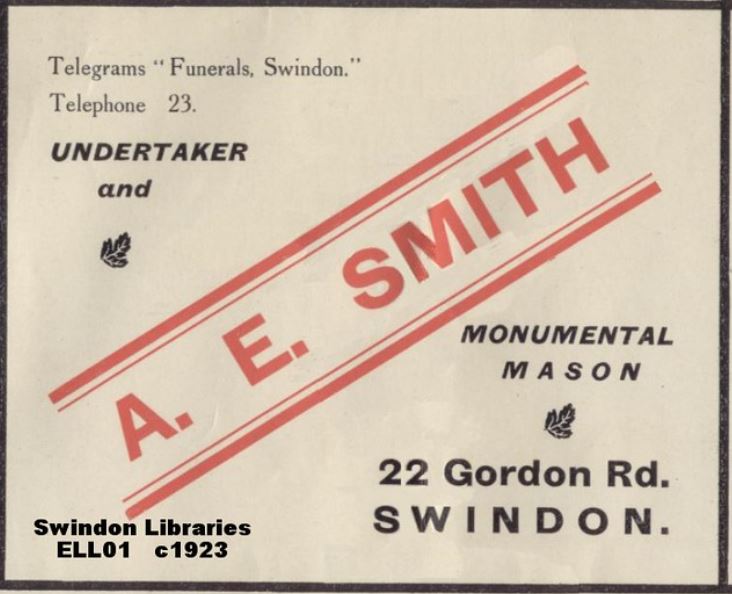
Probably the undertaker most associated with Radnor Street Cemetery is Henry Smith and the family business he established. Omnipresent in the cemetery from the 1880s and throughout the 20th century, the firm of A.E. Smith continues in business to this day with premises at Queens Drive, Swindon.
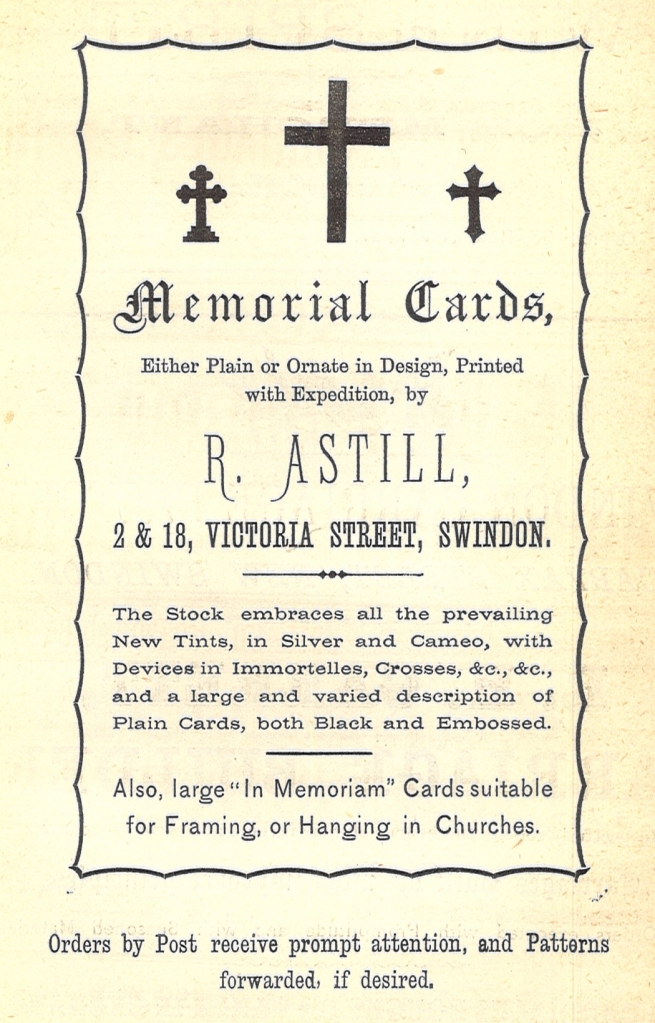
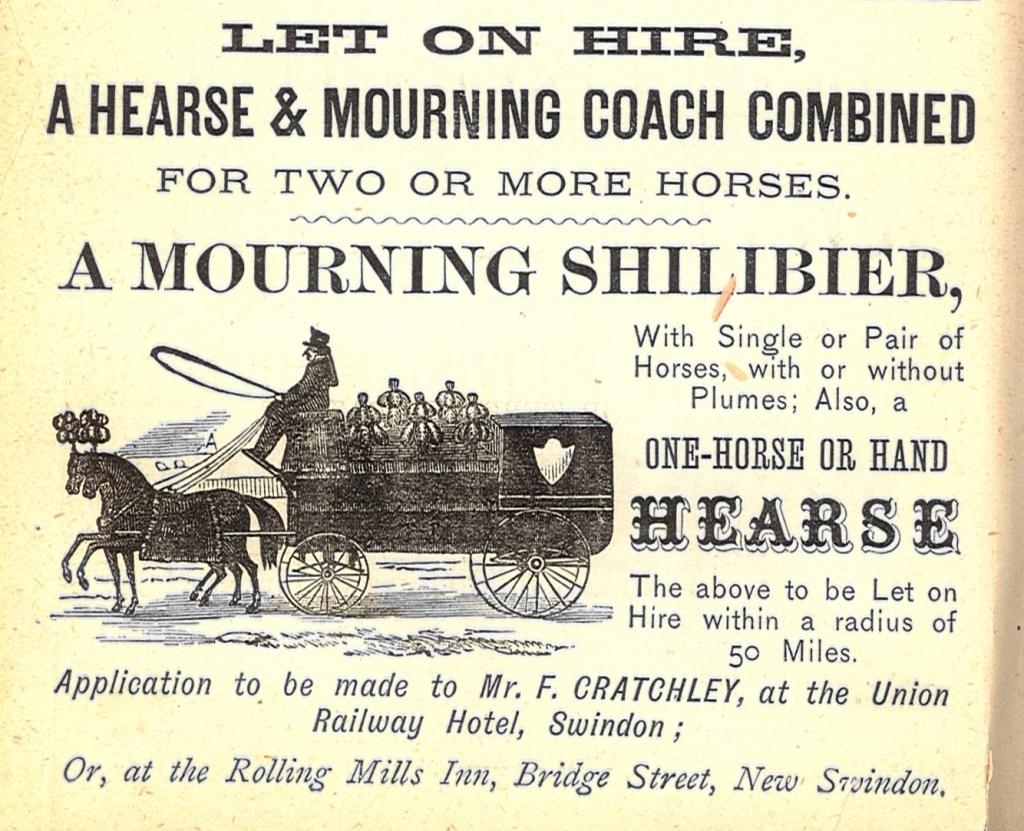
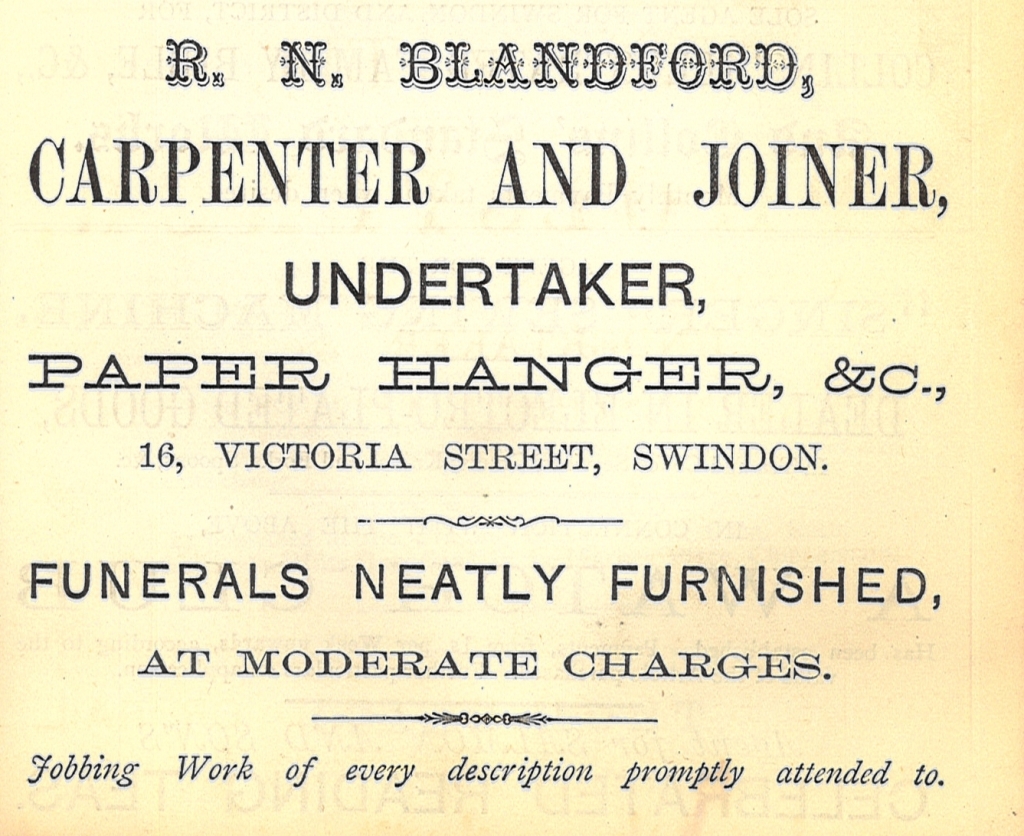
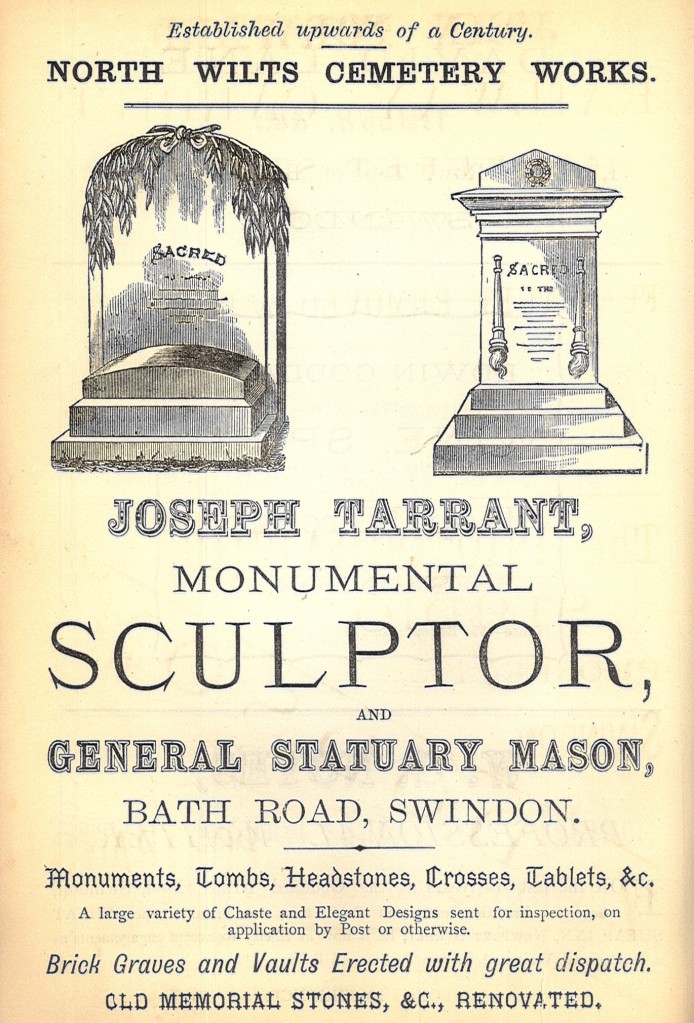
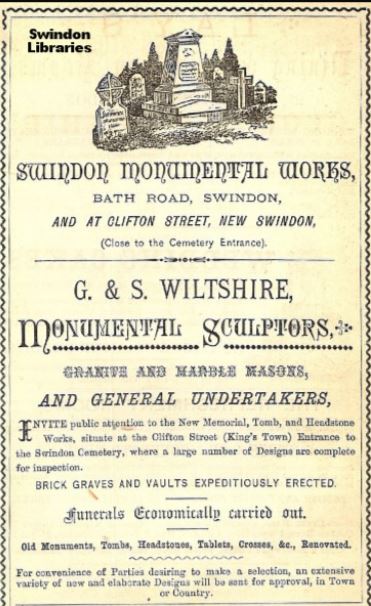
And then there were Memorial Cards and mourning attire and monuments and memorials and yes, there was a Swindon business to provide all of these services.
The burial of Swindon’s dead continued to be a controversial subject even after the opening of Radnor Street Cemetery in 1881.
The following letter to the editor of the Swindon Advertiser reveals burial practices that should have been eliminated following legislation passed during the previous 30 years.
To the Editor of the Swindon Advertiser
Sir – Can any of your readers tell me how it is that the inhabitants of that part of the parish of Swindon known as Old Swindon do not use the new cemetery, provided at their cost some five years ago? When it was decided to purchase this cemetery it was generally held out as an inducement to ratepayers to part with their money that the parish church burial ground would be closed, except to owners of vaults. Instead of this being the case, however, the churchyard is not only being crowded with bodies, but some of those interred there are being dug up in a most indecent manner to make room for more.
At the funeral of a pauper this week there was exposed beside the grave the skull, vertebra, and other bones of a corpse which previously occupied the same ground, together with the handles and other portions of the coffin furniture. I do not think this is right, or that it is decent. With the spacious cemetery we have it cannot be necessary. I am told that the reason Swindon paupers are buried in the churchyard instead of the cemetery is that the poor law authorities refuse to pay the cemetery fees. If this is so I do hope the Swindon guardians will bestir themselves and put an end to such a state of things.
Did Emily stand at this spot? Did she watch the dappled sunlight dance across the headstone? But of course the tree may have been a mere sapling then, like her son who died aged 17. Perhaps she had no time to stand and stare, what is there to ponder on when a son is taken before his time. The headstone may have been a later addition, raised after both she and her husband Fred had gone. There were a lot of words written about Fred (a well-known Swindonian) when he died.
What is there to say when a 17 year old son has been taken. Nothing that is of any comfort.
Death of Mr Fred Tegg
A Well known Swindonian
We sincerely regret to announce the death of Mr Fred Tegg, which took place quite suddenly at his residence, Lyndhurst, Clifton Street, Swindon, on Sunday.
Deceased was in his usual health and attending to his duties last week, and the end came quite suddenly. He was apparently quite well on Christmas Day and on Sunday morning, but in the afternoon of the latter day he was taken suddenly ill, and passed away about half-past two
Mr Fred Tegg was a typical self-made man. Born at Bucklebury, in Berkshire, he came to Swindon some forty years ago, and started work as a carpenter in the GWR Works. By his indomitable courage, he rose to a higher post, and then, coming under the eye of the late Mr Samuel Carlton, then Manager of the GWR Works, he made further headway, being a good shorthand writer. In those days shorthand was little known, and it may be here recalled that the present Mayor of Swindon (Ald. W.H. Lawson) and Mr W. H. Stanier, an ex-Mayor, in addition to Mr. Fred Tegg, were the only shorthand writers connected with the GWR Works at that time. Mr. Tegg was taught shorthand by Miss Wreford, and in after years he did a great deal of reporting for the Swindon Advertiser.
Owing to his great abilities as a stenographer, Mr Fred Tegg made great progress and at the time of his demise he was Chief Clerk to Mr. H.C. King, Manager of the Locomotive Dept. He had completed his term of service, and was about to retire, when the sudden call came.
Mr Tegg was for 12- or 13-years Secretary to the GWR Medical Fund Society, in the work of which he was deeply interested. He was also a prominent Oddfellow being a member of the “Mackie’s Good Intent” Lodge and he was present at a meeting recently. He had held all the high offices, and was a Trustee of the Lodge at the time of his death. He was most popular among all classes, and his death will be deeply mourned by a very large circle.
The Inquest
On Monday last the Deputy Coroner for North Wilts, Mr J.W. Pridham, held an inquest on the body of deceased at the Clifton Hotel. Mr J. Stafford being chosen foreman of the jury.
Evidence was given by Mr. E. Tegg (son of deceased) and Dr. Haddon, and the jury returned a verdict of death from cardiac failure.
Dr Haddon stated that life was extinct when he was called to deceased. Death was probably due to cardiac failure, caused by indigestion.
Impressive Funeral
Amidst many tokens which spoke eloquently of the respect and high esteem in which the late Mr. Tegg was held by all associated with him, the mortal remains of the deceased gentleman were laid to rest in the Swindon Cemetery, at three o’clock on Thursday afternoon. The funeral was an impressive one. Four carriages conveyed the family mourners, and no fewer than 90 gentlemen walked behind. Preceded by a hand bier bearing the many beautiful floral tributes, the cortege proceeded from Mr. Tegg’s late residence “Lyndhurst,” Clifton Street, to the Cemetery Chapel, where the Rev. J.T. Evans (Primitive Methodist minister), assisted by the Rev. H.W. Smith, conducted the first portion of the solemn rites. Later, the Rev. J.T. Evans also officiated at the graveside.
The remains were enclosed in a polished elm coffin with brass furnishings, and the breast-plate born the inscription: Frederick Tegg, died December 26, 1909. Aged 61 years.
Extracts from the Swindon Advertiser, Friday, December 31, 1909
Harry Frederick Hamilton Jerome Tegg was buried in grave plot B1695 on July 10, 1890. Fred Tegg was buried in the neighbouring plot B1694 where Emily joined him when she died in April 1932.
We don’t know where the chapel bell is or when it was removed. Was it taken down when the cemetery closed to new burials – or was it stolen by vandals?
A tolling bell was once a significant feature of death and funeral rituals. Traditionally a bell was run to warn of an impending death to alert the curate his services were required. A death knell was rung immediately after death when the number of pulls were significant, two for a woman with a pause and three for a man. A solemn toll was rung at the time of the funeral.
The Radnor Street Cemetery Chapel was designed in the Gothic Revivalist style by popular local architect W.H. Read. The bell tower is surmounted by its own set of mythical beasts, grotesques* that once guarded the now missing bell.
In 1881 when the Burial Board published the cost of a burial in the new cemetery it included –
For tolling Chapel bell if required 1s
For tolling Chapel bell above one hour extra, and so on in proportion 1s
Today the silent bell tower has been adopted by the cemetery pigeons who enjoy their very own room with a view.
*gargoyles redirect rain water – grotesques have no spout.
This is a tale of two disintegrating headstones and a misplaced grave marker. What began as an attempt to trace the occupants of two neighbouring graves has involved some confusing paperwork, but I’ve got there in the end.
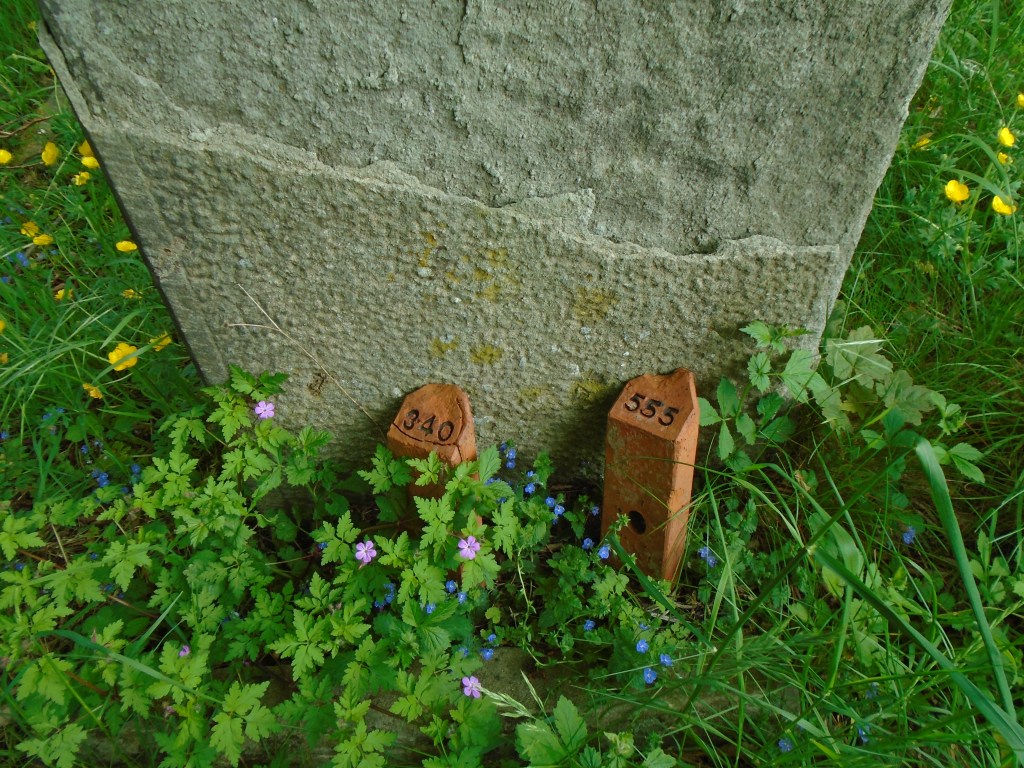
This is a cautionary tale of relying too heavily on the terracott grave markers in the cemetery. These portable brick like markers stamped with a letter and a number can be a big help when trying to pin point a plot, however they are very often in the wrong place. Perhaps back in the working day when there was a team of staff caring for the cemetery these markers were a useful identification aid. Unfortunately today they can be more of a hindrance, leading those searching for a grave on a confusing journey.
Many of the earliest burials in the newly opened cemetery took place here in Section A in the 1880s. In this area there are many public graves with numerous unrelated occupants. Funerals have always been an expensive business for the poor and frequently they had to bury their loved ones in a communal grave without a headstone. However, there are surviving headstones in Section A, among them several like these two badly weathered examples. Sadly, the inscriptions are completely lost and so it would appear is the identity and history of those buried here.
Someone has at some point propped up two of these grave markers at the back of one of the headstones, so I decided to see if they helped unlock the identity of who is buried here.
A consultation of the cemetery map quickly revealed that these are not the numbers of the two adjacent headstones. Grave plot A555 is a few rows removed from A340, as you can see from this image. However the marker for A340 is probably in the right location. The number of the neighbouring grave is plot A341 so now it was time to hit the burial registers, firstly the grave plot register.
After some research I was able to confirm that the two plots belong to the same extended family; the first of these to be buried in the new cemetery was Sarah Fortune, wife of William Fortune. She was 81 years old and her last home was at 1 Vilett Street, New Swindon where she lived with her daughter and her family. Her funeral took place on December 21, 1881 in plot A340.
The second family member to be interred in the cemetery was Mary Pickett, Sarah’s daughter. Mary was 67 years old and her funeral took place on May 3, 1890. Her last home had been Alderley, Gloucester, which has a connection to her husband’s family. Mary was buried in plot A340.
On October 11, 1904 Kate Minnie Brond was buried in plot A341. Kate was 35 years old and the granddaughter of Sarah Fortune. Her last home was at 25 Devizes Road where she lived with her parents Richard and Charlotte Fortune, her three younger sisters and her son Wilfrid Brond.
The last burial in this plot was on December 7, 1904. Wilfrid Percival Brond aged 5 years old died just weeks after the death of his mother.
Entries in the burial registers are slightly confusing. Sarah Fortune is described as being buried in plot A340 but the entry for her daughter Mary suggests she is the only one buried there. The details for plot A341 list Kate Brond, W.P. Brond and S. Fortune. All that we can be sure of is that Sarah Fortune is buried in one of these family graves. No doubt the lost inscription on the headstones would have settled the matter.
So, now all that is left to do is discover if there is a headstone on plot A555 and find out who is buried there.






 Radnor Street Cemetery