Aunt Charlotte would have loved all this

The re-imagined story …

It was a bitterly cold morning but we were the best dressed passengers on the platform at Swindon Junction that Boxing Day in 1906.

Uncle Alfred had polished his top hat to a shine and Bill looked prosperous, if a bit portly, with his fob watch chain stretched across his ample stomach.

I wasn’t sure how we would keep the children neat and tidy for the duration of the journey, but so far, they have been very well behaved.

We managed to find seats all together in one carriage, although it was a bit of a squeeze and Fred almost sat on Annie’s hat.

Aunt Charlotte would have loved all this.

My mother came prepared with a picnic hamper and enough food to sustain us on an expedition across the dark continent, never mind a trip to Cardiff.

No sooner had we passed through the station at Wootton Bassett Junction than my mother was handing round the scotch eggs.

We were met at Cardiff station by Florence’s uncle who took us to the church at Canton where the wedding ceremony took place and then it was back to the Davies’s home in Conbridge Road for the wedding breakfast.

The other day I was looking through some of my old bits and pieces with Maisie, my granddaughter. I’m moving in with her and her husband, I just can’t manage living alone anymore. I have to get rid of so much. It’s difficult.

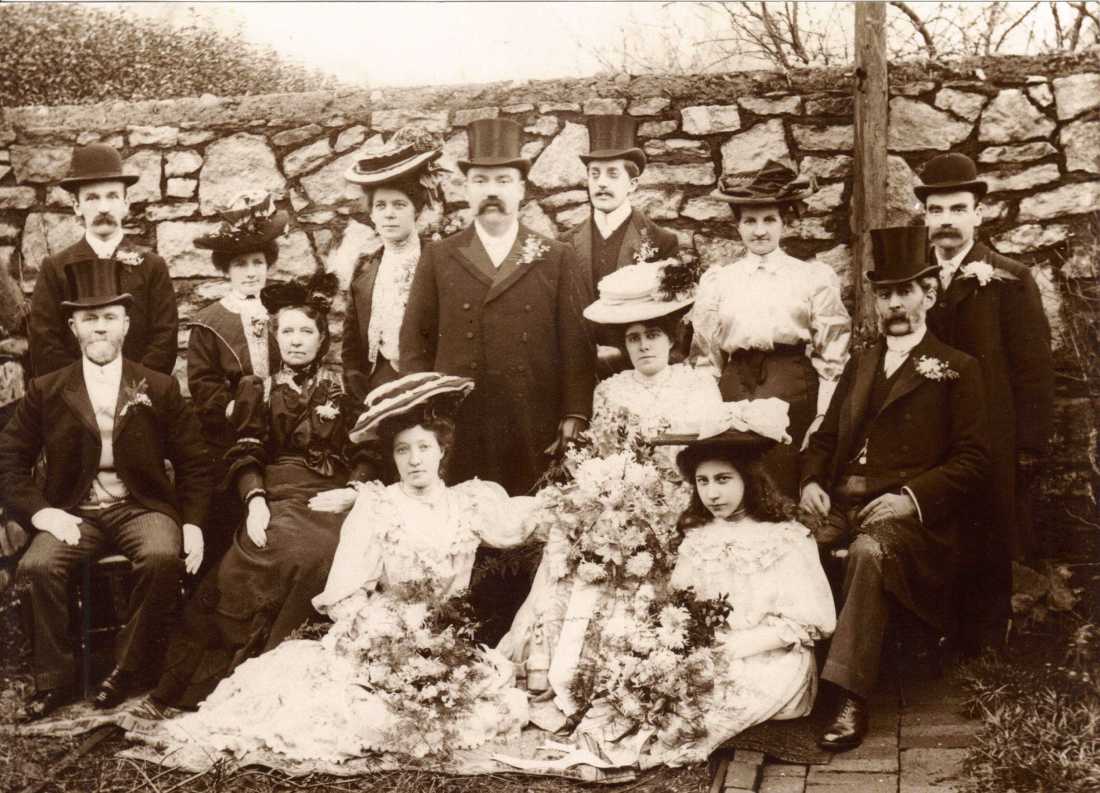
Maisie found Florence and Bill’s wedding photograph taken in the back garden in Canton on Boxing Day 1906.

“I love the ladies dresses,” said Maisie as she studied the sepia image. “Who are they all?”

I pointed out Uncle Alfred and Bill and Florence.

“I can’t remember who the others are, they are all members of the bride’s family.”

“They look a serious bunch,” she pulled a straight face. “Where are the Drinkwaters?”

“We were laughing and talking behind the photographer. I remember he asked us to be quiet as we were too much of a distraction.”

Aunt Charlotte would have loved that.

charlotte-and-alfred-drinkwater

The facts …

Alfred Drinkwater was born in Barton St Michael, Gloucestershire in 1848. He married Charlotte Dent at St Mark’s Church, Gloucester on April 12, 1869. The couple had a large family of eight sons and four daughters.

Alfred worked as an engine cleaner, a fireman and a 1st Class Engineman (Engine Driver) The family moved from Gloucester to Reading, eventually arriving in Swindon in the mid-1890s. There is a family story that he once drove Queen Victoria’s train.

Charlotte died at the family home in Theobald Street and was buried in Radnor Street Cemetery in plot D1453 on June 29, 1904.

Alfred outlived her by almost 30 years. He died at 112, Millbrook Street, Gloucester on July 26, 1932, his body returned to Swindon and the plot he shares with his wife.

Alfred and Charlotte’s nine-year-old daughter Nellie died in 1895. She is buried in Radnor Street Cemetery in plot B2398.

The couple’s eldest son Alfred James Henry served a six-year apprenticeship in the railway factory where he worked as a fitter. He married Annie Cummins in 1892 at St Mark’s, Swindon. The couple never left Swindon and their last family home together was at 27 Whitehead Street. Alfred James Henry died in 1949 and his wife Annie died the following year, 1950. They are buried together with Alfred’s parents. The cremated remains of L.C. Drinkwater, probably Alfred and Annie’s daughter Lilian Charlotte, were interred in the family plot in 1989.

William Charles John Drinkwater and his wife Florence, the couple who married in Cardiff on Boxing Day 1906, were living at 40 Montagu Street, Rodbourne at the time of the 1911 census. They later moved to Wales. William died in the Pontypool and District Hospital on July 9, 1942 and Florence died at her home, 21 Saint Matthews Road, Pontypool on June 5, 1958.
86d506fc-6c0e-40d4-8f67-92cea80dd834

Additional family history information obtained from Public Member’s Trees on http://www.ancestry.co.uk.
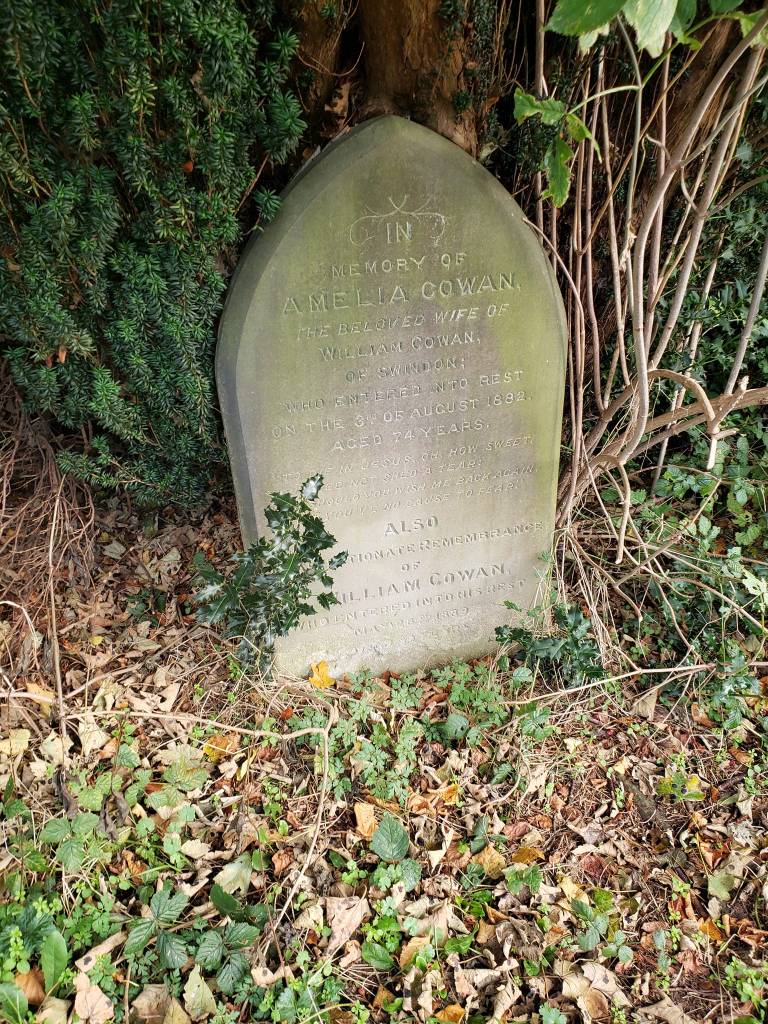
Amelia Cowan – Gentlewoman

William Cowan married Amelia Roberts at the parish church in Corse, Gloucestershire in 1879. It was a second marriage for both of them.

William had previously been married to Frances Weston who appears to have arrived in Swindon via Brixton after a few stops along the way (much as I have). She died in 1870 and is buried in Reading Cemetery.

Amelia had lived her entire life in the Gloucestershire parish of Ashleworth where she married John Roberts, a farmer of 40 acres, in 1827.

At her second marriage Amelia describes her status as that of ‘Gentlewoman’ an old fashioned term which has slipped out of usage but one I’d like to see revived! The definition of a gentlewoman is a woman who belongs to a high social class; one who is kind, polite and honest, cultured, educated and well mannered. Aren’t we all, ladies, aren’t we all?

Amelia and William’s marriage was of a relatively short duration, which was probably unsurprising given their ages – William was 79 and Amelia 70 when they married.

Amelia died at her home, 23 King William Street, and was buried on August 7, 1882 in grave plot E8636. William died in 1889 aged 89 years and lies buried with Amelia.

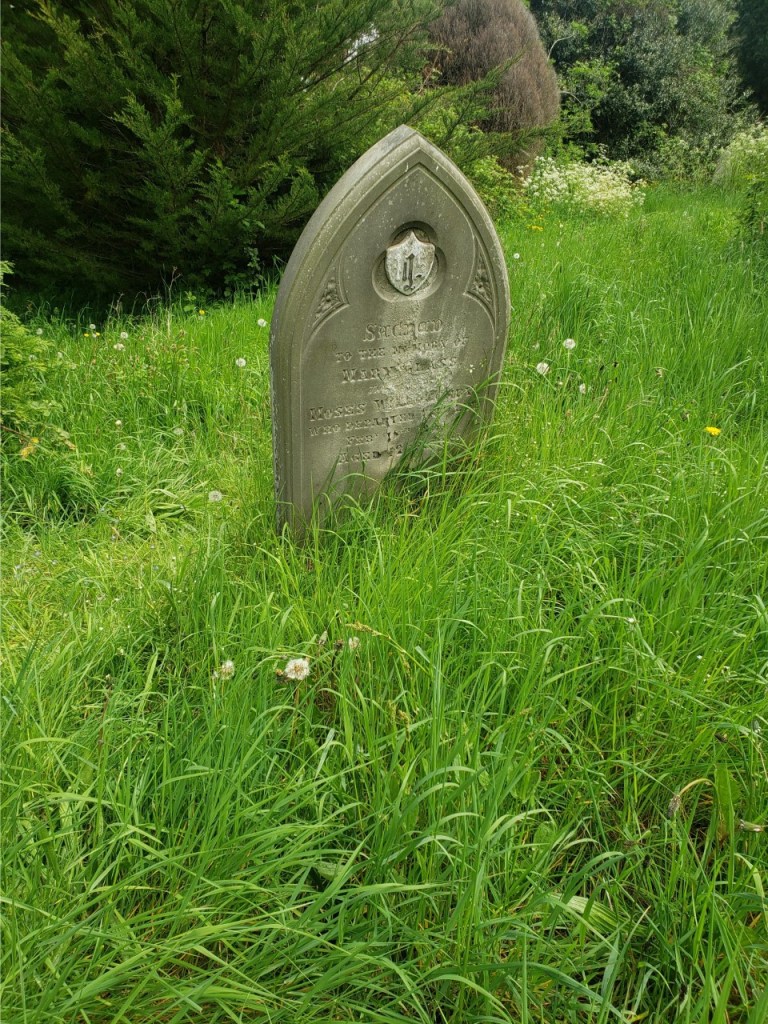
Moses Willoughby and the gossips

The re-imagined story …

“You remember Moses Willoughby?”

“Do I?”

“Yes, used to live in King Street, before his wife died.”

“No, I don’t remember him.”

“Yes you do – we always thought she was a lot older than him. Turned out there was only two years in it. We talked about it.”

“Did we?”

“He married again just a few months after she died. Don’t you remember?”

“No, I can’t say I do.”

“He moved up to Gorse Hill. We all reckoned his new wife had a bob or two.”

“Oh yes, I remember now. She was older than him.”

“No, that was his dead wife. His last wife was much younger than him. Give me strength – I think you’re losing your marbles.”

“No, I do remember him now. Moses Willoughby. Used to live in King Street. Moved to Gorse Hill.”

“Yes, that’s him. Well he’s dead.”

Early 20th century photograph of Cricklade Road published courtesy of Mr. T. Midwinter and Local Studies, Swindon Central Library.

The facts …

Thanks to the numerous genealogical resources available online it is now possible to piece together the history of those buried in Radnor Street Cemetery, even when the inscription on the headstone has deteriorated.

Moses Willoughby was born on October 22, 1818 and baptised in Highworth. He was the son of Charles and Ann Willoughby and grew up in Eastrop.

He married his first wife Ann Lay in Highworth on November 21, 1840. Their son John was baptised in Highworth on February 6, 1842.

Ann died in 1847. On the 1851 census Moses, 28 was working as an agricultural labourer and living at Bailey’s Piece, Highworth with his ten year old son John.

In 1855 he married for a second time. His bride was Mary Glass and the couple married in the parish church at Purton. They had a daughter Emily Kate baptised at Highworth on June 22, 1857. However, at the time of the census in 1861 there is no mention of Emily Kate, nor John, although he could well have left home/married by then.

By 1871 the couple had moved to Swindon and were living in Cetus Buildings on the canal side where Moses continued to work as a farm labourer. Moses declared that he was 46 and Mary 48.

At the time of the 1881 census Moses was employed as a factory labourer, almost certainly in the railway works. He states that he is 60 and Mary is 62.

Mary died at their home 3 King Street in February 1890, she was 72 years old. The funeral took place on February 19 when Mary was interred in plot A790.

On July 16, 1890 Moses married for the third time. His wife was Mary Ann Haskins, a 49 year old spinster. At the time of the 1891 census the couple were living at 255 Cricklade Road, Gorse Hill. Moses was still working as a General Labourer in the GWR Works and they had two lodgers, both labourers in the Works.

Moses died on March 9, 1892. He left effects valued at £84 0s 7d to his widow Mary Ann Willoughby. He was buried three days later in Radnor Street Cemetery in plot A790, which he shares with his second wife.

Attempts to trace John Willoughby and his half sister Emily Kate have so far been unsuccessful.