We don’t know where the chapel bell is or when it was removed. Was it taken down when the cemetery closed to new burials – or was it stolen by vandals?
A tolling bell was once a significant feature of death and funeral rituals. Traditionally a bell was run to warn of an impending death to alert the curate his services were required. A death knell was rung immediately after death when the number of pulls were significant, two for a woman with a pause and three for a man. A solemn toll was rung at the time of the funeral.
The Radnor Street Cemetery Chapel was designed in the Gothic Revivalist style by popular local architect W.H. Read. The bell tower is surmounted by its own set of mythical beasts, grotesques* that once guarded the now missing bell.
In 1881 when the Burial Board published the cost of a burial in the new cemetery it included –
For tolling Chapel bell if required 1s
For tolling Chapel bell above one hour extra, and so on in proportion 1s
Today the silent bell tower has been adopted by the cemetery pigeons who enjoy their very own room with a view.
*gargoyles redirect rain water – grotesques have no spout.
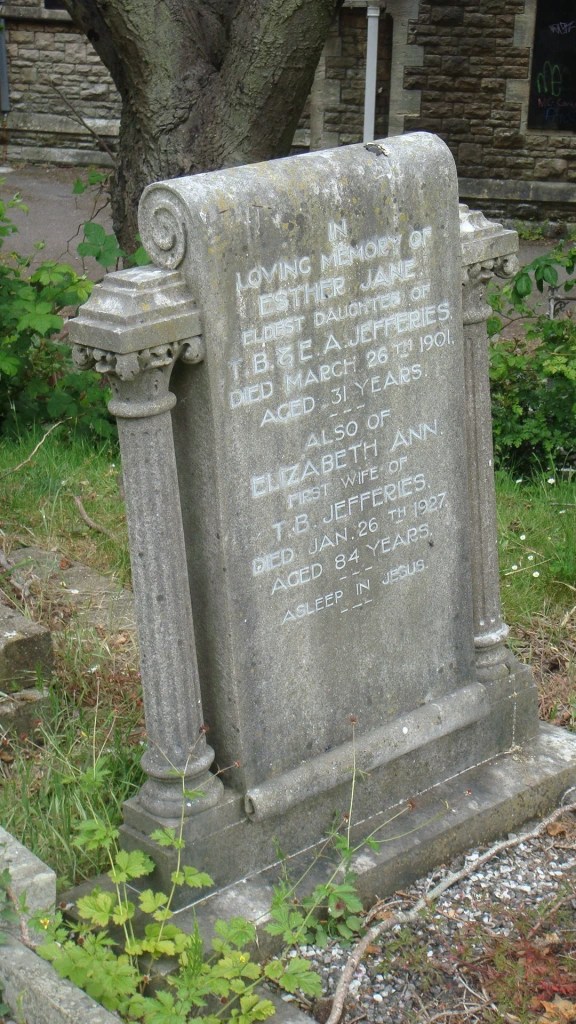
I chose to research this grave because I liked the typeface and all the funeral symbolism on the headstone.
A scroll can mean a number of things in headstone iconography including a love of learning and a religious belief, which is very appropriate for this family. It can also mean a life cut short with the past rolled up and the future yet to unfurl. This would make sense when you note that Esther J. Jefferies, the first person buried in this grave, was only 31 when she died. The pillars either side suggest an entrance and this symbolises an entry into heaven. At the top of the pillars are acanthus leaves, which have several interpretations symbolising the prickly journey of life to death and also enduring life. So, there’s a lot going on with this headstone.
Elizabeth Ann was born in Cricklade in 1843. She worked in service as a young woman before marrying Thomas Bennett Jefferies, a slater and plasterer. Their first home was in Wootton Bassett where Thomas was born. By 1891 they had moved to 18 Union Street, Swindon where the elder sons were now apprentice plasterers.
The 1911 census finds them at 165 Victoria Road and on this census we get some more details about the family. Thomas and Elizabeth had been married 42 years during which time they had 10 children, four of whom had already sadly died. And then I found a fantastic photo of the couple’s five sons, thought to have been taken at the wedding of their sister Ellen to Harry Frederick Keene in 1906. They are pictured in order of seniority left to right – Joseph, Thomas, John, Winfrith Frederick (usually referred to as Fred) and Charles Wesley.
Eldest son Joseph Page Jefferies emigrated to Australia with his family in around 1913. Following his wife’s death, he married for a second time in 1936 in Sydney, where he died in 1939. The couple’s third son, John Nelson became the assistant borough surveyor here in Swindon and in 1903 lived at 2 Hunt Street.
Death of Mrs T.B. Jefferies
With the death of Mrs Elizabeth Ann Jefferies, of 1 Durham Street, there has passed away one of the best known figures in Wesleyan Methodism in the town. Mrs Jefferies, who was 84 years of age, was a native of Cricklade, being the daughter of Mr and Mrs Joseph Page. She married Mr Thomas Bennett Jefferies at Purton Parish Church on September 26th, 1868, and the couple came to live in Swindon 46 years ago. Mr Jefferies is the oldest local preacher on the local Wesleyan plan, and although he has been preaching for over 60 years he continues to take appointments.
Mrs Jefferies was taken ill with influenza, and pneumonia supervened with fatal results. The funeral took place at the Central Mission Church on Monday, and was conducted by Pastor A.E. Stocking, assisted by the Rev. W. Kelson and the Rev. H.B. Turner. The committal rites at the Cemetery were performed by Pastor Stocking. Among the mourners were Mr T.B. Jefferies (widower), Messrs. Thomas Henry, John Nelson and Charles Wesley Jefferies (sons), Mrs Ellen Elizabeth Keene (daughter) Mrs Eliza Priscilla Jefferies (daughter-in-law), Mr Joseph Jefferies (son-in-law), Mrs Cottrill (half-sister), Mr Jesse Jefferies and Mr E. Jones (representing the local preachers of the Circuit).
North Wilts Herald, Friday, February 4, 1927.
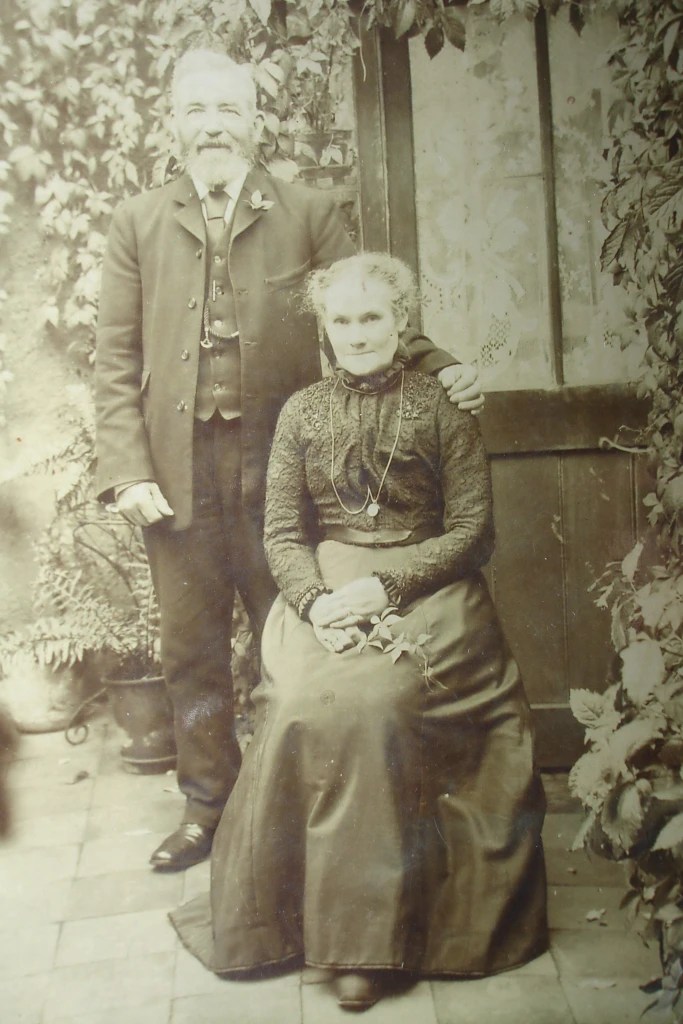
Thomas Bennett and Elizabeth Ann Jefferies
Esther Jane Jefferies (Thomas and Elizabeth’s eldest daughter) was the first person to be buried in grave plot D109. She died in 1901 aged 31 years old. Elizabeth Ann Jefferies (Thomas’s first wife) was buried with her daughter on January 31, 1927. Next came Ellen Jefferies (Thomas’s second wife) who died in 1931 and finally Thomas Bennett Jefferies who was buried on April 18, 1932.
“Yes, used to live in King Street, before his wife died.”
“No, I don’t remember him.”
“Yes you do – we always thought she was a lot older than him. Turned out there was only two years in it. We talked about it.”
“Did we?”
“He married again just a few months after she died. Don’t you remember?”
“No, I can’t say I do.”
“He moved up to Gorse Hill. We all reckoned his new wife had a bob or two.”
“Oh yes, I remember now. She was older than him.”
“No, that was his dead wife. His last wife was much younger than him. Give me strength – I think you’re losing your marbles.”
“No, I do remember him now. Moses Willoughby. Used to live in King Street. Moved to Gorse Hill.”
“Yes, that’s him. Well he’s dead.”
Early 20th century photograph of Cricklade Road published courtesy of Mr. T. Midwinter and Local Studies, Swindon Central Library.
The facts …
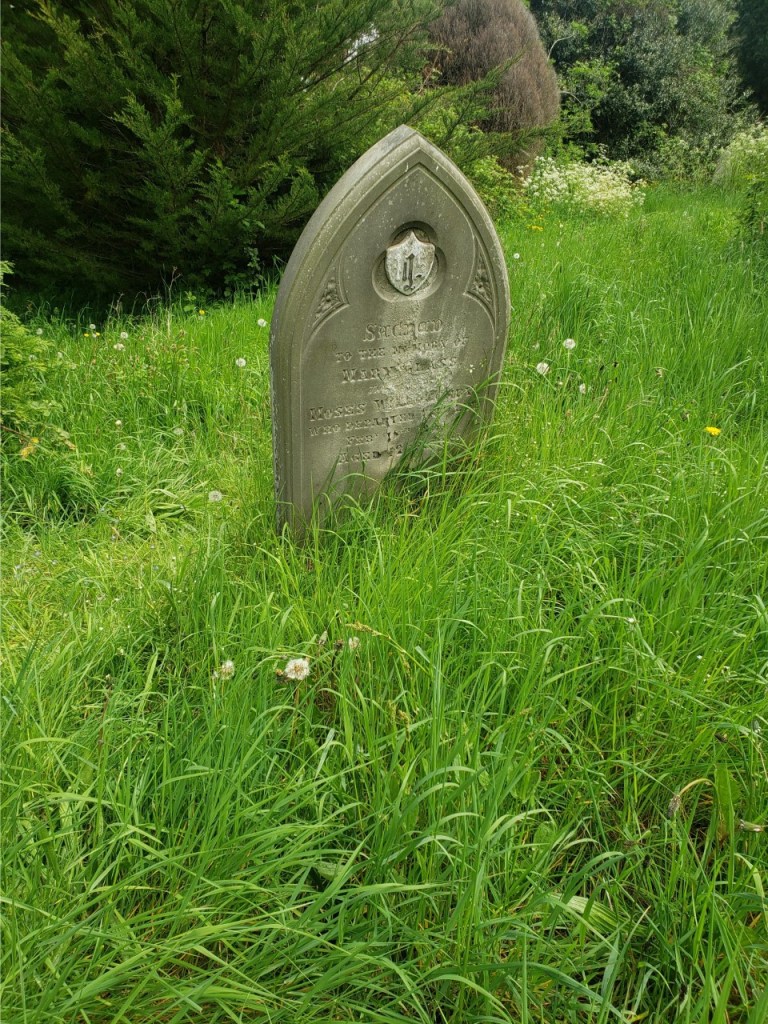
Thanks to the numerous genealogical resources available online it is now possible to piece together the history of those buried in Radnor Street Cemetery, even when the inscription on the headstone has deteriorated.
Moses Willoughby was born on October 22, 1818 and baptised in Highworth. He was the son of Charles and Ann Willoughby and grew up in Eastrop.
He married his first wife Ann Lay in Highworth on November 21, 1840. Their son John was baptised in Highworth on February 6, 1842.
Ann died in 1847. On the 1851 census Moses, 28 was working as an agricultural labourer and living at Bailey’s Piece, Highworth with his ten year old son John.
In 1855 he married for a second time. His bride was Mary Glass and the couple married in the parish church at Purton. They had a daughter Emily Kate baptised at Highworth on June 22, 1857. However, at the time of the census in 1861 there is no mention of Emily Kate, nor John, although he could well have left home/married by then.
By 1871 the couple had moved to Swindon and were living in Cetus Buildings on the canal side where Moses continued to work as a farm labourer. Moses declared that he was 46 and Mary 48.
At the time of the 1881 census Moses was employed as a factory labourer, almost certainly in the railway works. He states that he is 60 and Mary is 62.
Mary died at their home 3 King Street in February 1890, she was 72 years old. The funeral took place on February 19 when Mary was interred in plot A790.
On July 16, 1890Moses married for the third time. His wife was Mary Ann Haskins, a 49 year old spinster. At the time of the 1891 census the couple were living at 255 Cricklade Road, Gorse Hill. Moses was still working as a General Labourer in the GWR Works and they had two lodgers, both labourers in the Works.
Moses died on March 9, 1892. He left effects valued at £84 0s 7d to his widow Mary Ann Willoughby. He was buried three days later in Radnor Street Cemetery in plot A790, which he shares with his second wife.
Attempts to trace John Willoughby and his half sister Emily Kate have so far been unsuccessful.
Every cemetery should have a cat – and we used to have one.
We never knew where he lived, only that it was somewhere local – maybe Kent Road or Clifton Street or perhaps Radnor Street itself. Most days he would be in the cemetery, prowling through the long grass on his deathly, daily business; stalking the wildlife. He barely acknowledged us and we never approached him – he wasn’t that kind of cat. He had a distinctive face and we had a nickname for him – too controversial to reveal here.
And then one day I saw his photograph on a local vet’s Facebook page, like a fugitive on a wanted poster – Found in Radnor Street Cemetery – some well meaning animal lover had captured him and deposited him at the vet’s.
We wondered if he would ever find his way back home, and more importantly, back to the cemetery.
Every cemetery should have a cat. We had one once. He looked a bit like this – only more menacing.
As you look across the cemetery, you will see large areas without headstones or grave markers. But we know there are no empty burial spaces here as the cemetery was full when it closed in the 1970s.
These empty spaces are graves where families were unable to afford a headstone or memorial of any kind. There are also a large number of public graves where families were unable to afford even a burial plot. These plots often contain numerous burials, usually of unrelated persons. And then there are also the infant burial plots where the babies are buried and there are a large number of those in the cemetery.
I came across plot C63 while was researching the death of Emily Hobbs. Emily had died at the Stratton Infirmary aged 75 years old. Her home address was given as 34 Linslade Street and she was buried here on September 24, 1938.
When I looked at the plot details I soon discovered that this was a public plot, so I knew there would not be a headstone. But what surprised me was that there were four other people by the name of Hobbs already buried here when Emily died in 1938.
Research revealed that this plot was originally designated as a babies plot. The first burial to take place was that of Edgar Henry Smith a 10 week old baby who died in June 1896. A week later another baby was buried here 17 month old Grace Emily Hobbs from 31 Linslade Street. In February 1897 Laura Louise Hobbs aged 5 years old from 31 Linslade Street was buried here. In November of that year Myra Agnes Smith, little Edgar’s sister, was buried here aged 3 months old. And on February 13, 1909 the last burial of a baby was that of three day old Violet Mary Bishop. However, nine years before that, William John Hobbs aged 15 months of Groves Street was also buried here.
Could it be a coincidence that so many babies by the name of Hobbs were buried in this plot?
Emily Leviss married Charles Hobbs at St Leonard’s Church, Blunsdon on December 22, 1883. The young couple were both aged 20 and had to obtain the consent of their parents to marry. On the marriage certificate Charles’s father is named as William Hobbs a labourer but Emily has given no father’s name or details, suggesting that she was probably born illegitimately.
The couple moved to Rodbourne where they lived at various address in Groves Street, Linslade Street and Redcliffe Street.
In 1891 Emily and Charles are living at 31 Linslade Street. Charles works as a Blacksmith Striker in the Works. The couple have two children – five year old Frederick Thomas and Henry James aged 3. Living with them is Emily’s grandmother Hannah Matthews aged 75 who works as a Laundress. Charlotte M. Willis is visiting the family on census night.
By 1901 the family are living at 31 Linslade Street and by then they have another son Reginald Charles who is 7 years old.
But it isn’t until we get to the 1911 census that the full tragedy of the family comes to light. Charles and Emily are by then both 48 years old. Elder sons Frederick and Henry have moved out and moved on. Still living at home are Reginald Charles, Edward Alfred and youngest son Norman Stanley Leviss Hobbs aged just 2 years old. Charles and Emily have been married for 27 years and during that time Emily has had 10 children and 5 have died.
As well as the three children buried here Hubert Robert Hobbs died in 1904 aged 10 months and is buried in plot B1318. Florence Maud Hobbs died in January 1907 aged one year old and is buried in B1845.
When Emily’s husband Charles died in 1913, he was buried in grave plot C63 with his children, presumably at Emily’s request, and then when she died 25 years later she joined them. This is quite an unusual situation for a public grave. Perhaps it shows a more compassionate side of an authority that allowed this family to be reunited even though they could not afford to buy their own grave plot.
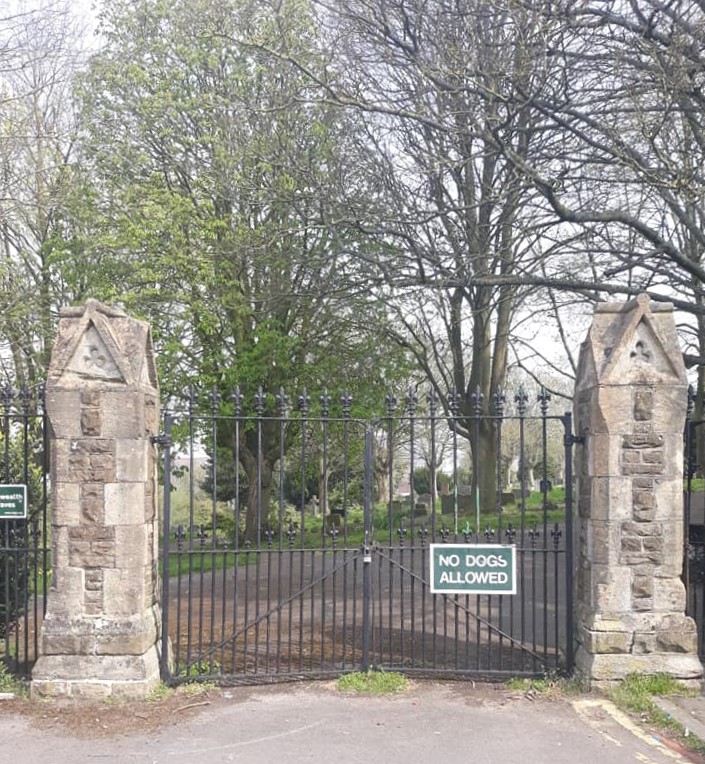
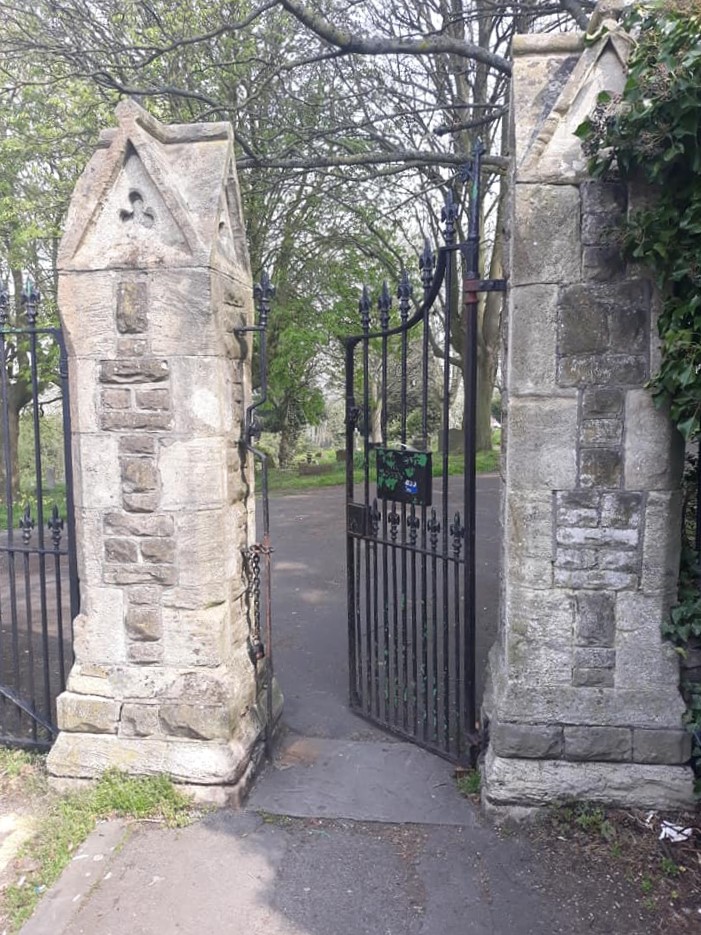
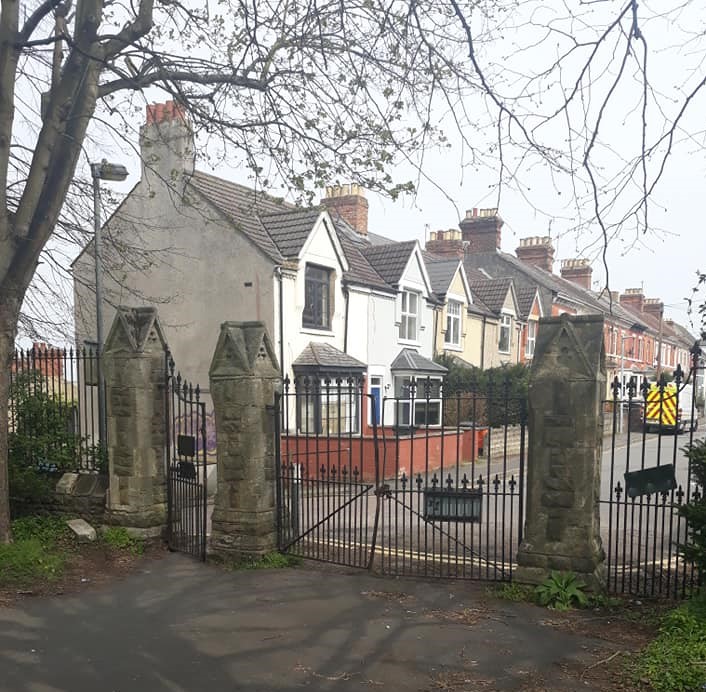
It was always Mark’s dream to see the cemetery gates and railings painted black with the fleur de lis finials burnished in gold. Custodian of the military history of the cemetery, Mark was a painter and decorator by trade and the state of the cemetery railings was a source of professional frustration for him. Today the gates and railings reveal a motley coat of green and black paint, which came first is difficult to work out.
In 1885, just four years after the cemetery had opened, it would seem the railings were already in need of maintenance.
The Swindon Burial Board are desirous of receiving tenders for the following work:- Clean and Paint, with two coats of good oil paint, the whole of the iron fencing around the Cemetery; Paint twelve seats with three coats of good oil paint; Size and Varnish the outside of the chapel door.
For further Particulars, apply to the Caretaker, The Cemetery Lodge.
Tenders to be sent to me the undersigned, on or before the 11th day of May, 1885.
The Board do not bind themselves to accept the lowest or any Tender.
This is a tale of two disintegrating headstones and a misplaced grave marker. What began as an attempt to trace the occupants of two neighbouring graves has involved some confusing paperwork, but I’ve got there in the end.
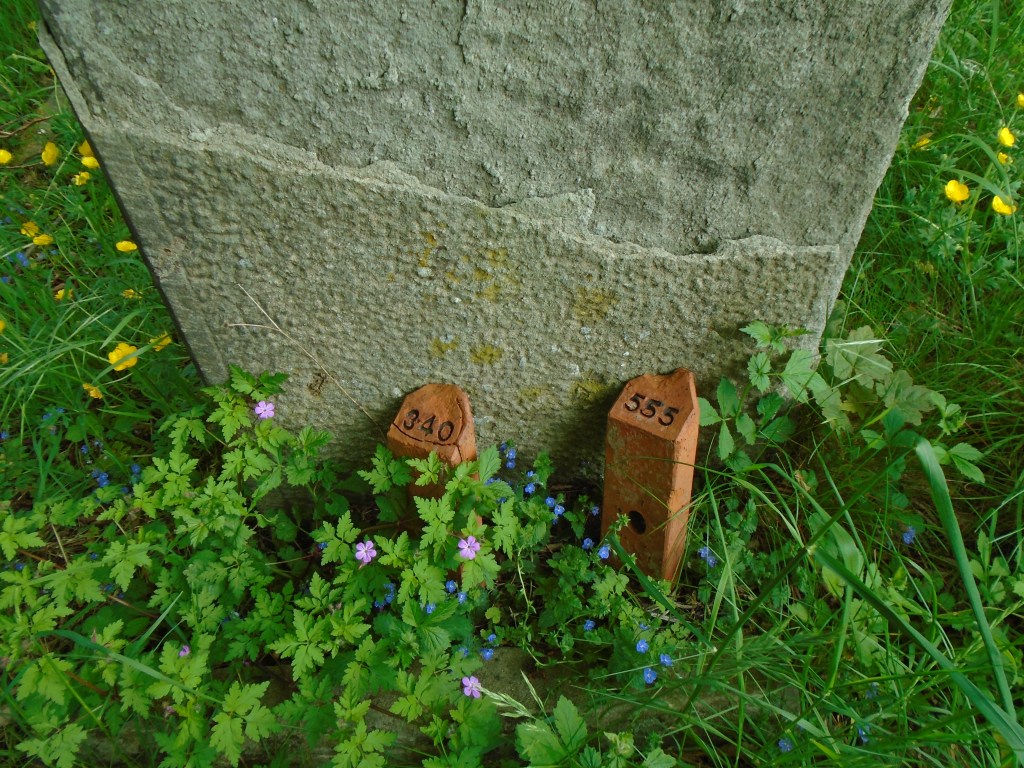
This is a cautionary tale of relying too heavily on the terracott grave markers in the cemetery. These portable brick like markers stamped with a letter and a number can be a big help when trying to pin point a plot, however they are very often in the wrong place. Perhaps back in the working day when there was a team of staff caring for the cemetery these markers were a useful identification aid. Unfortunately today they can be more of a hindrance, leading those searching for a grave on a confusing journey.
Many of the earliest burials in the newly opened cemetery took place here in Section A in the 1880s. In this area there are many public graves with numerous unrelated occupants. Funerals have always been an expensive business for the poor and frequently they had to bury their loved ones in a communal grave without a headstone. However, there are surviving headstones in Section A, among them several like these two badly weathered examples. Sadly, the inscriptions are completely lost and so it would appear is the identity and history of those buried here.
Someone has at some point propped up two of these grave markers at the back of one of the headstones, so I decided to see if they helped unlock the identity of who is buried here.
A consultation of the cemetery map quickly revealed that these are not the numbers of the two adjacent headstones. Grave plot A555 is a few rows removed from A340, as you can see from this image. However the marker for A340 is probably in the right location. The number of the neighbouring grave is plot A341 so now it was time to hit the burial registers, firstly the grave plot register.
After some research I was able to confirm that the two plots belong to the same extended family; the first of these to be buried in the new cemetery was Sarah Fortune, wife of William Fortune. She was 81 years old and her last home was at 1 Vilett Street, New Swindon where she lived with her daughter and her family. Her funeral took place on December 21, 1881 in plot A340.
The second family member to be interred in the cemetery was Mary Pickett, Sarah’s daughter. Mary was 67 years old and her funeral took place on May 3, 1890. Her last home had been Alderley, Gloucester, which has a connection to her husband’s family. Mary was buried in plot A340.
On October 11, 1904 Kate Minnie Brond was buried in plot A341. Kate was 35 years old and the granddaughter of Sarah Fortune. Her last home was at 25 Devizes Road where she lived with her parents Richard and Charlotte Fortune, her three younger sisters and her son Wilfrid Brond.
The last burial in this plot was on December 7, 1904. Wilfrid Percival Brond aged 5 years old died just weeks after the death of his mother.
Entries in the burial registers are slightly confusing. Sarah Fortune is described as being buried in plot A340 but the entry for her daughter Mary suggests she is the only one buried there. The details for plot A341 list Kate Brond, W.P. Brond and S. Fortune. All that we can be sure of is that Sarah Fortune is buried in one of these family graves. No doubt the lost inscription on the headstones would have settled the matter.
So, now all that is left to do is discover if there is a headstone on plot A555 and find out who is buried there.
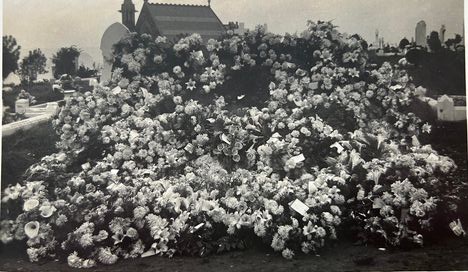
I have recently received several old photographs of Radnor Street Cemetery and how I wish there was one of this funeral where the report says ‘there was a wealth of floral tributes.’
Lilian Pitt was just 19 years old when she died suddenly in 1928. Her two brothers Charlie and Willie travelled up for the funeral with their mother from Abercynon in the Rhonnda Valley while sister Violet came down from her home in Hampstead, London. Other mourners included various cousins and Rose Pitt, the aunt with whom Lilian lived.
The Late Miss Pitt – An impressive tribute to the memory of Miss Lilian Pitt (aged 19), whose death occurred suddenly at 182, Victoria Road, where she lived with her aunt, Miss Rose Emily Pitt, and who was a very popular scholar at the Trinity Presbyterian Church, was paid by the Rev. J.H. Gavin, B.D., at the funeral service at the Victoria Road Presbyterian Church. Mr Gavin mentioned Miss Pitt’s connection with the Sunday School and the Bible Class, and said she was always a good scholar. Miss Pitt was formerly a scholar at Clarence Street School and later was a very popular student at the Euclid Street Secondary School. Her school colleagues subscribed and sent a beautiful wreath to be placed on her grave. Another beautiful wreath was received from the Presbyterian Sunday School. The Rev. J.H. Gavin also officiated at the burial service at the Radnor Street Cemetery.
The chief mourners were: Mrs L.G. Anderson, Abercynon (mother), Miss Violet Pitt, Hampstead (sister), Osborne, Charlie and Willie Pitt, Abercynon (brothers), Miss Rose Pitt, Swindon (aunt), Miss Phyllis Lewis and Miss Cissie Lewis, Swindon (cousins) Mr and Mrs Tom Lewis, Swindon (cousins), Mrs Caswell (Rodbourne Cheney), and Mr Ernie Strange. There was a wealth of floral tributes.
North Wilts Herald Friday, January 27, 1928.
Photograph taken at the funeral of Ethel Mary Franklin
Photograph taken at the funeral of Robert Powell
Today you are more likely to find primroses and daffodils on the Radnor Street Cemetery graves – just as beautiful.
Lilian Gertrude Pitt aged 19 was buried on June 23, 1928 in grave plot C3678. Her grandfather Thomas Pitt was buried with her in 1921 and her aunt Rose Emily Pitt joined them when she died in 1938. There is also a child buried with them. Beryl Davies who died aged 17 months old in 1941, It is not known if the little girl is related to the Pitt family.
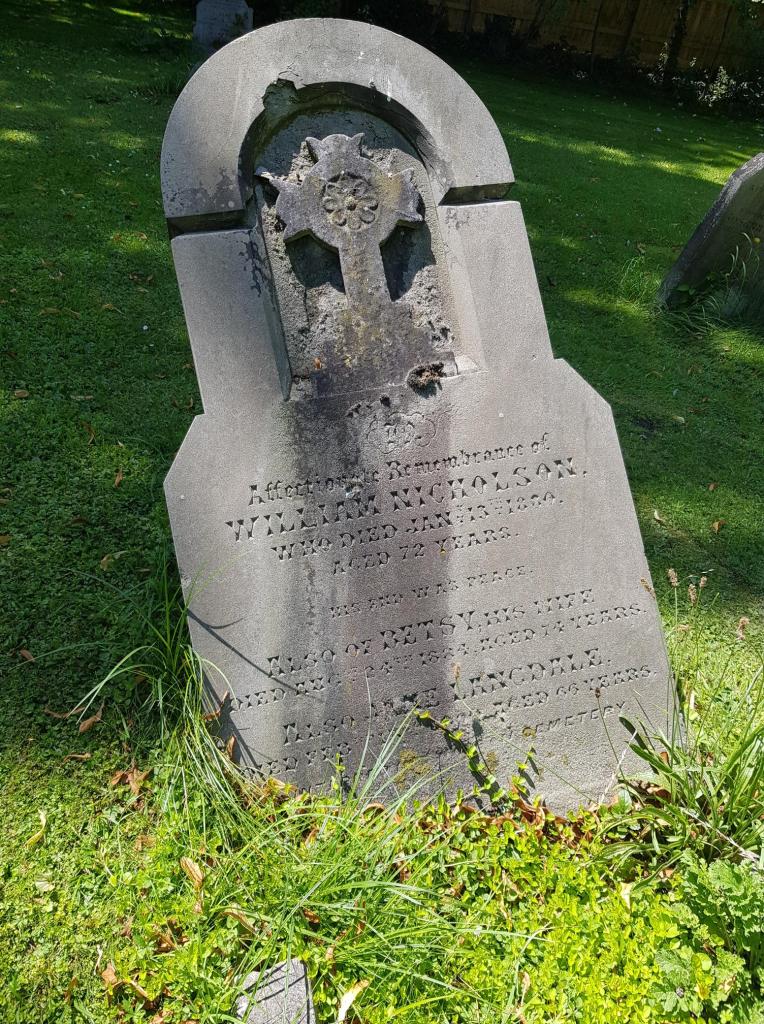
There were a lot of words written about William Nicholson following his death in 1880.
We are sorry to notice the death, on the 13th instant, at New Swindon, of Mr William Nicholson, who, for the long period of nearly 45 years, was a valued and trusted servant of the Great Western Railway Company, and who at the time of his death was, we believe, the oldest foreman in the employ of that company, having served in that capacity very close upon 40 years.
Leaving his native place, Bolton, in Lancashire, very shortly after serving his time as an apprentice to the engineering business, he went to Liverpool, where he married, and obtained employment in an establishment where Daniel (now Sir Daniel) Gooch and his brother were serving their articles as pupils. He, however, did not stay there long, but removed to Paddington, where the Great Western Railway Company had just opened their first engineering works, and when the Swindon works were opened Mr Nicholson came to Swindon, now 39 years since, and after a very short time was appointed foreman over the turning and fitting department, and in this important position he remained until about 15 years ago, when the whole of the Swindon works were considerably enlarged under the direction of the late Mr Armstrong, and the new gas works were then put under the sole charge of Mr Nicholson, and in this position he remained until his death, which took place on Tuesday week, after a somewhat protracted illness caused by heart disease and dropsy.
During his lengthened connection with Swindon and the Railway Company Mr Nicholson enjoyed the respect and esteem of all who knew him. He was devoted to his duties and the interests of his employers, and was strictly conscientious in all his dealings, whilst to the thousands of men who had been placed under his superintendence he was always kind and courteous.
Having known Mr Nicholson from the time when he first came to Swindon, it affords us some satisfaction to be able to bear our testimony to the sterling character of a strictly honest and upright man, and one who, although never ostentatious in any of his dealings, by his general demeanour set a good example before those under him or who came in contact with him. We have been asked to publish the following, which has been forwarded to us by an old workman under Mr Nicholson:
“Another old servant of the Great Western Railway Company has gone to his long home. Mr William Nicholson, who was one of the earliest arrivals from Paddington to Swindon on the opening of the line, and who for many years occupied the position of foreman in the fitting and turning shops in the local department, but latterly that of superintendent of the gas works recently erected by the GWR Company, he having only survived to witness the completion of the extensive and elaborate works of which he was so proud. He was followed to his last resting place, in St. Mark’s Churchyard, by numerous foremen of the works, and a large number of old hands who served under him, who attended to bear testimony to the respect they bore him while living. His widow, with whom he has lived for upwards of half a century on the most affectionate terms, is left to mourn her loss.”
The Swindon Advertiser, Saturday, January 24, 1880.
And in 1992 railway and local historian Trevor Cockbill wrote a few more in his excellent book A Drift of Steam, describing William Nicholson as a devout Wesleyan Methodist who founded the New Swindon Wesleyan Methodist Society and became the first Superintendent of its Sunday School.
But when it comes to his wife Betsey no one appears to have written about her.
William married Betsey Langdale at St Anne’s Church Liverpool on May 17, 1830. We find them on the 1851 census living at Westcott Place, Swindon with four of their children, Betsey’s sister Jane Langdale, a lodger and a 12 year old servant girl. Apart from the official census records the only words I have discovered about Betsey appear on her headstone – and even this isn’t how things might first appear.
William died in 1880 and was buried in the churchyard at St. Mark’s. Betsey died in 1884 but by then the churchyard at St Mark’s had closed and the new cemetery at Radnor Street had opened, which is where Betsey was buried on August 30, 1884 in grave plot A55. She lies in an unmarked grave where she was later joined by the sister who had lived with her for so many years, Jane Langdale who was buried on February 17, 1890. However, the family had made sure that both Betsey and Jane were remembered by adding their names to William’s headstone – interred in Swindon Cemetery.
Today I’m returning to the story of Georgina Verschoyle and although I am no nearer to understanding how or why she came to be living in Swindon, I do know more about her life here.
A view of St Mark’s Church taken from Radnor Street Cemetery
Following her death a lengthy obituary was published in the parish magazine of St. Mark’s Church.
Requiescat in Pace
Miss Verschoyle died on Dec. 20, and was laid to her rest in the Swindon cemetery on Sat., Dec. 23rd. Her health had been failing for several years, and though the end did not seem near to her friends, she was not strong enough to stand against a bad attack of Influenza, that scourge of our country at the present time.
Many who read these lines, perhaps far away now, will remember the time when she came to Swindon thirteen years ago. In those days Church life was just starting in S. Mark’s Parish. She threw herself with untiring energy into the work as a volunteer helper, and indeed continued as such to the end.
Before she had been in the parish many weeks she obtained the Vicar’s permission to commence a Bible Class for Men. The attempt was a decided success. A good number joined at once, and between 50 and 60 men have assembled, while on one of the last occasions when she presided over her Class at the new Parish Rooms, over seventy men were in attendance.
During the whole of the same period she has conducted a large Mothers’ Meeting, and for the last few years a Bible Class for Women at S. John’s. Unlike many of the kind, these classes have never diminished in the numbers of those attending them. People who have experience in such matters know well that classes such as these can only be kept together for so long a period by diligent and unceasing work and earnest prayer.
It is however in the District that we think that Miss Verschoyle’s work has chiefly been done. Well trained in Church work in earlier days at Clewer, Guildford, Market Drayton, S. Giles’, Reading, and S. Luke’s, Torquay, she had attained the habit of regular and systematic visiting. From early morning to late evening she was to be seen every day in all weathers going to all parts of the parish amongst the sick and the whole, bearing the message of comfort. Her daily visits to the dying were a striking feature of her work. Many a one in Paradise will, we believe, thank God for that regular earnest teaching which helped to bring the soul out of darkness into the light of Christ, while many a one living now, who may read these words will gratefully acknowledge that the turn in his life was due to her sympathy and help.
Miss Verschoyle knew the secret of success, viz., that no work for God can prosper unless His help is sought. She was regularly to be seen in her place at the daily Services of the Church, gathering strength into her own life, that she might be the better able to impart it to others. Indeed the Church was very dear to her; she enriched it with many costly gifts, and as each Festival came round, she spent time, money, and labour in decorating the Font with flowers.
We need scarcely say that she was beloved and respected by those amongst whom she worked. While we thank God for her work in the Parish, let us pray to Him to send to our Parish other such workers, and let us ask Him to give us grace to profit by her teaching and example, that when the great day comes, we may be found worthy to be on the King’s right hand among those to whom the word of comfort shall be spoken, “Come, ye blessed of my Father, inherit the kingdom prepared for you from the foundation of the world.
InsideSt Mark’s Church, Swindon
The Late Miss Verschoyle.
Dear Friends,
It has been suggested to me that some of those who have known Miss Verschoyle and her work in the parish may like to place some kind of memorial to her in S. Mark’s Church, where she was so constant a worshipper. I do not think it would be suitable to have an organised collection for such a purpose as this, but if any of those who read these words like to send a contribution, great or small, I will very gladly receive it. The nature of the memorial must be decided by the amount contributed. Yours truly, Maurice Ponsonby.
Throughout the year fund raising updates appeared in the parish magazine until in November the Rev. Ponsonby declared it was probably time to close the account and think about how the money should be spent.
I wonder if anyone can tell us what kind of memorial was chosen for Miss Verschoyle and whether it still survives in St. Mark’s today.
Fr Toby from St. Mark’s has sent the following words and kindly offered to provide a photograph.
The memorial is a window in the south aisle depicting Matt 15.28. The dedication on a plaque underneath reads: “This window is given by many friends in grateful memory of Georgina Verschoyle who fell asleep on Dec. 20th 1893 after 13 years of unceasing labour for God in this parish. Requiescat in pace.”
















 Radnor Street Cemetery