Stephen and Augusta Nicholas

Sometimes I find articles in the local newspaper which provide so much information that there is really no need to do any further research.

The North Wilts Herald published the story of their life together when Stephen and Augusta Nicholas celebrated their Diamond Wedding Anniversary in 1931. Just four months later they published an account of Stephen’s funeral.
Married 60 years

Diamond Wedding of Mr and Mrs S. Nicholas, of Swindon

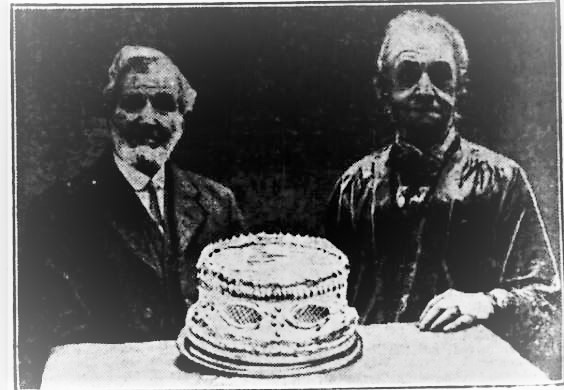
Mr and Mrs Stephen Nicholas of 106 Princes street, Swindon, celebrated their diamond wedding on Saturday. Mr Nicholas is 83 years of age and his wife 79.

Both are in fairly good health, and they enjoyed a little party of relatives who came to wish them good luck. Mr Nicholas was particularly pleased with a wedding cake which his children had made for him.

Both Mr and Mrs Nicholas were born at Nunnery, near Frome, in Somerset, and they were married at the Parish Church on 10 October, 1871. Mrs Nicholas was formerly Miss Augusta Hillier.

In those days her husband worked in the flour mills, and at the time of his marriage his wages were only 12s a week. A little more than two years after the wedding they moved to Wales, where Mr Nicholas worked for the Gloucester Wagon Repairing Company. The next move was to Bristol, and in August, 1876, he and his wife came to Swindon, where he entered the GWR Works. Here he remained for 43 years, retiring in 1919 at the age of 71 years.

Mr and Mrs Nicholas had six children, all of them born in Swindon, but only three are now alive. These are Miss Nicholas, who lives with her father and mother, Mrs J. Ruddle and Mr Bertie Charles Nicholas, who worked in the GWR factory. There are five grand-children – the children of Mrs Ruddle.

Mr Nicholas was a wood wagon builder by trade, and for 30 years he was a chargeman in the 21 Wagon Shop. His foreman was Mr Joseph Wilkinson, and his under foreman, Mr John Money, is now 86 years of age and lives close to him in Gordon Road.

Ever since they came to Swindon Mr and Mrs Nicholas have been members of the Regent street Primitive Church, which they joined when the Rev. Thomas Pinnock was the minister. Mr Nicholas is still a trustee of the church, and both he and his wife have been Sunday School teachers.

Mr and Mrs Nicholas have been the recipients of numerous presents from members of the Regent Street Primitive Methodist Church.

North Wilts Herald, Friday, October 16, 1931.

Mr S. Nicholas

Fine Tributes to a Swindon Methodist

The funeral of Mr Stephen Nicholas, of 106, Princes street, Swindon, took place on Wednesday afternoon, and was largely attended by relatives and friends and representatives of religious and other bodies with which he was associated.

Mr Nicholas, who had reached the age of 84, recently celebrated his golden [diamond] wedding. His wife has been ill for some time. They were both natives of Nunney, near Frome, Somerset. They came to Swindon in 1876, and Mr Nicholas was employed in the GWR Works for 43 years, retiring in 1919. He was a chargeman in the Wagon Shop for 30 years.

Ever since they came to Swindon, Mr and Mrs Nicholas have been members of the Regent Street Primitive Methodist Church and both were Sunday School teachers.

The first portion of the burial service was conducted at the Regent Street Church, the officiating ministers being the Revs. J. Lindsay, T. Sutcliffe and E.P. Sellars.

The interment took place in the Radnor street cemetery. The family mourners were Mr and Mrs B. Nicholas ( son and daughter in law), Mrs J. Ruddle (daughter), and Mr Ruddle, Mr L. Ruddle (grandson), Miss G. Ruddle (grand daughter), Mr J. Nicholas (brother) and Mrs Cooper.

Representatives were present from the GWR Works, from the Primitive Methodist Church, the sons of Temperance Friendly Society, and other bodies with which Mr Nicholas was associated. Amongst these were Messrs. T. Greenwood, S. Stone, A. Painter, Llewellyn, Wheeler, S. Hanks, G. Harvey, H.J. Franklin, F. Smith, F. Hoare, S. Hardy, Beasant, F. W. Vincent, W.T. Harding, G. Shell, W. King and F.W. Ludlow.

The funeral arrangements were carried out by Mr A.E. Smith, of Gordon Road.

North Wilts Herald, Friday, February 5, 1932.
Silas Fry – Primitive Methodist

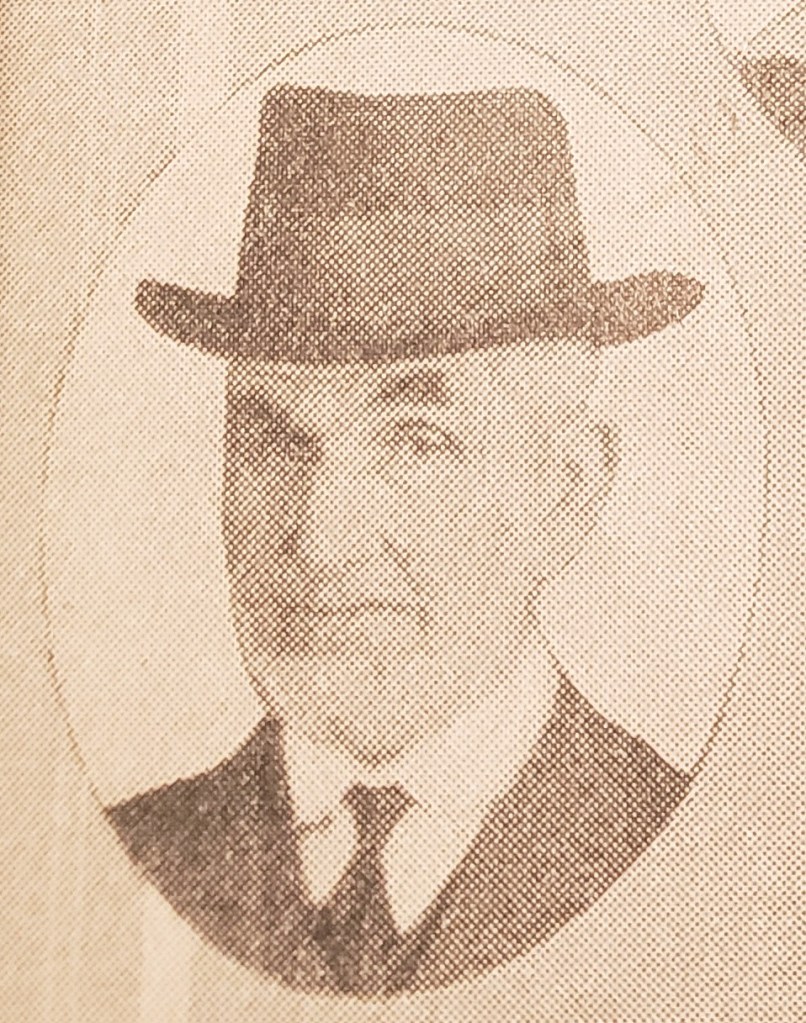
Silas Fry and his wife Lydia were a pretty dynamic couple. When Silas died in 1925 the North Wilts Herald published a lengthy obituary detailing his many accomplishments, which included his work as a member of Swindon Town Council, his membership of the old Gorse Hill Cricket Club and his lifelong membership of the Primitive Methodist Church.

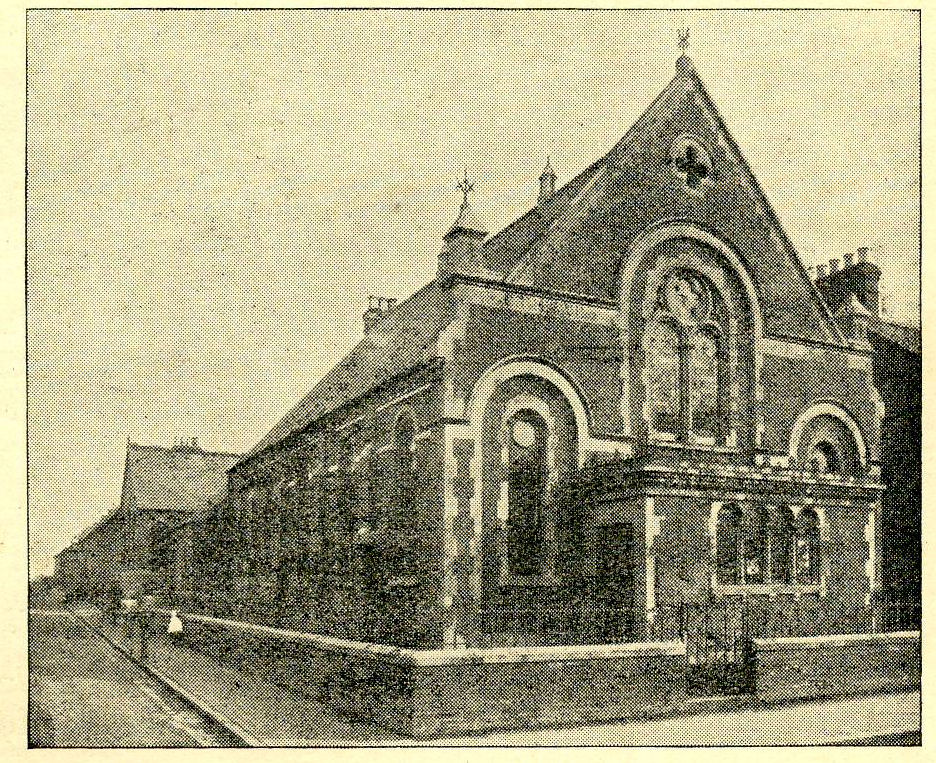
Primitive Methodist Chapel, Cricklade Road, Gorse Hill

Silas was born in 1874, the son of Oliver Fry, newsagent/grocer and Primitive Methodist preacher, and his first wife Esther Ayliffe. He grew up in Gorse Hill and never moved away, living with his wife Lydia at first 110 Chapel Street and then 71 Cricklade Road where he died on June 14, 1925.

Death of a Swindon Councillor

Mr Silas Fry’s Many Activities

The Funeral

The death occurred on Sunday of Mr Silas Fry, a member of the Swindon Town Council and a well known figure in many departments of public life in the town.

A few months ago Mr Fry, who was 51 years of age, underwent a serious operation at a Swindon nursing home, and he made such good progress afterwards that strong hopes were entertained that he would make a complete recovery, but he suffered a relapse.

A son of Mr Oliver Fry, who was prominently identified with local government affairs, deceased was at one time a member of the Swindon and Highworth Board of Guardians, and on his retirement from that body he was succeeded by his wife, who is still an active and useful member. In November 1922, Mr Fry was elected to the Town Council as one of the representatives of North Ward, and in that capacity he rendered much useful public service. He served on the Watch and Pleasure Grounds Committee, being this year’s vice chairman, and other committees of which he was a member were the Sewage and Allotments, Works and Streets, General Purposes and Emergency, and the Swindon and District Hospital Board.

Deceased had been organist at the Gorse Hill Primitive Methodist Church since he was nine years of age, and when the services were conducted in the old chapel, now used as the Salvation Army Barracks. He was also Superintendent of the Sunday School, and president of the local Christian Endeavour. For 20 years Mr Fry was choirmaster, succeeding the late Mr J.J. Henly. He was also one of the pioneers of the old Gorse Hill Perseverance Cricket Club, which afterwards became the Gorse Hill Primitive Methodist. He was a keen cricketer, and played until four years ago.

Extracts from the North Wilts Herald, Friday, June 19, 1925.

You may also like to read:

Lydia Fry – For Services Rendered

Richard James Leighfield – Master Builder

This is another magnificent pink granite memorial full of funerary iconography.  The fluted pillars or columns at the top symbolise the door to heaven and the passageway to eternity.  The letter L is displayed prominently passing through this entrance. The thorny acanthus leaves symbolise the prickly path of earthly life to death and eventual eternal life.

This is the last resting place of the Leighfield family. Firstly, of Elizabeth, ‘the devoted wife of Richard James Leighfield of Witney Street, Swindon who died after a long and painful illness after which she sweetly fell asleep in Jesus on February 2, 1910 aged 49 years.’ Elizabeth was buried with the couple’s second son David who had died aged just 3 weeks old in 1892.

The inscription on this memorial is the first verse of a hymn called The Christian’s Good Night – lyrics by Sarah Doudney and music by Ira D. Sankey.

Sleep on beloved sleep and take thy rest,

Lay down thy head upon thy Saviour’s breast.

We love thee well but Jesus loves thee best.

Good night, good night, good night.

Richard was born in Wootton Bassett in 1859 the son of postman James Leighfield and his wife Ann. At the age of 12 Richard was already working as a mason’s labourer, later becoming a bricklayer and by 1891 he was a Master Builder.

In 1887 he married Elizabeth Hunt and at the time of the 1891 census they were living at 83 Clifton Street with their two year old son James. 

Richard built houses on Clifton Street, Whitney Street* and Ponting Street. At the turn of the century, encouraged by the growth of New Swindon, he purchased a parcel of land on the east side of Whitney Street on which he built a house known as 1 Whitney Street. Behind the house he developed office accommodation, yard, stables and a workshop from which he conducted his business. On the rest of the land he built 6 cottages which he let, principally to members of his staff. Between 1901-1916 the family firm built 39 houses at St Mary’s Grove.

Following Elizabeth’s death, Richard married Clara Williams in 1913. The couple married at the Primitive Methodist Chapel in Regent Street where they were both members. Clara was a descendant of John and Mary Pike who opened their home on Eastcott Hill for meetings during the early days of Primitive Methodism in Swindon.

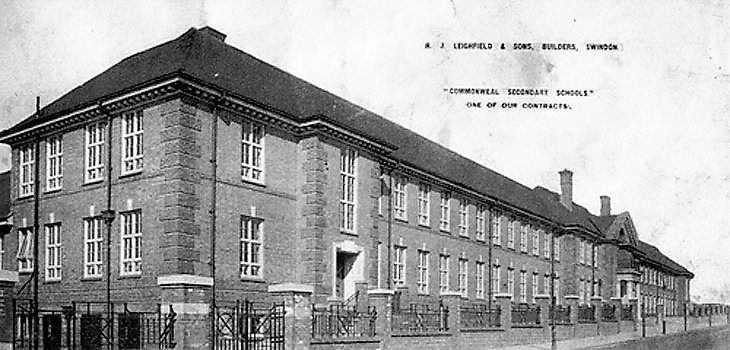
The Leighfield family firm continued to be busy during the 1920s and 30s when among their projects they built the Primitive Methodist Church at The Circle, Pinehurst; Commonweal School, The Mall, Old Town; the Co-op on Groundwell Road and the Swindon Corporation Electricity Dept showrooms at Regent Circus.

Richard died at his home 109 Bath Road in 1948 aged 89. His funeral took place on April 22 when he was buried in grave plot E8440 with his first wife and son. His second wife Clara died in 1964 and was buried in the family plot.

The Leighfield business continues today at the Coped Hall Business Park in Royal Wootton Bassett.

*The spelling of Whitney/Witney Street varies.

Ignatius Michael Howell

It was the name of the occupant that drew my attention to this grave.

Ignatius Michael Howell. He had a brother, Aloysius. Pretty distinctive names in Stratton St Margaret, I would imagine.

St Ignatius was an early Christian writer. He was one of the five Apostolic Fathers and the third Bishop of Antioch. He died c108 in the Roman arena. St Aloysius was a 16th century Jesuit who died during an epidemic in 1591. It’s probably fair to say that William and Esther Howell were a devout couple.

William worked as a Railway Clerk and in 1884 when he was 16 years old, Ignatius followed his father into the Works in the Clerks & Draughtsman Department. By 1893 he was earning £80 a year, rising to £110 by 1899.

Ignatius married Kate Celestine Knight on November 25, 1889 and the couple had eight children – seven daughters and one son, Mary, Agnes, Kathleen, Gertrude, Margaret, Monica, Winifred and William.

Ignatius died at his home at 154 Croft Road on April 19, 1951. He was buried in grave plot C3437 with his daughter Agnes who died in 1916 and his wife Kate Celestine who died in 1928.

Arthur William Burson J.P. – Prominent Baptist

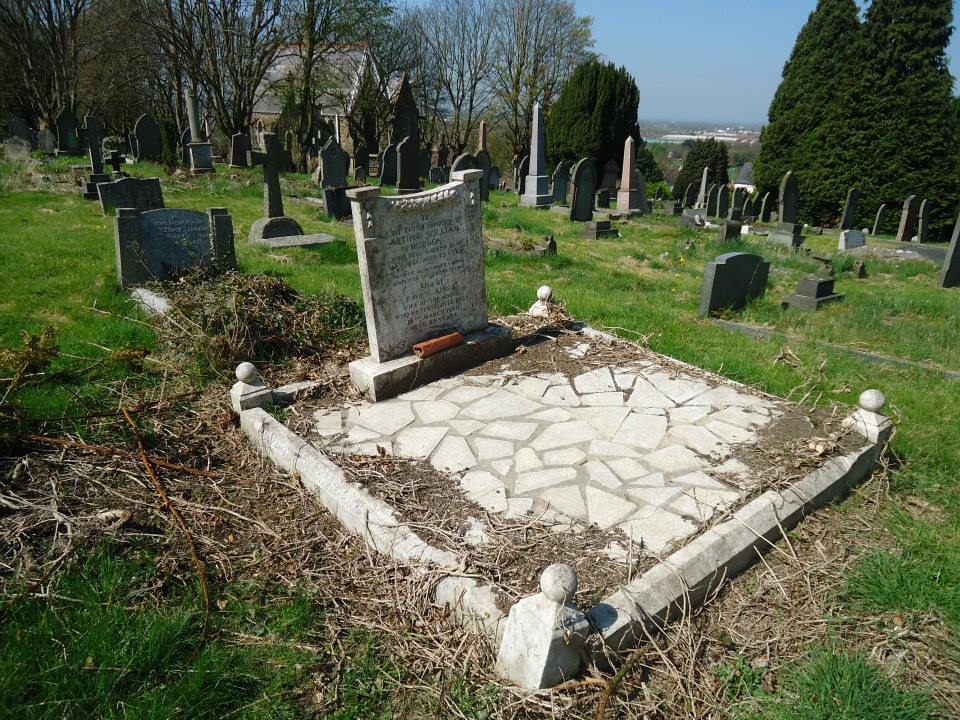
The photograph of the Burson family grave (see below) was taken several years ago. I now realise someone must have cleared and cleaned it around that time. When I tried to find it recently, thinking it would be an easy task, I was surprised to discover the memorial dulled and dirty. Is it the pollution in our air, less obvious than the smoke of factory chimneys and coal fires of the past, that causes such discolouration?

This is the story of Arthur William Burson who was born in Steventon, Berks, the son of farmer Richard Burson and his wife Louisa. In 1871 Richard was farming 140 acres and employing six labourers and two boys at Sutton Courtney, but Arthur appears to have been unwilling to follow in his father’s agricultural footsteps.

By 1881 Arthur had moved to Swindon and was working as a grocer’s assistant, living above the shop at 57 Bridge Street. In 1888 he married Emily Anna Solway and at the time of the 1891 census the couple were living at 52 Fleet Street where Arthur appears to have his own business.

Ten years later and the family business was at 94 Commercial Road. By now the couple have three daughters, Edith, Elsie and Hilda, fourth daughter Grace was born in 1903. The family later lived at 69, Bath Road.

When he died in 1934 a lengthy obituary published in the North Wilts Herald described him as ‘A.W. Burson J.P. – Swindon Business Man Who Once Owned Seven Shops.’

Death of A.W. Burson J.P.

Swindon Business Man Who Once Owned Seven Shops

A Swindon man who rose from a lowly position behind a grocer’s counter to become the owner of seven prosperous shops in Swindon, in one of which he had served as an assistant, is the history of Mr Arthur William Burson, of 69 Bath road, Swindon, whose death occurred last Friday.

There is however a poignant side to his death in that it has robbed him of the opportunity of seeing the completion of the Stratton Green Baptist Chapel, towards the building of which he had given £1,000 as a memorial to two of his children.

Mr Burson, who was well known as a prominent Baptist, died after an illness which had lasted more than three months. He was suffering from bronchial trouble, when heart trouble supervened.

Born at Steventon.

In 1861, Mr Burson was born at Steventon, Berks, and at an early age was apprenticed to the grocery trade at Reading. His connection with Swindon started in 1880 when he was engaged as an assistant in the grocery busines of H. Freeth and Son. For five years he remained in this position, and then made his first venture into business ownership. In partnership with the late Mr Thomas Harry, of Swindon, he opened a shop in Abergwynid, near Maesteg, South Wales, and this business was carried on by the two for five years.

Then, however, he returned to Swindon. With Mr Harry, he became joint proprietor of the business in which he had served as assistant – H. Freeth and Son, and conducted no fewer than seven shops in the town.

The business continued in their joint ownership for two years until the death of Mr. Harry, when Mr Burson assumed sole control. As proprietor of the firm of H. Freeth and Son he continued to take an active part in the conduct of the business until 1926 when he retired.

Gift to Town Gardens

In the year of his retirement, and more or less as a token of gratitude for the prosperity which he had achieved in Swindon, Mr Burson presented to the town the clock over the bandstand in the Town Gardens.

Though he was one of the oldest members of the Swindon Bench of Magistrates, having been a member since the Bench was first appointed in 1907, it was by reason of his religious activities that Mr Burson was better known. He was baptised in 1880 at the Baptist church which stood in Fleet street, and which is now demolished.

On returning to Swindon he continued his association with the Baptist faith in the town, and became connected with the Baptist Tabernacle, which had replaced the former church in Fleet Street.

For many years he was also superintendent of the Gorse Hill Baptist Sunday School, and was also treasurer, and teacher in Baptist Sunday Schools in Swindon for over 50 years.

Former Town Councillor.

At the time of his death he was one of the elders of the Baptist Tabernacle, treasurer of the Tabernacle Sunday School and held a similar post in connection with the Swindon Colportage Association. A prominent teetotaller since the age of 18, he was one of the oldest members of the Tabernacle Temperance Society.

He held a seat on the Town Council from 1900 to 1909, and again from 1911 to 1921 continuous.

While in Wales Mr Burson married a Miss Salway, who was a native of Somerset. Mrs Burson survives him. They celebrated the 46th anniversary of their wedding last Easter. There were four children, all daughters, of whom two are dead. One died in 1913, and the other two years ago. The two surviving daughters are Mrs Dadds, [Dadge] of Bath road, and Mrs Higgins, of Broome Manor lane.

Early this year Mr Burson came forward with an offer of £1,000 towards the cost of the new church at Stratton Green as a memorial to his invalid daughter, on whom the money had been settled as a future provision for her. Announcing his gift, Mr Burson said, “She had been taken and I should like her memory to be enshrined in the new building.”

The cheque for £1,000 was signed by Mr Burson and handed over to the Stratton Baptist officials about six weeks ago, during Mr Burson’s final illness. The Swindon Advertiser is informed, therefore, that the gift will not be affected in any way by the death of the donor.

It has now been suggested by those connected with the Stratton Church that, as a gesture of gratitude to Mr Burson for his gift, the new church shall contain a memorial window to the two daughters of Mr Burson who had pre-deceased him.

The Funeral

In the presence of a large congregation of mourners, the funeral took place on Wednesday afternoon.

The first portion of the service was conducted at the Baptist Tabernacle and the interment took place in the Radnor Street Cemetery.

Extracts from the North Wilts Herald, Friday May 25, 1934.

Arthur William Burson, 73 years, of 69 Bath Road was buried on May 23, 1934 in grave plot E7588. His wife Emily Anna died in March 1950 and was buried with him his this impressive grave plot.

James Lambdin – The Singing Ploughboy

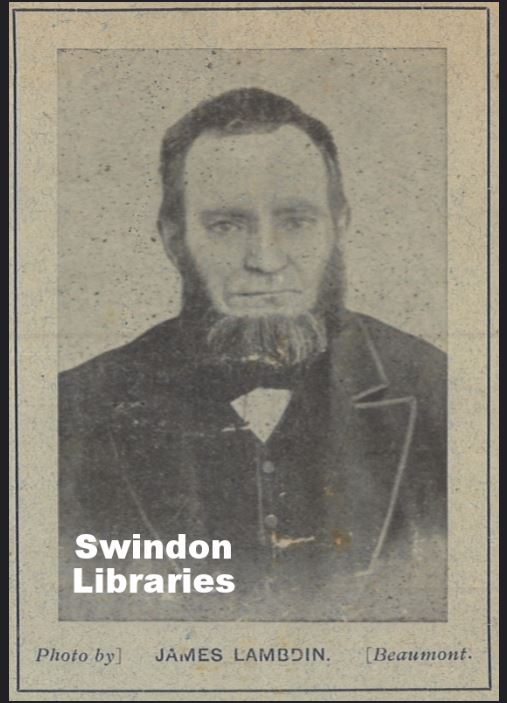
Image published courtesy of Local Studies, Swindon Central Library

James Lambdin died suddenly and, it would appear, without making a will. Perhaps he had no worldly goods to leave. His life had been spent spreading the word of God.

James was born in Aldbourne in 1850, the son of Joseph and Sarah Lambdin. By the age of 10 years old he was working as an agricultural labourer. He later moved to Swindon and a job in the railway works, but it is his service in the Wesleyan Methodist Church that he is remembered for.

James married twice. His first wife, Faithfull Maria Dew, whom he married in 1874, died two years later aged just 22 years old. She was buried in the churchyard at St. Mark’s.

In 1878 he married Eliza Burt. The couple made their home first in Stratton St. Margaret (1881) and then in Gorse Hill living at 24 Hinton Street (1891) and 21 Avening Street (1901). They had one child, a daughter Beatrice, born in 1886.

A pamphlet produced after his death was entitled – Memoirs of James Lambdin – The Singing Ploughboy who became a Great Preacher and 30 years a Class Leader at Gorse Hill, Swindon.

The Angel Reaper has passed over the Bath Road Wesleyan Circuit, and taken away one of the staunchest adherents, Mr James Lambdin, of Gorse Hill. Mr Lambdin was a highly respected member of the Wesleyan body and looked up to throughout the whole circuit and was widely known for his wise exposition of the Scriptures.

He was a native of Aldbourne, and only the Sunday previous to his lamented death, he went to his birthplace to fulfil a preaching engagement. The day before that he had called upon one of his class members who was almost at the point of death, and the following day week, he himself had taken that journey from whence no traveller returns.

His illness was very short but painful, and his last words were a benediction for his fellow class members and workers. The loss is being felt very keenly throughout the circuit. Last Sunday morning, the preacher at Cricklade Road, a very old and devoted layman, was completely overcome with grief, and the evening congregation were greatly impressed by an impromptu memorial service.

I hear a whisper that a short memoir with a photograph will be prepared shortly.

The Swindon Advertiser, Friday, February 28, 1908.

James Lambdin was buried in Radnor Street Cemetery on February 27, 1908 in grave plot B2912. His wife Eliza survived him by more 19 years and was buried with him on February 3, 1927. The inscription on the modest headstone reads ‘To the revered memory of James Lambdin – Promoted Feb 23, 1908’

John and Alice Robson – a memorial full of meaning

This is the final resting place of John Davison Robson, an engineer whose last home was at 24 Read Street.  John was another person who had moved around the country.  We tend to think of this as a modern trend, but people have always moved to go where the work is and 19th century Swindon had plenty of that to offer.

John was born in Wellington, County Durham in 1839.  By 1858 he was living in Bristol where he married Alice Storey that year.

Each set of census returns reveal John and Alice living at a different address, with their children born in Bristol, Frome and Trowbridge. 

This memorial is full of symbolism.   The inscription is on a scroll, a symbol of life and time. Both ends rolled up indicate a life that is unfolding like a scroll of uncertain length with the past and future hidden. 

The acanthus leaf has several meanings in funeral iconography.  One of the oldest and most common motifs to appear on headstones, it is associated with the rocky ground where most ancient Greek cemeteries were located.  Its thorny leaves also represent life’s prickly and difficult path.

Passion flowers represent Christ’s passion during Easter week. Across the cemetery there is a memorial to Esther Swinford, who was murdered by her former fiancé. Her headstone has a spray of passion flowers tumbling across it, possibly a misplaced reference to her murder as a crime of passion.

John died on December 4, 1904 and his wife Alice died just eight days later on December 12.

They are buried with their daughter Margaret who died in 1902.  Another daughter Alice Cooper is remembered on this memorial.  She died in 1893 and is interred in Cardiff cemetery.

Ebenezer Evans – Sunday School Teacher

The re-imagined story …

“Put your feet up Gramps,” we used to tell my grandfather. Always dashing about he was, as if a ten hour shift in the Rolling Mills wasn’t enough to tire him.

Then, of course there was the Chapel. What little spare time he had was spent in the Baptist Chapel just behind the house where he and Nan lived. He might as well have lived there, I used to think. Wonder he hadn’t worn a path from the garden gate to the Chapel door.

One of the founding deacons he was, along with a Sunday School teacher and a dozen other duties he performed.

When he retired they presented him with an armchair.

“There we are Gramps, now you can put your feet up proper.”

He never did, mind.

The facts …

Ebenezer Evans was one of the foundation deacons of the Cambria Baptist Chapel

A Teacher’s Retirement – On Sunday afternoon an interesting ceremony took place at the Cambria Baptist Chapel, New Swindon, in the presentation to Mr Ebenezer Evans of an easy chair as a slight token of the esteem of his fellow teachers on his retiring from the school through advancing years and consequent declining health. Mr Evans has been a teacher in the Sunday School for 20 years, and had spent a similar time in Sunday School work in South Wales before coming to Swindon. The presentation was made by Mr J. Green, superintendent, on behalf of the teachers and scholars, who willingly subscribed towards the gift. Mr Evans, evidently much surprised, thanked the subscribers for their kindness, adding some good advice to those present who were beginning life.

The Faringdon Advertiser, Saturday, August 13, 1898.

Ebenezer Evans moved to Swindon following the opening of the Rolling Mills. By 1868 he was living at 38 Cambria Place and the 1871 census describes him as a 40 year old Rail Straightener born in Beaufort, Brecon. Living with him were his wife Jane and children John L. 14, Elizabeth 12 both born in Ebbw Vale, Monmouthshire and David 8, William 5, Sarah 3 and 1 year old Edith all born in Swindon. Also living with them in the small cottage were two lodgers. The couple would go on to have another two children, Mary Ann and George.

Jane, wife of Ebenezer Evans, died in November 1900 aged 65 and was buried on November 8 in grave plot C1167. Ebenezer died in 1903 aged 72 and was buried with his wife on February 19, 1903.

Lydia Fry – For Services Rendered

Following the horrors of the First World War an increasing number of women began to take their place on the political stage at both national and local level.

Lydia Fry was already serving as a member of the Swindon and Highworth Poor Law Board of Guardians, before standing at the Town Council elections in December 1919.

Lydia was born in 1871, the fourth child and only daughter of agricultural labourer Richard Wilson and his wife Fanny.

She spent her childhood at Buscot, Berkshire but by 1891 Richard, Fanny and Lydia were living at 35 Bright Street in Gorse Hill. Richard worked as a platelayer labourer on the railway and Lydia was a shirt seamstress.

In 1892 Lydia married Silas Fry. Their first daughter Esther was born in December of that year. A second daughter Miriam was born in 1893. In 1901 the family lived at 110 Chapel Street and from around 1911 until the death of Silas in 1925 at 71 Cricklade Road.

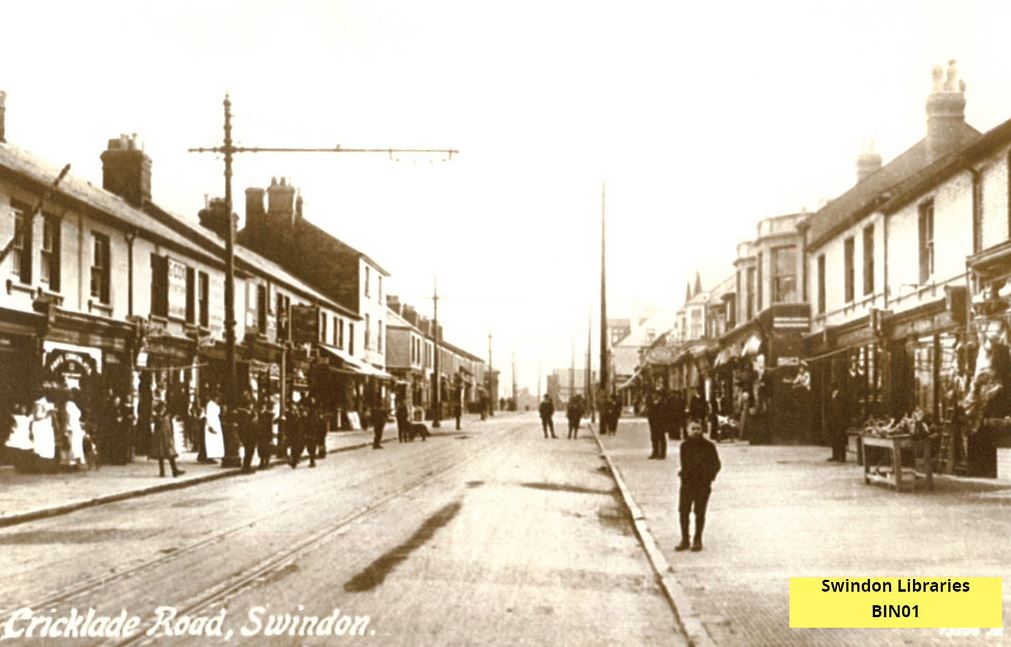
Image of Cricklade Road, Gorse Hill published courtesy of Andy Binks, Local Studies, Swindon Central Library.

When Silas died in 1925 the North Wilts Herald published a fulsome obituary detailing his many accomplishments. However, when Lydia died on April 24, 1941 only a brief account of her funeral was published in the same newspaper. There was no mention of her political career or her public service. Fortunately, in 1924 the North Wilts Herald published this account of Lydia’s life and work, written by W. Bramwell Hill.

For Services Rendered

Mrs Silas Fry’s Good Record

By W Bramwell Hill

Public service of all kinds has its times of difficulty, and, frequently, of irritation. You are not your own. You are bought with the price of the lurid light of criticism, half truth, misunderstanding, and misrepresentation. Happily that is not the only state. Such work does on occasion know a transition into the realm of tangible reward, even though the true reward is in the race well run, and the game well played, with patience and imperturbability of fine motive as the fairy hand-maidens of high endeavour. For what they receive in the unalloyed joy of doing a great work, whatever the sphere, multitudes toil on and in their toil rejoice.

To such a band the subject of our brief sketch this week belongs.

Mrs Silas Fry, of Cricklade Road, Gorse Hill, wife of Councillor S. Fry, is a lady well known for a splendid record of faithful work in her own area. Her chief activities have been in connection with the Swindon and Highworth Board of Guardians (of which she has been a member for some 17 years, I believe) and the Cricklade Road Primitive Methodist Sunday School. It is quite possible – yea, it is more than probable – that the energy for the one task has been found in the service of the other. In the realm of the Sunday School she has put in no fewer than 26 years of successive service, and during the recent Sunday School rally held amid the sylvan setting of Bassett Down House (by kind permission of Mrs Arnold Forster) Mrs. Fry was presented with a diploma of honour, the gift of the Connexional Sunday School Union.

Mrs Fry’s record, by the way, is largely confined to one school – Cricklade Road. In young people’s work, in the choir, the Christian Endeavour movement, as a representative to the Quarterly Board, as well as being a most effective speaker, she is well known. In these times of women’s recognition a certain appropriateness is found in the projection of the good record of Mrs Fry, who, in co-operation with her husband, has put in a vast amount of unostentatious service for the public weal.

North Wilts Herald, Friday, June 6, 1924.

Lydia Elizabeth Fry died aged 69 years at 24 Dudmore Road. She was buried on April 27, 1940 in grave plot D808 she shares with her husband Silas.

Fred and Mary Winchcombe

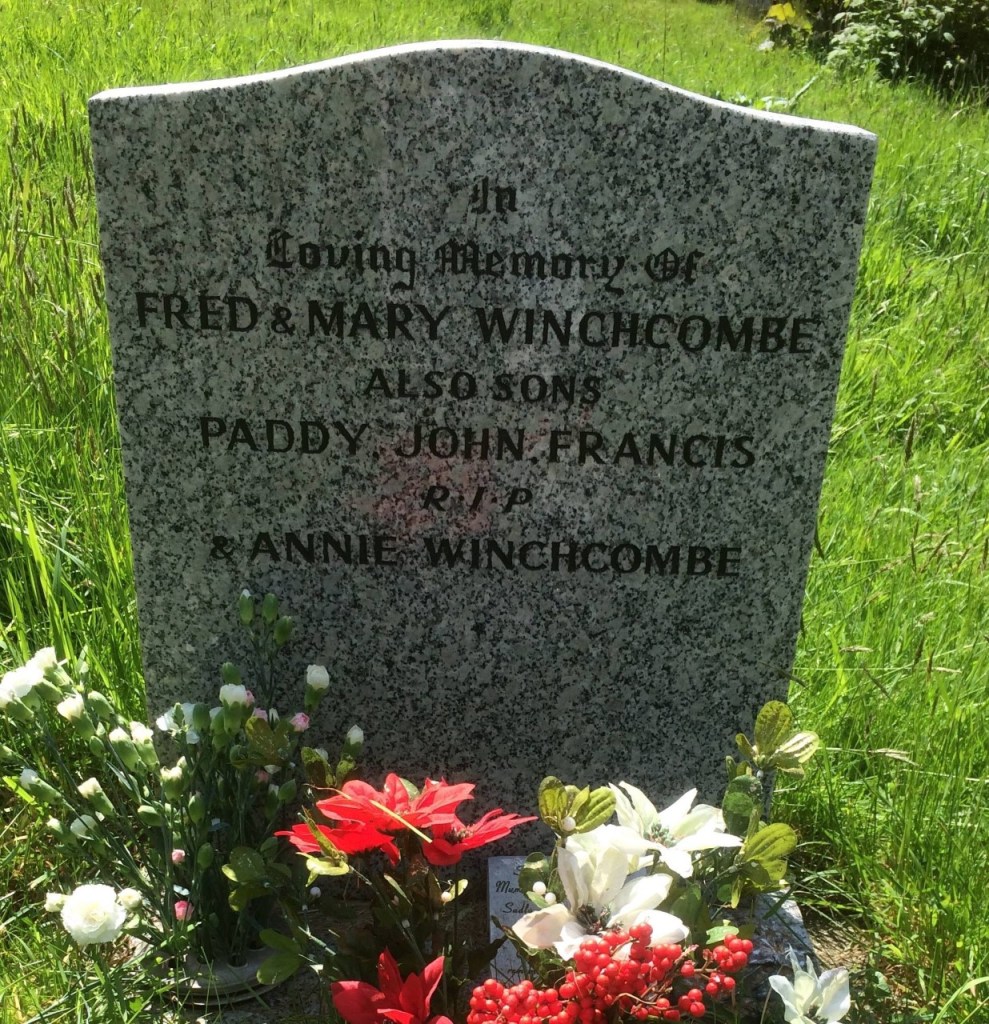
This is the last resting place of Fred and Mary Winchcombe who married in 1911 and had a family of six sons and two daughters. Mary died in 1951 and Fred in 1964.

Several years ago their granddaughter, Mary, joined us on one of our walks and kindly sent me the following information about her grandparents.

Fred Winchcombe worked in the GWR and walked in from Chiseldon each day. He and the men he walked in with had the habit of taking a quick pint in the Patriots Arms on the way in, and one day he met up with recruitment men from Kings Troop.

Grandad took the King’s Shilling and joined Kings Troop and was posted to Ireland. He was stationed just outside of Kilkenny and the only watering hole deemed safe for the troops to drink in (he was CofE) was Mastersons Hotel in Kilkenny High Street. This was owned by Mary Morrisey’s uncle, and she worked there. Mary was Roman Catholic.

They met, fell in love and Fred asked her to marry him. Her family were not opposed as long as Fred changed religion. He did, they were married in Holy Rood Church, Swindon.

They started married life in Chiseldon, but as Mary insisted on walking into Swindon every day for Mass, Fred moved them to 10 Union Street, Old Town where they raised their children in a two up two down terraced house with outside toilet and no bathroom.

Mary very much wanted to go back to Ireland to see her own parents and siblings, but both parents died before they ever managed to save enough money for her fare.