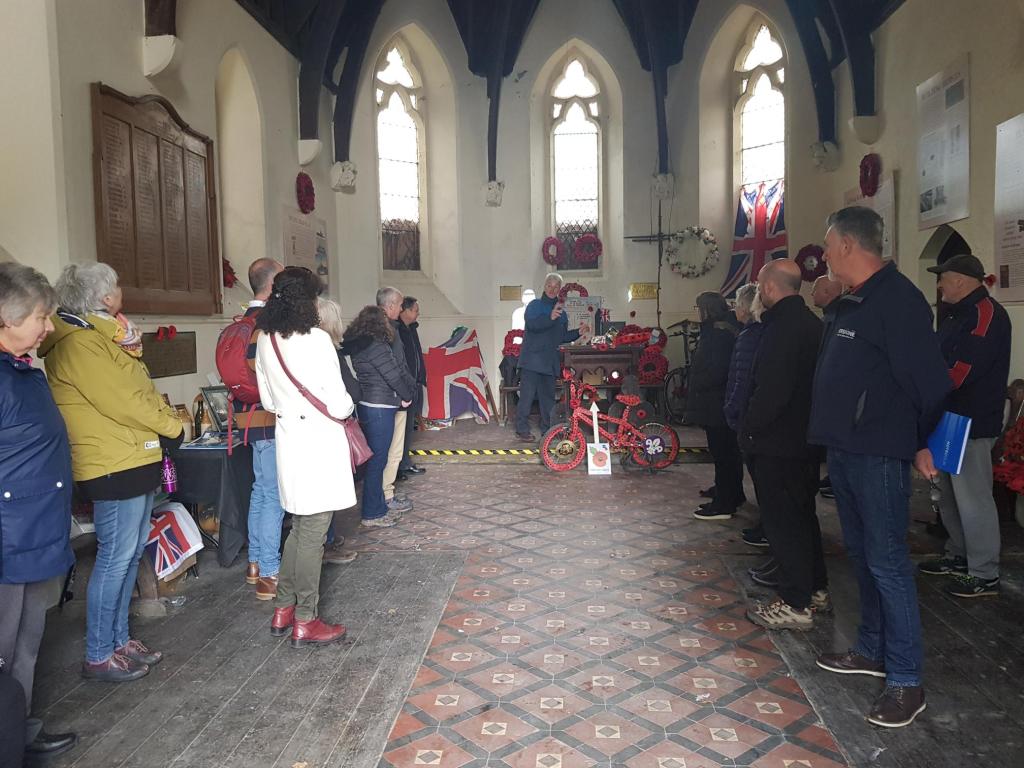
We had torrential rain, thunder and eventually beautiful sunshine on our guided cemetery walk yesterday, during which we welcomed regular and new cemetery followers.
Kevin updated us on the work of the CWGC Eyes On Hands On team and in honour of the forthcoming 80th anniversary he spoke about Private Kenneth William Scott-Browne, killed in an air accident during D Day training.
The sad story of Elizabeth Jane Hardy who died at the Wilts County Mental Hospital in Devizes in 1934 and was buried there in error.
Exhumation of Swindon Woman
Re-Burial in Radnor Street Cemetery
The Late Mrs Hardy
Early on Friday morning, in the presence of about half-a-dozen people, the body of Mrs Elizabeth Jane Hardy, aged 82 of Swindon, was removed from the grave in the hillside cemetery at the Wilts County Mental Hospital at Devizes, where it has been for just over a month.
The exhumation, by request of the Home Secretary, Sir John Gilmour, who granted the order, was carried out “As quietly as possible,” and only three members of the public were present at the re-burial at the Radnor Street Cemetery, Swindon, an hour later.
Secret Proceedings
And so at last satisfaction has been secured in connection with the unfortunate mistake that led to Mrs Hardy being buried in the Mental Hospital grounds against the expressed wish and without the knowledge of her 82 year-old husband, Mr Samuel Hardy, of 4, Euclid Street, Swindon.
Not a single relative was afforded an opportunity of attending the first burial, or of sending a few flowers down to the hospital, and immediately he heard of what had taken place, Mr Hardy and other members of the family, who naturally, were greatly distressed, vowed that they would not rest until an exhumation order had been secured.
In order to avoid any kind of public demonstration, the proceedings on Friday morning were carried out with the utmost secrecy.
The exhumation order was issued on Monday through Mr A.E. Withy, who has been acting for Mr Hardy, and the Mental Hospital authorities were immediately notified. Last Thursday afternoon the arrangements for lifting the body were completed, and Mr F.N.W. Baker, son-in-law, accompanied by Mr D.S. Smith (son of Mr A.E. Smith, the undertaker) motored down to the hospital cemetery on Friday morning.
The grave had been opened by the time they arrived, and when the coffin was disinterred Mr Baker expressed a wish that the lid should be raised in order that he might identify the body. This was done.
Those present at the exhumation included Dr. J.W. Leech, acting medical superintendent of the hospital, Mr J. S. Deavin, Clerk, and the Rev. Dudley, hospital chaplain.
The Mourners
The elm coffin was then enclosed in a magnificent oaken shell, and brought in a hearse to Swindon.
Just after nine o’clock, following a short service conducted by the Rev. Bertram E. Woods, of the Methodist Central Mission, Swindon, the re-burial took place in the Radnor Street Cemetery, in the grave which was originally opened for the public funeral that had been arranged to take place on Tuesday, 3 April.
The mourners present were Mr Samuel Hardy, husband; Mrs F.N.W. Baker and Mr Baker, daughter and son-in-law; Miss Joan Baker, granddaughter; Mr and Mrs Walter Timbrell, niece and nephew; Mrs Butt, Mrs Tylee and Mrs Selby, nieces; Mr and Mrs F. Baker, and Mrs Trowbridge, friends.
Mr Hardy, in conversation with a North Wilts Herald reporter, said the members of the family were greatly relieved to know that their efforts had been successful, and they owed a great debt of gratitude to the many friends who had sympathised with them in this sad affair.
“We are particularly grateful to Sir Reginald Mitchell Banks,” added Mr Hardy. “When the appeal was made to him, he instantly responded, and despite the great call upon his time personally sought the Home Secretary in order to hasten forward the granting of a licence.”
North Wilts Herald, Friday, 11 May, 1934.
Elizabeth Jane Hardy was buried in grave plot D919 where her husband joined her when he died in 1937.
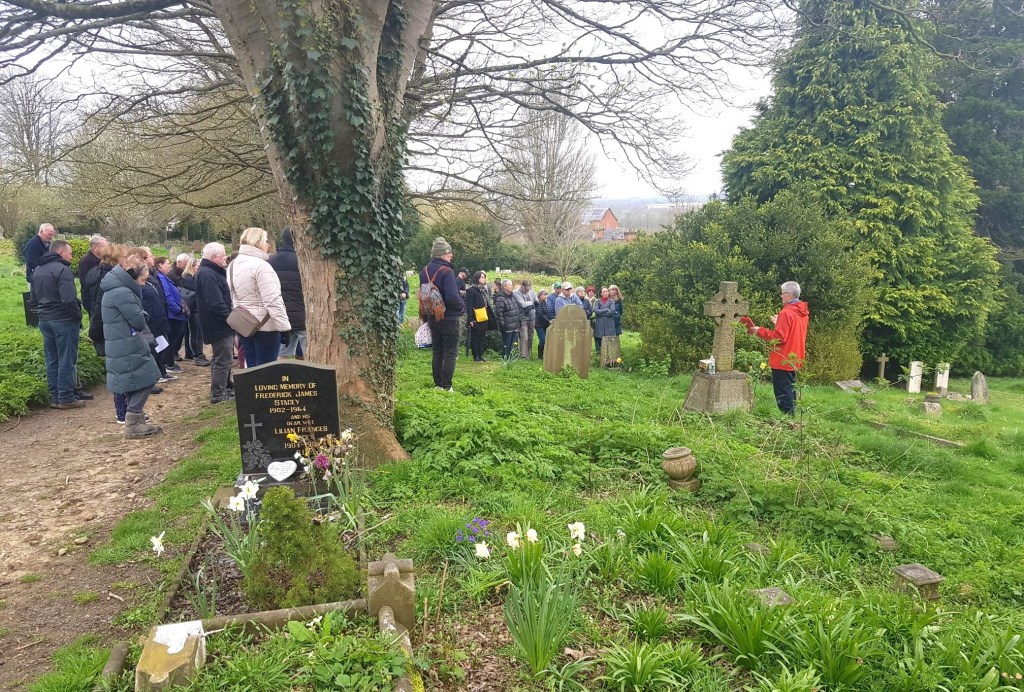
Thank you to everyone who joined us on Sunday for a guided cemetery walk. We are always so fortunate with the weather and following a morning of rain we enjoyed a dry and pleasant afternoon.
This week Andy, Kevin and I told the stories of Trooper Cecil Howard Goodman and Scout leader William Rowland Bird among others and I will (eventually) sort out the story of Olive Henry, which has left me in confusion over recent weeks.
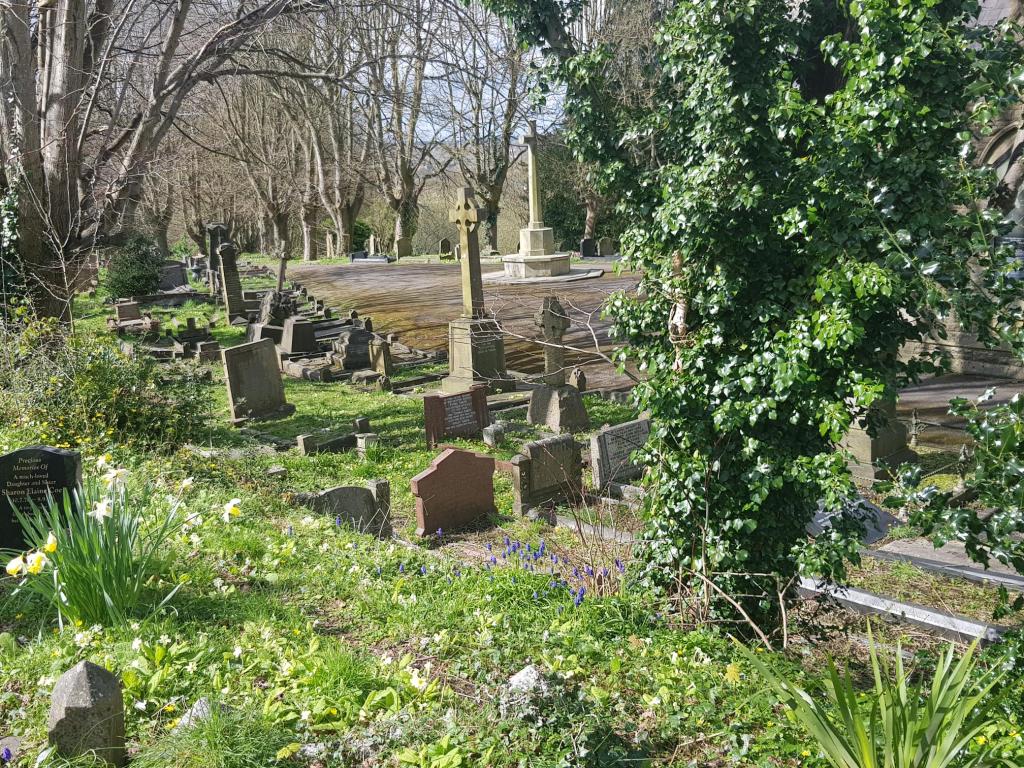
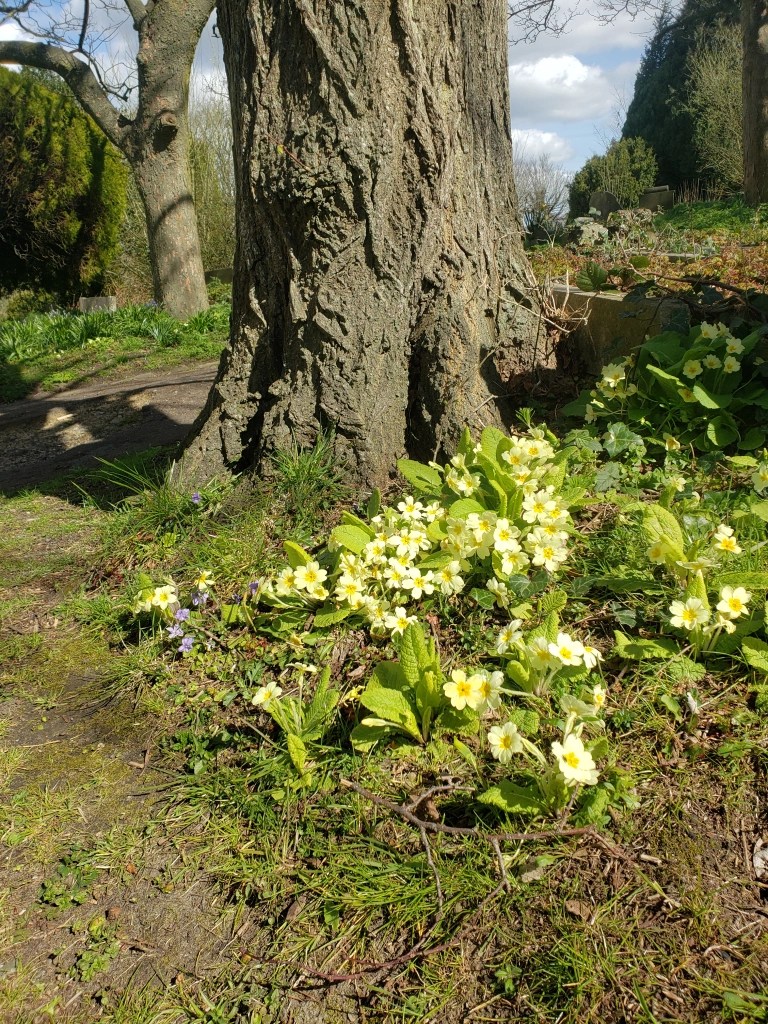
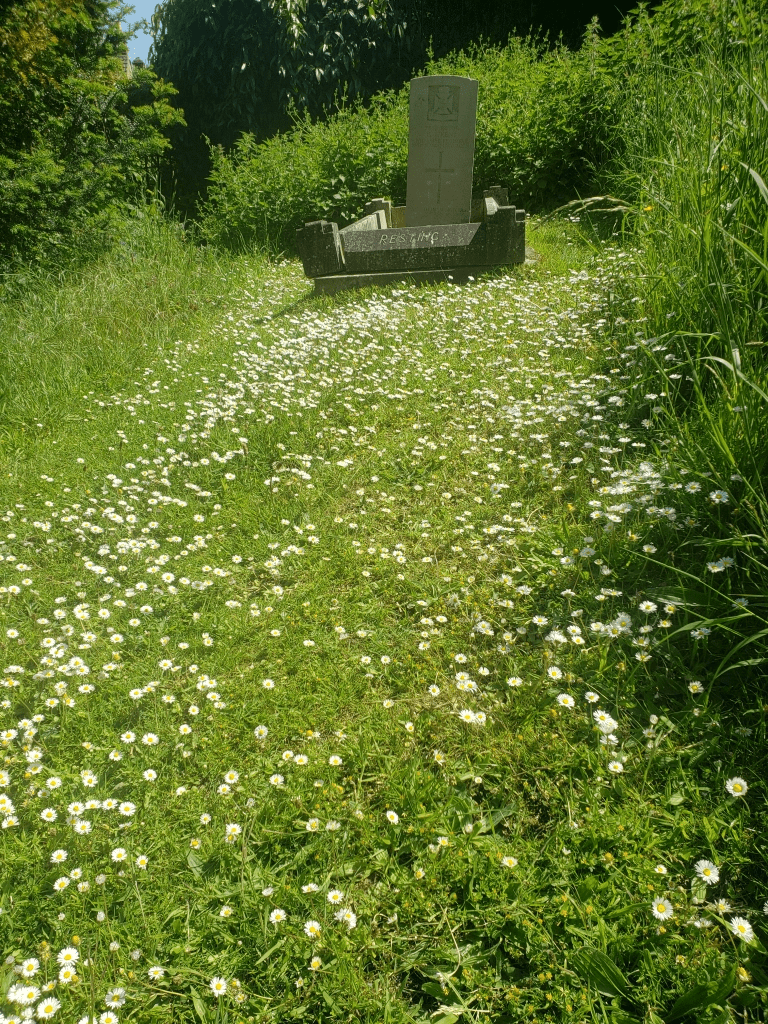
Here are a few cemetery photographs. Our next walk is on Sunday May 26.
If you are looking for an escape this beautiful April Sunday you will find a piece of paradise in the churchyard at St. James’s, Avebury.
As you might expect the parish church of St James’s, Avebury is an ancient one. A place of worship has existed on this site for more than a thousand years and evidence of those Anglo Saxon builders remain in the church today, including masonry, window apertures and the tub font.
The present church includes a magnificent 15th century rood loft saved by the parishioners a century later when such features were banned. Concealed behind a lathe and plaster construction on the east wall of the nave it was rediscovered during restoration work in the early 19th century. Outside in the churchyard the headstones are arranged in neat rows, although unfortunately few survive from the early history of the church.
Lying in their own piece of paradise is the fittingly named Paradise family. James Paradise was born in Avebury, the son of Francis and Hester Paradise, and was baptised in St James’s on March 29, 1763. On December 11, 1794 he married Susanna Townsend at Winterbourne Monkton. The parish register for that church reveals that James made a firm signature while Susanna made just her mark.
Susanna returned to James’s home in Avebury where she raised a large family of 13 children, all of whom were baptised at St. James’s church. Her first child, a daughter named Hester after the child’s paternal grandmother, was baptised on November 1, 1795 and her last, another daughter, Jane on December 6, 1821.
James appears to have spent his working life as a labourer, although when he made his Will in 1834 he describes himself as a Yeoman. James died in March 1837. His detailed Will runs to four pages, but Susanna’s, written in 1838, is much more straightforward.
This is the last Will and Testament of me Susanna Paradice of the parish of Avebury in the County of Wilts Widow I give and bequeath all my monies and securities for money wearing apparel Personal Estate and Effects whatsoever and wheresoever unto & equally between all my daughters who shall be living at the time of my decease and I hereby appoint Hester Underwood wife of George Underwood sole Executrix of this my Will hereby revoking all former Wills by me at any time heretofore made and declaring this only to be my Will In witness whereof I have to this my last Will and Testament set my hand and affixed my seal this fifteenth day of August one thousand eight hundred and thirty eight Susanna Paradice – Signed by the Testatrix Susanna Paradise in the presence of us present all the same time who have hereunto subscribed our names as witnesses this fifteen day of August one thousand eight hundred and thirty eight John Whittington Solcr Bristol Robert Coles his Clerk.
Susanna died in January 1841 aged 66 years and was buried on January 8 with her husband James. Susanna’s five daughters were all still living at the time of her death.
Eldest daughter Hester, whom Susanna made her executrix, married George Underwood, a sawyer, in 1821. She had just one surviving daughter, Ann. Hester died in 1845.
Second daughter Sarah married agricultural labourer George Coleman in 1831. When she made her Will (valued at a Personal Estate of £22) she appointed Thomas Kemm, gentleman farmer at Avebury Manor, as her Executor. Sarah died on April 11, 1884 aged 84.
Third daughter Ann married James Dew, a master Carpenter on July 4, 1839. She died in 1865 aged 55.
Fourth daughter, Eliza married William Maton, a joiner, on February 12, 1835. Eliza had two sons, John and James. On April 9 1849 they set sail on the Tory for a new life in New South Wales.
Youngest daughter Jane Paradise married Thomas Blake, a saddler, on October 20, 1842. Jane had at least seven children and died in 1908 at the age of 86.
While James and Susanna’s daughters lived long and eventful lives their sons were not so fortunate, four of them dying at a tragically young age.
The burial registers record that Richard Paradise died aged 9 was buried on January 7, 1815. His death had occurred ‘by an accident from an Horse.’
Next to be buried in the churchyard at Avebury was James and Susanna’s eldest son George. Born in 1797 George died in 1817 aged 19 years.
On February 4, 1830 William Paradise was buried next to his brothers George and Richard. He died aged 23 years and according to the burial registers he was ‘accidently killed.’ Aaron Paradise died in 1832 aged 20 years old and joins the sad row of brothers reunited in death.
Today the churchyard at St. James is a tranquil place, despite the many visitors who visit historic Avebury, a tourist attraction since time immemorial.
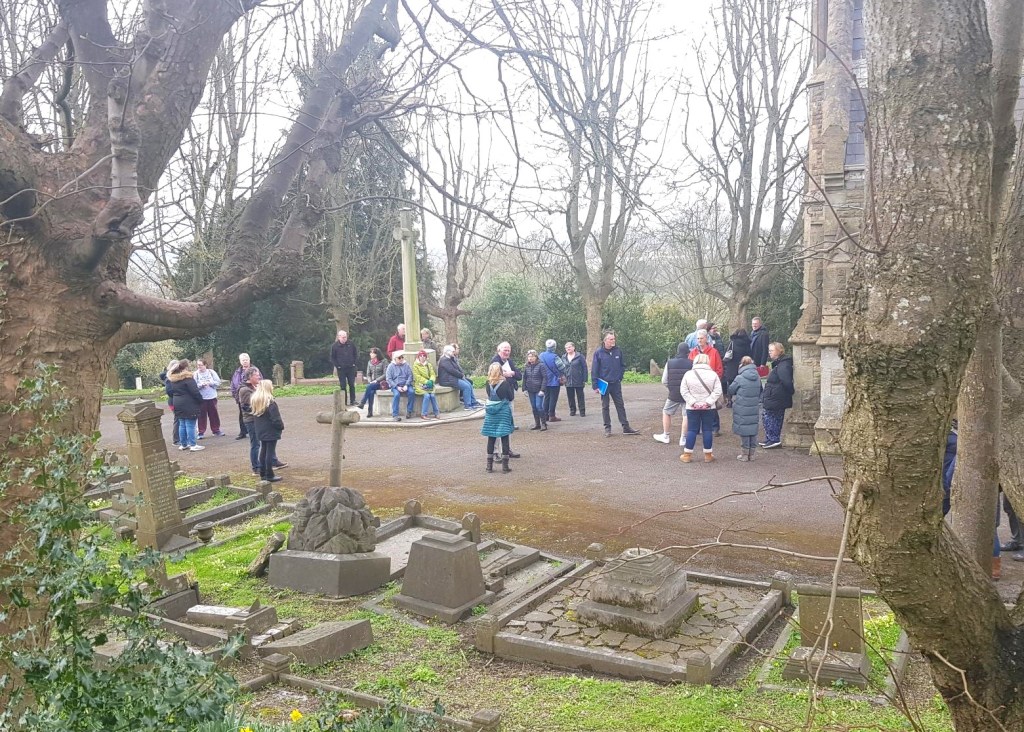
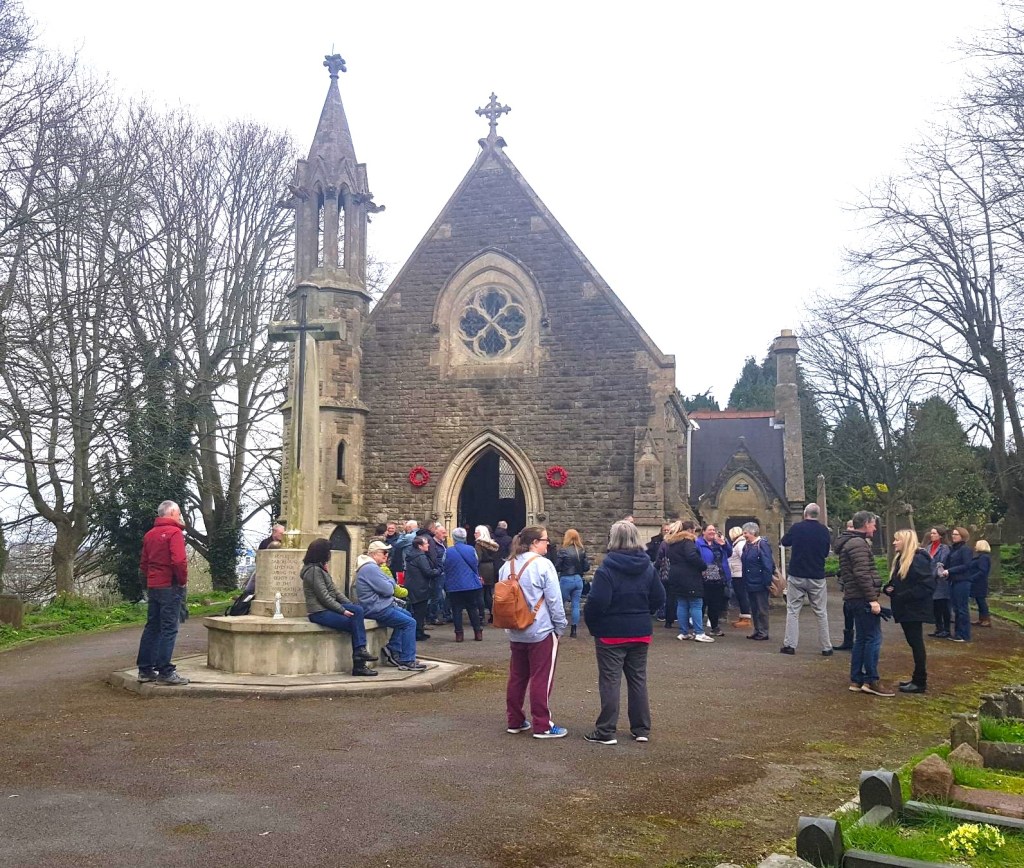
A large number of people attended our last Radnor Street Cemetery walk as you can see from the photograph below. However, perhaps surprisingly, far fewer attended the walks we organised at St Marks several years ago.
Among those buried in the churchyard by the railway track are Engineer William Frederick Gooch the younger brother of Sir Daniel Gooch, employed as Manager at the Swindon GWR Works at the time of the 1861 census.
A hugely influential man in the early history of the Works and the Railway Village was Works Manager Minard C. Rea. who died in 1857. His memorial is published below.
And, probably most famously, is the memorial to Joseph Armstrong, Locomotive, Carriage and Wagon Superintendent at the Great Western Railway 1864-1877.
The churchyard was closed to new burials in 1881 – after a mere 36 years it was already full. The new Swindon Cemetery on Kingshill, better known today as Radnor Street Cemetery, opened on August 6 that same year.
Poet Laureate John Betjeman was a big fan of St. Mark’s.
‘The parishioners of St Philip and St Jacob in Bristol entreated the Great Western to build a church for their workers; directors stumped up money, subscriptions were raised, land was presented and by 1845, St Mark’s church was built.
There it stands today close beside the line on the Bristol side of the station. A stone building, all spikes and prickles outside, designed by Gilbert Scott who was then a young man and who lived to build hundreds of rather dull copy-book churches all over Britain, and to build St Pancras Hotel, the Foreign Office in London and to restore many cathedrals.
One cannot call it a convenient site. Whistles and passing trains disturb the services, engine smoke blackens the leaves and tombstones, and eats into the carved stonework of the steeple. But it is a strong church and though it is not much to look at, it is for me the most loved church in England. For not carved stones nor screen and beautiful altars, nor lofty arcades nor gilded canopies, but the priests who minister and the people who worship make a church strong. If ever I feel England is Pagan, and that the poor old Church of England is tottering to its grave, I revisit St Mark’s, Swindon. That corrects the impression at once. A simple and definite faith is taught; St Mark’s and its daughter churches are crowded. Swindon, so ugly to look at to the eyes of the architectural student, glows golden as the New Jerusalem to eyes that look beyond the brick and stone…
Extracts published from First and Last Loves a collection of essays on architecture published in 1952.
With so many interesting stories to tell we were a little surprised that these walks did not prove more popular. Perhaps it is because Radnor Street Cemetery has an extra special place in the hearts and memories of 21st century Swindonians.
Photograph from our most recent guided cemetery walk at Radnor Street Cemetery
When James John was born in Bristol in 1857 he shared the family surname Green. His parents, James Henry Green and Sarah Kettle Cummings, had married at St. James, Bristol on December 25, 1856. In 1861 they were still living in Bristol, still under the name of Green but sometime after this they adopted the name Brown and so far I haven’t been able to discover why.
Their eldest son James John Green/Brown led an equally colourful life. He had three wives (not all at the same time) and 9 children.
In 1879 he married Annie Russell the first of his three wives and by 1881 they were living with the Brown family at 13 Holbrook Street, Swindon where James worked as a Hair Carder.
By 1891 he had set up in business as a Furniture Dealer at 8 Station Road where the couple were living with their five children Annie 9, Charles 8, Nellie 6, Mabel 4 and three year old Archibald. It is here that Annie sadly died in 1899 aged 37 years and the couple’s daughter Nellie in 1906 aged 21.
In 1900 James John married Emma Harrison who died in 1903. His third wife was Elizabeth Nutman whom he married in 1908. She died in 1920. Neither of these two wives appear to be buried in Radnor Street Cemetery.
In 1911 James John Brown was the licensed victualler at the Bell Hotel in Old Town. In 1915 he was a candidate in the local elections where he represented Queens Ward.
James John Brown died on November 27, 1921 at the Duchess of Sutherland Public House in Hornsey, London where his son was the landlord. His home address was given as The Burlington, 8 Buenos Ayres, Margate.
His body was returned to Swindon where he was buried Radnor Street Cemetery in grave plot D40. He is buried with his first wife Annie and their daughter Nellie. The grave is marked by an obelisk memorial. All things Egyptian were popular in the 19th century and remained so into the 20th. The Egyptian obelisk is a symbol of eternal life and resurrection and represents the sun god Ra. Perhaps James John Brown was hoping to have a go at continuing his colourful life!
Many thanks to everyone who joined us for the first of this season’s walks. The weather was kind and the rain held off.
We were joined by members of the Menham family as Andy spoke about Swindon Town football legend Bob Menham. Kevin followed by telling us of the military career of his son Reginald Menham and reading a poignant letter taken from Mark Sutton‘s book Tell Them of Us.
There were lots of fascinating conversations as visitors shared their family history stories with us. It was lovely to meet Clare and I hope you found your family grave. I look forward to receiving your information and photographs to publish here.
Our next walk will take place on Sunday April 28. Meet at the chapel for 2 pm.
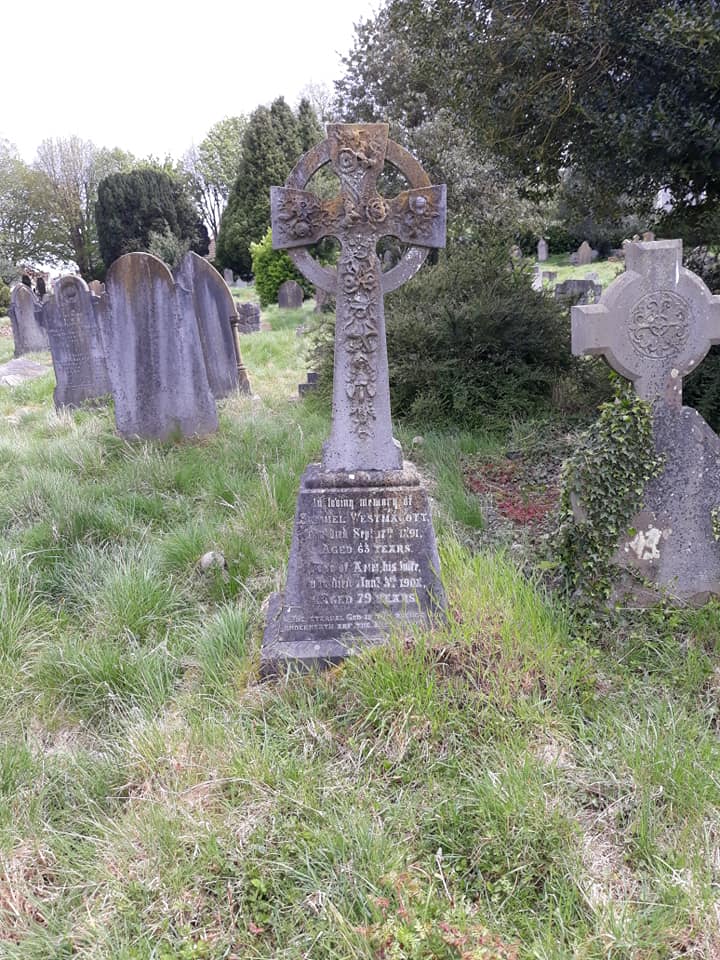
Reading between the lines of this fulsome obituary Samuel Westmacott sounds a force of nature with strong opinions and not afraid to voice them. He was even temporarily expelled from the Methodist church on the issue of “original sin”…
The Late Samuel Westmacott – A Pioneer of Swindon nonconformity.- A funeral sermon in memory of the late Mr Samuel Westmacott, of New Swindon, who died on the 17th ult., at the age of 63 years, was preached recently in the Regent Street Primitive Methodist Chapel, New Swindon, to a large congregation, by the Rev. T. Pinnock, of London
Taking for his text II. Timothy iv., verses 7 and 8, “I fought the good fight,” the rev. gentleman preached an excellent sermon, and in referring to the life of the deceased Methodist, said Mr Westmacott was converted when 19 years of age. He had lived in Swindon nearly all his life, only removing on one occasion to Purton for a short time, and had worked earnestly in the cause of Methodism.
He was a long way in advance of his time, not being prepared to adopt the theology of the Church, and consequently he and several others with him were expelled for a time, the question on which the expulsion took place being “original sin.” Deceased was a man who held very strong views, and sometimes in expressing them he unintentionally wounded the feelings of even his dearest and strongest friends. But under his rough exterior there was a warm heart, which those who knew him well at once recognised.
Mr Pinnock mentioned that he himself was the minister at Swindon when that chapel in which they were then assembled was built, and he had no hesitation in saying that had it not been for the efforts of Mr Samuel Westmacott the church would not have been built at that time. At a meeting in the year 1875, when the proposed erection of the church was discussed, the members of the committee, to the number of 24, decided to postpone the erection of the building, and they were just about to close the meeting when Mr Westmacott rose and presented the matter to them in a different light to what they had seen it before, and by the sheer force of his will converted the meeting to adopt his view of the matter, and they resolved to proceed with the building at once. And whilst the church was being built Mr Westmacott rendered great assistance, both personally, financially, by his counsel, and in every possible way.
Extracts from the Swindon Advertiser, Saturday, October 31, 1891.
Samuel Westmacott died aged 63 years at 30 Bridge Street. He was buried on September 21, 1891 in plot E8399, a grave he shares with his wife Ann who died in 1908 aged 79.
Looks like we might all see some rain today. But spring is just around the corner and our guided cemetery walks will begin again at the end of this month.
The Spring walks are scheduled for:
March 31, April 28 and May 26.
Summer walks are yet to be arranged but our Autumn walks are already in the diary.
September 1 and 29 and October 27.
Our Remembrance Day Service is Sunday November 10.
Well, what can you expect from a typical guided cemetery walk?
A gentle meander through 11½ acres of our picturesque Victorian cemetery. Our CWGC volunteers will tell you about their work to maintain the war graves and the incredible stories they have discovered. Learn about the people who made Swindon; from the boilermakers to the businessmen. Hear about the women who contributed to every aspect of life in Swindon from the home, the factory floor and the magistrates bench! This year we will have even more stories to tell.
And this time I need some help identifying a couple of photographs.
We’ve already met David Uzzell – the inspiration behind the work of war poet Edward Thomas, so now let’s meet his brother John.
John married Rachel Bennett on Christmas Day 1864 at the parish church in Cirencester. He worked as a baker and in 1871 lived with Rachel and their two children Emily 6 and Frank 4 in Gloucester Street, Cirencester. His parents lived in nearby Factory Yard alongside his brother David and his wife Fanny and their son William.
John and Rachel went on to have a large family of at least nine children. Four sons – Frank, Harris, James John and Raymond and five daughters – Emily Rosina, Edith Ellen, Mabel Harris, Mary Maria and Minnie Bennett. In 1881 they lived in Ashton Keynes; in 1891 they were at 27 Stepstairs Lane, Cirencester and in 1901 they were in South Cerney.
At the time of her death in 1907 Rachel was living at 17 Ipswich Street, here in Swindon. A couple of her married daughters had moved to Swindon, which maybe how she came to be here. She was buried in grave plot B2754 on November 12, 1907.
John survived her by 15 years. He died aged 79 at the Purton Infirmary and was buried with Rachel on September 12, 1922.
And now those photos.
Is this John and Rachel with their children? Or is it John Uzzell the elder with his wife Sarah and their children? Unfortunately, the photograph is undated.
And who is this? John Uzzell the elder or the younger? Is this Rachel? Again, undated.












 Radnor Street Cemetery